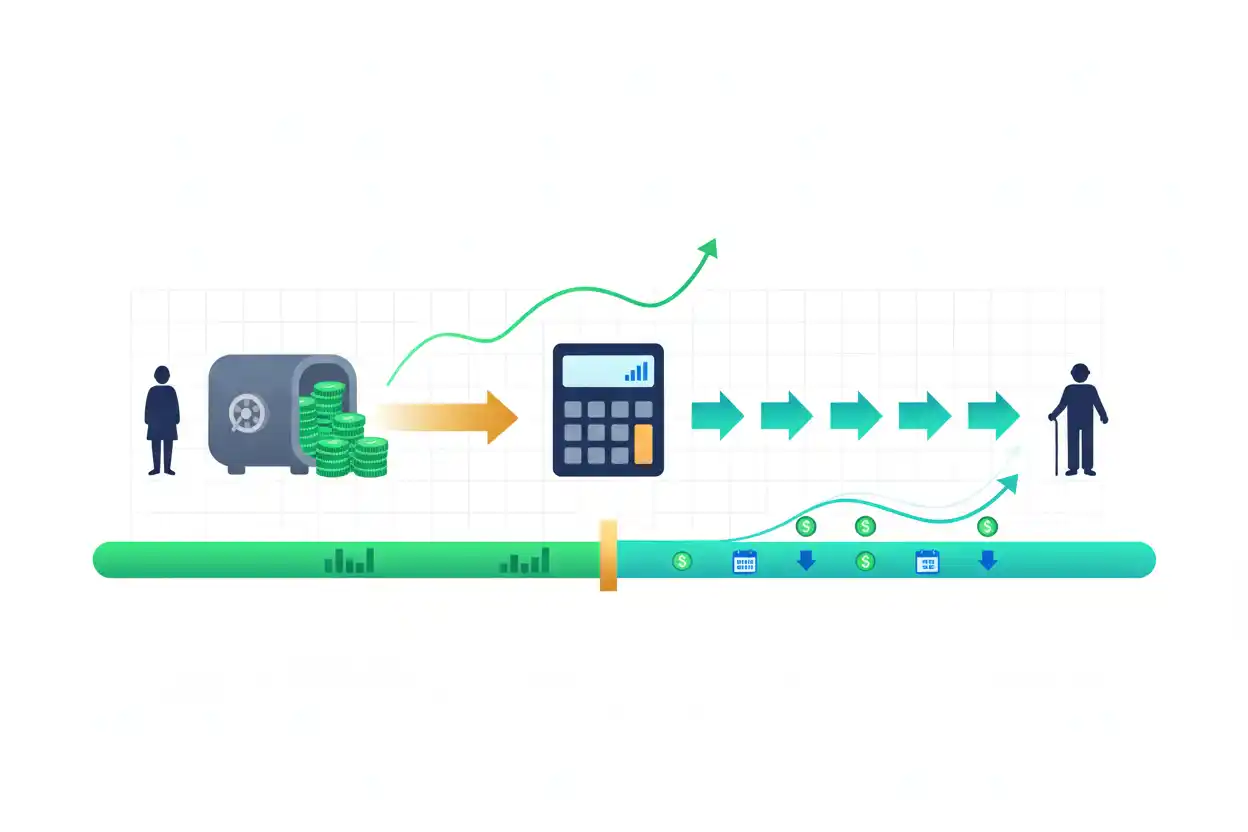
Annuity payouts are the periodic payments an annuity owner receives after money has been converted into an income stream. Depending on the contract, payments may continue for a fixed number of years, for the annuitant’s lifetime, for two people’s lifetimes, or according to another guaranteed payout structure.
The basic idea is straightforward: a larger amount of money must be distributed across an expected payment period while accounting for investment or pricing assumptions. However, the exact calculation depends heavily on the type of annuity and the payout option selected.
A fixed-period annuity can often be approximated with a standard present-value formula. A lifetime annuity is more complex because the insurer must also account for longevity and contractual guarantees.
What Is an Annuity Payout?
An annuity payout is an income payment made from an annuity contract. Payments may be monthly, quarterly, annually, or structured according to the terms of the contract.
For example, someone might contribute $200,000 to an annuity and later elect to receive monthly income. The resulting payment is not determined simply by dividing $200,000 by a number of months. Interest assumptions, payout duration, guarantees, and—in lifetime contracts—longevity assumptions can affect the amount.
This payout phase is one part of the broader way annuities work. Some annuities accumulate value for years before payments begin, while immediate annuities can begin distributing income relatively soon after purchase.
How Are Annuity Payouts Estimated?
For a fixed payment period, the calculation resembles the payment formula used for an amortizing financial balance.
The main variables are:
- the amount available to fund payments;
- the assumed periodic interest rate;
- the number of payments;
- the timing of each payment.
If payments occur at the end of each period, the standard present-value annuity formula can be rearranged to solve for the payment.
Periodic Payment = Present Value × r ÷ [1 − (1 + r)^−n]
Where:
- Present Value is the amount funding the payout;
- r is the interest rate per payment period;
- n is the total number of payments.
This formula is most useful for illustrating a fixed-period payout. It should not be treated as an exact quote for a lifetime income annuity because lifetime contracts incorporate additional actuarial assumptions.
Annuity Payout Example
Suppose $200,000 is available to generate payments for 20 years.
Assume:
- Starting balance = $200,000
- Annual interest assumption = 4%
- Payment frequency = monthly
- Payout period = 20 years
First, calculate the monthly interest rate.
Monthly Rate = 4% ÷ 12 = 0.333333%
In decimal form:
r = 0.04 ÷ 12 = 0.00333333
Next, calculate the number of payments.
n = 20 × 12 = 240 payments
Insert the numbers into the payout formula:
Payment = $200,000 × 0.00333333 ÷ [1 − (1.00333333)^−240]
Calculate the discount factor:
(1.00333333)^−240 ≈ 0.4507
Then:
1 − 0.4507 ≈ 0.5493
The numerator is:
$200,000 × 0.00333333 ≈ $666.67
Therefore:
Payment ≈ $666.67 ÷ 0.5493 ≈ $1,211.96 per month
Under these assumptions, the estimated payment is approximately $1,211.96 per month for 20 years.
The total nominal payments would be:
Total Payments = $1,211.96 × 240 ≈ $290,870.40
That total exceeds the original $200,000 because the calculation assumes the remaining balance continues earning 4% while distributions are being made.
What Happens If the Interest Assumption Changes?
The assumed rate has a meaningful effect on estimated annuity payouts.
With the same starting balance and payout period, a higher assumed return allows more of each payment to be supported by earnings rather than principal. A lower assumed rate generally produces a lower estimated payment.
This is one reason a payout calculation should not be interpreted in the same way as APY on a savings account. APY describes effective annual growth after compounding, while an annuity payout calculation addresses how a balance can be converted into recurring income.
Fixed-Period vs Lifetime Annuity Payouts
A fixed-period calculation has a known number of payments. A lifetime payout does not.
With a 20-year payout, for example, the calculation can use exactly 240 monthly payments. With a lifetime annuity, nobody knows in advance exactly how many monthly payments will ultimately be made.
Insurers therefore use actuarial pricing.
A simplified conceptual relationship is:
Lifetime Payment ≈ Amount Annuitized ÷ Annuity Factor
The annuity factor reflects several assumptions, which may include expected payment duration, interest rates, age at the start of income, contract features, and guarantees.
This means two contracts funded with the same dollar amount can produce different annuity payouts.
Factors That Affect Annuity Payouts
Amount Annuitized
All else being equal, a larger premium or accumulated balance generally supports a larger payout.
If one contract has twice as much money available and all other pricing assumptions are identical, its payment capacity is correspondingly greater.
Age When Income Begins
Lifetime income calculations depend partly on expected payment duration. Starting lifetime payments at different ages can therefore change the quoted payment.
This does not work exactly like a fixed-term calculation because lifetime contracts price an uncertain payment horizon rather than a predetermined number of months.
Interest and Pricing Assumptions
Interest rates influence how much income can potentially be supported by the assets backing the payment stream.
However, the interest assumption embedded in an annuity quote should not automatically be interpreted as the annuity owner’s investment return.
For investments generally, annualized return measures performance over time using a different calculation and answers a different question.
Single-Life vs Joint-Life Income
A single-life option generally continues while one specified person is alive.
A joint-life structure may continue until both covered individuals have died, depending on the contract terms. Because the expected payment period can be longer, adding a second covered lifetime can reduce the initial payment compared with an otherwise similar single-life arrangement.
Period-Certain Guarantees
A lifetime annuity can sometimes include a guaranteed minimum payment period, such as 10 or 20 years.
If the annuitant dies during the guaranteed period, remaining payments may continue to a beneficiary according to the contract.
Because this guarantee has economic value, adding it can reduce the initial periodic payment compared with an otherwise equivalent life-only structure.
Refund Features
Some contracts include provisions designed to return some remaining value to beneficiaries if the annuitant dies relatively early.
Such protection generally changes the economics of the contract and can affect the quoted payout.
Payment at the Beginning vs End of the Period
Timing also matters.
A standard ordinary annuity assumes payments occur at the end of each period. An annuity due assumes payments occur at the beginning of each period.
Because each annuity-due payment arrives one period earlier, the present value relationship differs.
For otherwise identical cash flows:
Value of Annuity Due = Value of Ordinary Annuity × (1 + r)
This distinction matters when comparing formulas or modeling payment schedules.
How Long Will an Annuity Payout Last?
The answer depends on the selected payout structure.
A fixed-period annuity may specify an exact duration such as 10, 15, or 20 years. A lifetime option may continue until death. A joint-life option may continue according to the survival of two people. Some contracts combine lifetime income with a guaranteed minimum period.
Therefore, asking only “How much does a $200,000 annuity pay?” leaves out essential information.
A more useful question is:
How much could $200,000 pay under a specified payout structure, starting age, payment frequency, and set of guarantees?
Does a Higher Payout Mean a Better Annuity?
Not necessarily.
A larger initial payout can result from accepting fewer guarantees, using a shorter payment period, beginning payments later, or selecting a structure that transfers more longevity risk to the annuitant.
Therefore, payout size should be considered alongside liquidity, guarantees, inflation exposure, beneficiary provisions, contract expenses, and the role the annuity plays within overall asset allocation.
The highest monthly payment is not automatically the most appropriate contract.
Annuity Payout Rate vs Investment Return
A common mistake is treating an annuity payout rate as though it were an investment yield.
Suppose a $100,000 annuity pays $6,000 during the first year. Dividing $6,000 by $100,000 gives 6%.
Simple Payout Rate = $6,000 ÷ $100,000 = 6%
That does not necessarily mean the investment earned a 6% return.
Part of the $6,000 may represent a return of the annuitant’s own principal. Lifetime annuity pricing may also incorporate longevity pooling and other contract characteristics.
Therefore, a payout percentage and investment return are different measurements.
How to Compare Annuity Payout Estimates
When comparing quotes, hold as many variables constant as possible.
Compare contracts using the same:
- premium;
- start date;
- annuitant information;
- payout frequency;
- single-life or joint-life structure;
- period-certain guarantee;
- refund provisions;
- inflation or escalation features.
Otherwise, one quote may appear to offer a higher payout simply because it provides fewer guarantees.
For retirement-income planning, annuity income also needs to be evaluated alongside liquid savings and other assets within a broader savings and investing strategy.
Limitations of Annuity Payout Calculations
A mathematical estimate is useful for understanding the mechanics, but it cannot reproduce every insurer’s actual quote.
Lifetime annuity pricing can include assumptions and contractual provisions that are not visible in a simple present-value formula. Product terms can also differ substantially.
In addition, a fixed dollar payment can lose purchasing power over a long retirement if it does not increase with inflation.
For that reason, annuity payout calculations are best used to understand relationships between principal, rates, time, and payments—not as substitutes for an actual contract illustration.
Frequently Asked Questions
What determines annuity payouts?
Annuity payouts can depend on the amount annuitized, payment start date, payout duration, interest assumptions, age for lifetime contracts, payment frequency, guarantees, and whether income covers one or multiple lives.
How much does a $100,000 annuity pay per month?
There is no single universal payment. The answer depends on the payout option, start age, current contract pricing, guarantees, and whether the income lasts for a fixed period or for life.
How do you calculate a fixed-period annuity payout?
A common formula is:
Payment = PV × r ÷ [1 − (1 + r)^−n]
PV is the starting amount, r is the periodic rate, and n is the number of payments.
Why do lifetime annuity payouts differ from fixed-period calculations?
Lifetime payments have an uncertain duration. Insurers therefore incorporate actuarial assumptions rather than using only a predetermined number of payments.
Does a higher interest rate increase an estimated fixed payout?
All else being equal, yes. A higher assumed rate means more of the payment can be supported by growth on the remaining balance.
Does starting an annuity later increase the payout?
For many lifetime structures, a later start can produce a different—and often higher—initial payment because expected payment duration is shorter. Actual quotes depend on the contract and pricing assumptions.
What is a life-only annuity payout?
A life-only payout generally continues for the annuitant’s lifetime and stops at death. Because it provides fewer beneficiary guarantees than some alternatives, it may offer a different initial payout than guaranteed-period or refund structures.
What is a period-certain annuity?
A period-certain feature guarantees payments for a specified minimum period. If the annuitant dies before that period ends, payments may continue to a beneficiary according to the contract.
Is an annuity payout rate the same as a return rate?
No. A payout can include both earnings and return of principal, so dividing annual payments by the original premium does not necessarily calculate investment return.
Can annuity payments run out?
Fixed-period payments end according to their specified schedule. Lifetime annuity payments are generally structured to continue for the covered lifetime under the contract’s terms.
Why can two companies quote different annuity payouts?
Pricing assumptions, contract guarantees, product design, expenses, and other actuarial factors can differ between insurers, producing different payments from the same premium.
Should an annuity payout be evaluated only by monthly income?
No. Payment amount is important, but guarantees, liquidity, inflation exposure, beneficiary treatment, contract terms, and the role of the annuity in the overall financial plan also matter.