
APY, or annual percentage yield, measures the effective amount an interest-bearing balance can earn over one year after accounting for compounding.
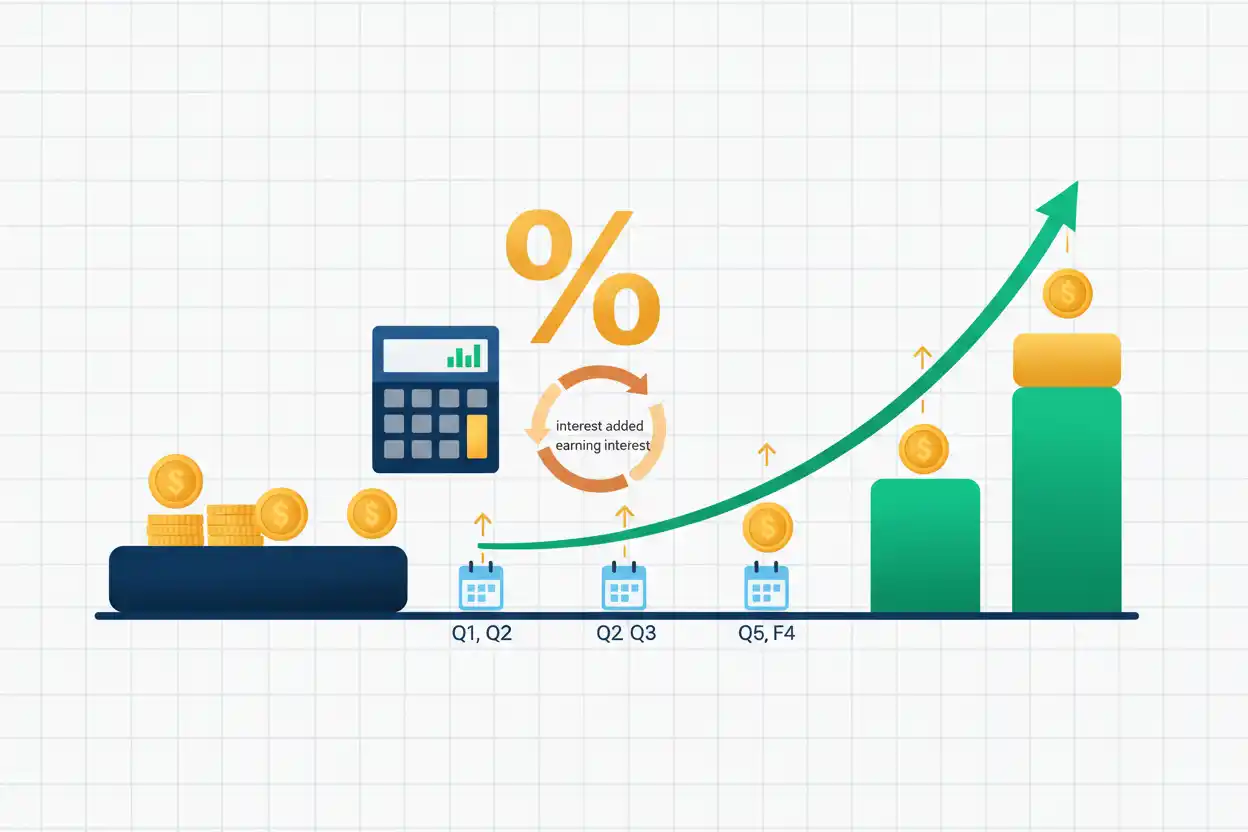
That distinction matters because a stated annual interest rate does not always tell you how much the balance actually grows. If interest is credited more than once per year and each new interest payment begins earning additional interest, the effective annual yield can be higher than the nominal rate.
The more frequently interest compounds, the greater the difference can become.
What Does APY Mean?
APY stands for annual percentage yield.
It expresses the effective annual growth rate of an interest-bearing balance when compound interest is included.
Suppose an account has a nominal annual interest rate of 5% but compounds monthly. The account earns a small amount of interest each month. Once credited, that interest becomes part of the balance and can earn interest during subsequent months.
Consequently, the effective annual yield is slightly more than 5%.
APY is especially useful when comparing savings products with different compounding schedules because it puts them on a common annual basis.
APY Formula
When the nominal annual rate and compounding frequency are known, APY can be calculated as:
APY = (1 + r ÷ n)^n − 1
Where:
- r = nominal annual interest rate as a decimal;
- n = number of compounding periods per year.
Multiply the final decimal result by 100 to express APY as a percentage.
APY Calculation Example
Assume:
- Nominal annual interest rate = 5%
- Monthly compounding
- Number of compounding periods = 12
Convert 5% to decimal form:
r = 5% = 0.05
Insert the values into the APY formula:
APY = (1 + 0.05 ÷ 12)^12 − 1
Calculate the monthly rate:
0.05 ÷ 12 = 0.00416667
Add 1:
1 + 0.00416667 = 1.00416667
Raise the result to the 12th power:
1.00416667^12 ≈ 1.0511619
Subtract 1:
APY ≈ 1.0511619 − 1 = 0.0511619
Convert to a percentage:
APY ≈ 5.1162%
Therefore, a 5% nominal rate compounded monthly produces an APY of approximately 5.12%.
What APY Means in Dollars
Suppose you deposit $10,000 and the APY is 5.1162%, assuming the balance remains untouched and the assumptions used in the calculation hold.
The approximate one-year growth is:
Interest Earned = $10,000 × 0.051162 ≈ $511.62
The approximate ending balance becomes:
Ending Balance = $10,000 + $511.62 = $10,511.62
This is why APY is useful: it translates periodic compounding into a single effective annual percentage.
APY vs Interest Rate
An interest rate and APY can be identical in some circumstances, but they are not always the same measurement.
A nominal annual rate typically states the basic annual rate before the effect of intra-year compounding.
APY includes that compounding effect.
For example:
- nominal rate: 5%;
- monthly compounding;
- APY: approximately 5.12%.
If interest compounds only once annually, the difference disappears.
APY with Annual Compounding = (1 + r)^1 − 1 = r
Therefore, a 5% rate compounded once annually has a 5% APY.
Why Compounding Frequency Matters
Compounding determines how quickly credited interest itself begins producing additional interest.
Consider the same nominal rate under different schedules. Annual compounding applies interest once. Monthly compounding divides the nominal rate across 12 periods. Daily compounding uses many more periods.
As the number of compounding periods rises, the effective annual yield approaches the continuously compounded limit.
However, more frequent compounding does not turn a modest rate into a dramatically larger return. The difference is usually incremental because each period applies only a fraction of the annual rate.
APY With Periodic Interest Rates
If you already know the rate earned during each compounding period, the formula can be written more directly.
APY = (1 + Periodic Rate)^n − 1
For example, suppose an account earns 0.4% each month.
Convert 0.4% to decimal form:
Monthly Rate = 0.004
Then:
APY = (1.004)^12 − 1
APY ≈ 0.04907 = 4.907%
The effective annual yield is approximately 4.91%.
APY and Compound Growth
APY focuses on one year’s effective yield, but the same compounding principle can continue across multiple years.
If an account earns a constant 5% APY and interest remains invested, an illustrative balance after three years can be calculated as:
Future Value = Principal × (1 + APY)^Years
For $10,000:
Future Value = $10,000 × (1.05)^3
Future Value = $10,000 × 1.157625
Future Value = $11,576.25
This example assumes the APY remains constant for all three years and that no deposits or withdrawals occur.
In practice, rates on many deposit products can change.
APY vs Average Return
APY should not be confused with average return.
APY describes an effective one-year yield after compounding under a particular interest structure. Average return typically summarizes several observed investment returns across multiple periods.
An investment with volatile annual gains and losses therefore requires different analysis from a deposit account earning a defined periodic interest rate.
APY and Asset Allocation
APY can be useful when evaluating the cash or interest-bearing portion of a portfolio, but it does not determine an investor’s overall asset allocation.
Asset allocation addresses how money is distributed among different asset classes based on risk, goals, liquidity needs, and time horizon.
A high APY on one cash product does not by itself answer whether a portfolio should hold more or less cash.
APY and Annuities
The mechanics of compounding can also appear in long-term financial calculations, but APY should not be confused with annuity payouts.
Annuity payout calculations focus on converting a balance into a series of payments. APY focuses on effective annual accumulation.
Likewise, an annuity due concerns the timing of recurring payments at the beginning of each period rather than the effective annual yield of a deposit.
The broader annuities topic therefore involves different cash-flow relationships from a standard APY calculation.
APY When Money Is Added or Withdrawn
APY is easiest to interpret when the balance remains unchanged except for credited interest.
Additional deposits and withdrawals complicate the dollar outcome because each amount remains in the account for a different length of time.
For example, earning a 5% APY does not mean every dollar deposited during the year earns 5%. A dollar added near the end of the year has much less time to compound.
The stated APY still describes the product’s yield mechanics, while the account holder’s actual dollar earnings depend on cash-flow timing.
APY Does Not Guarantee Future Rates
APY calculations are mathematical, but the rate used in the calculation may not remain constant.
Variable-rate accounts can change their rates. Promotional rates may apply only under specified conditions or periods. Account fees or qualification requirements can also affect the economic value to the customer.
Therefore, when comparing products, examine the rate structure and conditions rather than relying only on the headline APY.
How to Compare APYs Properly
When two products are otherwise comparable, the higher APY indicates greater effective annual interest under the stated assumptions.
However, a complete comparison can also consider:
- whether the rate is fixed or variable;
- minimum or maximum balances;
- withdrawal restrictions;
- fees;
- liquidity;
- eligibility conditions;
- how often interest is credited.
Within a broader savings and investing plan, yield is only one part of the decision.
Common APY Calculation Mistakes
One frequent error is entering 5 instead of 0.05 into the formula.
Percentages should first be converted to decimals.
Another mistake is failing to match the annual rate with the correct compounding frequency. If interest compounds monthly, both the periodic rate and the exponent must reflect 12 periods.
A third mistake is simply dividing an annual rate by 12 and treating the result as the complete annual yield. That calculation finds a nominal monthly rate, not APY.
Frequently Asked Questions
What does APY stand for?
APY stands for annual percentage yield. It expresses an effective annual interest rate after accounting for compounding.
What is the APY formula?
The standard formula is:
APY = (1 + r ÷ n)^n − 1
Here, r is the nominal annual rate and n is the number of compounding periods per year.
Is APY the same as an interest rate?
Not always. APY includes the effect of compounding, while a stated nominal interest rate may not.
Why is APY higher than the stated rate?
If interest compounds more than once per year, previously credited interest can earn additional interest. That increases the effective annual yield.
Can APY equal the interest rate?
Yes. If interest compounds once per year, the APY equals the nominal annual rate.
Is a higher APY better?
For otherwise equivalent deposit products, a higher APY produces greater effective annual interest. Other factors such as fees, restrictions, rate variability, and liquidity can still matter.
Does APY include compound interest?
Yes. Accounting for compound interest is the main reason APY can differ from a nominal annual rate.
How do I convert APY to a dollar return?
For a simple one-year illustration with no additional deposits or withdrawals:
Interest ≈ Starting Balance × APY
The actual result depends on the account’s terms and balance changes.
Does APY stay the same for multiple years?
Not necessarily. A fixed rate may remain unchanged for a defined period, while variable rates can change. Multi-year projections should not automatically assume today’s APY continues indefinitely.
Does APY include deposits made during the year?
APY describes the yield mechanics, not the timing of individual deposits. Money deposited later in the year has less time to earn interest.
Is APY an investment return?
APY is an effective annual yield measurement commonly used for interest-bearing accounts. Market investments with changing prices and irregular returns typically require different performance measures.
What is the fastest way to compare two savings rates?
When the products have similar terms and risks, comparing their APYs provides a standardized way to compare effective annual interest after compounding.