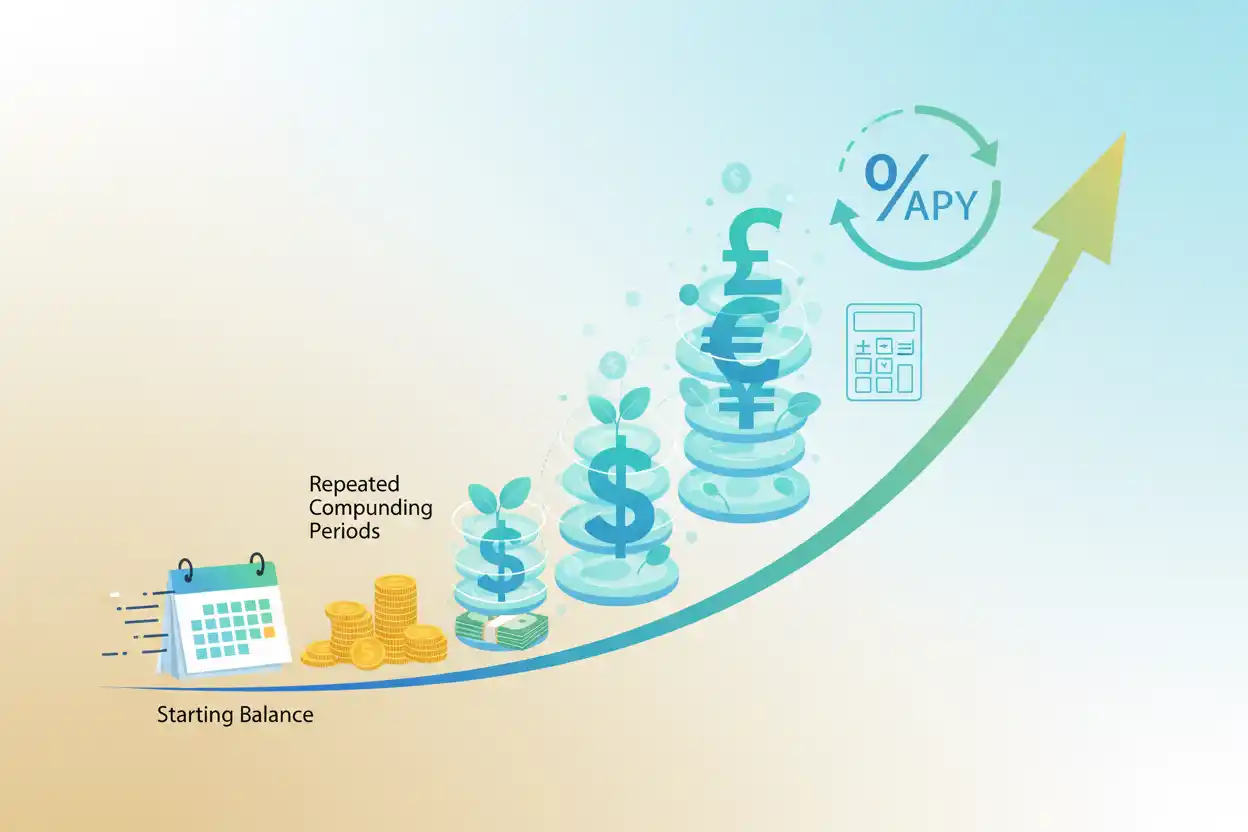

Compound interest occurs when interest is calculated on both the original principal and interest that has already been added to the balance.
That creates a compounding effect: once interest becomes part of the balance, it can generate additional interest during later periods.
The amount of compound interest depends on four major variables—principal, interest rate, compounding frequency, and time. Additional contributions or withdrawals can further change the result.
What Is Compound Interest?
With simple interest, interest is calculated only on the original principal.
With compound interest, the balance itself changes as interest is credited.
Suppose $10,000 earns 5% annually.
After one year:
$10,000 × 1.05 = $10,500
If the $500 of interest remains in the account, the second year’s interest applies to $10,500 rather than the original $10,000.
After year two:
$10,500 × 1.05 = $11,025
The additional $25 above $11,000 comes from earning interest on previously earned interest.
Compound Interest Formula
For a nominal annual rate compounded a fixed number of times per year:
Future Value = P × (1 + r ÷ n)^(n × t)
Where:
- P = principal;
- r = nominal annual interest rate as a decimal;
- n = number of compounding periods per year;
- t = number of years.
Compound interest itself is:
Compound Interest = Future Value − Principal
This version assumes no additional deposits or withdrawals.
Compound Interest Example
Suppose:
- Principal = $10,000
- Nominal annual rate = 5%
- Compounding = monthly
- Time = 10 years
Use:
Future Value = $10,000 × (1 + 0.05 ÷ 12)^(12 × 10)
Calculate the monthly rate:
0.05 ÷ 12 = 0.00416667
Calculate the number of periods:
12 × 10 = 120
Then:
Future Value = $10,000 × (1.00416667)^120
Future Value ≈ $16,470.09
Now calculate the compound interest:
Compound Interest = $16,470.09 − $10,000
Compound Interest ≈ $6,470.09
Under these assumptions, the balance grows by approximately $6,470.09 over 10 years.
How Compounding Frequency Changes Growth
Interest can compound annually, semiannually, quarterly, monthly, daily, or according to another schedule.
Holding the nominal annual rate constant, more frequent compounding generally produces a slightly larger effective annual yield.
For a 5% nominal rate:
Annual Compounding
APY = (1 + 0.05)^1 − 1 = 5%
Monthly Compounding
APY = (1 + 0.05 ÷ 12)^12 − 1
APY ≈ 5.1162%
The difference is not enormous, but it becomes meaningful as principal and time increase.
Compound Interest and APY
APY converts a nominal rate and compounding structure into an effective annual yield.
APY = (1 + r ÷ n)^n − 1
Using a 5% nominal rate compounded monthly:
APY = (1 + 0.05 ÷ 12)^12 − 1
APY ≈ 0.0511619
APY ≈ 5.1162%
This means a balance left under those assumptions for a full year grows at an effective rate of approximately 5.1162%.
Why Time Has Such a Large Effect
Compound growth is exponential rather than linear.
Consider $10,000 earning an effective 5% annually.
After 10 years:
$10,000 × 1.05^10 ≈ $16,288.95
After 20 years:
$10,000 × 1.05^20 ≈ $26,532.98
After 30 years:
$10,000 × 1.05^30 ≈ $43,219.42
The second and third decades produce increasingly large dollar gains because the rate applies to an expanding balance.
This same relationship underlies compound annual growth rate calculations, although CAGR works backward from beginning and ending values rather than starting with a stated interest rate.
Compound Interest vs Simple Interest
Simple interest can be calculated as:
Simple Interest = Principal × Rate × Time
For $10,000 at 5% over 10 years:
Simple Interest = $10,000 × 0.05 × 10
Simple Interest = $5,000
Ending value:
$10,000 + $5,000 = $15,000
With monthly compounding at the same 5% nominal rate, the earlier example reached approximately:
$16,470.09
The difference comes from repeatedly earning interest on previously credited interest.
Compound Interest With Regular Contributions
Savings often include recurring deposits rather than a single initial principal.
For equal contributions made at the end of each period, the future value of an ordinary annuity can be calculated as:
Future Value of Contributions = PMT × [(1 + i)^n − 1] ÷ i
Where:
- PMT = contribution each period;
- i = interest rate per period;
- n = number of contributions.
Suppose you contribute $300 at the end of every month for 10 years and earn a hypothetical 6% nominal annual rate compounded monthly.
Monthly rate:
i = 0.06 ÷ 12 = 0.005
Number of deposits:
n = 10 × 12 = 120
Then:
Future Value = $300 × [(1.005)^120 − 1] ÷ 0.005
Future Value ≈ $49,163.80
Total contributions are:
$300 × 120 = $36,000
Estimated growth above contributions is:
$49,163.80 − $36,000 = $13,163.80
This illustration assumes a constant return and end-of-month contributions.
Contributions at the Beginning of Each Period
If each contribution occurs at the beginning rather than the end of the period, every deposit receives one additional period of growth.
The ordinary-annuity result can be adjusted:
Future Value of Beginning-of-Period Contributions = Ordinary Annuity Future Value × (1 + i)
Timing therefore matters even when the contribution amount and rate are identical.
Compound Interest on CDs
CDs commonly communicate returns using APY because the measure incorporates compounding into an effective annual percentage.
For a CD, however, the practical result also depends on the product’s term, withdrawal conditions, rate structure, and whether credited interest remains in the account.
Compounding mathematics explains growth; the contract determines which assumptions actually apply.
Compound Interest in College Planning
Long time horizons can make compounding especially relevant to college cost planning.
If education is 15 years away, money saved today has substantially more time to compound than money saved one year before enrollment.
At the same time, future college costs can also rise through compounded annual increases.
Planning therefore often involves two compound-growth processes:
- growth in savings;
- growth in expected costs.
The difference between them affects the future funding gap.
Compound Interest and Cost of Living
Compound growth does not automatically mean purchasing power improves.
If savings grow while the cost of living also rises, the relevant question is how much the balance can buy in the future.
For example, an account growing 3% annually while living costs rise 4% annually may increase in nominal dollars while losing purchasing power relative to those costs.
That is why nominal compound growth and real economic progress are not always identical.
Compound Interest and Bond Mathematics
Discounting future bond cash flows is mathematically related to compounding.
Measures such as convexity examine how a bond’s price changes as its yield changes, while compound interest explains how values accumulate forward through time.
The direction differs:
- compounding moves present value forward;
- discounting moves future value backward.
Both rely on powers of 1 + rate.
Continuous Compounding
A theoretical alternative is continuous compounding.
The formula is:
Future Value = P × e^(r × t)
Where e is the mathematical constant approximately equal to 2.71828.
For $10,000 at 5% continuously compounded for 10 years:
Future Value = $10,000 × e^(0.05 × 10)
Future Value = $10,000 × e^0.5
Future Value ≈ $16,487.21
Continuous compounding is useful in financial mathematics, although many consumer accounts use discrete compounding schedules.
What Happens When the Rate Changes?
The basic compound-interest formula assumes a constant rate.
If rates change over time, calculate each segment separately.
Suppose:
- Year 1 return = 4%;
- Year 2 return = 6%;
- Year 3 return = 3%.
Then:
Ending Value = Principal × 1.04 × 1.06 × 1.03
For $10,000:
Ending Value = $10,000 × 1.04 × 1.06 × 1.03
Ending Value ≈ $11,354.72
Simply inserting the arithmetic average rate into a fixed-rate formula will not always produce the exact same result.
Compound Interest on Debt
Compounding can work against a borrower as well as for a saver.
When unpaid interest is added to a debt balance and later interest is charged on the larger balance, the debt can compound.
The exact mechanics depend on the loan or credit agreement.
This is why the direction of the cash flow matters: compound growth can increase assets or increase liabilities.
Common Compound Interest Mistakes
One mistake is entering 5 into a formula instead of 0.05.
Another is using an annual rate without dividing by the number of compounding periods.
A third is using years in the exponent when interest actually compounds monthly.
People also sometimes assume a stated rate is automatically the same as APY even when compounding occurs more than once per year.
Frequently Asked Questions
What is compound interest?
Compound interest is interest calculated on both the original principal and previously credited interest.
What is the compound interest formula?
Future Value = P × (1 + r ÷ n)^(n × t)
Compound interest is the resulting future value minus the original principal.
Why is compound interest powerful?
Because previously earned interest can generate additional interest, growth can accelerate over long periods.
Does monthly compounding beat annual compounding?
If the same nominal annual rate is used, monthly compounding generally produces a slightly higher effective annual yield than annual compounding.
What is APY?
APY is the effective annual yield after accounting for compounding.
Is APY the same as an interest rate?
Not always. A nominal rate may exclude the intra-year compounding effect, while APY incorporates it.
How does time affect compound interest?
Longer time allows more compounding cycles, which can substantially increase growth when rates are positive.
Can compound interest apply to debt?
Yes. Depending on the agreement, unpaid interest may increase the balance on which later interest is calculated.
Does compound interest guarantee investment growth?
No. The formula produces a result from the rate assumptions entered. Market investment returns can vary and can be negative.
How do regular deposits change compound growth?
Each deposit has its own time to compound. Earlier contributions generally have more periods in which to grow.
What happens if the rate changes every year?
Each period should be compounded using the applicable rate rather than assuming one constant rate.
Why does compound interest matter in savings and investing?
It helps explain how principal, rate, time, and contribution timing interact within a broader Savings & Investing plan.