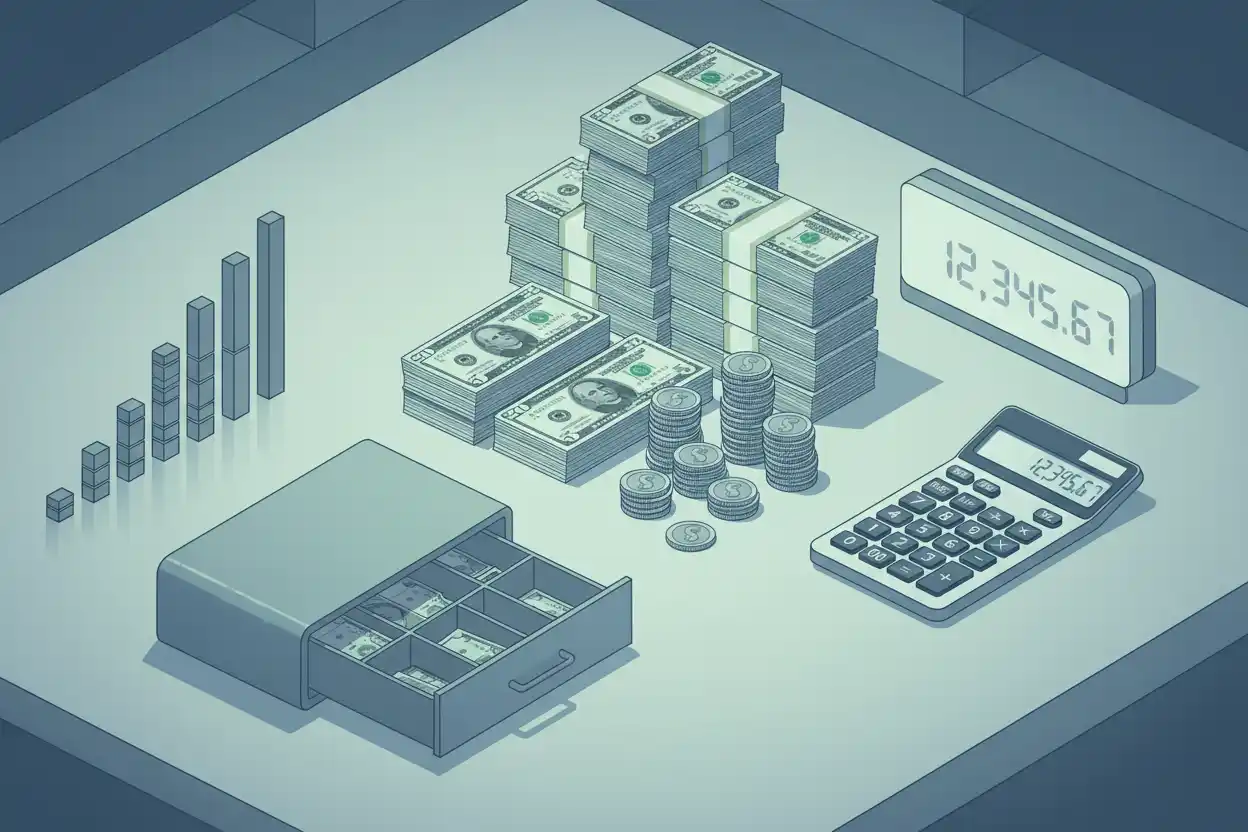

Counting cash accurately is easier when bills and coins are separated by denomination before totals are calculated.
The core calculation is simple: multiply the number of pieces by the value of each denomination, then add the subtotals.
That method works for a cash drawer, petty-cash box, tip pool, cash envelope, or any other collection of physical currency.
The challenge is usually not the formula. It is maintaining an orderly process so bills, coins, currencies, and already-counted amounts are not mixed or counted twice.
How to Count Cash
Use the same basic sequence each time:
- Separate bills from coins.
- Sort each group by denomination.
- Count the number of pieces in each denomination.
- Multiply quantity by denomination value.
- Add all denomination subtotals.
- Recount independently if accuracy matters.
The fundamental formula is:
Denomination Subtotal = Number of Pieces × Denomination Value
Then:
Total Cash = Sum of All Denomination Subtotals
Counting Bills Example
Suppose you have:
- 7 × $100 bills;
- 12 × $50 bills;
- 18 × $20 bills;
- 9 × $10 bills;
- 13 × $5 bills;
- 22 × $1 bills.
Calculate each subtotal.
$100 Bills
7 × $100 = $700
$50 Bills
12 × $50 = $600
$20 Bills
18 × $20 = $360
$10 Bills
9 × $10 = $90
$5 Bills
13 × $5 = $65
$1 Bills
22 × $1 = $22
Now add the subtotals.
Bill Total = $700 + $600 + $360 + $90 + $65 + $22
Bill Total = $1,837
The bills total $1,837.
Counting Coins Example
Suppose you have:
- 34 quarters;
- 27 dimes;
- 18 nickels;
- 43 one-cent coins.
Convert each denomination to dollars.
Quarters:
34 × $0.25 = $8.50
Dimes:
27 × $0.10 = $2.70
Nickels:
18 × $0.05 = $0.90
One-cent coins:
43 × $0.01 = $0.43
Add them:
Coin Total = $8.50 + $2.70 + $0.90 + $0.43
Coin Total = $12.53
If the bill total was $1,837:
Total Cash = $1,837 + $12.53
Total Cash = $1,849.53
Cash Counting Table
A denomination worksheet can reduce errors.
| Denomination | Quantity | Subtotal |
|---|---|---|
| $100 | 7 | $700 |
| $50 | 12 | $600 |
| $20 | 18 | $360 |
| $10 | 9 | $90 |
| $5 | 13 | $65 |
| $1 | 22 | $22 |
| $0.25 | 34 | $8.50 |
| $0.10 | 27 | $2.70 |
| $0.05 | 18 | $0.90 |
| $0.01 | 43 | $0.43 |
| Total | $1,849.53 |
Writing down each quantity creates an audit trail and makes a recount easier.
Count High or Low Denominations First?
Either approach can work if it is used consistently.
Counting from the largest denomination downward often makes the running total easier to monitor:
$100 → $50 → $20 → $10 → $5 → $1 → coins.
Another approach is to count smaller amounts first and build upward.
Consistency matters more than the direction.
Changing methods midway can increase the chance of double-counting or skipping a stack.
Count Pieces Before Calculating Dollars
A useful technique is to record the number of pieces first.
Suppose there are 37 twenty-dollar bills.
Do not try to maintain a mental running total while simultaneously moving the bills.
First establish:
Quantity = 37
Then calculate:
37 × $20 = $740
Separating the physical count from the arithmetic reduces cognitive load and makes errors easier to identify.
Fast Mental Multiplication by Denomination
Some denomination calculations can be simplified.
For $20 bills:
Number of Bills × 2 × 10
For 37 bills:
37 × 2 = 74
74 × 10 = $740
For $50 bills:
Number of Bills ÷ 2 × 100
If the count is 18:
18 × $50 = $900
For quarters:
4 Quarters = $1
So 36 quarters equal:
36 ÷ 4 = $9
Mental shortcuts can be useful, but recorded quantity × denomination calculations are safer for formal reconciliation.
Counting Cash in Bundles
If currency has already been arranged into equal bundles, count the bundles and then verify at least enough individual pieces to confirm the bundle size.
Suppose each bundle contains 25 twenty-dollar bills.
One bundle is:
25 × $20 = $500
Eight complete bundles are:
8 × $500 = $4,000
If another 13 loose $20 bills remain:
13 × $20 = $260
Therefore:
Total $20 Bills = $4,000 + $260 = $4,260
Do not assume every bundle contains the stated quantity unless the bundling process is reliable.
Cash Drawer Reconciliation
Counting cash is often part of reconciling a register.
Suppose:
- Opening cash float = $300
- Cash sales recorded = $2,450
- Cash refunds = $150
- Expected closing cash = ?
A simplified calculation is:
Expected Cash = Opening Cash + Cash Received − Cash Paid Out
Expected Cash = $300 + $2,450 − $150
Expected Cash = $2,600
If the physical count is $2,585:
Cash Difference = Actual Cash − Expected Cash
Cash Difference = $2,585 − $2,600
Cash Difference = −$15
The drawer is $15 short relative to the recorded activity.
If actual cash were $2,615:
$2,615 − $2,600 = +$15
The drawer would be $15 over.
Cash Over/Short Formula
A standard reconciliation relationship is:
Cash Over or Short = Actual Counted Cash − Expected Cash
Interpretation:
- positive result = over;
- negative result = short;
- zero = reconciled exactly.
A discrepancy does not automatically identify its cause.
Possible causes include change errors, unrecorded transactions, incorrect starting cash, refunds, payouts, data-entry errors, or counting mistakes.
Count Again Before Investigating a Difference
If a cash drawer does not reconcile, recount the physical cash before assuming a transaction problem.
A useful process is:
- recount each denomination;
- verify multiplication;
- verify subtotal addition;
- compare the starting float;
- review cash receipts and payouts;
- investigate transaction records.
This sequence begins with the easiest errors to eliminate.
Handling Cents Correctly
One common error is mixing cents and dollars.
For example:
73 cents = $0.73
not:
$73
When entering denominations into a calculator or spreadsheet, use:
- quarter = 0.25;
- dime = 0.10;
- nickel = 0.05;
- one cent = 0.01.
Maintaining dollars as the common unit prevents place-value errors.
Counting Cash by Weight
Businesses handling very large quantities of standardized coins may use calibrated equipment to estimate quantities by weight.
For ordinary manual cash counting, however, piece counts are more transparent.
Weight-based estimates can be affected by mixed denominations, foreign coins, debris, wear, or incorrect equipment settings.
For a small number of coins, direct counting is generally easier to verify.
Keep Different Currencies Separate
Do not add different currencies together at face value.
For example:
$500 + €300 ≠ $800
They are different monetary units.
First count each currency separately.
If a common reporting currency is required, use an appropriate currency exchange rate and record the conversion assumption.
The converted total can change when exchange rates change.
Counting Cash for a Budget
Physical cash systems sometimes divide money into categories such as groceries, transportation, or entertainment.
The counting calculation remains the same, but each envelope should be totaled separately before calculating the household total.
This can be useful when comparing actual available cash with a broader cost-of-living budget.
For example, if a household planned $600 for groceries but only $145 remains, the remaining proportion is:
$145 ÷ $600 × 100 ≈ 24.17%
About 24.17% of the original grocery cash remains.
Cash on Hand Does Not Include Future Interest
Counting cash establishes the nominal amount physically present now.
It does not include potential future earnings.
If $5,000 is held as physical cash:
Cash Count = $5,000
The total remains $5,000 simply because time passes.
By contrast, money in an interest-bearing account may grow through compound interest.
Those are separate calculations: one measures current currency, while the other models growth.
Cash Totals and Cumulative Interest
Likewise, cumulative interest measures interest accumulated across a loan or investment period.
It should not be mixed into a physical-cash count unless the interest has actually been received as cash and is present in the amount being counted.
Maintaining that distinction helps prevent projected financial values from being confused with money physically on hand.
Cash Counting vs Investment Risk Measures
Counting denominations is direct arithmetic.
Specialized measures such as convexity address an entirely different problem—how bond prices respond nonlinearly to yield changes.
A $20 bill contributes exactly $20 to a cash count. A bond’s market value can change even when its promised face value is unchanged.
Recognizing the difference between face-value arithmetic and market valuation is important when moving from cash management to investing.
Avoid Double Counting
Double counting frequently occurs when:
- a stack is moved back into an uncounted area;
- bundles are included individually and again as bundles;
- coins are counted once in rolls and again after opening;
- register totals are added to physical cash instead of used for comparison.
A simple physical separation helps.
Create three areas:
Uncounted → Being Counted → Counted
Once money reaches the counted area, do not return it to the uncounted area without restarting that denomination.
Common Counting Cash Mistakes
The most common mistakes are simple but consequential.
They include:
- miscounting the number of pieces;
- multiplying by the wrong denomination;
- mixing cents and dollars;
- forgetting loose bills or coins;
- double-counting bundles;
- combining different currencies without conversion;
- adding expected register cash to actual cash instead of comparing them.
A written denomination sheet eliminates many of these errors.
Frequently Asked Questions
What is the easiest way to count cash?
Sort money by denomination, count the pieces in each group, multiply each quantity by denomination value, and add the subtotals.
What is the cash-counting formula?
Total Cash = Σ(Quantity × Denomination Value)
How do I count a stack of $20 bills?
Count the number of bills and multiply by $20. For example:
37 × $20 = $740
How do I count quarters quickly?
Four quarters equal $1. For an exact formula:
Number of Quarters × $0.25
How should I count bills and coins together?
Calculate the bill total and coin total separately, then add them.
How do I reconcile a cash drawer?
Calculate expected cash from the opening amount and recorded transactions, count the actual cash, and subtract expected cash from actual cash.
What does a negative cash difference mean?
If:
Actual Cash − Expected Cash < 0
the drawer is short by the absolute value of the difference.
What does a positive cash difference mean?
It means the physical cash exceeds the expected amount.
Should I recount cash if the drawer does not balance?
Yes. Rechecking denominations and arithmetic is a sensible first step before investigating transaction records.
Can different currencies be added together?
Not directly. Count each currency separately and convert them to a common currency if a combined value is required.
Does cash earn compound interest?
Physical cash itself does not generate interest simply by being held. Interest requires an applicable interest-bearing arrangement.
Why is accurate cash counting important?
Accurate counting supports budgeting, register reconciliation, petty-cash control, deposits, and day-to-day cash management within a broader Savings & Investing framework.