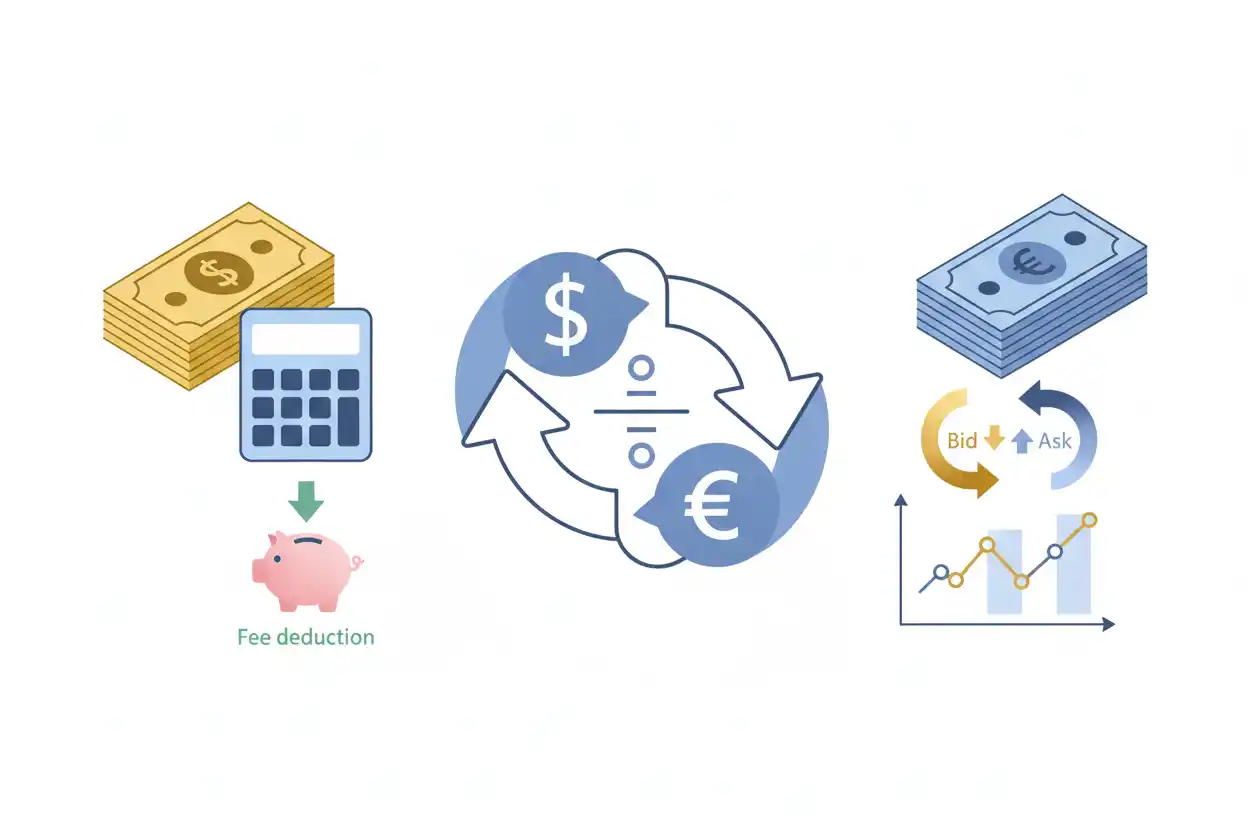

Currency exchange converts an amount expressed in one currency into an equivalent amount expressed in another currency using an exchange rate.
The arithmetic can be simple, but exchange-rate notation matters. Depending on how the rate is quoted, you may multiply by the rate or divide by it.
Fees and exchange-rate spreads can also cause the amount actually received to differ from the result shown by a headline market rate.
For that reason, an accurate currency exchange calculation should answer three questions: What rate is being quoted? In which direction is it quoted? What fees or spread apply?
What Is Currency Exchange?
Currency exchange is the conversion of monetary value from one currency to another.
For example, a traveler might exchange U.S. dollars for euros, a company might convert foreign revenue into its reporting currency, or an investor might translate an overseas investment value.
Every conversion requires an exchange rate.
If one U.S. dollar buys 0.90 euros, the quote can be written conceptually as:
1 USD = 0.90 EUR
This means $100 converts to €90 before fees.
Currency Exchange Formula
If the exchange rate tells you how much destination currency one unit of source currency buys:
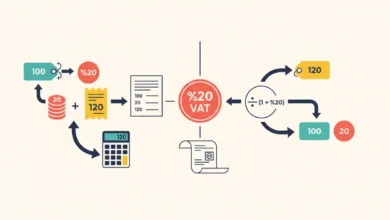
Destination Currency = Source Currency × Exchange Rate
Suppose:
1 USD = 0.90 EUR
To convert $500:
EUR = $500 × 0.90
EUR = €450
Before fees or spread adjustments, $500 converts to €450.
Converting Back in the Opposite Direction
If the quote remains:
1 USD = 0.90 EUR
and you want to convert €450 into U.S. dollars, divide by 0.90:
USD = €450 ÷ 0.90
USD = $500
The direction of the quote determines whether multiplication or division is required.
Reciprocal Exchange Rates
An exchange rate can be inverted.
If:
1 USD = 0.90 EUR
then:
1 EUR = 1 ÷ 0.90 USD
1 EUR ≈ 1.1111 USD
The reciprocal rate is approximately:
1 EUR ≈ 1.1111 USD
Multiplying €450 by 1.1111 produces approximately $500.
Currency Exchange Example
Suppose a traveler has $2,000 and receives a quoted rate of:
1 USD = 0.85 units of Destination Currency
Before fees:
Converted Amount = $2,000 × 0.85
Converted Amount = 1,700 destination-currency units
Now suppose the provider charges a flat fee equal to 20 destination-currency units.
Net Amount = 1,700 − 20
Net Amount = 1,680
The customer receives 1,680 units, not 1,700.
Percentage Currency Exchange Fee
Suppose instead that a provider charges a 2% transaction fee based on the converted amount.
Gross converted value:
1,700 units
Fee:
Fee = 1,700 × 2%
Fee = 34 units
Net proceeds:
Net Amount = 1,700 − 34
Net Amount = 1,666 units
A percentage fee can therefore be modeled as:
Net Amount = Gross Converted Amount × (1 − Fee Rate)
For this example:
1,700 × 0.98 = 1,666
Exchange Rate Spread
A currency provider may not charge only an explicit fee.
It can also offer a customer exchange rate that differs from a reference or wholesale rate.
Suppose the reference rate is:
1 USD = 0.9000 EUR
but the customer receives:
1 USD = 0.8820 EUR
For $1,000:
At the reference rate:
$1,000 × 0.9000 = €900
At the customer rate:
$1,000 × 0.8820 = €882
Difference:
€900 − €882 = €18
The customer receives €18 less because of the rate difference.
Measuring the Rate Difference
Using the same example:
Reference Rate = 0.9000
Customer Rate = 0.8820
Difference:
0.9000 − 0.8820 = 0.0180
As a percentage of the reference rate:
Rate Difference % = 0.0180 ÷ 0.9000 × 100
Rate Difference = 2%
The customer rate is 2% less favorable in this simplified example.
Effective Exchange Rate
When fees are charged, calculate the rate actually received.
Suppose:
- Source amount = $1,000
- Net destination amount = €873
Then:
Effective Exchange Rate = Net Destination Amount ÷ Source Amount
Effective Exchange Rate = €873 ÷ $1,000
Effective Exchange Rate = 0.873 EUR per USD
This effective rate incorporates the combined outcome of the quoted conversion and applicable charges included in the net amount.
Bid and Ask Rates
Tradable currencies are commonly associated with bid and ask prices.
The bid generally represents the price at which a market participant is willing to buy.
The ask generally represents the price at which a market participant is willing to sell.
The difference is the bid-ask spread.
Spread = Ask Price − Bid Price
Suppose:
- Bid = 1.1000
- Ask = 1.1020
Then:
Spread = 1.1020 − 1.1000
Spread = 0.0020
The practical cost implied by a spread depends on the pair, quote convention, transaction direction, and trade size.
Cross Currency Conversion
Sometimes there is no direct rate available for the currencies you want to convert.
A cross rate can be derived using an intermediate currency.
Suppose:
1 USD = 0.90 EUR
and:
1 USD = 150 JPY
To estimate how many yen correspond to one euro:
First find the dollar value of one euro:
1 EUR = 1 ÷ 0.90 USD
Then convert to yen:
JPY per EUR = 150 ÷ 0.90
JPY per EUR ≈ 166.67
So:
1 EUR ≈ 166.67 JPY
The calculation assumes internally consistent rates and ignores transaction costs.
Currency Exchange and Counting Cash
When physically counting cash, different currencies should be totaled separately.
For example:
$500 + €400
should not be reported as “$900.”
First count each currency, then perform the exchange calculation if a common currency total is required.
This keeps face-value counting separate from conversion.
Currency Exchange and Cumulative Interest
Suppose an overseas account has generated €800 of cumulative interest.
The interest amount is first measured in euros.
If it needs to be reported in dollars, apply the relevant exchange rate separately.
An exchange-rate movement can change the dollar-equivalent value even when the euro interest total remains unchanged.
Currency Exchange and Cost of Living
Exchange rates can materially affect international cost-of-living comparisons.
A salary may appear high in nominal local currency but have different purchasing power after conversion and local expenses are considered.
Currency conversion answers how much one currency is worth in another. Cost-of-living analysis asks what that converted money can buy.
They are related but distinct questions.
Currency Exchange and Depreciation
Depreciation reduces the accounting carrying amount of certain assets over their useful lives.
When an asset is purchased in a foreign currency, the exchange conversion and the depreciation schedule are separate calculations.
First determine the appropriate recorded value under the applicable accounting treatment. Then depreciation allocates the relevant depreciable amount according to the chosen method.
Currency Exchange vs Current Yield
Current yield expresses annual bond coupon income relative to market price.
If the bond is denominated in a foreign currency, currency movements can affect an investor’s home-currency result even when the bond’s local-currency current yield does not change.
Currency risk and bond-income yield therefore need to be evaluated separately.
Percentage Change in an Exchange Rate
Suppose a quote changes from 0.90 to 0.95 destination units per source unit.
Percentage Change = (New Rate − Old Rate) ÷ Old Rate × 100
Percentage Change = (0.95 − 0.90) ÷ 0.90 × 100
Percentage Change ≈ 5.56%
The source currency now buys approximately 5.56% more destination currency under this quote convention.
Reversing the quote changes how the percentage movement is expressed, which is another reason notation matters.
Why Currency Quotes Can Be Confusing
The same exchange relationship can be displayed in reciprocal forms.
For example:
USD/EUR = 0.90
and:
EUR/USD ≈ 1.1111
describe reciprocal relationships.
If you apply the wrong rate direction, the answer can be dramatically incorrect.
Before calculating, write the quote in words:
One source-currency unit buys X destination-currency units.
Then the correct operation is usually obvious.
Common Currency Exchange Mistakes
A frequent mistake is multiplying when the quote requires division.
Another is ignoring explicit fees.
People can also compare providers using only their fee labels while overlooking different exchange rates.
Finally, mixing currencies before converting them to a common unit produces meaningless totals.
Frequently Asked Questions
What is currency exchange?
Currency exchange is the process of converting value from one currency into another using an exchange rate.
What is the basic currency conversion formula?
When one source unit buys a stated number of destination units:
Destination Amount = Source Amount × Exchange Rate
When do I divide by the exchange rate?
You divide when converting in the opposite direction from the way the rate is quoted.
How do I reverse an exchange rate?
Reciprocal Rate = 1 ÷ Quoted Rate
What is an exchange-rate spread?
It is the difference between rates at which currency can be bought and sold, or more broadly the difference between relevant quoted prices.
Are currency exchange fees always shown separately?
No. Some cost can be reflected in the exchange rate offered rather than appearing only as an explicit fee.
What is an effective exchange rate?
It is the actual destination amount received divided by the source amount spent after relevant charges reflected in the net proceeds.
How do I compare two currency exchange providers?
Compare the final amount received for the same source amount, currency pair, and transaction conditions rather than comparing only headline rates or fee labels.
Can exchange rates change?
Yes. Market exchange rates can change continuously, while individual providers determine when and how their customer rates update.
Can I add dollars and euros together?
Not directly. Convert them to a common currency first if a combined monetary value is needed.
What is a cross exchange rate?
It is a rate between two currencies derived through one or more intermediate currency relationships.
Why does currency exchange matter in investing?
Foreign-currency movements can increase or reduce home-currency returns, so conversion effects can matter within a broader Savings & Investing strategy.