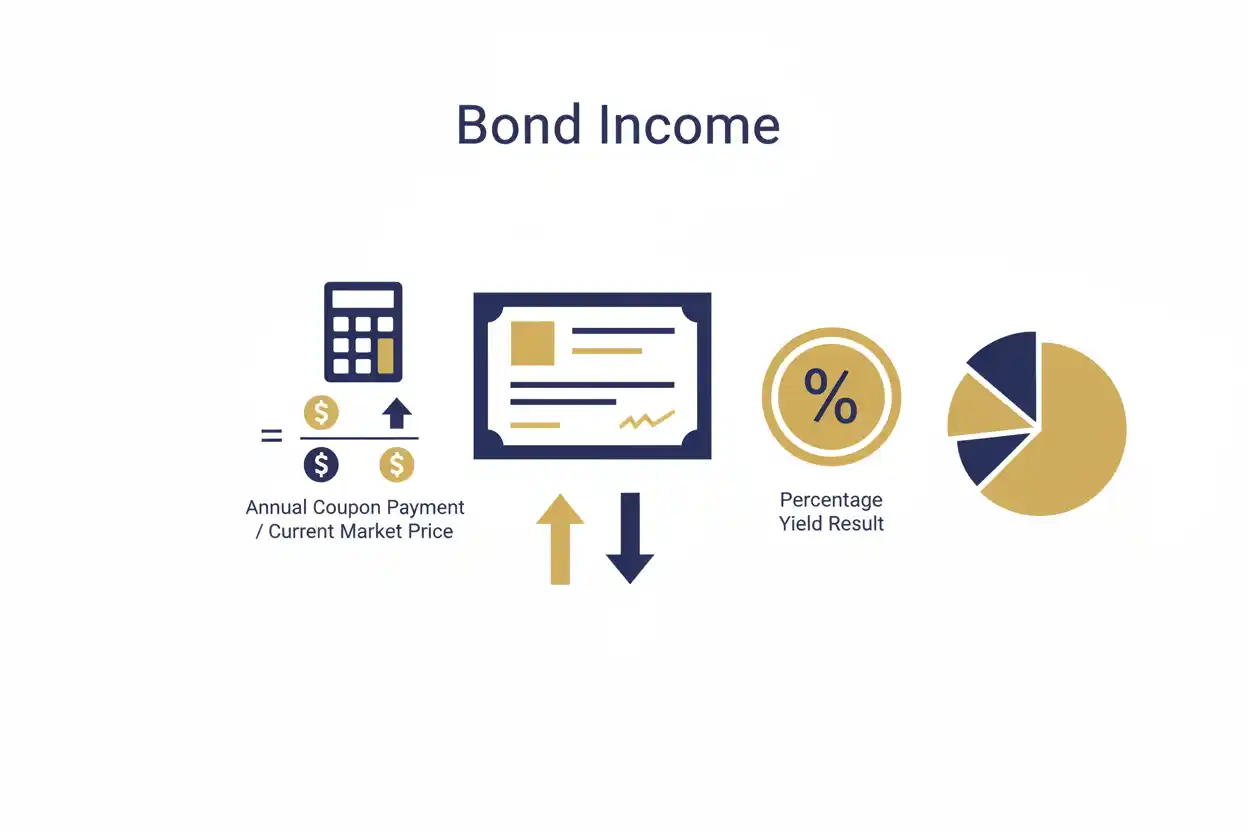

Current yield measures a bond’s annual coupon income relative to its current market price.
It is one of the simplest fixed-income yield calculations.
If a bond pays $60 per year and currently costs $950, its current yield is approximately 6.32%.
The calculation is useful for comparing current coupon income with the amount required to purchase the bond today, but it does not measure the bond’s complete return.
What Is Current Yield?
Current yield answers:
How much annual coupon income does this bond produce as a percentage of its current market price?
The formula uses two inputs:
- annual coupon payment;
- current market price.
It does not directly incorporate the bond’s maturity value, time remaining, reinvestment of coupons, or future sale price.
Current Yield Formula
Current Yield = Annual Coupon Payment ÷ Current Market Price × 100
For example:
- Annual coupon = $50
- Market price = $1,000
Then:
Current Yield = $50 ÷ $1,000 × 100
Current Yield = 5%
When the bond trades exactly at face value, current yield equals the coupon rate for a conventional fixed-rate bond.
Current Yield Example
Suppose:
- Face value = $1,000
- Coupon rate = 6%
- Market price = $950
First calculate annual coupon income.
Annual Coupon = Face Value × Coupon Rate
Annual Coupon = $1,000 × 0.06
Annual Coupon = $60
Now calculate current yield.
Current Yield = $60 ÷ $950 × 100
Current Yield ≈ 6.3158%
Rounded:
Current Yield ≈ 6.32%
The bond’s current yield is approximately 6.32%.
Why Current Yield Differs From Coupon Rate
Coupon rate is based on face value.
Coupon Rate = Annual Coupon ÷ Face Value × 100
Current yield uses market price.
Current Yield = Annual Coupon ÷ Market Price × 100
In the previous example:
Coupon Rate = $60 ÷ $1,000 = 6%
while:
Current Yield = $60 ÷ $950 ≈ 6.32%
The difference occurs because the investor can buy $60 of annual coupon income for only $950.
Current Yield When a Bond Trades at a Discount
A discount bond has:
Market Price < Face Value
Suppose a $1,000-face-value bond pays $50 annually but trades for $800.
Current Yield = $50 ÷ $800 × 100
Current Yield = 6.25%
The coupon rate is only:
$50 ÷ $1,000 × 100 = 5%
Current yield is higher because the investor pays less than face value.
Current Yield When a Bond Trades at a Premium
A premium bond has:
Market Price > Face Value
Suppose the same $50 coupon bond trades for $1,200.
Current Yield = $50 ÷ $1,200 × 100
Current Yield ≈ 4.17%
The coupon rate remains 5%, but current yield falls to approximately 4.17% because the investor must pay $1,200 to receive $50 of annual coupon income.
Current Yield at Par
If the market price equals face value:
Market Price = Face Value
then:
Current Yield = Coupon Rate
For example:
- Face value = $1,000
- Market price = $1,000
- Annual coupon = $70
Coupon rate:
$70 ÷ $1,000 = 7%
Current yield:
$70 ÷ $1,000 = 7%
Both equal 7%.
Semiannual Coupon Payments
Current yield uses the total annual coupon, even when the bond makes more than one payment per year.
Suppose a bond pays $30 every six months.
Annual coupon:
Annual Coupon = $30 × 2
Annual Coupon = $60
If market price is $960:
Current Yield = $60 ÷ $960 × 100
Current Yield = 6.25%
Do not use only one $30 semiannual payment in the numerator.
Monthly or Quarterly Income
The same logic applies to other payment frequencies.
If quarterly coupon payments total $80 over the year:
Annual Coupon = $80
If market price is $1,050:
Current Yield = $80 ÷ $1,050 × 100
Current Yield ≈ 7.62%
Payment frequency affects when income arrives but the numerator is annualized coupon income.
Current Yield Does Not Include Capital Gain or Loss
Suppose a $1,000-face-value bond trades for $900 and pays $50 annually.
Current yield:
$50 ÷ $900 × 100 ≈ 5.56%
If the investor eventually receives $1,000 at maturity, there may also be a $100 gain relative to the $900 purchase price.
Current yield ignores that gain.
Likewise, purchasing a premium bond for $1,100 that eventually repays $1,000 creates a $100 difference that current yield does not capture.
This is one of the metric’s most important limitations.
Current Yield vs Total Return
Suppose an investor buys a bond for $900, receives $50 of coupon income, and sells it one year later for $930.
Holding-period return is:
Return = (Coupon + Price Change) ÷ Beginning Price
Return = [$50 + ($930 − $900)] ÷ $900
Return = $80 ÷ $900
Return ≈ 8.89%
Starting current yield was:
$50 ÷ $900 ≈ 5.56%
The realized one-year return is higher in this example because the bond also gained $30 in market value.
Current Yield vs Broader Yield Analysis
Current yield deliberately answers a narrow question.
It does not attempt to solve for the return implied by all future bond cash flows.
That broader analysis requires additional information such as maturity, redemption value, and timing.
Keeping this distinction clear prevents current yield from being used as a substitute for more comprehensive bond-return measures.
Current Yield and Cumulative Interest
Cumulative interest totals interest income or expense across multiple periods.
Current yield instead relates one year’s coupon amount to the bond’s current price.
Suppose a bond has paid $300 of coupons over five years.
That $300 can be described as cumulative coupon income.
If the bond currently trades for $900 and pays $60 annually:
Current Yield = $60 ÷ $900 = 6.67%
The two measurements answer different questions.
Current Yield and Currency Exchange
If a bond is denominated in a foreign currency, its local-currency current yield may remain unchanged while the investor’s home-currency result changes because of currency exchange.
For example, a bond can continue paying the same foreign-currency coupon even while that currency weakens against the investor’s domestic currency.
Current yield therefore does not capture exchange-rate risk.
Current Yield and Depreciation
Depreciation concerns allocating the cost of certain assets across their useful lives.
Current yield concerns investment income relative to bond price.
Although both can involve percentages and asset values, depreciation is an accounting allocation concept, while current yield is a fixed-income income measure.
Current Yield and Discounts
A bond purchased below face value can be described as trading at a discount, but this is different from ordinary consumer discounts.
For consumer pricing, a discount directly reduces a listed purchase price.
For bonds, market pricing below face value also affects the relationship between coupon income, purchase price, and eventual maturity value.
The percentage-off formula should not replace fixed-income yield analysis.
Current Yield and Cash Counting
Current yield is calculated from financial values rather than by physically counting cash.
If coupon payments are actually received in cash, they can of course become part of a cash balance.
But the current-yield denominator is the bond’s current market price, not the amount of physical currency on hand.
Can Current Yield Be Zero?
Yes.
A bond that makes no periodic coupon payments has:
Annual Coupon = $0
Therefore:
Current Yield = $0 ÷ Market Price = 0%
A zero-coupon security can still produce a return through the difference between its purchase price and redemption value.
Current yield simply does not measure that return.
Can Current Yield Be Negative?
For a conventional positive-price bond with nonnegative coupon payments, the standard current-yield calculation will not be negative.
A negative total investment return can still occur if the bond’s market price falls enough or other losses occur.
Again, current yield measures coupon income relative to current price—not total profit or loss.
What Makes Current Yield Useful?
Current yield is useful because it is:
- simple;
- easy to calculate;
- based on current market price;
- useful for comparing annual coupon income.
Its simplicity is also its main limitation.
Investors evaluating fixed-income positions within a broader Savings & Investing plan should not interpret current yield as a complete measure of expected or realized return.
Common Current Yield Mistakes
The most common mistake is dividing the coupon by face value, which simply reproduces the coupon rate.
Another is using only one semiannual payment instead of annual coupon income.
Investors can also mistakenly assume current yield includes the gain or loss between market price and face value.
Finally, a higher current yield is not automatically better because market price can fall in response to greater credit or other risks.
Frequently Asked Questions
What is current yield?
Current yield is annual bond coupon income divided by the bond’s current market price.
What is the current yield formula?
Current Yield = Annual Coupon ÷ Current Market Price × 100
How is annual coupon calculated?
Annual Coupon = Face Value × Coupon Rate
for a conventional fixed-rate bond.
Is current yield the same as coupon rate?
No. Coupon rate uses face value; current yield uses market price.
When does current yield equal coupon rate?
When a conventional fixed-rate bond trades at face value.
Why is current yield higher on a discount bond?
The same annual coupon is being received for a lower purchase price.
Why is current yield lower on a premium bond?
The investor pays more than face value to receive the same contractual coupon income.
Does current yield include maturity value?
No. It ignores the gain or loss between purchase price and the amount received at maturity.
Does current yield include price changes?
No. It measures coupon income relative to current price, not total holding-period return.
Can a zero-coupon bond have a current yield of zero?
Yes. With no annual coupon payment, the standard current-yield numerator is zero.
Is a higher current yield always better?
No. A higher yield may accompany greater credit risk or other reasons for a lower market price.
What is current yield best used for?
It is best used as a simple measure of annual coupon income relative to today’s bond price.