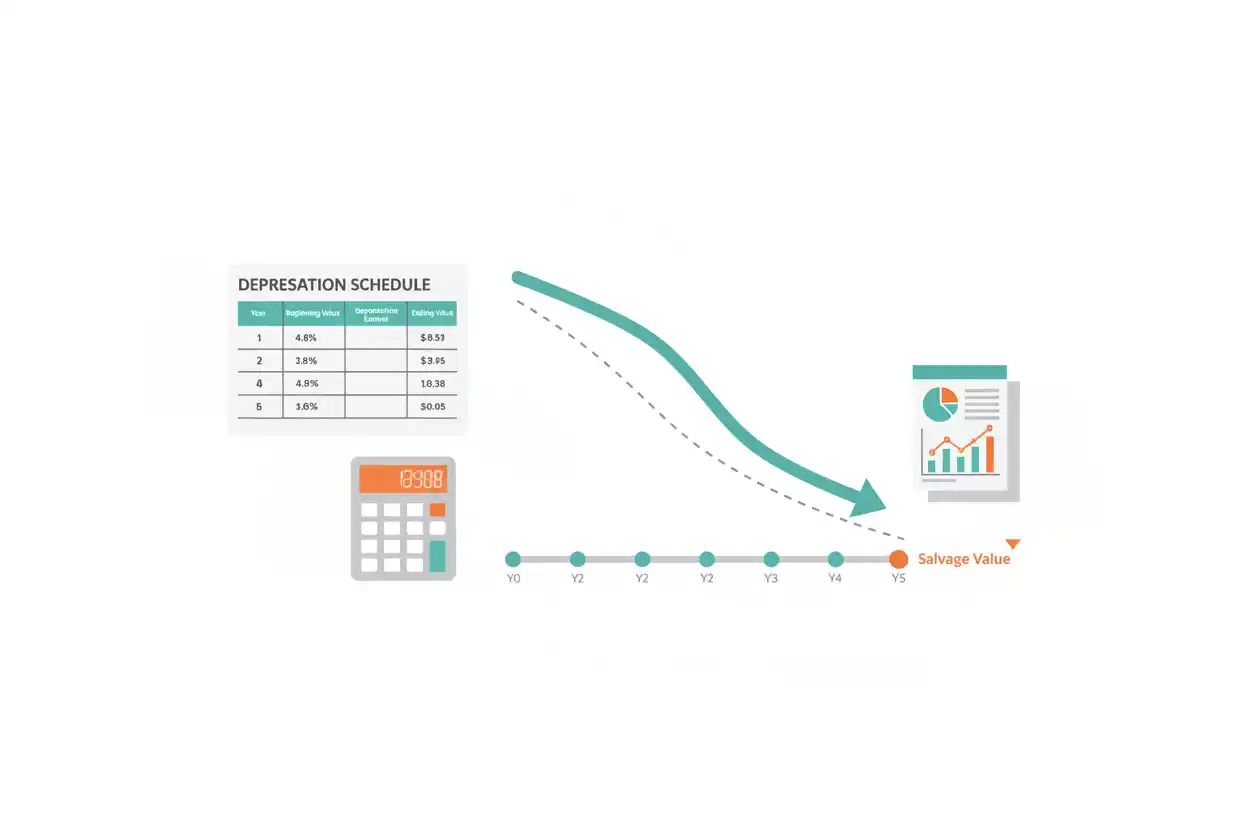

Depreciation is the systematic allocation of the depreciable amount of a long-lived tangible asset across its useful life.
Instead of recognizing the entire depreciable cost as an expense in one period, depreciation spreads that cost according to an accounting method intended to reflect how the asset’s economic benefits are consumed.
Common methods include straight-line depreciation, declining-balance methods, and units-of-production depreciation.
The method selected changes the timing of expense recognition, but it does not change the asset’s original purchase price.
What Is Depreciation?
Depreciation applies to tangible assets with useful lives extending beyond a single accounting period.
Examples can include machinery, vehicles, equipment, furniture, and buildings, depending on the applicable accounting treatment.
The core variables are:
- asset cost;
- residual or salvage value;
- useful life;
- depreciation method.
A simplified depreciable amount is:
Depreciable Amount = Asset Cost − Residual Value
If equipment costs $50,000 and has an estimated residual value of $5,000:
Depreciable Amount = $50,000 − $5,000
Depreciable Amount = $45,000
That $45,000 is the amount allocated under the depreciation method.
Straight-Line Depreciation Formula
Straight-line depreciation allocates an equal amount to each full period of the asset’s useful life.
Annual Depreciation = (Asset Cost − Residual Value) ÷ Useful Life
Suppose:
- Asset cost = $50,000
- Residual value = $5,000
- Useful life = 5 years
Then:
Annual Depreciation = ($50,000 − $5,000) ÷ 5
Annual Depreciation = $45,000 ÷ 5
Annual Depreciation = $9,000
The asset records $9,000 of depreciation per full year under this simplified straight-line example.
Straight-Line Depreciation Schedule
| Year | Beginning Book Value | Depreciation | Accumulated Depreciation | Ending Book Value |
|---|---|---|---|---|
| 1 | $50,000 | $9,000 | $9,000 | $41,000 |
| 2 | $41,000 | $9,000 | $18,000 | $32,000 |
| 3 | $32,000 | $9,000 | $27,000 | $23,000 |
| 4 | $23,000 | $9,000 | $36,000 | $14,000 |
| 5 | $14,000 | $9,000 | $45,000 | $5,000 |
At the end of year five:
Book Value = Cost − Accumulated Depreciation
Book Value = $50,000 − $45,000
Book Value = $5,000
The ending book value equals the assumed residual value.
Accumulated Depreciation
Accumulated depreciation is the total depreciation recorded from the date the asset was placed in service through the reporting date.
Net Book Value = Asset Cost − Accumulated Depreciation
After three years in the straight-line example:
Accumulated Depreciation = $9,000 × 3
Accumulated Depreciation = $27,000
Therefore:
Net Book Value = $50,000 − $27,000
Net Book Value = $23,000
Accumulated depreciation is a running total, similar in mathematical structure to other cumulative financial measures, though its accounting purpose is distinct from cumulative interest.
Straight-Line Depreciation Rate
If residual value is zero and useful life is five years, the straight-line rate can be expressed as:
Straight-Line Rate = 1 ÷ Useful Life
Straight-Line Rate = 1 ÷ 5
Straight-Line Rate = 20% per year
When residual value is not zero, applying 20% directly to original cost would not necessarily reproduce the correct depreciable amount unless the method is structured accordingly.
The dollar formula is therefore often clearer.
Declining-Balance Depreciation
Declining-balance depreciation is accelerated.
It records larger depreciation charges earlier in the asset’s life and smaller charges later.
A general form is:
Depreciation Expense = Beginning Book Value × Depreciation Rate
Unlike straight-line depreciation, the calculation uses the asset’s declining book value rather than allocating an identical dollar amount every year.
Double-Declining-Balance Method
Double-declining balance commonly uses twice the straight-line rate.
DDB Rate = 2 ÷ Useful Life
For a five-year useful life:
DDB Rate = 2 ÷ 5 = 40%
Suppose:
- Cost = $50,000
- Residual value = $5,000
- Useful life = 5 years
Year 1:
Depreciation = $50,000 × 40%
Depreciation = $20,000
Ending book value:
$50,000 − $20,000 = $30,000
Year 2:
Depreciation = $30,000 × 40%
Depreciation = $12,000
Ending book value:
$30,000 − $12,000 = $18,000
Year 3:
Depreciation = $18,000 × 40%
Depreciation = $7,200
Ending book value:
$18,000 − $7,200 = $10,800
The method generally should not depreciate the asset below its applicable residual value.
Why Accelerated Depreciation Changes the Schedule
Straight-line depreciation spreads expense evenly.
Accelerated methods recognize more depreciation earlier.
Using the same $50,000 asset:
- Straight-line year-one depreciation = $9,000
- DDB year-one depreciation = $20,000
The timing is substantially different.
That affects accounting profit and book value during individual periods even though depreciation remains an allocation of asset cost rather than a direct measurement of market value.
Units-of-Production Depreciation
The units-of-production method connects depreciation to actual use or output.
First calculate depreciation per unit:
Depreciation per Unit = (Cost − Residual Value) ÷ Estimated Total Units
Suppose:
- Cost = $100,000
- Residual value = $10,000
- Estimated lifetime output = 180,000 units
Then:
Depreciation per Unit = ($100,000 − $10,000) ÷ 180,000
Depreciation per Unit = $90,000 ÷ 180,000
Depreciation per Unit = $0.50
If the machine produces 30,000 units this year:
Annual Depreciation = 30,000 × $0.50
Annual Depreciation = $15,000
This method varies depreciation according to measured usage rather than simply the passage of time.
Depreciation vs Market Value
Book value is not necessarily market value.
Suppose a vehicle has:
Net Book Value = $20,000
The vehicle could potentially sell for $15,000, $20,000, or $25,000 depending on market conditions.
Depreciation is an accounting allocation process.
It should not automatically be interpreted as a forecast of resale price.
Depreciation vs Discounts
A discount reduces a purchase price at the time of a transaction.
Depreciation allocates the relevant asset amount after recognition over its useful life.
For example, suppose equipment has a $60,000 list price and receives a $10,000 purchase discount.
If the resulting recognized cost is $50,000, depreciation calculations begin from the appropriate recorded cost rather than pretending the $10,000 discount is annual depreciation.
Depreciation and Currency Exchange
Suppose machinery is purchased from a foreign supplier.
The transaction may first require currency exchange or translation into the reporting currency.
Once the appropriate asset cost has been established under the applicable accounting rules, depreciation allocates the depreciable amount.
Currency conversion and depreciation should therefore be handled as distinct calculations.
Depreciation vs Current Yield
Current yield measures annual coupon income relative to a bond’s current price.
Depreciation measures cost allocation for tangible assets.
A 10% depreciation rate does not mean an asset generates a 10% yield, nor does it necessarily mean its market price falls exactly 10%.
Depreciation and Dividend Yield
Dividend yield relates annual dividends to a stock’s market price.
Depreciation can affect a company’s reported expenses and earnings, but dividend yield is calculated from dividend distributions and share price.
The two metrics can interact indirectly through financial statements and corporate decisions, but their formulas serve separate purposes.
Full-Year vs Partial-Year Depreciation
An asset purchased during the year may not always receive a full year’s depreciation in the first accounting period.
The treatment depends on the accounting policy, applicable rules, and timing convention.
For a simplified straight-line monthly calculation:
Monthly Depreciation = Annual Depreciation ÷ 12
If annual depreciation is $12,000:
Monthly Depreciation = $12,000 ÷ 12
Monthly Depreciation = $1,000
If nine months are recognized:
Partial-Year Depreciation = $1,000 × 9
Partial-Year Depreciation = $9,000
The appropriate convention must match the accounting framework being used.
Changes in Useful Life or Residual Value
Depreciation estimates are based partly on assumptions.
Useful life and residual value can sometimes be revised when new information changes expectations.
That means a schedule should not necessarily be viewed as immutable from the date of purchase.
The remaining depreciable amount may need to be allocated over the revised remaining life according to the applicable accounting requirements.
Depreciation Does Not Equal Cash Outflow
The cash used to purchase an asset typically occurs separately from depreciation expense recognition.
For example, paying $50,000 for equipment today is a cash transaction.
Recording $9,000 of depreciation next year does not itself require another $9,000 cash payment.
This distinction is important when analyzing accounting profit and cash flow.
Common Depreciation Mistakes
One mistake is forgetting residual value.
Another is applying a straight-line rate to the wrong base.
People also sometimes allow an accelerated schedule to depreciate an asset below its intended residual value.
A further mistake is interpreting book depreciation as though it represented actual market-value decline.
Frequently Asked Questions
What is depreciation?
Depreciation is the systematic allocation of the depreciable amount of a tangible long-lived asset across its useful life.
What is the straight-line depreciation formula?
Annual Depreciation = (Cost − Residual Value) ÷ Useful Life
What is accumulated depreciation?
It is the total depreciation recognized on an asset through a particular date.
How do you calculate net book value?
Net Book Value = Asset Cost − Accumulated Depreciation
What is declining-balance depreciation?
It is an accelerated method that applies a depreciation rate to the asset’s declining book value.
What is double-declining balance?
It is an accelerated method commonly based on twice the straight-line rate.
What is units-of-production depreciation?
It allocates depreciation according to actual units produced or another measurable usage base.
Is depreciation the same as market-value loss?
No. Accounting depreciation and market-value changes are separate concepts.
Does depreciation involve a cash payment every year?
No. Recording depreciation expense does not itself create a new cash outflow.
Can depreciation go below residual value?
A depreciation schedule generally should respect the residual value used under the applicable method and accounting assumptions.
Is land depreciated like equipment?
Land commonly has different accounting treatment because it may not have a finite useful life in the same way as depreciable equipment. Specific treatment depends on the applicable accounting framework.
Why does depreciation matter?
It affects asset book values and periodic expenses and is part of understanding business finances within the wider Finance topic.