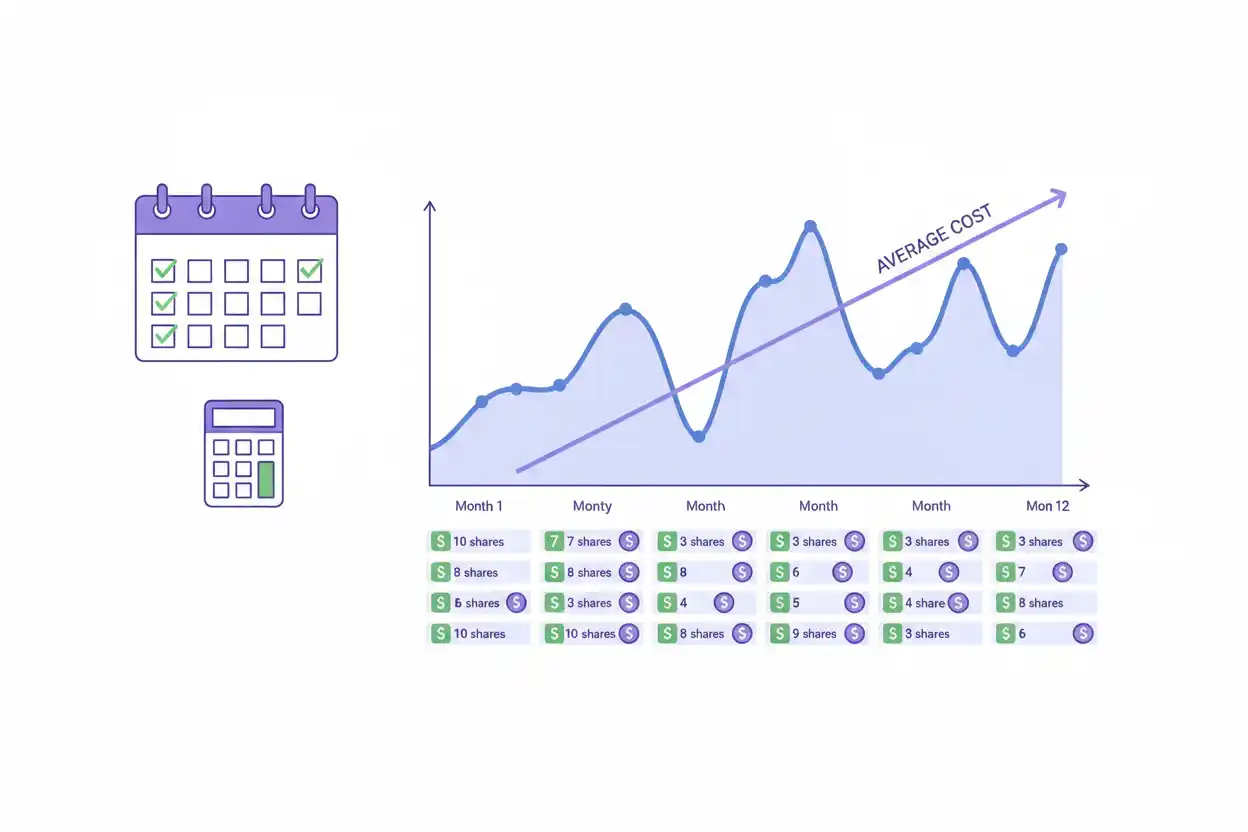
Dollar-cost averaging is an investment approach in which a fixed amount of money is invested at regular intervals rather than investing the entire planned amount at one time.
Because the contribution stays constant while market prices change, the investor buys more units when prices are lower and fewer units when prices are higher.
The method can create a disciplined contribution schedule and reduce the need to choose one exact entry date. It does not eliminate market risk, guarantee a profit, or ensure that the investor obtains the lowest possible average price.
What Is Dollar-Cost Averaging?
Dollar-cost averaging, often shortened to DCA, separates an investment into recurring purchases.
For example, instead of investing $6,000 on one day, an investor might invest:
$500 per month × 12 months = $6,000
Each $500 contribution purchases however many units are available at that period’s market price.
The number of units purchased can be calculated as:
Units Purchased = Amount Invested ÷ Price per Unit
Dollar-Cost Averaging Example
Suppose an investor contributes $500 at four different prices:
| Period | Contribution | Price | Units Purchased |
|---|---|---|---|
| 1 | $500 | $50 | 10.00 |
| 2 | $500 | $40 | 12.50 |
| 3 | $500 | $25 | 20.00 |
| 4 | $500 | $50 | 10.00 |
Calculate each purchase.
Period 1:
$500 ÷ $50 = 10 units
Period 2:
$500 ÷ $40 = 12.5 units
Period 3:
$500 ÷ $25 = 20 units
Period 4:
$500 ÷ $50 = 10 units
Total units:
10 + 12.5 + 20 + 10 = 52.5 units
Total invested:
$500 × 4 = $2,000
Average Cost Per Unit
The investor’s average purchase cost per unit is:
Average Cost per Unit = Total Amount Invested ÷ Total Units Purchased
Using the example:
Average Cost = $2,000 ÷ 52.5
Average Cost ≈ $38.10 per unit
The investor’s average cost is approximately $38.10 per unit.
Why You Should Not Average the Market Prices
The four prices were:
- $50
- $40
- $25
- $50
Their arithmetic average is:
($50 + $40 + $25 + $50) ÷ 4
$165 ÷ 4 = $41.25
But the investor’s actual average cost per unit was only about $38.10.
Why?
Because the fixed $500 contribution bought more units when the price was $25 and fewer units when the price was $50.
The appropriate investment-cost calculation is therefore:
Total Dollars Invested ÷ Total Units Purchased
not the simple arithmetic average of observed prices.
What Happens If Prices Rise Continuously?
Dollar-cost averaging does not guarantee a lower cost than investing immediately.
Suppose prices rise over four periods:
- $25;
- $30;
- $35;
- $40.
A $500 contribution each period buys:
$500 ÷ $25 = 20 units
$500 ÷ $30 ≈ 16.67 units
$500 ÷ $35 ≈ 14.29 units
$500 ÷ $40 = 12.5 units
Total units:
20 + 16.67 + 14.29 + 12.5 ≈ 63.46 units
Total invested:
$2,000
Average cost:
$2,000 ÷ 63.46 ≈ $31.52
An investor who had invested all $2,000 at the initial $25 price would have purchased:
$2,000 ÷ $25 = 80 units
In a steadily rising market, delaying part of the investment can therefore result in fewer units than investing earlier.
What Happens If Prices Fall?
Now suppose prices decline:
- $40;
- $35;
- $30;
- $25.
Recurring $500 purchases buy progressively more units as prices fall.
This can reduce the average purchase cost compared with the earlier high prices.
However, the investor still experiences a decline in market value on units purchased before the fall.
Dollar-cost averaging changes purchase timing; it does not turn declining investments into risk-free investments.
DCA and Market Timing
One reason investors use dollar-cost averaging is to reduce reliance on choosing a single market entry point.
Instead of asking:
Is today exactly the right day to invest?
the investor follows a predetermined schedule.
This can reduce the behavioral temptation to postpone investing indefinitely while waiting for a perfect price.
However, DCA is still a timing strategy. It intentionally keeps some planned capital uninvested until future dates.
That creates a tradeoff between reducing one-time entry-point risk and delaying market exposure.
Regular Contributions From Income
Dollar-cost averaging often occurs naturally through recurring savings.
For example, someone might invest a fixed amount from each paycheck.
If $300 is invested monthly:
Annual Contributions = $300 × 12
Annual Contributions = $3,600
The process can continue regardless of whether market prices are currently high or low.
This systematic structure is different from trying to predict short-term market movements.
Dollar-Cost Averaging and Dividend Yield
Investors purchasing dividend-paying stocks through DCA may acquire shares at different dividend yields because both share prices and dividend rates can change.
If annual dividends remain $2:
At $50 per share:
Dividend Yield = $2 ÷ $50 = 4%
At $40:
Dividend Yield = $2 ÷ $40 = 5%
The lower-priced purchase obtains more shares and a higher yield based on the unchanged dividend, but neither the dividend nor future share price is guaranteed.
DCA and Earnings Yield
The same changing-price relationship affects earnings yield.
If earnings per share remain $5:
At a $100 stock price:
Earnings Yield = $5 ÷ $100 = 5%
At $80:
Earnings Yield = $5 ÷ $80 = 6.25%
But falling prices can coincide with falling earnings expectations.
A lower purchase price therefore does not automatically mean the investment has become more attractive.
Dollar-Cost Averaging and Discounts
Consumer discounts have a defined original price and reduction percentage.
A falling investment price does not work the same way.
If a stock falls from $100 to $80, saying it is “20% off” describes the price decline mathematically:
($100 − $80) ÷ $100 = 20%
But it does not prove the stock is undervalued.
The company’s economic value may also have changed.
Dollar-Cost Averaging and Depreciation
Depreciation is an accounting method for allocating asset cost over its useful life.
Dollar-cost averaging concerns repeated investment purchases at changing prices.
The word “cost” appears in both topics, but their formulas and purposes are unrelated.
Dollar-Cost Averaging and Duration
If recurring investments are directed toward bonds or bond funds, interest-rate exposure remains relevant.
Duration helps describe fixed-income cash-flow timing and sensitivity to yield changes.
DCA determines when money is invested.
Duration helps analyze one dimension of the risk of what is purchased.
One cannot replace the other.
DCA and Asset Allocation
A contribution schedule should fit the investor’s broader asset allocation.
For example, investing $500 per month entirely into stocks can gradually increase equity exposure if other portfolio components are not adjusted.
Recurring contributions can instead be directed toward underweight asset classes as part of a rebalancing process.
This allows new cash flows to contribute both to investing discipline and portfolio maintenance.
Emergency Fund Before DCA
Money needed for unexpected near-term expenses serves a different purpose from long-term investment capital.
An emergency fund prioritizes liquidity and accessibility.
Investing emergency reserves into volatile assets merely because a DCA schedule exists can expose near-term spending needs to market losses.
The appropriate separation between emergency savings and investments depends on the person’s circumstances and liquidity needs.
Dollar-Cost Averaging and Compounding
DCA itself is not the same as compounding.
DCA describes when contributions are made.
Compound interest describes how returns can build on prior returns.
The two can work together.
Earlier recurring contributions generally have more time to compound than later contributions if investment returns are positive.
DCA With Transaction Costs
Frequent purchases can matter if each transaction carries a fee.
Suppose an investor contributes $100 monthly but pays a $5 fee for each purchase.
Effective amount invested:
$100 − $5 = $95
Fee percentage:
$5 ÷ $100 = 5%
In that situation, transaction costs materially reduce the amount actually invested.
The importance of this issue depends on the account and transaction-cost structure.
DCA With Fractional Shares
If fractional shares are available, a fixed contribution can usually be invested more precisely.
Without fractional shares, part of the planned contribution may remain uninvested when the contribution is smaller than the price of a whole share.
For example, if one share costs $120 and the monthly budget is $100, purchasing exactly $100 of the stock requires fractional-share capability.
The mathematical DCA formula assumes divisible units unless otherwise stated.
Does DCA Reduce Risk?
It can reduce single-entry timing risk because the entire investment is not committed at one market price.
However, DCA does not eliminate:
- market risk;
- company-specific risk;
- interest-rate risk;
- inflation risk;
- valuation risk;
- the possibility of permanent loss.
Once all planned funds are invested, the portfolio remains exposed to the underlying investments.
Common Dollar-Cost Averaging Mistakes
One mistake is calculating average cost by averaging market prices rather than dividing total invested dollars by total units.
Another is assuming DCA guarantees a profit.
Investors can also continue contributing to a deteriorating investment merely because the schedule is automatic.
Finally, DCA should not be used as a reason to invest money that needs to remain liquid for near-term expenses.
Frequently Asked Questions
What is dollar-cost averaging?
Dollar-cost averaging means investing a fixed dollar amount at regular intervals regardless of changing market prices.
What is the DCA formula for units purchased?
Units Purchased = Contribution ÷ Price per Unit
How do I calculate my average purchase price?
Average Cost per Unit = Total Amount Invested ÷ Total Units Purchased
Does dollar-cost averaging guarantee a lower average price?
No. If prices consistently rise, investing the full amount earlier could result in a lower purchase price.
Does DCA guarantee a profit?
No. The investment can still decline after purchases are made.
Why does DCA buy more shares when prices fall?
Because the dollar contribution remains fixed while each unit costs less.
Is DCA better than lump-sum investing?
Neither approach is universally superior. The result depends on market path, liquidity, risk tolerance, and the purpose of the capital.
Does DCA eliminate market timing?
It reduces reliance on choosing one entry date, but it still determines a schedule for when capital enters the market.
Can I use DCA with ETFs or funds?
Mathematically, the method can be applied to any investment that can be purchased repeatedly in appropriate units, subject to account and product rules.
Do fees matter for DCA?
Yes. Recurring transaction costs can reduce the amount invested, particularly when contributions are small.
Is DCA the same as compounding?
No. DCA describes recurring contributions; compounding describes growth on prior returns.
Where does DCA fit in investing?
It is a contribution method that can support a disciplined Savings & Investing strategy, but the quality and risk of the underlying investment still matter.