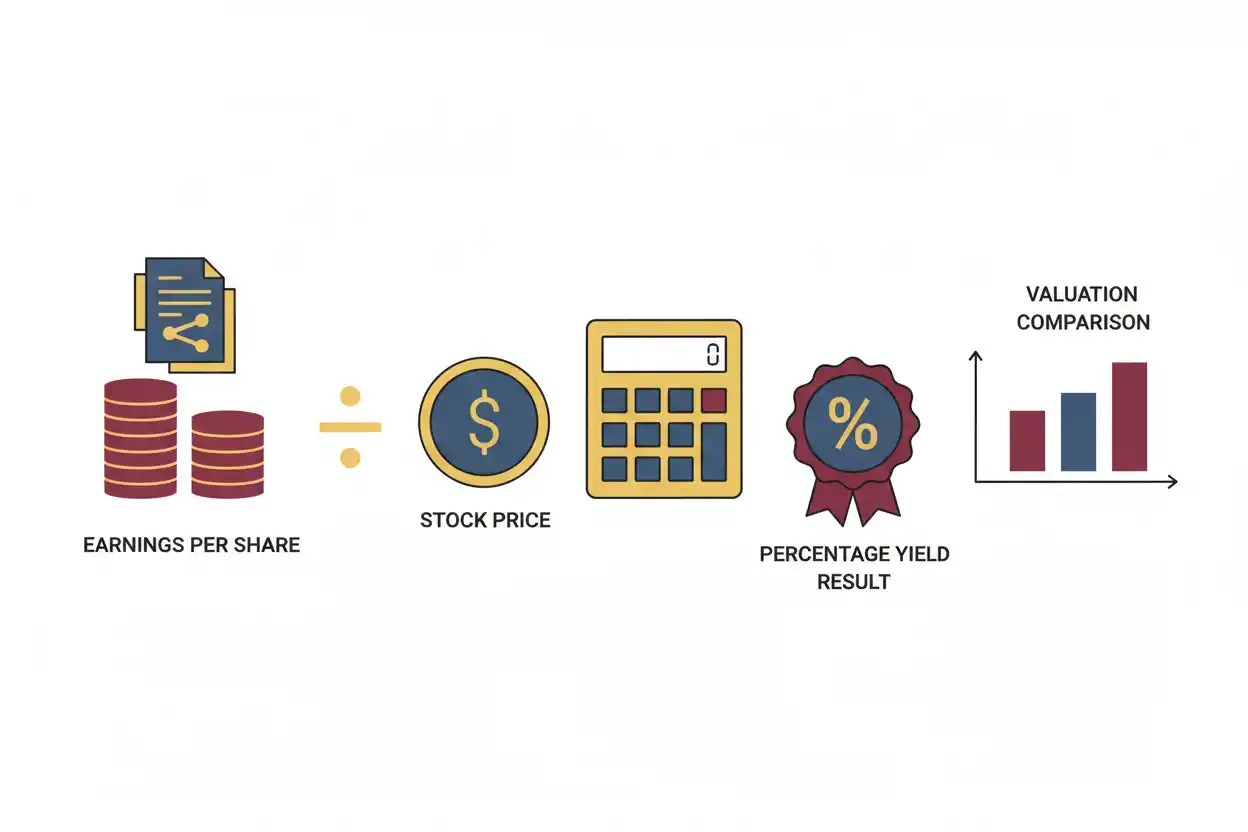

Earnings yield compares a company’s earnings per share with its share price.
It is essentially the earnings-to-price ratio and can be viewed as the mathematical inverse of the price-to-earnings ratio when both measures use consistent positive earnings figures.
If a company earns $5 per share and its stock trades for $100, its earnings yield is 5%.
That does not mean shareholders receive a 5% cash payment or are guaranteed a 5% investment return. Earnings belong to the company before decisions about dividends, reinvestment, debt repayment, acquisitions, or other uses of capital.
What Is Earnings Yield?
Earnings yield expresses earnings per share as a percentage of market price.
It answers:
How large are the company’s measured earnings relative to the price investors currently pay for one share?
The formula is useful because it puts stock valuation into a yield-like format.
For example, a P/E ratio of 20 corresponds mathematically to a 5% earnings yield when earnings are positive and the same earnings definition is used.
Earnings Yield Formula
Earnings Yield = Earnings per Share ÷ Share Price × 100
Where:
- Earnings per Share (EPS) represents the earnings amount attributed to each share under the chosen measurement;
- Share Price is the market price per share.
Earnings Yield Example
Suppose:
- EPS = $5
- Stock price = $100
Then:
Earnings Yield = $5 ÷ $100 × 100
Earnings Yield = 5%
The company’s earnings represent 5% of its current share price.
Earnings Yield From P/E Ratio
When the P/E ratio uses the same positive EPS and price:
Earnings Yield = 1 ÷ P/E Ratio
Suppose:
P/E = 20
Then:
Earnings Yield = 1 ÷ 20
Earnings Yield = 0.05
Earnings Yield = 5%
This matches the $5 EPS and $100 share-price example.
Another Earnings Yield Example
Suppose a company earns $8 per share and its stock trades for $160.
Earnings Yield = $8 ÷ $160 × 100
Earnings Yield = 5%
Now suppose the share price falls to $120 while EPS remains $8.
Earnings Yield = $8 ÷ $120 × 100
Earnings Yield ≈ 6.67%
The earnings yield rose because the price fell.
That does not automatically mean the stock became a better investment. The lower price could reflect expectations that future earnings will decline.
How Price Affects Earnings Yield
Holding EPS constant:
Price ↓ → Earnings Yield ↑
Price ↑ → Earnings Yield ↓
Suppose EPS remains $4.
At $40:
Earnings Yield = 10%
At $50:
Earnings Yield = 8%
At $80:
Earnings Yield = 5%
The underlying earnings in this example did not change.
Only the price changed.
How Earnings Affect Earnings Yield
Holding price constant:
Earnings ↑ → Earnings Yield ↑
Earnings ↓ → Earnings Yield ↓
Suppose the share price remains $100.
If EPS rises from $5 to $7:
Old yield:
$5 ÷ $100 = 5%
New yield:
$7 ÷ $100 = 7%
If EPS falls to $2:
$2 ÷ $100 = 2%
The ratio can therefore change because of the numerator, denominator, or both.
Earnings Yield vs P/E Ratio
These measures express the same price-and-earnings relationship from opposite directions when inputs are consistent.
P/E:
P/E = Share Price ÷ EPS
Earnings yield:
Earnings Yield = EPS ÷ Share Price
For a $100 stock earning $5:
P/E = $100 ÷ $5 = 20
and:
Earnings Yield = $5 ÷ $100 = 5%
Because:
1 ÷ 20 = 5%
A lower P/E corresponds mathematically to a higher earnings yield when earnings remain positive.
Earnings Yield vs Dividend Yield
Dividend yield measures actual or expected dividend distributions relative to share price.
Earnings yield measures company earnings relative to share price.
Suppose:
- EPS = $6
- Annual dividend = $2
- Share price = $100
Then:
Earnings Yield = $6 ÷ $100 = 6%
while:
Dividend Yield = $2 ÷ $100 = 2%
The remaining earnings may be retained by the company.
They are not automatically distributed to shareholders.
Earnings Yield Is Not a Cash Yield
A bond coupon or cash-account interest payment represents a contractual or account-based cash-flow relationship.
Corporate earnings are different.
A company can report substantial earnings while paying no dividend at all.
Therefore, comparing earnings yield directly with current yield requires care.
Current yield represents annual bond coupon income relative to market price.
Earnings yield represents accounting earnings relative to equity market price.
Trailing Earnings Yield
A trailing earnings yield generally uses earnings from a completed historical period.
Suppose trailing EPS is $4 and the current stock price is $80.
Trailing Earnings Yield = $4 ÷ $80
Trailing Earnings Yield = 5%
This ratio uses historical earnings but today’s market price.
If the company’s future profitability changes significantly, the trailing figure may become less informative.
Forward Earnings Yield
A forward earnings yield uses forecast earnings rather than completed historical earnings.
Suppose expected next-year EPS is $6 and the stock price is $100.
Forward Earnings Yield = $6 ÷ $100
Forward Earnings Yield = 6%
The calculation is straightforward.
The uncertainty comes from the earnings forecast.
Actual future earnings may differ materially.
Negative Earnings Yield
If EPS is negative, earnings yield is also negative.
Suppose:
- EPS = −$3
- Stock price = $60
Then:
Earnings Yield = −$3 ÷ $60 × 100
Earnings Yield = −5%
A negative earnings yield indicates a net loss under the earnings measure used.
The reciprocal relationship with P/E becomes less useful because conventional P/E interpretation is generally problematic when earnings are negative.
Zero Earnings
If EPS is zero:
Earnings Yield = $0 ÷ Share Price = 0%
The P/E ratio, however, cannot be meaningfully calculated as price divided by zero.
This is one example in which expressing valuation through earnings yield can behave mathematically differently from the reciprocal P/E framing.
Earnings Yield and Dollar-Cost Averaging
An investor using dollar-cost averaging purchases at different prices over time.
If company earnings remain constant while the price changes, each purchase occurs at a different earnings yield.
However, actual earnings also change over time.
A lower stock price can coincide with lower expected earnings, so DCA should not assume that every price decline automatically creates a higher sustainable earnings yield.
Earnings Yield and Duration
Duration measures fixed-income cash-flow timing and interest-rate sensitivity.
Earnings yield is an equity valuation ratio.
Comparing a stock’s 6% earnings yield directly with a bond’s duration of 6 would be meaningless because the measures use different units and answer different questions.
Earnings Yield and Emergency Funds
An emergency fund is designed primarily around liquidity and the ability to cover unexpected expenses.
A high earnings yield does not make a stock an appropriate substitute for emergency cash.
Stocks can decline significantly precisely when liquidity is needed.
Asset purpose should therefore be considered before expected return or valuation measures.
Earnings Yield and Expense Ratio
An expense ratio measures fund operating expenses relative to assets.
Earnings yield measures corporate earnings relative to stock price.
If an investor accesses equities through a fund, both can matter—but in different ways.
The earnings characteristics belong to the underlying companies, while the expense ratio describes a cost of owning the fund structure.
Earnings Yield and Valuation
A higher earnings yield means more measured earnings per dollar of stock price.
That can indicate a lower valuation relative to current earnings.
But there may be reasons the market assigns that lower valuation, including:
- expected earnings declines;
- cyclicality;
- financial leverage;
- business risk;
- weak growth prospects;
- uncertainty about earnings quality.
A high earnings yield is therefore a starting point for analysis, not proof of undervaluation.
Earnings Quality Matters
The EPS used in the numerator can materially affect the result.
Potential differences include:
- reported earnings;
- adjusted earnings;
- trailing earnings;
- forecast earnings;
- diluted versus basic EPS.
Two sources can show different earnings yields for the same company because they use different EPS definitions or dates.
Always compare valuation ratios using consistent inputs.
Earnings Yield and One-Time Items
Suppose a company reports unusually high earnings because of a one-time gain.
That can temporarily increase EPS and therefore earnings yield.
If the gain is not repeatable, extrapolating the resulting yield into future years can be misleading.
The same concern applies when a one-time expense temporarily suppresses earnings.
Context matters.
Earnings Yield Does Not Measure Growth
Two companies can both have a 5% earnings yield but very different expected growth rates.
Company A may have stable earnings with little expected growth.
Company B may be reinvesting heavily and expected to grow faster.
The earnings yield alone cannot determine which stock offers the better risk-adjusted opportunity.
Earnings Yield Does Not Equal Total Return
Suppose a company has a 7% earnings yield.
The shareholder’s eventual return could still be:
- much higher than 7%;
- lower than 7%;
- negative.
Market-price changes and actual distributions determine investment outcomes.
Earnings yield is a valuation metric, not a return guarantee.
Common Earnings Yield Mistakes
One mistake is treating earnings yield as cash received by shareholders.
Another is assuming a high yield means the stock is undervalued.
Investors can also compare trailing earnings yield for one company with forward earnings yield for another without recognizing the inconsistent inputs.
Finally, the reciprocal P/E relationship should not be relied upon mechanically when earnings are zero or negative.
Frequently Asked Questions
What is earnings yield?
Earnings yield is earnings per share divided by the current share price.
What is the earnings yield formula?
Earnings Yield = EPS ÷ Share Price × 100
What does a 5% earnings yield mean?
It means measured earnings per share equal 5% of the current share price.
Is earnings yield the inverse of P/E?
Yes, when both calculations use the same positive earnings and share-price inputs.
Earnings Yield = 1 ÷ P/E
Is earnings yield the same as dividend yield?
No. Earnings yield uses company earnings; dividend yield uses cash dividends distributed to shareholders.
Is earnings yield paid to investors?
No. Company earnings can be retained rather than distributed.
Can earnings yield be negative?
Yes. Negative EPS produces a negative earnings yield.
What happens if EPS is zero?
Earnings yield is zero, while a conventional P/E calculation becomes undefined because it requires division by zero.
Is a higher earnings yield always better?
No. A high yield may reflect significant business risk or expectations of falling earnings.
What is trailing earnings yield?
It uses historical earnings, usually from a completed measurement period, relative to current share price.
What is forward earnings yield?
It uses forecast earnings relative to current share price.
How should earnings yield be used?
It can support valuation comparisons within a broader Savings & Investing analysis, but should be considered alongside earnings quality, growth, financial strength, and risk.