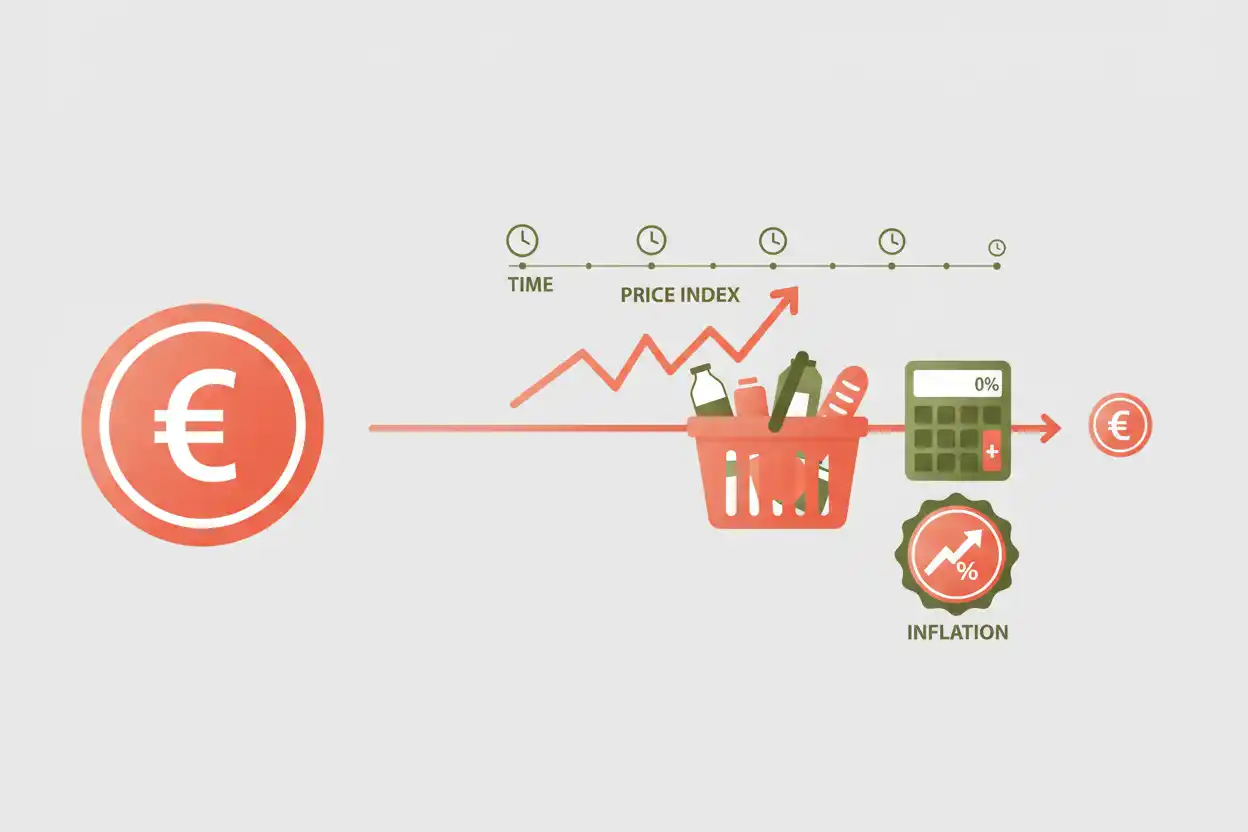
Inflation is a sustained increase in the general level of prices, which reduces the purchasing power of a unit of money over time.
If the same basket of goods costs $100 today and $103 one year later, that basket has experienced a 3% price increase.
From a personal-finance perspective, inflation matters because a savings balance can increase in nominal dollars while still losing purchasing power if it grows more slowly than prices.
Understanding inflation therefore requires distinguishing between nominal value and real value.
What Is Inflation?
Inflation describes the rate at which prices rise across a broad group of goods and services over time.
It does not mean every price rises at the same rate.
During the same period:
- housing can rise faster than average;
- some food prices can fall;
- energy can fluctuate sharply;
- technology prices can behave differently again.
Broad inflation measures combine many categories to estimate an overall change in consumer prices.
In the United States, the Consumer Price Index is one commonly used measure of changes in prices paid by consumers for a representative basket of goods and services.
Inflation Rate Formula
If a price index is available for two dates:
Inflation Rate = (New Price Index − Old Price Index) ÷ Old Price Index × 100
Suppose:
- old index = 312;
- new index = 325.
Then:
Inflation Rate = (325 − 312) ÷ 312 × 100
Inflation Rate = 13 ÷ 312 × 100
Inflation Rate ≈ 4.17%
Prices represented by the index increased approximately 4.17% over the period.
Simple Price Inflation Example
Suppose an item costs $80 today and $84 one year later.
Increase:
$84 − $80 = $4
Inflation for that specific item:
$4 ÷ $80 × 100 = 5%
Its price increased 5%.
That does not necessarily mean the economy-wide inflation rate was also 5%.
One product is not a complete price index.
How Inflation Changes Future Costs
If a cost increases at a constant annual rate:
Future Cost = Current Cost × (1 + Inflation Rate)^Years
Suppose annual household expenses are $50,000 and increase by 3% per year for 10 years.
Future Cost = $50,000 × 1.03¹⁰
Future Cost ≈ $67,195.82
Under that assumption, expenses equivalent to $50,000 today would cost approximately $67,196 after 10 years.
Inflation Compounds
A common mistake is multiplying annual inflation by the number of years.
For 3% inflation over 10 years:
3% × 10 = 30%
But compounding produces:
1.03¹⁰ − 1 ≈ 34.39%
The cumulative price increase is approximately 34.39%, not 30%.
That occurs because each year’s percentage increase applies to a price level already increased by previous years.
Purchasing Power Formula
Purchasing power can be expressed by discounting a future nominal amount for inflation.
Real Value in Today’s Money = Future Nominal Amount ÷ (1 + Inflation Rate)^Years
Suppose you expect to have $100,000 in 20 years and assume 3% annual inflation.
Real Value = $100,000 ÷ 1.03²⁰
Real Value ≈ $55,367.58
Under those assumptions, $100,000 in 20 years would have purchasing power roughly equivalent to $55,368 today.
Why Cash Can Lose Real Value
Suppose $10,000 is held without earning interest while prices rise 4%.
The account still contains:
$10,000
in nominal terms.
But the amount required to buy the same basket becomes:
$10,000 × 1.04 = $10,400
The original $10,000 can no longer purchase the full basket.
The nominal amount is unchanged, but its real purchasing power has fallen.
Nominal Return vs Real Return
Investment returns are often quoted in nominal terms.
To estimate the real return:
Real Return = (1 + Nominal Return) ÷ (1 + Inflation Rate) − 1
Suppose:
- nominal investment return = 8%;
- inflation = 3%.
Then:
Real Return = 1.08 ÷ 1.03 − 1
Real Return ≈ 0.04854
Real Return ≈ 4.85%
The investment’s real increase in purchasing power is approximately 4.85%.
Approximate Real Return
For relatively modest rates, a shortcut is:
Approximate Real Return ≈ Nominal Return − Inflation
Using the same numbers:
8% − 3% = 5%
The precise result was about 4.85%.
The subtraction method is useful for quick intuition, but the ratio formula is more accurate.
Inflation and Holding Period Return
A nominal holding period return can be adjusted for the inflation experienced during the same period.
Suppose a portfolio earns 10% while prices rise 6%.
Approximate real return:
10% − 6% = 4%
Exact:
1.10 ÷ 1.06 − 1 ≈ 3.77%
An investment can therefore report a positive nominal return while delivering much smaller real growth.
Inflation and Future Value
Future value calculations often produce nominal future amounts.
Suppose $50,000 grows to $100,000 over many years.
Whether that represents a true doubling of economic purchasing power depends on how prices change during the same period.
A useful long-term plan therefore evaluates both:
- future nominal wealth;
- future purchasing power.
Inflation and Future Value of Annuity
Recurring savings modeled with the future value of annuity formula can produce an impressive future balance.
But a $1 million target 30 years from now will not necessarily have the purchasing power that $1 million has today.
If the goal is based on future spending, the target itself may need to grow with inflation.
Inflation and Investment Growth
Investment growth should be evaluated in both nominal and real terms for long-horizon goals.
Suppose investments grow 6% annually while inflation averages 3%.
Nominal wealth grows substantially.
Real wealth grows more slowly because part of the nominal increase merely compensates for higher prices.
This distinction becomes especially important over decades.
Inflation and IRA Planning
Long-term retirement savings held in an IRA may remain invested for many years.
A future retirement balance should therefore not be evaluated only by its nominal dollar amount.
If retirement occurs decades later, expected living expenses will likely differ from today’s amounts.
Retirement projections need internally consistent return and inflation assumptions.
Consumer Price Index vs Personal Inflation
A broad consumer index represents the spending pattern of a defined population.
Your own expenses can move differently.
For example, a household spending a large percentage on rent may experience faster personal cost increases when housing rises rapidly.
Another household with different housing arrangements could experience a smaller change.
Therefore:
Personal Inflation ≠ Necessarily Published Average Inflation
A broad index is useful for economic comparison, but individual budgets still matter.
Inflation vs One-Time Price Increase
A single price increase does not necessarily represent ongoing inflation.
Suppose a product jumps from $10 to $12 once and remains at $12 for several years.
The initial price level increased 20%.
But if the price then remains unchanged, that product is no longer experiencing continuing annual inflation.
Inflation is fundamentally about changes in price levels through time.
Deflation
Deflation is a decline in a broad price level.
If an index falls from 200 to 194:
Price Change = (194 − 200) ÷ 200
Price Change = −3%
The index declined 3%.
Deflation increases the purchasing power of money relative to the affected price basket, although sustained deflation can have broader economic consequences.
Disinflation
Disinflation means inflation remains positive but slows.
Suppose annual inflation changes from:
6% → 4%
Prices are still rising.
They are simply rising more slowly than before.
A lower inflation rate is not the same as falling prices.
Inflation and Interest Rates
Nominal interest rates and inflation are closely connected in financial decision-making.
If a savings account earns 4% while inflation is 5%, the balance grows in nominal terms but loses real purchasing power under the simplified comparison.
This is why evaluating interest rates without inflation can provide an incomplete picture.
Inflation and Debt
Inflation can affect borrowers and lenders differently.
If debt has a fixed nominal payment while income and prices rise over time, that payment may represent a smaller share of future nominal income.
However, inflation can also lead to higher borrowing costs, making new debt more expensive.
The effect depends on the debt structure and broader financial environment.
Inflation and Maximum Drawdown
Maximum drawdown measures the largest peak-to-trough decline in an investment.
Inflation measures purchasing-power erosion.
A portfolio can have no major market drawdown yet still lose real value if its return stays below inflation for an extended period.
Market risk and purchasing-power risk are therefore distinct.
Why Inflation Assumptions Matter
Suppose a retirement plan requires $60,000 of annual spending today.
At 2% inflation for 25 years:
$60,000 × 1.02²⁵ ≈ $98,436
At 4%:
$60,000 × 1.04²⁵ ≈ $159,950
The assumption changes future nominal spending by more than $60,000 per year.
Long-term planning should therefore test multiple scenarios instead of relying on one exact inflation forecast.
Common Inflation Mistakes
One mistake is treating every price increase as economy-wide inflation.
Another is subtracting multi-year inflation rates rather than compounding them.
People can also compare nominal investment returns with today’s purchasing power without adjusting for inflation.
Finally, published inflation may not match an individual household’s actual expense pattern.
Frequently Asked Questions
What is inflation?
Inflation is an increase in the general price level over time, which reduces the purchasing power of money.
How is inflation calculated from an index?
Inflation Rate = (New Index − Old Index) ÷ Old Index × 100
What does 3% inflation mean?
It means the measured price level increased approximately 3% over the specified period.
Does 3% annual inflation for 10 years equal 30% total inflation?
Not exactly. Compounding produces approximately 34.39%.
How do I estimate a future cost?
Future Cost = Current Cost × (1 + Inflation Rate)^Years
How do I calculate real purchasing power?
Real Value = Future Nominal Amount ÷ (1 + Inflation Rate)^Years
What is a real investment return?
It is the investment return after accounting for inflation.
What is the exact real-return formula?
Real Return = (1 + Nominal Return) ÷ (1 + Inflation Rate) − 1
Is CPI the same as my personal inflation rate?
Not necessarily. Personal spending patterns can differ from the basket and weights used in a broad index.
What is deflation?
Deflation is a decrease in a broad price level.
What is disinflation?
Disinflation means prices are still rising, but the inflation rate is slowing.
Why does inflation matter for investing?
It determines how much nominal investment growth translates into real purchasing power within a broader Savings & Investing strategy.