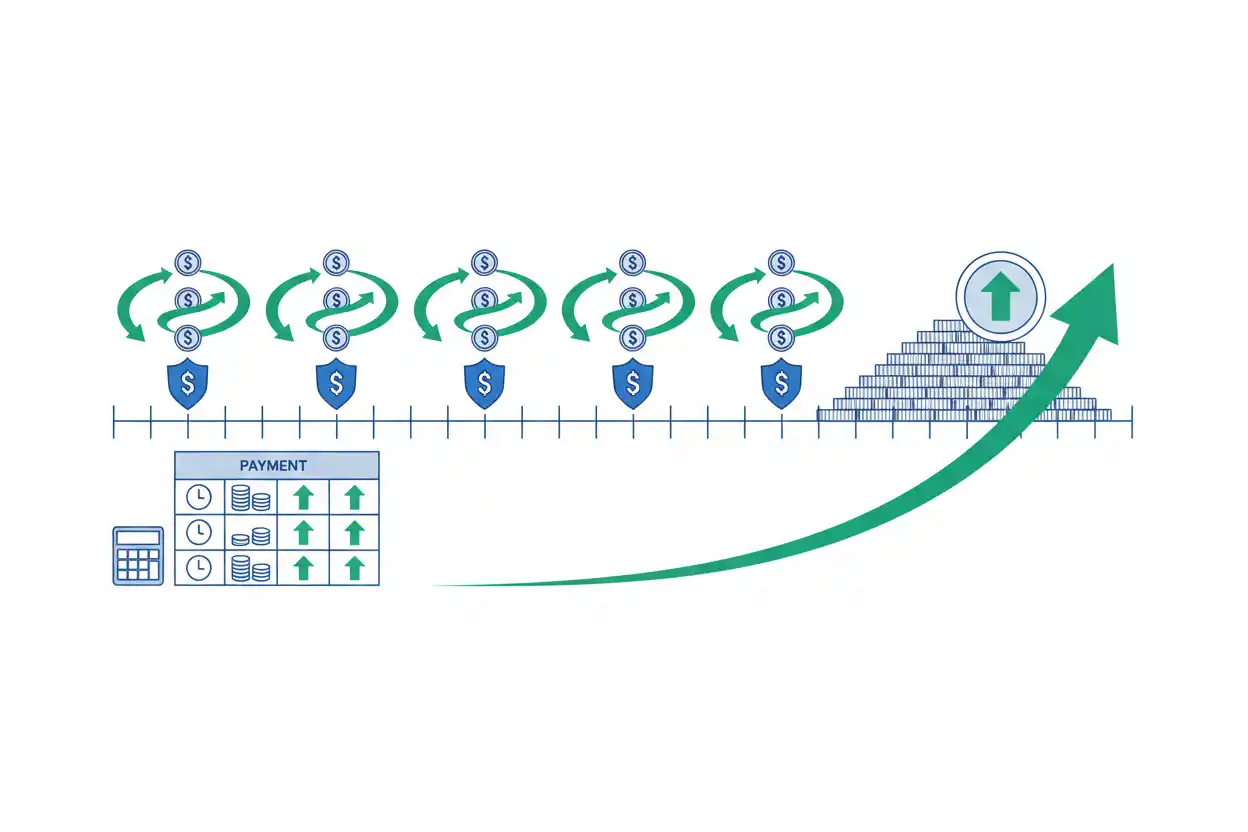

The future value of annuity calculation determines what a series of equal recurring payments could accumulate to after earning an assumed rate of return.
Unlike a standard future-value calculation, which begins with one lump sum, an annuity calculation accounts for multiple payments made at different times.
A contribution made in year one has more time to compound than a contribution made in year ten.
The formula captures that timing difference.
What Is the Future Value of an Annuity?
The future value of an annuity is the accumulated value of a sequence of equal cash flows at a specified future date.
Examples can include:
- annual investment contributions;
- monthly savings deposits;
- retirement contributions;
- recurring reserve contributions.
The calculation depends on whether payments occur at the end or beginning of each period.
Ordinary Annuity Formula
An ordinary annuity assumes payments occur at the end of each period.
FV of Ordinary Annuity = PMT × [(1 + r)^n − 1] ÷ r
Where:
- PMT = equal payment each period;
- r = interest or growth rate per period;
- n = number of payments.
Future Value of Annuity Example
Suppose you invest:
- $5,000 at the end of each year;
- for 10 years;
- at an assumed 6% annual return.
Use:
FV = $5,000 × [(1.06)^10 − 1] ÷ 0.06
Calculate:
1.06¹⁰ ≈ 1.7908477
Subtract 1:
1.7908477 − 1 = 0.7908477
Divide by 0.06:
0.7908477 ÷ 0.06 ≈ 13.180795
Multiply by $5,000:
FV ≈ $5,000 × 13.180795
FV ≈ $65,903.98
The future value is approximately $65,903.98.
How Much Was Actually Contributed?
Total contributions were:
$5,000 × 10 = $50,000
Future value:
$65,903.98
Growth above contributions:
$65,903.98 − $50,000
$15,903.98
Under the assumed 6% return, approximately $15,903.98 of the ending amount comes from compounded growth.
Why Each Contribution Grows Differently
Because deposits occur at the end of each year:
- the first $5,000 contribution compounds for nine years before the ending date;
- the second compounds for eight;
- the final contribution earns no full year’s growth before the measurement point.
The formula adds all those differently timed future values together.
Conceptually:
FV = PMT(1 + r)^(n−1) + PMT(1 + r)^(n−2) + … + PMT
The annuity formula is simply a compact version of this geometric series.
Verify the Example Manually
For the $5,000 annual-contribution example:
First contribution:
$5,000 × 1.06⁹ ≈ $8,447.39
Second:
$5,000 × 1.06⁸ ≈ $7,969.24
Continue through the tenth contribution:
$5,000
Adding all 10 future values produces approximately:
$65,903.98
This verifies the annuity formula.
Monthly Contribution Example
Suppose:
- monthly contribution = $500;
- nominal annual rate = 6%;
- monthly compounding;
- time = 20 years;
- deposits occur at the end of each month.
Monthly rate:
r = 0.06 ÷ 12 = 0.005
Number of payments:
n = 20 × 12 = 240
Then:
FV = $500 × [(1.005)^240 − 1] ÷ 0.005
FV ≈ $231,020
Total contributions:
$500 × 240 = $120,000
The remaining amount represents growth under the assumed rate.
Future Value of Annuity Due
An annuity due assumes payments occur at the beginning of each period.
Because every payment gets one additional period of compounding:
FV of Annuity Due = FV of Ordinary Annuity × (1 + r)
Using the earlier annual example:
Ordinary-annuity FV:
$65,903.98
Multiply by 1.06:
FV Due = $65,903.98 × 1.06
FV Due ≈ $69,858.22
Beginning-of-year contributions accumulate to more because each deposit is invested one year earlier.
Ordinary Annuity vs Annuity Due
Assume:
- contribution = $5,000;
- return = 6%;
- 10 annual deposits.
Ordinary annuity:
≈ $65,903.98
Annuity due:
≈ $69,858.22
Difference:
$69,858.22 − $65,903.98 ≈ $3,954.24
Payment timing creates nearly $4,000 of additional future value in this example.
Future Value of Annuity vs Future Value
The standard future value formula applies to one starting amount.
FV = PV × (1 + r)^n
The future value of annuity formula applies to repeated equal payments.
Using the lump-sum formula for recurring deposits incorrectly assumes every contribution was invested at the starting date.
That overstates growth.
Future Value of Annuity and FIRE
Recurring investing is central to many FIRE accumulation plans.
Suppose someone contributes $30,000 annually for 20 years.
At a hypothetical 6% return:
FV = $30,000 × [(1.06)^20 − 1] ÷ 0.06
FV ≈ $1,103,568
The formula isolates the value created by recurring contributions.
If there is also an existing portfolio, calculate that lump sum separately and then add the two future values.
Combining a Lump Sum and Recurring Contributions
Suppose:
- current portfolio = $100,000;
- annual contribution = $20,000;
- return = 6%;
- period = 15 years.
Future value of existing $100,000:
$100,000 × 1.06¹⁵ ≈ $239,656
Future value of contributions:
$20,000 × [(1.06)¹⁵ − 1] ÷ 0.06
≈ $465,516
Combined:
$239,656 + $465,516 ≈ $705,172
The ending portfolio is approximately $705,172 under these assumptions.
Future Value of Annuity and Expense Ratios
Recurring expense ratios can lower the return that contributions retain.
Suppose the gross return assumption is 7%, but fund expenses reduce the simplified net assumption to 6.5%.
The annuity calculation should use the relevant net growth assumption if the goal is estimating investor wealth after recurring fund costs.
Over decades, even modest changes in r can materially alter the ending value.
Future Value of Annuity and Holding Period Return
Holding period return measures return over a specified investment period.
An annuity future-value calculation focuses instead on the ending value of a series of cash flows.
When multiple deposits occur, evaluating investment performance requires care because a simple beginning-versus-ending return can confuse investment gains with money contributed by the investor.
Future Value of Annuity and Inflation
Inflation affects what the future balance can purchase.
Suppose an annuity calculation produces:
Future Balance = $500,000
That $500,000 is a nominal future amount.
If prices rise substantially before the money is needed, its purchasing power will be lower than $500,000 today.
Long-term planning should therefore keep nominal return and inflation assumptions consistent.
Contribution Needed for a Future Goal
The formula can be rearranged to solve for PMT.
PMT = FV × r ÷ [(1 + r)^n − 1]
Suppose the goal is $100,000 in 10 years at an assumed 5% annual return with end-of-year contributions.
PMT = $100,000 × 0.05 ÷ [(1.05)^10 − 1]
Calculate:
1.05¹⁰ − 1 ≈ 0.628895
Then:
PMT = $5,000 ÷ 0.628895
PMT ≈ $7,950.46
Approximately $7,950 per year would be required under the stated assumptions.
Monthly Contribution Needed
Suppose the goal is $250,000 in 20 years with:
- monthly contributions;
- nominal annual return = 6%;
- monthly rate = 0.005;
- n = 240.
Use:
PMT = FV × r ÷ [(1 + r)^n − 1]
PMT = $250,000 × 0.005 ÷ [(1.005)^240 − 1]
The required monthly contribution is approximately $541 under the assumptions.
What Happens If the Rate Changes?
The standard annuity formula assumes one constant periodic rate.
If returns vary every period, each contribution needs to be compounded through the actual sequence of later returns.
For example, if annual returns are:
- 5%;
- −3%;
- 8%;
- 4%;
there is no single fixed-rate annuity formula that exactly reproduces the path unless an equivalent rate is derived.
The fixed-rate formula is therefore best viewed as a scenario model.
What Happens If Contributions Change?
The standard formula also assumes equal payments.
If deposits are:
- $5,000 in year one;
- $6,000 in year two;
- $8,000 in year three;
calculate each contribution separately:
Future Value of Each Contribution = Contribution × (1 + r)^Remaining Periods
Then add the future values.
This is more accurate than forcing unequal payments into an equal-annuity formula.
Missing Contributions
If a planned payment is skipped, the standard annuity formula no longer exactly describes the actual cash flows.
Suppose $500 was planned monthly, but three contributions were missed.
The actual future value should be calculated from the deposits that were genuinely made.
Automation and budgeting can help maintain consistency, but formulas should reflect real cash flows when measuring actual results.
Future Value Does Not Guarantee Investment Performance
The formula can calculate:
$500 × [(1.005)^240 − 1] ÷ 0.005
exactly.
But the 0.5% monthly return assumption may not occur.
Market returns fluctuate, and losses are possible.
Therefore, annuity future-value models are best used to compare scenarios rather than predict an exact account balance.
Common Future Value of Annuity Mistakes
One common mistake is using the annual rate with monthly payments without dividing by 12.
Another is using years instead of total monthly payment periods.
A third is confusing ordinary annuity and annuity due.
People also sometimes apply the lump-sum future-value formula to the total amount they plan to contribute, incorrectly giving every contribution the full compounding period.
Frequently Asked Questions
What is the future value of an annuity?
It is the accumulated future value of a series of equal recurring payments after applying an assumed growth rate.
What is the ordinary annuity future-value formula?
FV = PMT × [(1 + r)^n − 1] ÷ r
What does PMT mean?
PMT is the equal contribution or payment made each period.
What is an annuity due?
An annuity due has payments at the beginning of each period rather than the end.
What is the annuity-due future-value formula?
FV Due = FV Ordinary × (1 + r)
Why does an annuity due have a higher future value?
Each payment receives one additional compounding period.
Can I use the formula for monthly deposits?
Yes, provided the rate and number of periods are converted to monthly terms consistently.
How do I calculate the contribution needed for a target?
PMT = FV × r ÷ [(1 + r)^n − 1]
for an ordinary annuity.
Does the formula work if contributions change every year?
Not directly. Unequal contributions should be valued separately unless another cash-flow model is used.
Is future value of annuity guaranteed?
No. The calculation is exact for the assumptions, but actual investment returns can differ.
What is the difference between future value and future value of annuity?
Future value handles one lump sum. Future value of annuity handles repeated equal payments.
Why is this calculation useful?
It helps estimate how recurring contributions can accumulate toward long-term goals within the broader Savings & Investing framework.