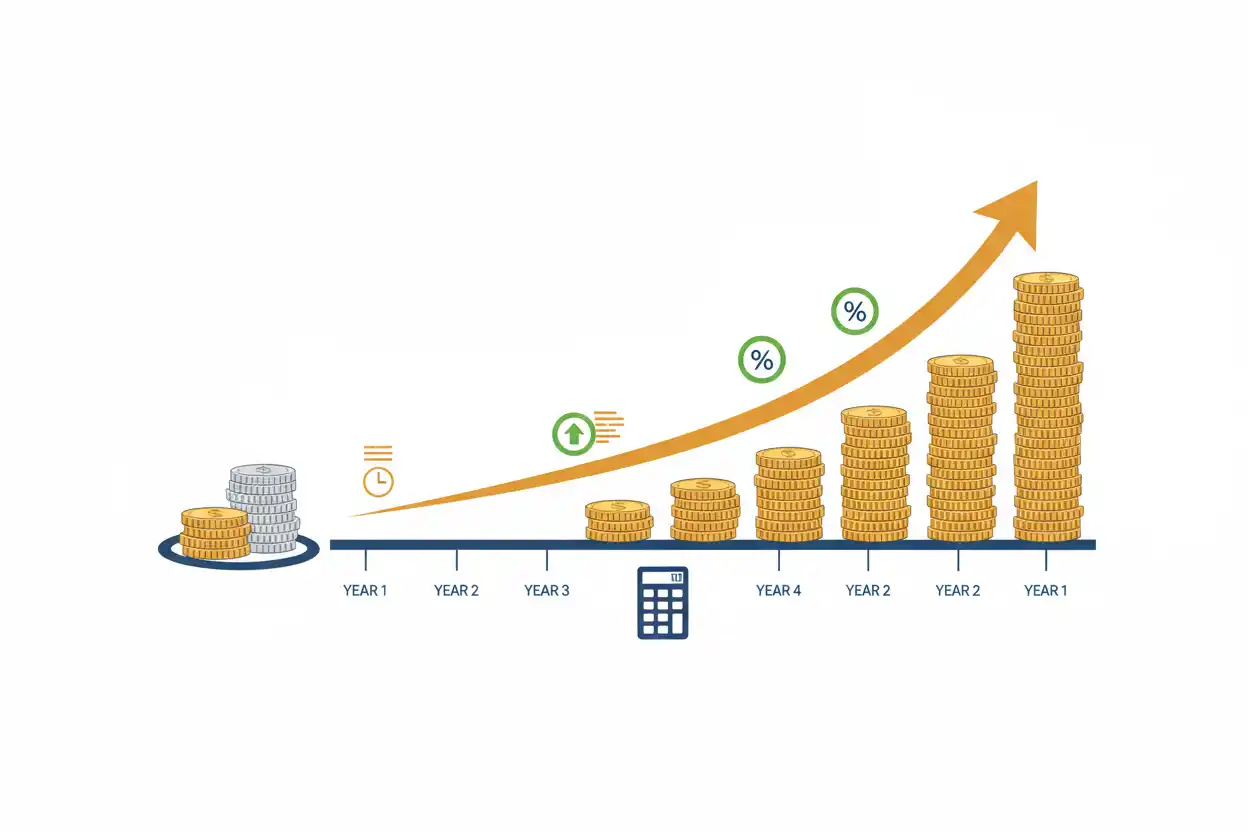

Future value estimates what money today could become at a specified point in the future under an assumed growth rate.
If $10,000 compounds at 6% annually for 10 years, its future value is approximately $17,908.
The formula is foundational in finance because it links four variables:
- present value;
- rate of return;
- compounding frequency;
- time.
Future value can be used for savings, investments, financial goals, and other compound-growth calculations.
What Is Future Value?
Future value, commonly abbreviated FV, is the value that a present amount would reach after growing for a specified number of periods.
The basic logic is:
Money Today × Growth Over Time = Future Money
If an amount earns a positive return, future value is larger than present value.
If the assumed return is negative, future value can be lower.
Future Value Formula
For annual compounding:
FV = PV × (1 + r)^n
Where:
- FV = future value;
- PV = present value;
- r = annual growth rate as a decimal;
- n = number of years.
Future Value Example
Suppose:
- present value = $10,000;
- annual return = 6%;
- time = 10 years.
Use:
FV = $10,000 × (1.06)^10
Calculate the growth factor:
1.06¹⁰ ≈ 1.790848
Then:
FV ≈ $10,000 × 1.790848
FV ≈ $17,908.48
The future value is approximately $17,908.48.
Verify Year by Year
The same result can be built one year at a time.
Year 1:
$10,000 × 1.06 = $10,600
Year 2:
$10,600 × 1.06 = $11,236
Year 3:
$11,236 × 1.06 = $11,910.16
The process continues until year 10.
Each year’s growth is calculated on the previous year’s larger balance.
That is compounding.
Future Value With Monthly Compounding
If interest compounds multiple times per year:
FV = PV × (1 + r ÷ m)^(m × t)
Where:
- m = compounding periods per year;
- t = years.
Suppose:
- PV = $10,000;
- nominal annual rate = 6%;
- monthly compounding;
- time = 10 years.
Then:
FV = $10,000 × (1 + 0.06 ÷ 12)^120
FV = $10,000 × 1.005^120
FV ≈ $18,193.97
Monthly compounding produces a slightly higher future value than annual compounding at the same nominal rate.
How Time Affects Future Value
Time can have a large effect because the growth is exponential.
Using $10,000 at 6% annually:
After 5 years:
$10,000 × 1.06⁵ ≈ $13,382.26
After 10 years:
≈ $17,908.48
After 20 years:
$10,000 × 1.06²⁰ ≈ $32,071.35
After 30 years:
$10,000 × 1.06³⁰ ≈ $57,434.91
The later years add larger dollar amounts because returns apply to a larger base.
How the Rate Affects Future Value
Suppose $20,000 grows for 20 years.
At 3%:
$20,000 × 1.03²⁰ ≈ $36,122
At 6%:
$20,000 × 1.06²⁰ ≈ $64,143
At 9%:
$20,000 × 1.09²⁰ ≈ $112,088
Small differences in annual rates can produce very large differences over long periods.
This is one reason return assumptions should be chosen carefully.
Future Value With a Negative Return
The same formula works with a negative rate as long as the growth factor remains mathematically valid.
Suppose $10,000 declines 5% annually for three years.
FV = $10,000 × (1 − 0.05)^3
FV = $10,000 × 0.95³
FV = $8,573.75
Future value is approximately $8,573.75.
Future Value With Changing Annual Returns
The standard formula assumes a constant rate.
If returns vary, multiply each year’s growth factor separately.
Suppose:
- Year 1 = +10%;
- Year 2 = −5%;
- Year 3 = +8%.
Then:
FV = PV × 1.10 × 0.95 × 1.08
For $10,000:
FV = $10,000 × 1.10 × 0.95 × 1.08
FV = $11,286
The ending value is $11,286.
Future Value vs CAGR
Future value begins with:
- a present value;
- a rate;
- a time period.
CAGR begins with:
- a beginning value;
- an ending value;
- a time period.
The mathematical relationship is closely connected.
Future value asks:
What ending value results from this growth rate?
CAGR asks:
What constant growth rate explains this ending value?
Future Value and FIRE
FIRE planning frequently requires projecting how current investments could grow toward a future target.
Suppose a current $400,000 portfolio needs to reach $1 million.
At a hypothetical 6% return:
Future Value = $400,000 × 1.06^n
Solving for the required time is a separate calculation, but the same future-value relationship defines the growth path.
Future Value and Expense Ratios
Expense ratios can reduce the return retained by an investor.
Suppose gross return is 7% but ongoing fund expenses reduce the simplified net rate to 6.5%.
Future value should then be modeled using the net assumption when estimating what the investor actually retains.
A small annual cost difference can materially affect long-term FV.
Future Value and Expense Ratio
The singular expense ratio calculation can help translate a fund percentage into an annual cost.
For future-value analysis, the relevant question is how the recurring cost affects the growth rate applied to the investment over time.
This keeps the one-year fee formula distinct from the multi-year compounding calculation.
Future Value of Regular Contributions
A single lump sum uses the ordinary future-value formula.
Recurring deposits require a different formula.
If equal deposits are made at the end of each period, use the future value of annuity formula:
FV of Annuity = PMT × [(1 + r)^n − 1] ÷ r
This prevents incorrectly treating all contributions as though they had been invested for the full period.
Future Value and Holding Period Return
Holding period return measures the investment return realized across a particular holding period.
Future value instead calculates an ending amount.
Suppose an investment grows from $10,000 to $12,000 with no distributions.
Future value is $12,000.
Holding-period return is:
($12,000 − $10,000) ÷ $10,000 = 20%
The dollar endpoint and percentage return are related but distinct.
Future Value and Inflation
Future value is usually expressed in nominal dollars unless inflation is explicitly incorporated.
A future $100,000 may not buy what $100,000 buys today.
For long-term goals, investors can either:
- increase future spending targets for inflation; or
- calculate values using real, inflation-adjusted returns.
The assumptions must remain internally consistent.
Solving for Present Value
The future-value formula can be rearranged.
PV = FV ÷ (1 + r)^n
Suppose you want $100,000 in 10 years and assume 5% annual growth.
PV = $100,000 ÷ 1.05¹⁰
PV ≈ $61,391.33
About $61,391 invested today would grow to $100,000 under the stated assumptions.
Solving for the Growth Rate
If present value, future value, and time are known:
r = (FV ÷ PV)^(1/n) − 1
Suppose:
- PV = $50,000;
- FV = $80,000;
- n = 8 years.
r = ($80,000 ÷ $50,000)^(1/8) − 1
r ≈ 6.05%
This is effectively a CAGR calculation.
Solving for Time
The formula can also solve for the number of periods using logarithms:
n = ln(FV ÷ PV) ÷ ln(1 + r)
Suppose:
- PV = $50,000;
- FV = $100,000;
- rate = 7%.
Then:
n = ln(2) ÷ ln(1.07)
n ≈ 10.24 years
At a constant 7% annual return, the amount would approximately double in 10.24 years.
Future Value Is a Scenario, Not a Guarantee
A calculation such as:
$100,000 × 1.08²⁰
is mathematically exact for the assumptions entered.
The uncertainty lies in whether an investment actually earns 8% every year.
Future-value models should therefore be used as scenarios rather than promises.
Common Future Value Mistakes
One mistake is entering 6 instead of 0.06 for a 6% rate.
Another is failing to match rate periods with compounding periods.
A third is using the lump-sum future-value formula for regular contributions.
People can also mistake nominal future dollars for equivalent purchasing power today.
Frequently Asked Questions
What is future value?
Future value is the amount a present sum could become after growing for a specified period at an assumed rate.
What is the future value formula?
For annual compounding:
FV = PV × (1 + r)^n
What does PV mean?
PV means present value—the amount available today.
What does r mean?
r is the growth or interest rate per period expressed as a decimal.
How does compounding frequency affect future value?
At the same nominal annual rate, more frequent compounding generally increases future value slightly.
Can future value be lower than present value?
Yes. Negative returns can produce a lower future value.
Can I use one future-value formula when returns change every year?
No. When rates vary, multiply the individual period growth factors.
Is future value guaranteed?
No. The arithmetic is exact for the assumptions, but future investment returns are uncertain.
What is the difference between future value and CAGR?
Future value calculates an ending amount from a rate. CAGR calculates the rate connecting a beginning and ending amount.
How do I calculate the present amount needed for a future goal?
PV = FV ÷ (1 + r)^n
Does future value include recurring deposits?
The basic lump-sum formula does not. Recurring deposits require an annuity or cash-flow calculation.
Why is future value important?
It helps connect today’s saving and investing decisions with long-term goals within the broader Savings & Investing framework.