
Holding period return measures the total return earned or lost while an investment is held.
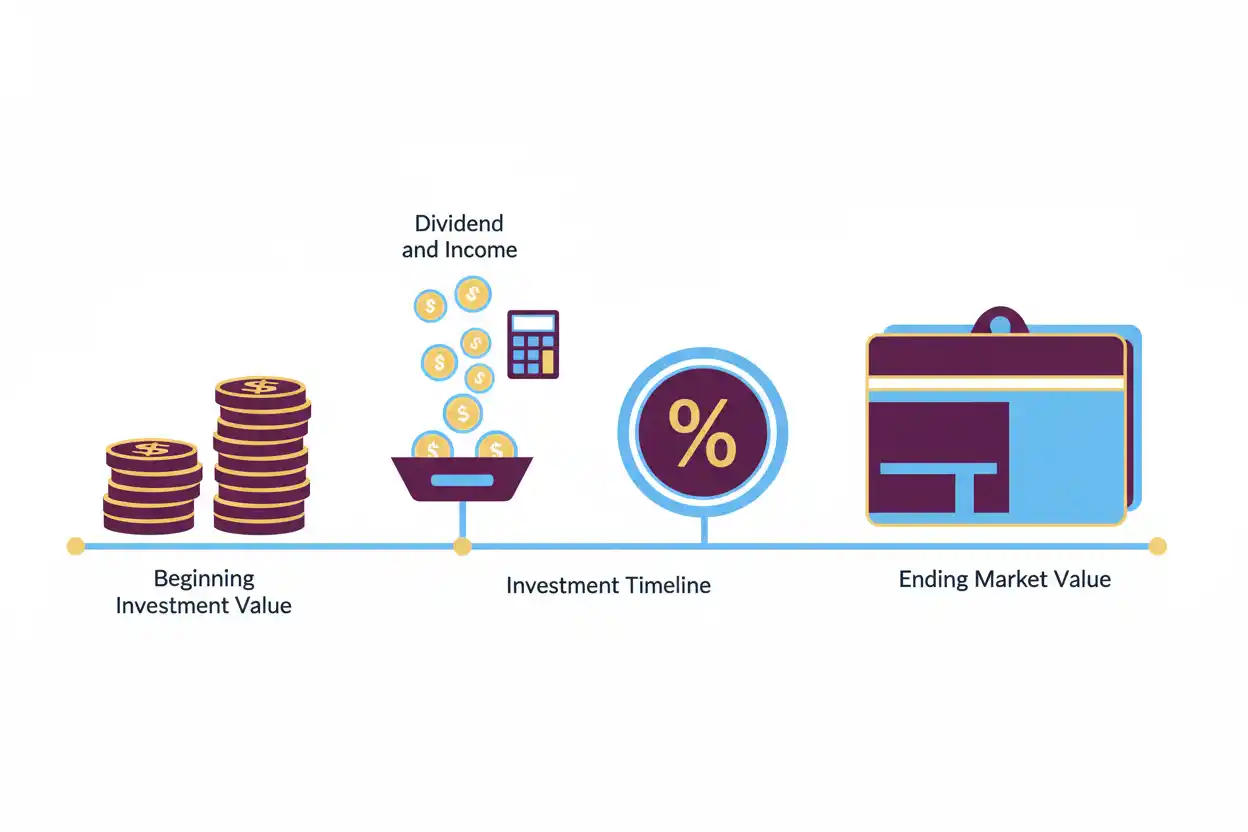
It combines two major sources of investment performance: changes in market value and income received during the holding period.
If an investment rises from $100 to $112 and pays $3 of income, its holding period return is 15%.
The calculation is useful because it captures the entire economic result over the selected period rather than looking only at price appreciation or income.
What Is Holding Period Return?
Holding period return, often abbreviated HPR, measures investment performance between a beginning date and an ending date.
The holding period could be:
- one month;
- six months;
- one year;
- several years;
- any other defined period.
The important point is that HPR measures the return over the whole selected period.
It does not automatically convert the result into an annual rate.
Holding Period Return Formula
The standard formula is:
Holding Period Return = (Ending Value − Beginning Value + Income Received) ÷ Beginning Value
It can also be written as:
HPR = (Ending Value + Income − Beginning Value) ÷ Beginning Value
Where:
- Beginning Value = investment value at the start;
- Ending Value = investment value at the end;
- Income = dividends, interest, or other cash distributions received.
Multiply the decimal result by 100 to express it as a percentage.
Holding Period Return Example
Suppose:
- Beginning investment value = $100
- Ending value = $112
- Income received = $3
Insert the numbers:
HPR = ($112 − $100 + $3) ÷ $100
Calculate the total gain:
$112 − $100 + $3 = $15
Then:
HPR = $15 ÷ $100
HPR = 0.15
Convert to a percentage:
Holding Period Return = 15%
The investment produced a 15% total return over the selected holding period.
Price Return vs Holding Period Return
Suppose the same investment rises from $100 to $112.
The price return is:
Price Return = ($112 − $100) ÷ $100
Price Return = 12%
But the investment also paid $3 of income.
Including that income produces:
Holding Period Return = 15%
Therefore, ignoring distributions understates total performance in this example.
Holding Period Loss Example
HPR can also be negative.
Suppose:
- Beginning value = $200
- Ending value = $175
- Dividend income = $5
Then:
HPR = ($175 − $200 + $5) ÷ $200
HPR = −$20 ÷ $200
HPR = −10%
The investment lost 10% over the holding period despite paying a dividend.
Income reduced the loss but did not eliminate it.
Holding Period Return With No Income
If there are no dividends, interest payments, or other distributions:
HPR = (Ending Value − Beginning Value) ÷ Beginning Value
Suppose an investment increases from $8,000 to $9,000.
HPR = ($9,000 − $8,000) ÷ $8,000
HPR = $1,000 ÷ $8,000
HPR = 12.5%
The holding period return is 12.5%.
Holding Period Return for a Bond
Suppose a bond is purchased for $950.
During the year:
- coupon income = $60;
- ending market price = $970.
Then:
HPR = ($970 − $950 + $60) ÷ $950
HPR = $80 ÷ $950
HPR ≈ 8.42%
The result includes both:
- $60 of coupon income;
- $20 of price appreciation.
This shows why holding period return answers a broader question than a yield metric alone.
HPR vs Current Yield
Current yield measures annual coupon income relative to current bond price.
Holding period return includes both income and price movement.
For example, a bond can begin with a 6% current yield yet produce a significantly different HPR if its market value rises or falls during the year.
The return actually experienced across the holding period therefore depends on more than current income.
HPR and Future Value
Future value works in the opposite direction.
Future value starts with:
- a present amount;
- an assumed rate;
- a number of periods;
and calculates an ending amount.
Holding period return starts with beginning and ending values and calculates the return connecting them.
For a $10,000 investment ending at $11,500 with no distributions:
HPR = ($11,500 − $10,000) ÷ $10,000 = 15%
Future value would instead use the 15% rate to reproduce the ending amount:
$10,000 × 1.15 = $11,500
HPR and Future Value of Annuity
The future value of annuity handles recurring contributions.
That distinction matters because ordinary HPR becomes harder to interpret when substantial external deposits or withdrawals occur during the measurement period.
Suppose an account begins at $10,000 and ends at $20,000, but the investor deposited another $8,000 halfway through the year.
A naive calculation would suggest:
($20,000 − $10,000) ÷ $10,000 = 100%
That clearly overstates investment performance because much of the increase came from the investor’s own contribution.
HPR With Additional Contributions
When external cash flows occur, the timing of those cash flows must be considered.
For simple cases, adjustments can separate contributed capital from investment growth.
For more complex cash-flow patterns, time-weighted or money-weighted methods may provide more meaningful performance measures.
Holding period return is cleanest when:
- there are no external cash flows; or
- cash flows can be explicitly incorporated without distorting the denominator.
Annualizing Holding Period Return
A return covering several years can be converted to an annualized compounded rate.
Annualized Return = (1 + HPR)^(1 ÷ Years) − 1
Suppose an investment earns a 15% total HPR over two years.
Annualized Return = 1.15^(1 ÷ 2) − 1
Annualized Return ≈ 7.24%
A 15% two-year holding period return therefore corresponds to approximately 7.24% per year compounded.
It would be incorrect simply to divide 15% by two and call 7.5% the compounded annual return.
Annualizing a Six-Month Return
Suppose an investment earns 5% in six months.
Six months equals 0.5 years.
Annualized Return = 1.05^(1 ÷ 0.5) − 1
Annualized Return = 1.05² − 1
Annualized Return = 10.25%
This does not mean the investor actually earned 10.25%.
The actual six-month HPR remains 5%.
The annualized number shows the equivalent annual rate if the same six-month growth pattern repeated.
HPR Across Multiple Periods
If returns are known for several consecutive periods, compound them.
Suppose:
- Year 1 HPR = 10%
- Year 2 HPR = −5%
- Year 3 HPR = 8%
The cumulative growth factor is:
1.10 × 0.95 × 1.08 = 1.1286
Therefore:
Cumulative HPR = 1.1286 − 1
Cumulative HPR = 12.86%
The total three-year return is 12.86%.
Simply adding:
10% − 5% + 8% = 13%
would not capture compounding exactly.
Holding Period Return and Inflation
A positive nominal return does not guarantee an increase in purchasing power.
Inflation can reduce the real value of investment gains.
Suppose:
- nominal HPR = 8%;
- inflation over the same period = 3%.
An approximate real return is:
8% − 3% = 5%
A more precise calculation is:
Real Return = (1 + Nominal Return) ÷ (1 + Inflation Rate) − 1
Real Return = 1.08 ÷ 1.03 − 1
Real Return ≈ 4.85%
The investment’s purchasing-power gain is approximately 4.85%.
HPR and Investment Growth
Investment growth looks more broadly at how principal, contributions, returns, and compounding can increase portfolio value over time.
HPR is narrower.
It measures the return experienced over one defined holding interval.
A portfolio can show strong long-term growth because of both investment returns and ongoing contributions, while HPR attempts to isolate performance for the selected holding period.
HPR and FIRE
Long-term FIRE planning often uses assumed future investment returns to model portfolio accumulation.
Holding period return is primarily backward-looking when calculated from actual beginning and ending values.
Historical HPR can inform analysis, but it should not be treated as a guaranteed future return assumption.
HPR With Reinvested Income
If distributions are reinvested, performance calculations need to avoid double counting.
Suppose the ending market value already includes additional shares purchased with dividends.
Adding those same dividends again as separate income could overstate performance.
The methodology should clearly specify whether:
- distributions are included separately; or
- ending value already reflects reinvested distributions.
Consistency matters more than the particular reporting convention.
Holding Period Return Does Not Measure Risk
Two investments can each earn a 12% HPR while experiencing very different paths.
Investment A might rise steadily.
Investment B might fall 40% before recovering sharply.
Their final HPR can be identical even though the investor experience and risk were very different.
Measures such as volatility and drawdown are needed to evaluate those differences.
Common Holding Period Return Mistakes
A common mistake is ignoring dividends or interest income.
Another is treating contributions as investment gains.
Investors can also annualize short holding periods as though the annualized rate were actually earned.
Finally, simply adding returns across multiple periods can produce a different result from compounding them.
Frequently Asked Questions
What is holding period return?
Holding period return measures the total investment gain or loss, including income, over a specified period.
What is the holding period return formula?
HPR = (Ending Value − Beginning Value + Income) ÷ Beginning Value
Does HPR include dividends?
Yes, when dividends or other distributions are received during the measurement period and are not already incorporated elsewhere in the calculation.
Can holding period return be negative?
Yes. If price losses exceed income and gains, HPR is negative.
Is HPR the same as annual return?
Only when the holding period is exactly one year. Other holding periods need annualization if an annual equivalent is required.
How do you annualize HPR?
Annualized Return = (1 + HPR)^(1 ÷ Years) − 1
Do I include deposits in HPR?
External contributions should not be treated as investment gains. Complex cash flows generally require a more appropriate performance methodology.
Is holding period return the same as yield?
No. Yield generally measures a specific income or cash-flow relationship, while HPR can include both income and price changes.
Does HPR account for inflation?
The standard HPR is nominal. A real return calculation can adjust the result for inflation.
Can I add yearly holding period returns together?
Not exactly. Consecutive returns should generally be compounded using growth factors.
Does a high HPR mean low risk?
No. HPR measures outcome, not the volatility or drawdowns experienced along the way.
Why is holding period return useful?
It provides a concise measure of total performance across a defined interval within a broader Savings & Investing analysis.