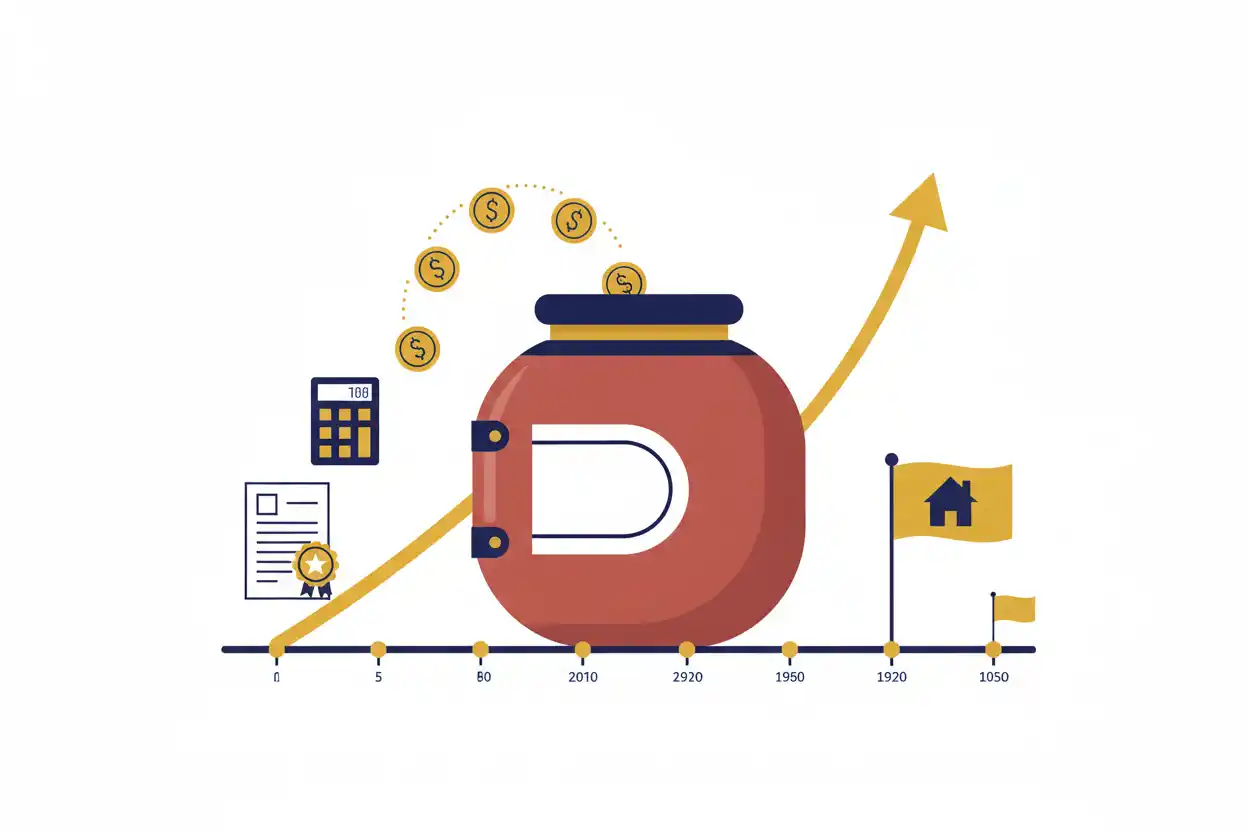

An IRA, or Individual Retirement Arrangement, is a U.S. tax-advantaged account used for retirement saving.
An IRA is not itself an investment. It is an account structure that can hold investments.
The future value of an IRA therefore depends on how much is contributed, how long the money remains invested, the performance and costs of the investments held, withdrawals, and the applicable tax rules.
Traditional and Roth IRAs use different tax structures, so two accounts with identical investment performance can produce different after-tax outcomes.
What Is an IRA?
IRA stands for Individual Retirement Arrangement.
Individuals with qualifying compensation can use IRAs to save for retirement subject to federal tax rules, annual contribution limits, eligibility requirements, and other restrictions.
Two widely used types are:
- Traditional IRA;
- Roth IRA.
Both can hold investments, but their tax treatment differs.
Annual contribution limits and income-related rules can change, so an IRA plan should use the limits applicable to the relevant tax year.
Traditional IRA Basics
A Traditional IRA generally uses a tax-deferred structure.
Depending on income, filing circumstances, and workplace retirement-plan coverage, a contribution may be deductible.
Investment growth inside the account is generally not taxed annually in the same way as ordinary taxable investment income.
Distributions from Traditional IRAs are generally subject to income-tax rules when withdrawn, although the precise treatment depends on factors such as deductible and nondeductible contributions.
The important planning principle is:
a Traditional IRA can shift taxation from the contribution or accumulation period toward the distribution period.
Roth IRA Basics
Roth IRA contributions are generally made with after-tax money rather than producing a current federal income-tax deduction.
When applicable requirements are satisfied, qualified Roth IRA distributions can generally be received tax-free under U.S. federal rules.
This creates a different timing structure:
Traditional IRA: potential tax benefit earlier, taxation generally later.
Roth IRA: no current deduction for the contribution, but potentially tax-free qualified distributions later.
Which structure is more advantageous depends partly on future and current tax circumstances.
IRA Contribution Limits
IRAs are subject to annual contribution limits.
The Traditional and Roth IRA contribution limit is generally shared rather than providing a full separate limit for each account type.
For example, if the applicable annual IRA contribution limit were $X and an individual contributed part of that amount to a Traditional IRA, only the remaining allowable amount could generally be contributed to a Roth IRA for the same year, assuming eligibility.
Current limits and income phaseouts should always be checked for the tax year being planned because these thresholds can change.
IRA Growth Formula
Investment growth inside an IRA can be modeled using the same compound-growth mathematics as other investments.
For one starting balance:
Future IRA Value = Current IRA Balance × (1 + Return)^Years
Suppose:
- current IRA balance = $50,000;
- hypothetical annual return = 7%;
- time = 20 years.
Then:
Future Value = $50,000 × 1.07²⁰
Future Value ≈ $193,484
The account grows to approximately $193,484 under the constant-return assumption.
The IRA tax structure does not create the 7% return. The underlying investments do.
IRA Growth With Annual Contributions
Suppose an investor contributes $6,000 at the end of each year for 30 years and earns a hypothetical 7% annual return.
FV of Contributions = PMT × [(1 + r)^n − 1] ÷ r
Then:
FV = $6,000 × [(1.07)^30 − 1] ÷ 0.07
FV ≈ $566,764.72
Total contributions:
$6,000 × 30 = $180,000
Estimated investment growth:
$566,764.72 − $180,000
≈ $386,764.72
Under these assumptions, investment growth becomes substantially larger than total contributions because early contributions have decades to compound.
The $6,000 figure here is purely an illustration and is not intended to represent the contribution limit for any specific tax year.
Adding an Existing IRA Balance
Suppose:
- current balance = $100,000;
- annual contribution = $6,000;
- return assumption = 7%;
- period = 20 years.
First calculate growth of the existing balance:
$100,000 × 1.07²⁰ ≈ $386,968
Then calculate recurring contributions:
$6,000 × [(1.07)²⁰ − 1] ÷ 0.07 ≈ $245,973
Combined projected value:
$386,968 + $245,973 ≈ $632,941
The account reaches approximately $632,941 under the hypothetical assumptions.
IRA Growth and Investment Growth
The broader investment growth calculation helps separate contributions from returns.
That distinction is particularly useful in retirement accounts.
If an IRA increases from $100,000 to $150,000 but $25,000 of new contributions or transfers were added, it would be incorrect to assume the investments generated the entire $50,000 increase.
Account growth and investment return are not automatically the same measurement.
IRA and Inflation
A retirement balance needs to be interpreted alongside inflation.
Suppose an IRA reaches $1 million in 30 years.
That $1 million will not necessarily have the purchasing power that $1 million has today.
At a hypothetical 3% annual inflation rate:
Today’s Purchasing-Power Equivalent = $1,000,000 ÷ 1.03³⁰
≈ $411,987
The example illustrates why retirement plans should distinguish nominal balances from real purchasing power.
IRA and Holding Period Return
Holding period return can measure the performance of investments held within an IRA over a specified period.
However, recurring contributions and withdrawals complicate simple account-level return calculations.
If account value increases because the owner added cash, that contribution should not be mistaken for investment performance.
IRA and Lump Sum vs SIP
The lump sum vs SIP question can arise when someone has retirement money available to invest.
For example, an individual might receive a contribution or rollover amount and decide whether to invest available cash immediately or phase it into the market over time.
The IRA determines the account’s tax framework.
The investment-timing decision determines when the money receives market exposure.
Those are separate choices.
IRA and Lump-Sum Investing
Lump-sum investing puts available capital into the selected investments at one time.
Inside an IRA, this might occur after:
- making a contribution;
- completing a rollover;
- receiving cash from an investment sale.
Leaving money in IRA cash is not the same as investing it.
An investor can fully fund an IRA yet leave the contribution uninvested if no investment purchase is made.
Traditional vs Roth: Simplified Tax Example
Consider two hypothetical accounts with identical investments.
Suppose each eventually contains $500,000.
The account balances are numerically identical.
But their spendable after-tax values may differ depending on:
- contribution history;
- whether Traditional contributions were deductible;
- Roth qualification requirements;
- future tax rates;
- withdrawal timing;
- applicable tax law.
Therefore, comparing account balances without considering future taxation can provide an incomplete picture.
Tax Diversification
Some retirement savers use both pre-tax or tax-deferred accounts and Roth-style accounts.
The goal may be to create flexibility in retirement by having assets with different tax treatments.
This concept is sometimes called tax diversification.
It does not guarantee lower lifetime taxes, because future tax rates and personal circumstances are uncertain.
IRA Investment Choices Matter
An IRA can potentially hold different kinds of permitted investments depending on the custodian and applicable rules.
The account’s long-term outcome therefore depends heavily on asset allocation and investment selection.
A conservative portfolio and an equity-heavy portfolio can have very different:
- expected returns;
- volatility;
- drawdowns;
- income characteristics.
The acronym IRA tells you the account structure—not the portfolio risk level.
IRA Fees Matter
Account fees and investment expenses reduce the amount available to compound.
Suppose a portfolio earns 7% before costs but retains only 6.5% after recurring expenses.
On $100,000 over 30 years:
At 7%:
$100,000 × 1.07³⁰ ≈ $761,226
At 6.5%:
$100,000 × 1.065³⁰ ≈ $661,437
Difference:
≈ $99,789
This simplified example shows why seemingly small recurring costs can become significant over decades.
IRA Withdrawals
IRA withdrawals can have tax consequences and, depending on circumstances, additional federal tax rules can apply.
Traditional and Roth accounts differ in how distributions are treated.
A withdrawal also reduces the amount remaining to compound.
Suppose $20,000 is removed from an account 15 years before retirement.
At a hypothetical 7% annual return, that $20,000 could otherwise have grown to:
$20,000 × 1.07¹⁵
≈ $55,181
The long-term economic effect can therefore exceed the amount withdrawn.
Required Distributions and Account Type
Traditional IRAs and Roth IRAs do not have identical lifetime distribution rules for the original account owner.
Rules concerning required distributions, inherited accounts, and qualified withdrawals can also change through legislation.
For long-term retirement planning, current IRS rules should be checked rather than relying on an old age threshold or inherited-account rule remembered from a previous tax year.
IRA Rollovers
A rollover generally moves retirement assets from one eligible retirement arrangement to another under applicable tax rules.
A rollover is not the same as a new annual IRA contribution.
This distinction matters because contribution limits and rollover rules operate differently.
Investors should also distinguish:
- account transfer;
- rollover;
- contribution;
- withdrawal.
Using those terms interchangeably can cause tax and recordkeeping problems.
IRA Beneficiaries
Beneficiary designations can affect what happens to an IRA after the owner’s death.
Inherited IRA rules can differ based on:
- beneficiary type;
- relationship to the owner;
- account type;
- timing;
- applicable law.
Estate-planning considerations therefore form a separate layer beyond ordinary IRA growth calculations.
IRA Growth Is Not Guaranteed
Tax advantages can improve the efficiency of long-term saving, but they cannot guarantee investment results.
An IRA invested in volatile assets can lose value.
A poorly diversified portfolio remains poorly diversified simply because it is inside a retirement account.
The account structure and the investment strategy should be evaluated separately.
Common IRA Mistakes
One mistake is assuming an IRA itself is an investment.
Another is using outdated contribution limits or income thresholds.
People can also contribute money to the account but forget to invest it.
Other errors include confusing rollovers with annual contributions or comparing Traditional and Roth balances without considering their different tax treatment.
Frequently Asked Questions
What does IRA stand for?
IRA stands for Individual Retirement Arrangement under U.S. federal tax terminology.
Is an IRA an investment?
No. It is an account structure that can hold investments.
What is the difference between Traditional and Roth IRAs?
Traditional and Roth IRAs use different tax timing. Traditional contributions may be deductible depending on circumstances, while qualified Roth distributions can generally receive tax-free federal treatment.
Does an IRA guarantee investment growth?
No. Returns depend on the investments held inside the account.
How do you project IRA growth?
A lump sum can be modeled with:
Future Value = Present Balance × (1 + Return)^Years
Recurring contributions require an annuity or cash-flow formula.
Can IRA contribution limits change?
Yes. Annual contribution limits and income-related thresholds can change, so current tax-year rules should be checked.
Can I contribute to both a Traditional and Roth IRA?
Potentially, but the annual IRA contribution limit is generally shared across Traditional and Roth IRA contributions and eligibility rules apply.
Does participating in a workplace plan automatically prevent IRA contributions?
Not necessarily. Workplace-plan coverage can affect Traditional IRA deduction rules, while other eligibility and income rules can also matter.
Can an IRA hold cash?
Yes, depending on the account arrangement, but cash held inside an IRA is not automatically invested in securities.
Why does inflation matter for IRA planning?
A future retirement balance must be evaluated by the purchasing power it can support, not only its nominal dollar amount.
Are IRA withdrawals always tax-free?
No. Tax treatment depends on account type, contribution history, distribution circumstances, and applicable tax rules.
Where does an IRA fit in financial planning?
It can serve as one retirement-saving account within a broader Savings & Investing strategy that also considers liquidity, asset allocation, taxes, and long-term spending needs.