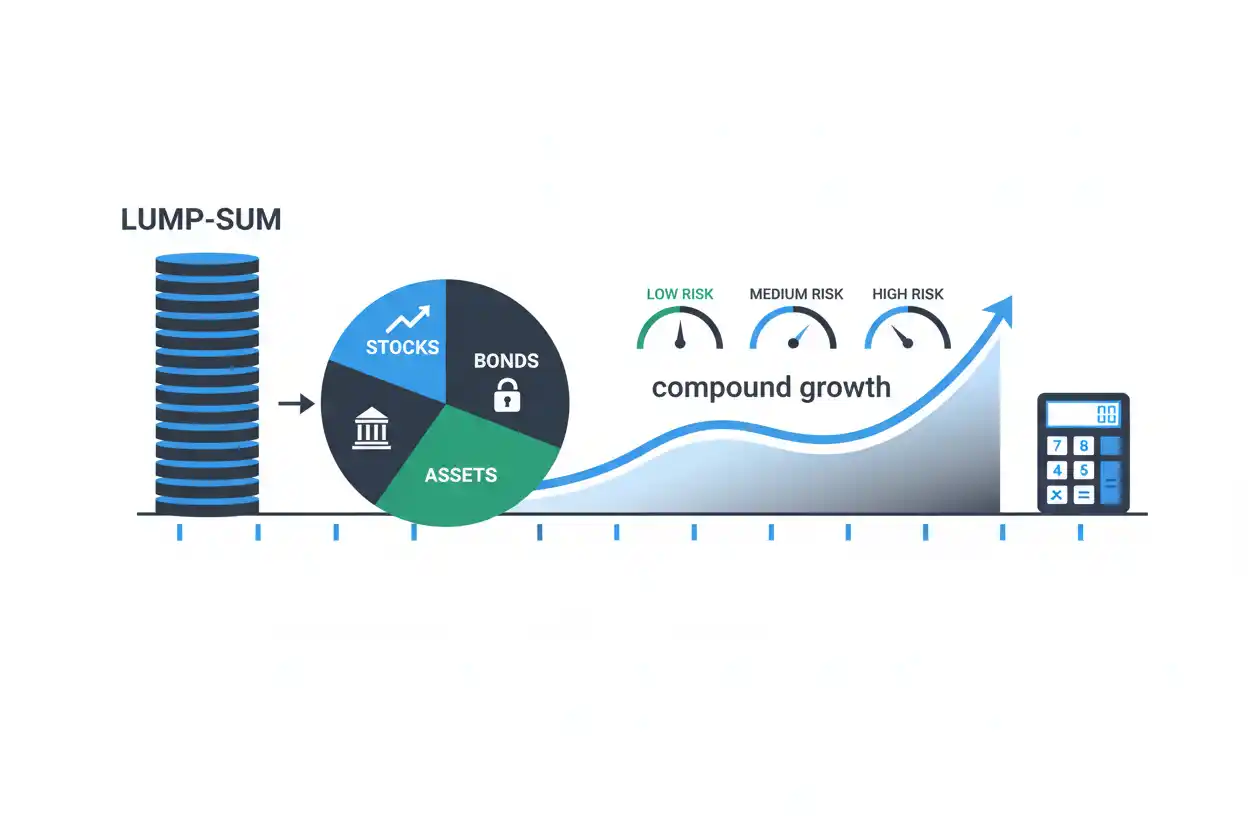
Lump-sum investing means investing an available amount of money at one time rather than deliberately spreading the investment across multiple future dates.
If $50,000 is available today and the full $50,000 is invested immediately, that is lump-sum investing.
The central advantage is time: the entire amount begins participating in investment gains or losses immediately. If the investment produces positive returns over the period, earlier market exposure gives more capital more time to compound.
The tradeoff is equally important. If markets fall shortly after the investment is made, the entire amount participates in that decline.
What Is Lump-Sum Investing?
Lump-sum investing describes investment timing, not a specific investment product.
A lump sum could be invested in:
- a diversified stock fund;
- bonds;
- a multi-asset portfolio;
- one stock;
- another eligible investment.
The defining characteristic is that the available capital is invested at once.
For example:
Available Capital = $50,000
Amount Invested Immediately = $50,000
There is no requirement to wait for a series of monthly or quarterly investment dates.
Lump-Sum Investing Formula
If a lump sum earns a constant compounded return, its future value can be modeled as:
Future Value = Initial Investment × (1 + Return)^Years
Where:
- Initial Investment = amount invested at the beginning;
- Return = assumed return per year;
- Years = investment period.
This formula calculates a scenario. Market returns are not actually guaranteed to remain constant.
Lump-Sum Investing Example
Suppose:
- lump sum = $50,000;
- hypothetical annual return = 7%;
- investment period = 15 years.
Use:
Future Value = $50,000 × 1.07¹⁵
Calculate the growth factor:
1.07¹⁵ ≈ 2.7590315
Then:
Future Value ≈ $50,000 × 2.7590315
Future Value ≈ $137,951.58
Under these assumptions, the $50,000 investment grows to approximately $137,951.58.
Calculate the Investment Growth
The amount contributed was $50,000.
Ending value:
$137,951.58
Investment growth:
Investment Growth = Ending Value − Initial Investment
Investment Growth = $137,951.58 − $50,000
Investment Growth = $87,951.58
Approximately $87,951.58 represents modeled growth above the original investment.
The broader mechanics of contributions and compounding are covered separately under investment growth.
Why Investing Earlier Can Matter
Suppose the same $50,000 is available today, but the investor waits one year before investing it.
If the money then receives only 14 years of 7% growth:
Future Value = $50,000 × 1.07¹⁴
Future Value ≈ $128,926.71
Investing immediately for 15 years produced:
$137,951.58
Waiting one year produced:
$128,926.71
Difference:
$137,951.58 − $128,926.71 = $9,024.87
Under the smooth 7% assumption, one additional year invested adds approximately $9,024.87 to the ending value.
This illustrates the opportunity cost of waiting when returns are positive.
But Markets Do Not Rise Smoothly
The constant-return example is useful for understanding compounding, but actual markets can fall immediately after a lump sum is invested.
Suppose $50,000 is invested and the market declines 25%.
Portfolio Value = $50,000 × 0.75
Portfolio Value = $37,500
The investor experiences a $12,500 decline.
This is the key short-term risk of investing all available capital at one entry point.
Recovery After a Loss
Losses and recoveries are mathematically asymmetric.
If $50,000 falls 25%:
$50,000 × 0.75 = $37,500
To return from $37,500 to $50,000:
Required Gain = ($50,000 − $37,500) ÷ $37,500
Required Gain = $12,500 ÷ $37,500
Required Gain ≈ 33.33%
A 25% decline therefore requires a 33.33% gain to recover.
This is one reason maximum drawdown matters when evaluating the risk of committing substantial capital at once.
Lump-Sum Investing vs Phased Investing
The workbook’s separate lump sum vs SIP comparison addresses which approach can perform better under different market paths.
The distinction for this page is simpler:
Lump-sum investing: invest available capital now.
Phased investing: intentionally keep part of available capital outside the chosen investment until later dates.
If future returns are strongly positive from the start, lump-sum investing benefits from greater time invested.
If prices decline shortly after the starting date, phased investing can purchase some later units at lower prices.
Neither outcome can be known in advance.
Lump Sum Is Different From Regular Saving
Suppose someone earns $1,000 each month and invests that money when it becomes available.
That is not necessarily a deliberate alternative to lump-sum investing.
The investor cannot invest all 12 future monthly contributions today because the money does not yet exist.
A true lump-sum-versus-phased-investing decision generally arises when the full capital is already available.
Examples can include:
- proceeds from an asset sale;
- inheritance;
- cash accumulated over time;
- a bonus;
- retirement rollover proceeds.
Lump-Sum Investing Inside an IRA
An IRA can hold investments, but contributing or transferring money into an IRA does not automatically invest it.
Suppose $20,000 of rollover cash reaches an IRA.
The investor could:
- invest the available cash at once;
- deliberately phase investment purchases over time;
- maintain some cash allocation.
The IRA determines the account structure. Lump-sum investing determines when the available money receives investment exposure.
Lump Sum and Compounding
The primary mathematical argument for early investment is compounding.
Consider $50,000 at 7%.
After 10 years:
$50,000 × 1.07¹⁰ ≈ $98,357.57
After 20 years:
$50,000 × 1.07²⁰ ≈ $193,484.22
The second decade adds:
$193,484.22 − $98,357.57 = $95,126.65
That second-decade growth is almost as large as the entire value after the first decade because returns are being generated on an increasingly large balance.
Entry Price Matters in the Short Term
Suppose an investor buys 500 units at $100 each.
Investment = 500 × $100 = $50,000
If the price falls to $80:
Value = 500 × $80 = $40,000
If another investor waits and invests $50,000 at $80:
Units = $50,000 ÷ $80
Units = 625
The second investor obtains 125 more units.
But if the price instead rises from $100 to $120 while the second investor waits, the delayed investor buys:
$50,000 ÷ $120 ≈ 416.67 units
Waiting helps only when later investment prices are favorable relative to the initial price.
Time in the Market vs Timing the Market
Lump-sum investing emphasizes maximizing the amount of time capital participates in expected investment returns.
Market timing attempts to improve results by waiting for a supposedly superior entry point.
The problem is that a successful timing decision usually requires two correct judgments:
- when not to invest;
- when to enter later.
An investor can correctly anticipate volatility yet still miss a rapid recovery.
Behavioral Risk
The mathematically optimal strategy is not useful if an investor cannot tolerate its volatility.
Suppose someone invests $200,000 and immediately sees a 30% decline.
Loss = $200,000 × 30%
Loss = $60,000
Remaining value:
$140,000
If that decline causes the investor to abandon the long-term strategy and sell, behavior can dominate the theoretical benefit of earlier investment.
Risk capacity and emotional tolerance therefore matter alongside expected return.
Diversification Still Matters
Investing a lump sum does not require concentrating the money in one security.
The amount can be distributed across an appropriate portfolio.
For example:
$100,000 Total
could theoretically be allocated among several asset classes according to a chosen strategy.
Timing and diversification answer different questions:
Timing: When does the money enter?
Diversification: What exposures does the money receive?
Lump Sum and Modified Duration
If a lump sum is invested in fixed-income securities, modified duration can help estimate sensitivity to changes in yield.
A bond portfolio with substantial duration can decline when market yields rise even though the investor used a lump-sum strategy.
Lump-sum investing does not remove the underlying risks of the asset purchased.
Holding Cash Has Its Own Risk
Delaying investment may reduce immediate market exposure, but cash has other risks.
These can include:
- inflation;
- low real return;
- opportunity cost;
- reinvestment uncertainty.
The relevant comparison is therefore not always “risky investment versus no risk.”
It is often one set of risks versus another.
When Lump-Sum Investing Can Be Reasonable
Lump-sum investing can be consistent with a plan when:
- the money is already available;
- the investment horizon is long;
- the portfolio is appropriately diversified;
- the investor can tolerate market declines;
- near-term liquidity needs have already been addressed.
Those conditions do not guarantee a positive outcome.
They simply make the strategy more aligned with a long-term investment objective.
When Phasing May Be More Practical
An investor may deliberately phase available capital when:
- a large immediate loss would cause unacceptable financial or behavioral stress;
- the investment plan explicitly calls for staged deployment;
- near-term liquidity remains uncertain;
- the portfolio allocation itself is still being adjusted.
The choice should be intentional rather than based on the belief that gradual investing guarantees protection.
Lump-Sum Investing Does Not Guarantee Higher Returns
Even if an investment has a positive long-term expected return, the realized result over a particular period can be negative.
For example:
Starting Value = $50,000
Ending Value = $42,000
Holding-period return:
($42,000 − $50,000) ÷ $50,000 = −16%
The fact that the capital was invested earlier did not prevent the loss.
Common Lump-Sum Investing Mistakes
One mistake is investing money needed for near-term expenses simply to maximize market exposure.
Another is confusing lump-sum investing with concentration in one asset.
Investors may also delay indefinitely while waiting for an ideal market level that never arrives.
Finally, using a smooth historical return assumption can create false confidence about the actual path the investment will experience.
Frequently Asked Questions
What is lump-sum investing?
Lump-sum investing means investing an available amount of capital at one time rather than deliberately spreading purchases over future dates.
What is the lump-sum growth formula?
Future Value = Initial Investment × (1 + Return)^Years
Why can lump-sum investing outperform phased investing?
When markets rise after the starting date, more capital receives more time to participate in those gains.
Can lump-sum investing lose money?
Yes. The entire investment is exposed to market declines from the beginning.
Does lump-sum investing mean buying one stock?
No. A lump sum can be invested in a diversified portfolio.
Is investing monthly from salary the opposite of lump-sum investing?
Not necessarily. If the future money is not available today, there is no existing lump sum to invest.
Does a market decline after investing mean the strategy was wrong?
Not automatically. The appropriate judgment depends on investment horizon, portfolio construction, risk, and whether the original plan remains valid.
What is the biggest risk of a lump sum?
One major risk is committing all available capital immediately before a substantial market decline.
Does lump-sum investing eliminate timing risk?
No. It selects one immediate entry point rather than spreading entry points across time.
Does waiting in cash eliminate risk?
No. Cash can face inflation and opportunity-cost risk.
Can lump-sum investing be used in an IRA?
Yes. Available IRA cash can potentially be invested at once, subject to the investments and account arrangements chosen.
How should lump-sum investing fit into a portfolio?
It should be considered within the broader Savings & Investing strategy, including diversification, liquidity, risk capacity, and time horizon.