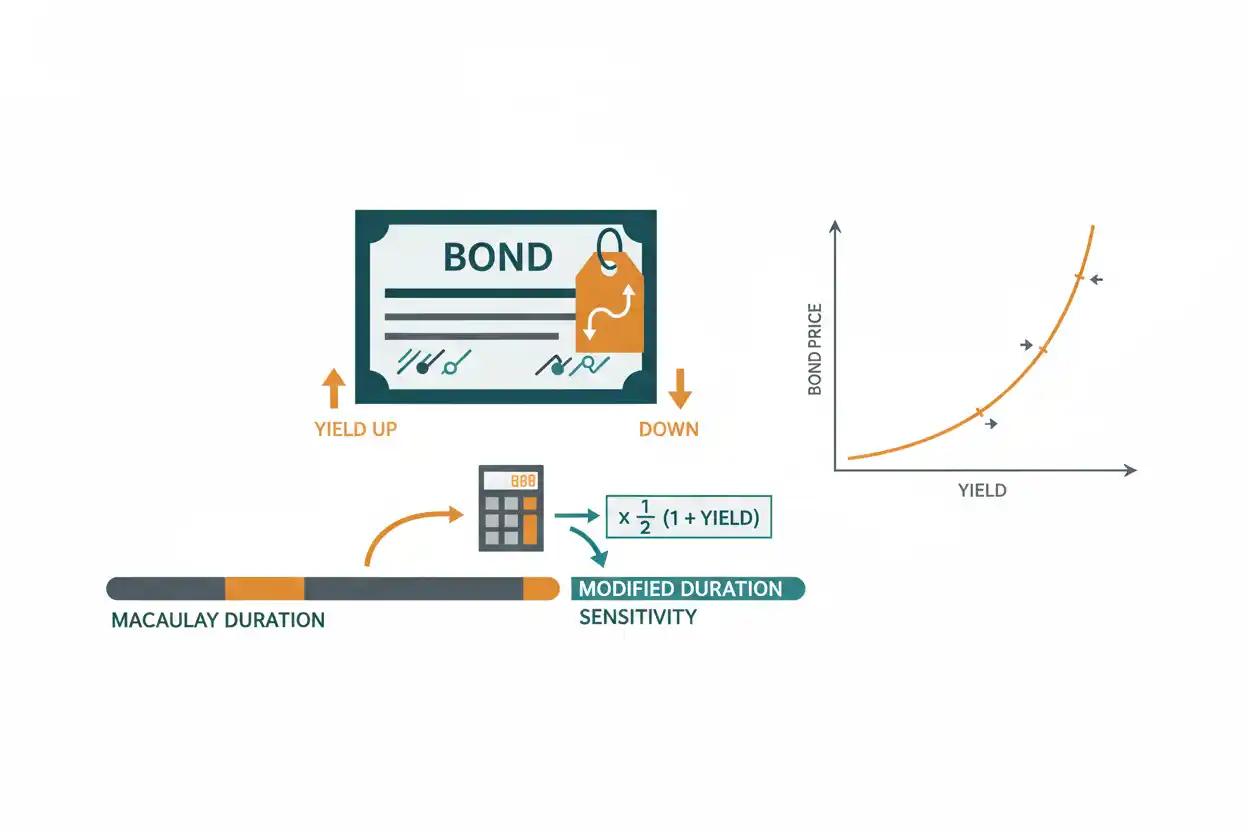
Modified duration estimates how sensitive a bond’s price is to a small change in yield.
If a bond has modified duration of 4.28, a one-percentage-point increase in yield implies an approximate 4.28% decline in price before accounting for convexity and other effects.
The relationship also works in the opposite direction: a one-percentage-point decline in yield implies an approximate 4.28% price increase under the linear duration estimate.
Modified duration is therefore primarily an interest-rate sensitivity measure, not a return, yield, or maturity measure.
What Is Modified Duration?
Modified duration converts Macaulay duration into an approximate price-sensitivity measure.
Macaulay duration measures the present-value-weighted average timing of a bond’s cash flows.
Modified duration adjusts that measure for the bond’s yield.
The result answers:
Approximately how much would the bond’s price change if its yield changed by a small amount?
Modified Duration Formula
For annual compounding:
Modified Duration = Macaulay Duration ÷ (1 + Yield to Maturity)
More generally, when yield is quoted nominally with m compounding periods per year:
Modified Duration = Macaulay Duration ÷ (1 + YTM ÷ m)
The yield convention and cash-flow frequency must be consistent.
Price Change Formula
Modified duration can estimate percentage price movement:
Approximate % Price Change = −Modified Duration × Change in Yield
Where the yield change is entered as a decimal.
For example:
0.50 percentage points = 0.005
not 0.50.
Modified Duration Example
Consider a five-year bond with:
- Face value = $1,000
- Annual coupon rate = 5%
- Annual coupon = $50
- Yield to maturity = 6%
- Annual coupon payments
Cash flows are:
- Year 1 = $50
- Year 2 = $50
- Year 3 = $50
- Year 4 = $50
- Year 5 = $1,050
Step 1: Calculate Bond Price
The bond price is the present value of its cash flows.
Price = $50 ÷ 1.06 + $50 ÷ 1.06² + $50 ÷ 1.06³ + $50 ÷ 1.06⁴ + $1,050 ÷ 1.06⁵
Evaluating the cash flows gives:
Bond Price ≈ $957.88
The bond trades below its $1,000 face value because its 5% coupon is below the 6% required yield in this example.
Step 2: Calculate Macaulay Duration
Macaulay duration is:
Macaulay Duration = Σ[t × PV(Cash Flowₜ)] ÷ Bond Price
Applying the time weights to all five discounted cash flows gives:
Macaulay Duration ≈ 4.5347 years
The weighted timing is shorter than the five-year maturity because coupon payments are received before maturity.
Step 3: Calculate Modified Duration
Use the annual-compounding formula:
Modified Duration = 4.5347 ÷ 1.06
Modified Duration ≈ 4.2780
The bond’s modified duration is approximately 4.28.
Step 4: Estimate a 0.50 Percentage-Point Yield Increase
Suppose yield rises from:
6.00% to 6.50%
Yield change:
Δy = 0.50% = 0.005
Apply modified duration:
Approximate Price Change = −4.2780 × 0.005
Approximate Price Change = −0.02139
Convert to a percentage:
Approximate Price Change ≈ −2.14%
The bond price is estimated to decline approximately 2.14%.
Convert the Estimate Into Dollars
Original price:
$957.88
Approximate dollar decline:
$957.88 × 2.139% ≈ $20.49
Estimated new price:
$957.88 − $20.49 ≈ $937.39
If the bond’s actual cash flows are repriced at a 6.5% yield, the price is approximately:
$937.66
The actual decline is about 2.11%.
The modified-duration estimate is close because the yield change is relatively small.
Yield Decline Example
Now suppose yield falls from 6% to 5.5%.
Δy = −0.005
Then:
Approximate Price Change = −4.2780 × (−0.005)
Approximate Price Change ≈ +2.14%
The duration-only estimate suggests the bond price rises approximately 2.14%.
Exact repricing gives a slightly different result because the actual price-yield relationship is curved rather than perfectly linear.
Why Modified Duration Has an Inverse Sign
For a conventional bond with fixed cash flows:
Yield ↑ → Price ↓
and:
Yield ↓ → Price ↑
The modified-duration value itself is commonly positive.
The negative sign is added in the price-change formula to represent this inverse relationship.
Modified Duration vs Macaulay Duration
Macaulay duration is expressed in units of time.
For example:
Macaulay Duration = 4.53 years
Modified duration is used as a price-sensitivity coefficient:
Modified Duration = 4.28
The numbers are related but answer different questions.
Macaulay duration:
When, on a present-value-weighted basis, are the bond’s cash flows received?
Modified duration:
How sensitive is the bond’s price to a small yield change?
Modified Duration vs Maturity
Maturity is the date of the final contractual payment.
A five-year coupon bond can have:
Maturity = 5 years
while:
Macaulay Duration < 5 years
because some value arrives earlier through coupons.
Modified duration then adjusts the Macaulay measure for yield.
Do not use maturity as a substitute for modified duration.
Modified Duration and Maximum Drawdown
Maximum drawdown measures an actual or historical peak-to-trough decline.
Modified duration estimates one source of potential bond price movement: changes in yield.
A bond portfolio might have modified duration of 6 and later experience a 12% drawdown, but that drawdown could reflect a combination of:
- interest rates;
- credit spreads;
- liquidity;
- other market conditions.
Modified duration is not a maximum-loss estimate.
Modified Duration and Money-Weighted Return
Money-weighted return measures investor performance after considering the timing and size of cash flows.
Modified duration does not measure performance.
A bond portfolio can have a modified duration of 5 while producing a positive, negative, or near-zero money-weighted return.
The metrics belong to different analytical layers.
Modified Duration and Lump-Sum Investing
An investor using lump-sum investing to purchase a bond portfolio immediately takes on the portfolio’s existing interest-rate sensitivity.
If the portfolio has high modified duration and market yields rise sharply soon after purchase, market value may decline materially.
Investment timing does not alter the basic meaning of duration.
Modified Duration and Lump Sum vs SIP
The lump sum vs SIP decision controls when capital is deployed.
Modified duration controls neither contribution timing nor average purchase price.
It measures the interest-rate sensitivity of the fixed-income securities owned at a particular point in time.
Modified Duration and Monthly Interest
Monthly interest calculates interest over monthly periods.
Modified duration may also require periodic yield adjustments when bond coupons are paid more than once per year, but the concepts are different.
For a semiannual bond, both yield and periods must be converted consistently before calculating duration.
Semiannual Compounding
Suppose:
- Macaulay duration = 6 years;
- nominal YTM = 8%;
- coupons paid semiannually.
Then:
Modified Duration = 6 ÷ (1 + 0.08 ÷ 2)
Modified Duration = 6 ÷ 1.04
Modified Duration ≈ 5.7692
Using:
6 ÷ 1.08
would be inconsistent with semiannual compounding.
Modified Duration of a Zero-Coupon Bond
For a zero-coupon bond, Macaulay duration equals maturity.
Suppose:
- maturity = 10 years;
- annual yield = 5%.
Then:
Macaulay Duration = 10
Modified duration:
Modified Duration = 10 ÷ 1.05
Modified Duration ≈ 9.5238
The bond is highly sensitive to yield changes because all cash flow arrives at maturity.
Coupon Rate and Modified Duration
All else equal, a lower coupon generally produces a longer duration because more of the bond’s value is concentrated in the final principal payment.
Higher coupons bring more cash flow forward, reducing weighted-average timing.
Therefore:
Lower Coupon → Generally Higher Duration
Higher Coupon → Generally Lower Duration
when other characteristics are comparable.
Maturity and Modified Duration
All else equal:
Longer Maturity → Generally Higher Duration
Longer-dated cash flows are more sensitive to changes in discount rates.
However, maturity alone does not determine duration because coupon size and yield also matter.
Why Convexity Creates Estimation Error
Modified duration treats the local price-yield relationship as approximately linear.
Actual bond pricing is curved.
This means equal yield moves upward and downward do not normally produce perfectly symmetrical price changes.
For larger yield changes, a convexity adjustment can improve the estimate.
Example of Larger Yield Movement
Using the example bond with modified duration 4.278, suppose yield rises by one percentage point.
Duration-only estimate:
Price Change ≈ −4.278 × 0.01
Price Change ≈ −4.28%
Exact repricing produces an approximately 4.16% decline.
The gap is larger than in the 0.50 percentage-point example because curvature becomes more important as the yield move increases.
Modified Duration Does Not Measure Credit Risk
A corporate bond can fall sharply even when government interest rates do not change.
If the issuer’s creditworthiness deteriorates, the market may demand a larger credit spread.
Modified duration can help approximate price sensitivity to a yield change, but it does not independently explain why the required yield changed.
Credit analysis remains necessary.
Portfolio Modified Duration
A simplified portfolio duration can be estimated as the market-value-weighted duration of individual holdings.
Portfolio Modified Duration = Σ(Weight × Modified Duration)
Suppose:
- 60% of a portfolio has modified duration 3;
- 40% has modified duration 7.
Then:
Portfolio Duration = 0.60 × 3 + 0.40 × 7
Portfolio Duration = 1.8 + 2.8
Portfolio Duration = 4.6
The portfolio’s approximate modified duration is 4.6, assuming consistent methodologies.
Common Modified Duration Mistakes
One mistake is entering a 0.5% yield change as 0.5 instead of 0.005.
Another is confusing Macaulay duration with modified duration.
Investors also sometimes use annual yield in a semiannual formula without adjusting compounding frequency.
Finally, modified duration should not be treated as an exact price forecast for large yield changes.
Frequently Asked Questions
What is modified duration?
Modified duration estimates the percentage sensitivity of a bond’s price to a small change in yield.
What is the modified duration formula?
For annual compounding:
Modified Duration = Macaulay Duration ÷ (1 + YTM)
What does modified duration of 5 mean?
It indicates that a one-percentage-point increase in yield corresponds to approximately a 5% price decline under the duration-only estimate.
Why is there a negative sign in the price-change formula?
Because conventional bond prices generally move inversely to yields.
Is modified duration measured in years?
It is derived from Macaulay duration, but it is commonly interpreted as a price-sensitivity coefficient rather than simply a time measure.
Is modified duration the same as maturity?
No. Maturity is the final payment date; modified duration reflects the timing of all cash flows and the bond’s yield.
What happens when yields fall?
A positive-duration bond generally rises in price, with the approximate change calculated using the negative yield change.
Why is modified duration only an approximation?
The true price-yield relationship is curved. Modified duration uses a linear approximation.
Does modified duration measure default risk?
No. It primarily measures price sensitivity to changes in yield.
Do higher-coupon bonds generally have shorter duration?
All else equal, yes, because more cash is received earlier.
Do longer-maturity bonds generally have higher duration?
All else equal, yes.
Why is modified duration useful?
It provides a practical way to estimate fixed-income interest-rate sensitivity within a broader Savings & Investing analysis.