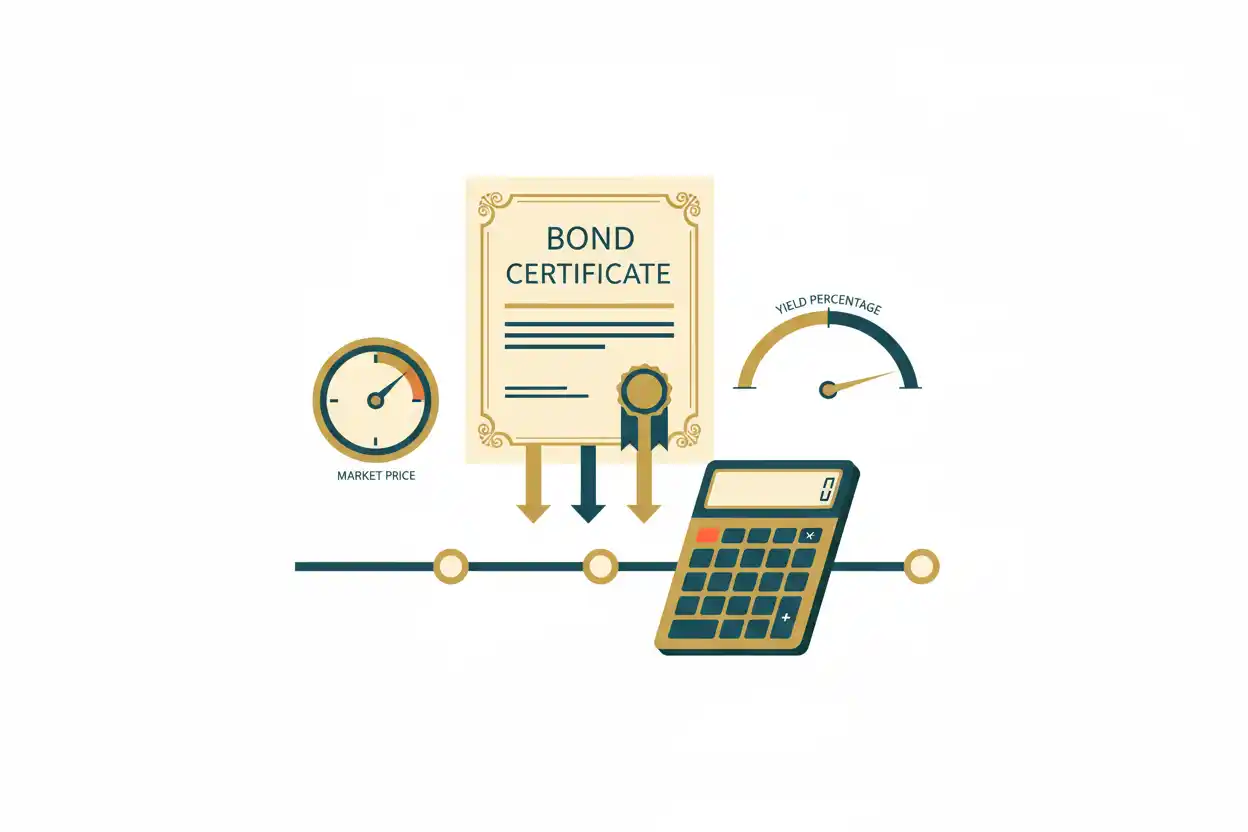
Bond yield measures the income or return associated with a bond relative to its price. The exact meaning depends on which yield measure you use.
Current yield compares annual coupon income with the bond’s current market price. Yield to maturity goes further by considering coupon payments, the purchase price, repayment of face value, and the time remaining until maturity.
That distinction matters because a bond’s coupon rate, market price, and yield are related but are not the same number.
What Is Bond Yield?
Bond yield expresses a bond’s return using a percentage.
Suppose a bond pays $60 of coupon interest each year. If the bond trades for $1,000, the simple income yield is 6%.
If the same bond falls to $900 while still paying $60 annually, the income relative to its market price becomes higher.
Conversely, if its price rises to $1,100, the same $60 coupon represents a lower percentage of the amount required to buy the bond.
This relationship is central to understanding the broader mechanics of bonds.
Current Yield Formula
The simplest commonly used bond yield measure is current yield.
Current Yield = Annual Coupon Payment ÷ Current Bond Price × 100
Current yield focuses on annual coupon income relative to today’s market price.
It does not include the gain or loss that may occur when the bond matures at face value.
Bond Yield Example
Assume a bond has:
- Face value: $1,000
- Coupon rate: 6%
- Annual coupon payment: $60
- Current market price: $950
First calculate the annual coupon payment if it is not already known.
Annual Coupon = Face Value × Coupon Rate
Annual Coupon = $1,000 × 6% = $60
Now calculate current yield.
Current Yield = $60 ÷ $950 × 100
Current Yield ≈ 6.3158%
Rounded:
Current Yield ≈ 6.32%
The bond’s coupon rate remains 6%, but its current yield is approximately 6.32% because the bond can be purchased for less than its $1,000 face value.
Coupon Rate vs Bond Yield
The coupon rate is based on face value.
Coupon Rate = Annual Coupon ÷ Face Value × 100
Using the same bond:
Coupon Rate = $60 ÷ $1,000 × 100 = 6%
Current yield instead uses market price:
Current Yield = $60 ÷ $950 × 100 ≈ 6.32%
Therefore:
Coupon rate: 6%
Current yield: about 6.32%
The two numbers are identical only when the bond trades at face value.
What Happens When a Bond Trades at a Discount?
A bond trades at a discount when its market price is below face value.
Suppose the $1,000 bond with a $60 annual coupon trades for $900.
Current Yield = $60 ÷ $900 × 100
Current Yield ≈ 6.67%
The current yield rises because the investor pays less to obtain the same $60 annual coupon.
If the investor holds the bond to maturity and the issuer pays the $1,000 face value as promised, the difference between the $900 purchase price and $1,000 redemption value also contributes to the investor’s return.
Current yield does not capture that additional component.
What Happens When a Bond Trades at a Premium?
A premium bond trades above face value.
Suppose the same bond trades for $1,100.
Current Yield = $60 ÷ $1,100 × 100
Current Yield ≈ 5.45%
The annual coupon has not changed, but the investor must pay more to receive it.
If the bond ultimately matures at $1,000, an investor purchasing at $1,100 also faces a $100 decline from purchase price to face value, assuming the bond is held to maturity and repaid normally.
That is why current yield alone does not provide a complete measure of a bond’s prospective return.
What Is Yield to Maturity?
Yield to maturity, or YTM, estimates the annualized return implied by a bond’s current price if the bond is held until maturity and its contractual cash flows occur as assumed.
The exact YTM is the discount rate that makes the present value of the bond’s future payments equal to its current price.
Bond Price = C ÷ (1 + y)¹ + C ÷ (1 + y)² + … + (C + F) ÷ (1 + y)ⁿ
Where:
- C = coupon payment per period;
- F = face value;
- y = yield per period;
- n = number of remaining periods.
Because the unknown yield appears in several powers, YTM is normally solved numerically rather than by simple rearrangement.
Approximate Yield to Maturity Formula
A commonly used approximation is:
Approximate YTM = [C + (F − P) ÷ n] ÷ [(F + P) ÷ 2]
Where:
- C = annual coupon;
- F = face value;
- P = current market price;
- n = years remaining to maturity.
Consider:
- Face value = $1,000
- Market price = $950
- Annual coupon = $60
- Years remaining = 5
First calculate the annualized price gain:
($1,000 − $950) ÷ 5 = $10
Add that to the annual coupon:
$60 + $10 = $70
Calculate the average of face value and price:
($1,000 + $950) ÷ 2 = $975
Then:
Approximate YTM = $70 ÷ $975
Approximate YTM ≈ 7.18%
Solving the full present-value equation for this example gives an annual YTM of approximately 7.23%, assuming annual coupon payments.
The approximation is useful for intuition, but the exact discounted-cash-flow calculation is preferable when precision matters.
Why Bond Price and Yield Move in Opposite Directions
A bond’s contractual coupon payments generally do not change just because market interest rates change.
Suppose newly issued comparable bonds begin offering higher yields. An older bond paying a smaller coupon becomes less attractive at its original price.
Its market price may therefore fall until its return becomes more competitive.
The reverse can happen when prevailing required yields decline.
In simplified terms:
Required Yield ↑ → Existing Bond Price ↓
Required Yield ↓ → Existing Bond Price ↑
This inverse relationship is one of the most important principles in fixed-income investing.
Bond Yield and Time to Maturity
Two bonds with the same coupon rate can react differently to changes in market yields if their maturities differ.
Longer-maturity bonds generally have more distant cash flows, so changes in the discount rate can have a larger effect on their present value.
Bond yield therefore needs to be interpreted alongside maturity rather than viewed as an isolated percentage.
Bond Yield and Credit Risk
Yield can also reflect credit risk.
Investors may demand a higher yield from an issuer perceived as more likely to experience financial difficulty.
However, a high bond yield is not automatically attractive. It may be high because the market has reduced the bond’s price in response to increased default risk.
Measures of banking resilience, such as the capital adequacy ratio, answer a different question but illustrate the broader importance of evaluating financial strength rather than looking only at quoted returns.
Bond Yield vs Average Return
Average return summarizes investment performance across multiple historical periods.
Bond yield usually describes the return implied by a bond’s price and cash flows.
Consequently, a bond with a 6% yield does not necessarily produce exactly a 6% realized holding-period return.
Selling before maturity, reinvestment conditions, defaults, transaction costs, and changing market prices can all affect the actual result.
Bond Yield vs Beta
Beta measures an investment’s historical sensitivity to a market benchmark.
Bond yield measures something different: the return relationship embedded in a bond’s income, price, maturity value, and timing.
A yield number therefore should not be interpreted as a measure of market sensitivity.
Bond Yield and Asset Allocation
Bonds can play different roles within an asset allocation strategy, including income generation, capital preservation objectives, or diversification from equity exposure.
However, selecting bonds solely because they have the highest quoted yields can materially change the risk profile of the portfolio.
Higher yield may accompany longer maturity, weaker credit quality, lower liquidity, embedded options, or other risks.
Current Yield Does Not Measure Total Return
Suppose an investor buys a $1,000-face-value bond for $950 and receives $60 during the year.
If the bond rises to $970 by year-end, the investor also has a $20 price gain.
Ignoring other complications:
Holding-Period Return = (Coupon Income + Price Change) ÷ Beginning Price
Holding-Period Return = ($60 + $20) ÷ $950
Holding-Period Return ≈ 8.42%
The bond’s starting current yield was approximately 6.32%, but the one-year holding-period return in this example is approximately 8.42%.
This shows why yield and realized return should not be treated as interchangeable terms.
Common Bond Yield Mistakes
One mistake is using face value rather than current market price in the current-yield formula.
Another is assuming coupon rate and current yield are always equal.
Investors can also misinterpret a high yield as guaranteed profit. A high yield may reflect meaningful credit or market risk.
Finally, current yield ignores the difference between purchase price and maturity value, while YTM depends on assumptions about holding period and contractual payments.
Frequently Asked Questions
What is bond yield?
Bond yield expresses the income or return associated with a bond relative to its price and, depending on the yield measure, its future cash flows.
What is the current bond yield formula?
Current Yield = Annual Coupon Payment ÷ Current Market Price × 100
Is bond yield the same as the coupon rate?
No. Coupon rate uses face value, while current yield uses the bond’s current market price.
Why does bond yield rise when price falls?
The contractual coupon remains the same while the purchase price becomes lower, increasing the coupon income as a percentage of price.
What is yield to maturity?
Yield to maturity is the discount rate that makes the present value of the bond’s remaining cash flows equal to its current market price.
Is current yield the same as YTM?
No. Current yield considers coupon income only. YTM also incorporates maturity value, purchase price, timing, and remaining life.
Can a bond yield be higher than its coupon rate?
Yes. This commonly occurs when a coupon-paying bond trades below face value.
Can bond yield be lower than the coupon rate?
Yes. A bond trading at a premium can have a current yield below its coupon rate.
Does a high bond yield mean the bond is better?
No. Higher yields can compensate investors for greater credit, maturity, liquidity, or other risks.
Does YTM guarantee the return I will earn?
No. YTM is an implied return based on assumptions. Actual results can differ because of defaults, reinvestment rates, selling before maturity, costs, or other factors.
Why do interest rates affect bond prices?
Existing bond prices adjust because investors compare their fixed cash flows with yields available from other investments of similar risk and maturity.
Where does bond yield fit in investment planning?
Bond yield can help compare fixed-income opportunities, but it should be evaluated alongside credit quality, maturity, liquidity, portfolio objectives, and the broader Savings & Investing strategy.