Mathematics
-

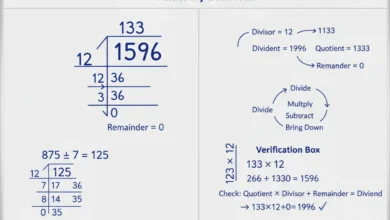
Long Division: Definition, Formula & Example
Long division is a step-by-step method for dividing numbers when the quotient cannot be found conveniently in one mental calculation.…
Read More » -
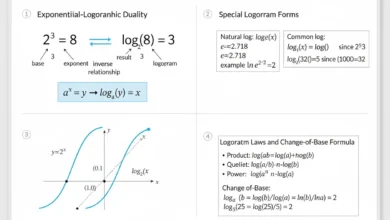
Logarithms: ln, log10, any base
Logarithms answer a fundamental question: what exponent must a base be raised to in order to produce a given number?…
Read More » -
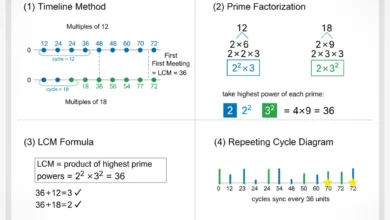
Least Common Multiple: Formula, Rules & Examples
The least common multiple of two or more integers is the smallest positive integer that is divisible by every number…
Read More » -
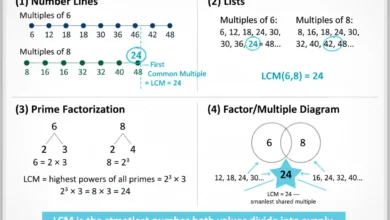
LCM: Least Common Multiple
LCM stands for least common multiple. It is the smallest positive integer that is a multiple of two or more…
Read More » -
Lattice Points: Definition, Formula & Example
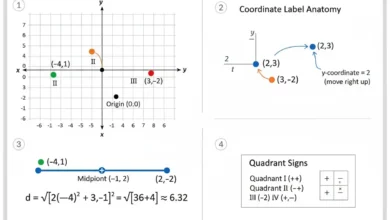
Lattice points are points in a coordinate system whose coordinates are integers. In a two-dimensional Cartesian plane, a point (x,…
Read More » -
Irrational Numbers: Formula, Rules & Examples
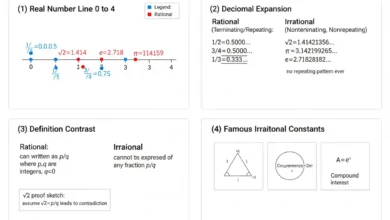
Irrational numbers are real numbers that cannot be written as a ratio of two integers. A rational number can be…
Read More » -
Integer Operations: Formula, Rules & Examples
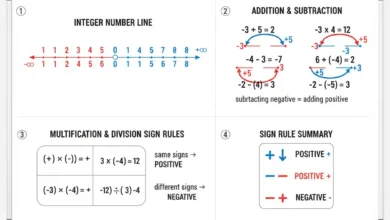
Integer operations are the rules for adding, subtracting, multiplying, and dividing positive whole numbers, negative whole numbers, and zero. The…
Read More » -
Improper Fractions: Formula, Rules & Examples
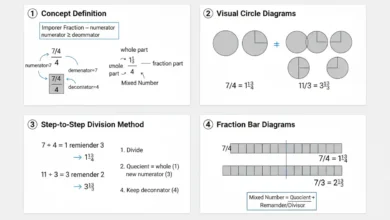
Improper fractions are fractions whose numerator is greater than or equal to the denominator when the denominator is positive. Their…
Read More » -
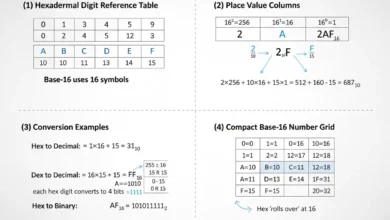
Hexadecimal: Base-16 Basics
Hexadecimal is a base-16 numeral system that uses sixteen symbols to represent values. It uses the familiar digits 0–9, then…
Read More » -
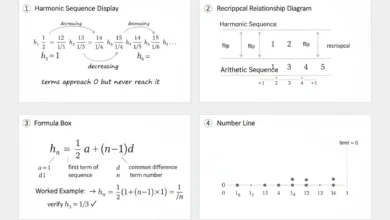
Harmonic Sequence: Formula, Rules & Examples
A harmonic sequence is a sequence of nonzero numbers whose reciprocals form an arithmetic sequence. For example: 1, 1/2, 1/3,…
Read More »