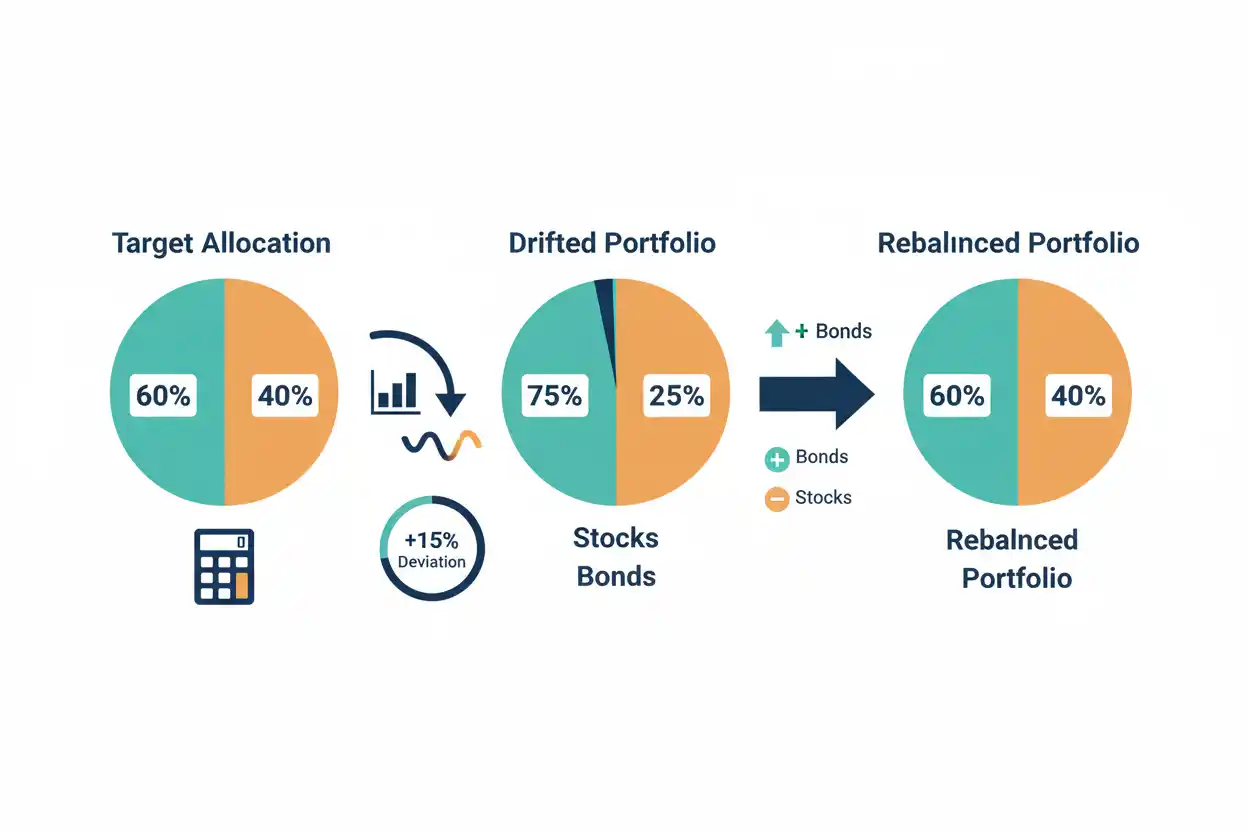

Portfolio rebalancing is the process of adjusting investments back toward a target asset allocation after market movements, contributions, or withdrawals cause the portfolio weights to drift.
Suppose a portfolio is designed to hold 60% stocks and 40% bonds. If stocks rise faster than bonds, the allocation might become 64.3% stocks and 35.7% bonds.
Rebalancing calculates how much needs to move between the holdings to restore the chosen 60/40 target.
The purpose is primarily risk control and portfolio discipline, not predicting which asset will perform best next.
What Is Portfolio Rebalancing?
A portfolio begins with target weights.
For example:
Stocks = 60%
Bonds = 40%
Market values then change independently.
Even if the investor makes no trades, the percentage allocation changes because each asset class grows or falls at a different rate.
Portfolio rebalancing restores the chosen target.
Portfolio Weight Formula
The weight of an asset is:
Asset Weight = Asset Value ÷ Total Portfolio Value × 100
Suppose:
- stocks = $60,000;
- bonds = $40,000.
Total:
$60,000 + $40,000 = $100,000
Stock weight:
$60,000 ÷ $100,000 = 60%
Bond weight:
$40,000 ÷ $100,000 = 40%
The portfolio begins exactly on target.
Portfolio Drift Example
Now suppose stocks gain 20%, while bond value remains unchanged.
New stock value:
$60,000 × 1.20 = $72,000
Bond value:
$40,000
New portfolio total:
$72,000 + $40,000 = $112,000
Stock weight:
$72,000 ÷ $112,000
≈ 64.29%
Bond weight:
$40,000 ÷ $112,000
≈ 35.71%
The portfolio has drifted from 60/40 to approximately 64.29/35.71.
Calculate the Target Dollar Values
Use:
Target Asset Value = Total Portfolio Value × Target Weight
For stocks:
$112,000 × 60% = $67,200
For bonds:
$112,000 × 40% = $44,800
Therefore, the target dollar values are:
- stocks = $67,200;
- bonds = $44,800.
Calculate the Rebalancing Trades
Use:
Required Trade = Target Value − Current Value
For stocks:
$67,200 − $72,000 = −$4,800
The negative result means stocks are $4,800 overweight.
For bonds:
$44,800 − $40,000 = +$4,800
Bonds are $4,800 underweight.
To restore the 60/40 target in this simplified example:
Sell $4,800 of Stocks
Buy $4,800 of Bonds
No new money is required.
Verify the Rebalanced Portfolio
After the trades:
Stocks:
$72,000 − $4,800 = $67,200
Bonds:
$40,000 + $4,800 = $44,800
Total:
$112,000
Weights:
$67,200 ÷ $112,000 = 60%
$44,800 ÷ $112,000 = 40%
The target allocation has been restored.
Why Rebalancing Changes Risk
When one risky asset class rises faster than another, it can become a larger part of the portfolio.
The portfolio may therefore become more exposed to that asset’s future movements.
This is why rebalancing and portfolio risk are closely connected.
Rebalancing does not guarantee lower losses, but it helps keep risk exposures closer to the allocation originally chosen.
Rebalancing With New Contributions
Selling is not always necessary.
Suppose the portfolio is again:
- stocks = $72,000;
- bonds = $40,000.
Instead of selling stocks immediately, the investor could direct new contributions toward bonds.
If $10,000 of new cash is available and all of it is added to bonds:
New Stocks = $72,000
New Bonds = $50,000
Total:
$122,000
New weights:
Stocks = $72,000 ÷ $122,000 ≈ 59.02%
Bonds = $50,000 ÷ $122,000 ≈ 40.98%
The contribution alone moves the portfolio close to the 60/40 target.
Exact Contribution Needed to Restore a Weight
Suppose no selling is allowed and new money can be added only to bonds.
Let x be the required contribution.
Target equation:
$72,000 ÷ ($112,000 + x) = 60%
Solve:
$72,000 = 0.60 × ($112,000 + x)
$72,000 = $67,200 + 0.60x
$4,800 = 0.60x
x = $8,000
If $8,000 is added entirely to bonds:
- stocks = $72,000;
- bonds = $48,000;
- total = $120,000.
Then:
$72,000 ÷ $120,000 = 60%
Rebalancing can therefore be performed with cash flows when available.
Rebalancing With Withdrawals
Withdrawals can also be directed toward overweight assets.
Suppose:
- stocks = 65%;
- bonds = 35%;
- target = 60/40.
If money needs to be withdrawn for spending, taking more of the withdrawal from stocks can reduce the overweight allocation without requiring a separate sell-and-buy transaction.
The exact trade depends on the portfolio value and withdrawal amount.
Calendar Rebalancing
One approach is to review the portfolio on a fixed schedule, such as:
- quarterly;
- semiannually;
- annually.
The investor checks the weights at each review date and rebalances according to the selected policy.
The advantage is simplicity.
The disadvantage is that substantial drift can occur between scheduled reviews.
Threshold Rebalancing
Another method is to rebalance only when an asset moves beyond a permitted range.
Suppose the target stock allocation is 60% with a five-percentage-point band.
Acceptable range:
55% to 65%
A stock weight of 63% remains inside the range.
A weight of 67% exceeds it and could trigger rebalancing.
Relative Thresholds
Some investors define a threshold relative to the target weight rather than using fixed percentage points.
Suppose:
- target = 60%;
- allowable relative deviation = 10%.
Deviation amount:
60% × 10% = 6 percentage points
The implied range becomes:
54% to 66%
The percentages used in a rebalancing policy should therefore be defined clearly.
Rebalancing Is Not Market Timing
Market timing tries to forecast future price movements.
Rebalancing generally does not require a forecast.
If stocks rise and become overweight, a rebalancing policy may sell some stocks simply because the allocation no longer matches the target.
The decision is based on portfolio structure rather than a prediction that stocks must fall next.
Rebalancing Can Mean Selling Recent Winners
Suppose stocks outperform bonds significantly.
Rebalancing may involve selling part of the asset that performed best and buying more of the lagging asset.
That can feel uncomfortable because it opposes recent momentum.
But the objective is not to reward or punish historical performance.
It is to restore the desired portfolio weights.
Rebalancing Does Not Guarantee Higher Return
A portfolio that is never rebalanced could outperform a rebalanced portfolio if the increasingly overweight asset continues outperforming.
For example, continuously rising stocks could make an unrebalanced equity-heavy portfolio earn more.
However, it would also take progressively more equity exposure.
Rebalancing is therefore better understood as a risk-maintenance process than a guaranteed return-enhancement strategy.
Portfolio Rebalancing and Present Value
Long-term portfolio targets often exist to fund future spending.
Present value can help translate a future liability into today’s financial terms.
Rebalancing then addresses a different question: whether the assets currently held still match the target allocation chosen for that liability.
Valuation and allocation maintenance should not be confused.
Pension Income and Rebalancing
Expected pension payouts can affect a household’s broader retirement-income picture.
However, a pension benefit generally cannot be bought and sold inside a brokerage account like a stock or bond fund.
A portfolio rebalancing calculation should therefore identify which assets are actually part of the tradable allocation.
Other income resources can influence the target allocation without becoming mechanical rebalancing positions.
Perpetuity Valuation vs Rebalancing
A perpetuity formula may be used to value an indefinite cash-flow stream.
Rebalancing does not use that formula.
If an asset’s market price changes after valuation assumptions change, however, its portfolio weight can change and trigger a rebalancing decision.
The valuation of an asset and its percentage weight are distinct steps.
Rebalancing a Three-Asset Portfolio
Suppose a $200,000 portfolio targets:
- 50% stocks;
- 30% bonds;
- 20% cash.
Target dollar values are:
Stocks = $200,000 × 50% = $100,000
Bonds = $200,000 × 30% = $60,000
Cash = $200,000 × 20% = $40,000
If current values are:
- stocks = $115,000;
- bonds = $55,000;
- cash = $30,000;
then trades required are:
Stocks:
$100,000 − $115,000 = −$15,000
Bonds:
$60,000 − $55,000 = +$5,000
Cash:
$40,000 − $30,000 = +$10,000
The trades net to zero:
−$15,000 + $5,000 + $10,000 = $0
Taxes Can Affect Rebalancing
In taxable accounts, selling appreciated investments can potentially create taxable gains.
This can make alternatives such as:
- directing new contributions;
- using dividends or interest;
- rebalancing inside tax-advantaged accounts;
worth considering where appropriate.
Tax treatment depends on jurisdiction and circumstances, so the mathematical target trade and the implementation strategy are separate decisions.
Transaction Costs and Spreads
Frequent rebalancing can create trading costs or bid-ask spread costs.
That means a policy that responds to tiny deviations may create unnecessary turnover.
Thresholds can help balance:
- maintaining target risk;
- avoiding excessive trading.
The optimal threshold cannot be determined from the weight formula alone.
Rebalancing Frequency
There is no universal rebalancing frequency suitable for every portfolio.
The appropriate process depends on:
- target allocation;
- volatility;
- transaction costs;
- taxes;
- cash flows;
- account structure;
- tolerance for drift.
A written rule can reduce emotional decision-making.
Common Portfolio Rebalancing Mistakes
One mistake is calculating target values from the original portfolio value rather than the current total.
Another is rebalancing every small market movement without considering costs.
Investors may also mistake recent outperformance as a reason to permanently abandon their allocation.
Finally, the target allocation itself should be reviewed when financial circumstances change rather than mechanically preserved forever.
Frequently Asked Questions
What is portfolio rebalancing?
Portfolio rebalancing adjusts investment holdings back toward predetermined target weights.
What is the asset-weight formula?
Asset Weight = Asset Value ÷ Total Portfolio Value × 100
How do I calculate the target dollar amount?
Target Value = Current Total Portfolio × Target Weight
How do I calculate the required trade?
Required Trade = Target Value − Current Value
What does a negative required trade mean?
It means the position is overweight and would need to be reduced to reach the target.
Can I rebalance without selling?
Potentially. New contributions, withdrawals, dividends, or other cash flows can sometimes be directed toward underweight or overweight positions.
What is threshold rebalancing?
It triggers action only when an allocation moves outside a predetermined tolerance band.
Is rebalancing market timing?
Not necessarily. A rules-based rebalance responds to allocation drift rather than predicting future prices.
Does rebalancing guarantee better returns?
No. Its primary purpose is maintaining intended portfolio risk and allocation.
How often should a portfolio be rebalanced?
There is no universal schedule. Calendar reviews, threshold rules, or a combination can be used.
Do taxes matter when rebalancing?
They can in taxable accounts because selling appreciated assets may have tax consequences.
Why is portfolio rebalancing important?
It helps keep actual asset exposure aligned with the risk and allocation choices established in the broader Savings & Investing plan.