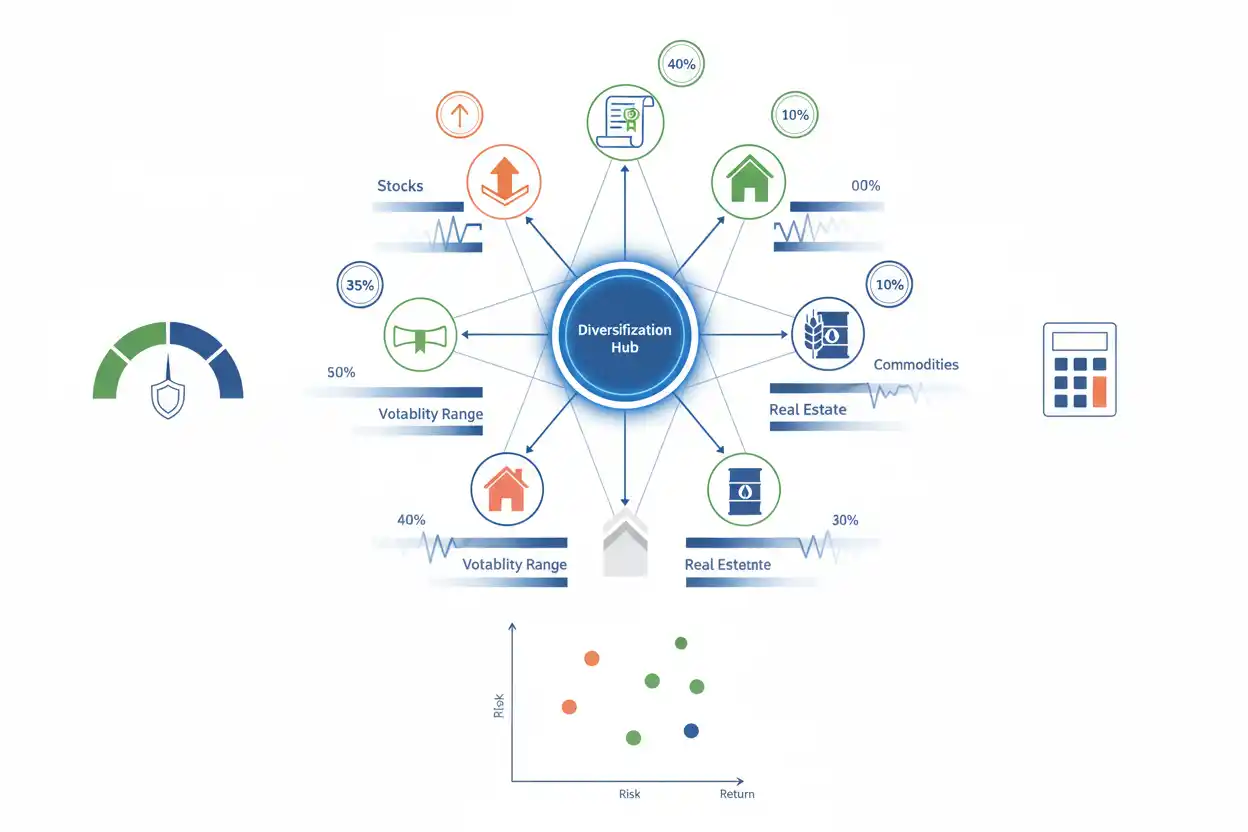
Portfolio risk describes the uncertainty and potential losses associated with a combination of investments.
It depends on more than the risk of each holding individually. Portfolio weights and the way assets move relative to one another also matter.
For example, combining a volatile asset with a more stable asset can reduce overall volatility, but the size of the reduction depends heavily on correlation. If the assets frequently rise and fall together, diversification provides less volatility reduction than if their returns behave differently.
This is why portfolio risk cannot be calculated by simply averaging the volatilities of the investments held.
What Is Portfolio Risk?
Portfolio risk is the uncertainty associated with the portfolio’s combined future returns and values.
Relevant forms of risk can include:
- market risk;
- interest-rate risk;
- credit risk;
- concentration risk;
- liquidity risk;
- currency risk;
- inflation risk;
- sequence risk;
- volatility.
No single statistic captures all of them.
Standard deviation is commonly used to quantify return volatility, but it should be viewed as one part of a broader risk assessment.
Portfolio Return Comes From Weights
For a two-asset portfolio:
Portfolio Return = w₁R₁ + w₂R₂
Where:
- w₁, w₂ = asset weights;
- R₁, R₂ = asset returns.
If:
- 60% is in Asset A;
- 40% is in Asset B;
and returns are:
- A = 8%;
- B = 3%;
then:
Portfolio Return = 0.60 × 8% + 0.40 × 3%
Portfolio Return = 4.8% + 1.2%
Portfolio Return = 6%
Risk uses the same weights but requires additional information about how the assets move together.
Two-Asset Portfolio Risk Formula
For two assets:
σₚ = √[w₁²σ₁² + w₂²σ₂² + 2w₁w₂σ₁σ₂ρ₁₂]
Where:
- σₚ = portfolio standard deviation;
- w₁, w₂ = portfolio weights;
- σ₁, σ₂ = individual asset volatilities;
- ρ₁₂ = correlation between the two assets.
The correlation term is what makes portfolio risk more than a weighted average.
Portfolio Risk Example
Assume:
- Asset A weight = 60%;
- Asset B weight = 40%;
- Asset A volatility = 15%;
- Asset B volatility = 8%;
- correlation = 0.20.
Convert to decimals:
w₁ = 0.60
w₂ = 0.40
σ₁ = 0.15
σ₂ = 0.08
ρ = 0.20
Now calculate each component.
Asset A Variance Contribution
0.60² × 0.15²
0.36 × 0.0225
= 0.0081
Asset B Variance Contribution
0.40² × 0.08²
0.16 × 0.0064
= 0.001024
Covariance Term
2 × 0.60 × 0.40 × 0.15 × 0.08 × 0.20
= 0.001152
Add them:
Portfolio Variance = 0.0081 + 0.001024 + 0.001152
Portfolio Variance = 0.010276
Take the square root:
Portfolio Volatility = √0.010276
Portfolio Volatility ≈ 0.10137
Convert to a percentage:
Portfolio Volatility ≈ 10.14%
Under these assumptions, the portfolio’s volatility is approximately 10.14%.
Why Portfolio Volatility Is Below 15%
Asset A alone has 15% volatility.
The portfolio is only about 10.14% volatile because:
- 40% is placed in the lower-volatility Asset B;
- the correlation is only 0.20.
Asset B does not move perfectly in sync with Asset A, so some movements offset or dilute one another.
That is the mathematical foundation of diversification.
Correlation of +1
If correlation equals +1, the assets move perfectly together in standardized terms.
Using the same weights and volatilities:
σₚ = w₁σ₁ + w₂σ₂
σₚ = 0.60 × 15% + 0.40 × 8%
σₚ = 9% + 3.2%
σₚ = 12.2%
Diversification still changes risk because the weights and volatilities differ, but there is no additional correlation benefit.
Correlation of Zero
If correlation is zero, the covariance term disappears.
σₚ = √[0.0081 + 0.001024]
σₚ = √0.009124
σₚ ≈ 9.55%
Risk is lower than with correlation +1.
Negative Correlation
If correlation is negative, the assets tend to move in opposite directions.
Using the same assumptions with correlation −0.50:
Covariance Term = 2 × 0.60 × 0.40 × 0.15 × 0.08 × (−0.50)
= −0.00288
Portfolio variance:
0.0081 + 0.001024 − 0.00288
= 0.006244
Portfolio volatility:
√0.006244 ≈ 7.90%
Negative correlation can substantially reduce portfolio volatility.
Correlation Does Not Stay Constant
Historical correlations can change.
Assets that appeared weakly correlated in calm markets may move more closely together during stress.
Therefore, a portfolio-risk calculation using one historical correlation estimate should not be interpreted as a guarantee of future diversification.
Correlation is an estimate, not a permanent property.
Portfolio Weights Matter
Even well-diversified assets cannot offset concentration if one position dominates the portfolio.
Suppose one stock represents:
80% of the portfolio
Even if the remaining 20% is diversified across many assets, the portfolio can still be heavily influenced by that one holding.
This is why concentration risk is a distinct consideration.
Portfolio Risk and Percentages
Portfolio weights are expressed using percentages.
For a fully invested portfolio:
Σ Portfolio Weights = 100%
If:
- stocks = 50%;
- bonds = 30%;
- cash = 20%;
then:
50% + 30% + 20% = 100%
Incorrect weights produce incorrect return and risk calculations.
Portfolio Risk and Rebalancing
Market movements cause portfolio weights to drift.
Portfolio rebalancing restores assets toward their target weights.
That matters for risk because a portfolio designed for 60% equity exposure can gradually become 70% or 75% equity after strong stock performance.
Without rebalancing, actual risk may move away from the level originally intended.
Portfolio Risk vs Maximum Loss
Standard deviation is not a maximum-loss estimate.
A portfolio with annual volatility of 10% can still experience a decline much larger than 10%.
Volatility describes the dispersion of returns around an average under the measurement methodology.
It does not create a hard boundary around outcomes.
Downside Risk
Some investors care more about negative returns than positive volatility.
Alternative measures can therefore focus on:
- downside deviation;
- maximum drawdown;
- value at risk;
- expected shortfall.
Each answers a different question.
There is no universal risk metric that captures every investor concern.
Portfolio Risk and Time Horizon
A portfolio appropriate for money needed in 30 years may be inappropriate for money needed next month.
The issue is not simply whether long-term returns are expected to be positive.
A near-term withdrawal creates a risk that the portfolio must be sold after an unfavorable market movement.
Time horizon therefore affects the amount and type of risk that can reasonably be accepted.
Portfolio Risk and Present Value
Present value helps determine what future cash needs are worth in today’s terms under a selected discount rate.
Portfolio risk addresses whether the assets intended to fund those needs could fluctuate or lose value.
The two calculations can therefore work together in planning:
- estimate the value of the liability;
- determine an appropriate asset allocation;
- analyze the risk of that portfolio.
Portfolio Risk and Annuity Liabilities
A stream of future payments can be valued using the present value of annuity formula when the cash flows are finite and regular.
The investment portfolio funding those payments may still have market risk.
The liability formula tells you what the payments are worth under assumptions.
Portfolio-risk analysis tells you how uncertain the asset values may be.
Portfolio Risk and Perpetuities
A perpetuity represents an indefinite cash-flow model.
Even when an asset is valued using a perpetuity formula, the investment can remain risky because:
- future cash flows can change;
- required returns can change;
- market values can fluctuate.
Valuation structure and portfolio risk are separate dimensions.
Expected Return vs Risk
Higher expected return is often associated with accepting additional uncertainty, but the relationship is not guaranteed for any specific investment or period.
A risky asset can produce:
- high positive returns;
- low returns;
- severe losses.
Risk means the outcome is uncertain—not that a high return is assured.
Diversification Across Asset Classes
Diversification can occur across:
- stocks and bonds;
- industries;
- geographic regions;
- issuers;
- maturities;
- currencies;
- investment styles.
Owning many securities does not automatically create meaningful diversification if those securities respond to the same economic drivers.
Diversification Cannot Eliminate Systematic Risk
Some market forces affect many investments at once.
Examples can include:
- broad recessions;
- interest-rate shocks;
- market liquidity stress;
- geopolitical events.
Diversification can reduce asset-specific risk but cannot ensure that an entire portfolio avoids losses.
Portfolio Risk and Leverage
Borrowing to increase investment exposure can magnify both gains and losses.
Suppose:
- investor capital = $100,000;
- borrowed amount = $50,000;
- total investment exposure = $150,000.
A 20% decline in the investment creates:
$150,000 × 20% = $30,000 loss
Relative to the investor’s $100,000 equity:
$30,000 ÷ $100,000 = 30% loss
Leverage therefore increases portfolio risk relative to the investor’s own capital.
Portfolio Risk and Liquidity
An investment can have low observed price volatility but still create significant liquidity risk.
If it is difficult to sell quickly at a reasonable price, the investor may be unable to access funds when needed.
Risk analysis should therefore not rely exclusively on historical standard deviation.
Common Portfolio Risk Mistakes
One mistake is averaging asset volatilities instead of accounting for correlation.
Another is assuming historical correlations are fixed.
Investors can also mistake low volatility for low total risk.
Finally, a diversified portfolio can still suffer losses because diversification reduces certain risks rather than eliminating all risk.
Frequently Asked Questions
What is portfolio risk?
Portfolio risk is the uncertainty and potential loss associated with a combination of investments.
How is two-asset portfolio volatility calculated?
σₚ = √[w₁²σ₁² + w₂²σ₂² + 2w₁w₂σ₁σ₂ρ₁₂]
What does correlation mean?
Correlation describes how closely two assets’ returns move together, ranging theoretically from −1 to +1.
Does lower correlation reduce portfolio risk?
All else equal, lower correlation can reduce combined portfolio volatility.
Can portfolio risk be lower than the risk of either individual asset?
Under some combinations of weights, volatilities, and correlations, yes.
Does diversification eliminate loss risk?
No.
Why do portfolio weights matter?
A larger allocation gives an asset greater influence over overall portfolio performance and risk.
Is volatility the same as maximum loss?
No. Standard deviation does not establish a maximum possible loss.
Why is rebalancing related to risk?
Because market movements can change asset weights and therefore alter the portfolio’s intended risk exposure.
Can correlations change?
Yes. Historical relationships between assets can change substantially.
Is a low-volatility investment always safe?
No. Credit, liquidity, inflation, concentration, and other risks may still be significant.
Why measure portfolio risk?
It helps align investment exposure with objectives, liquidity needs, and time horizon within a broader Savings & Investing strategy.