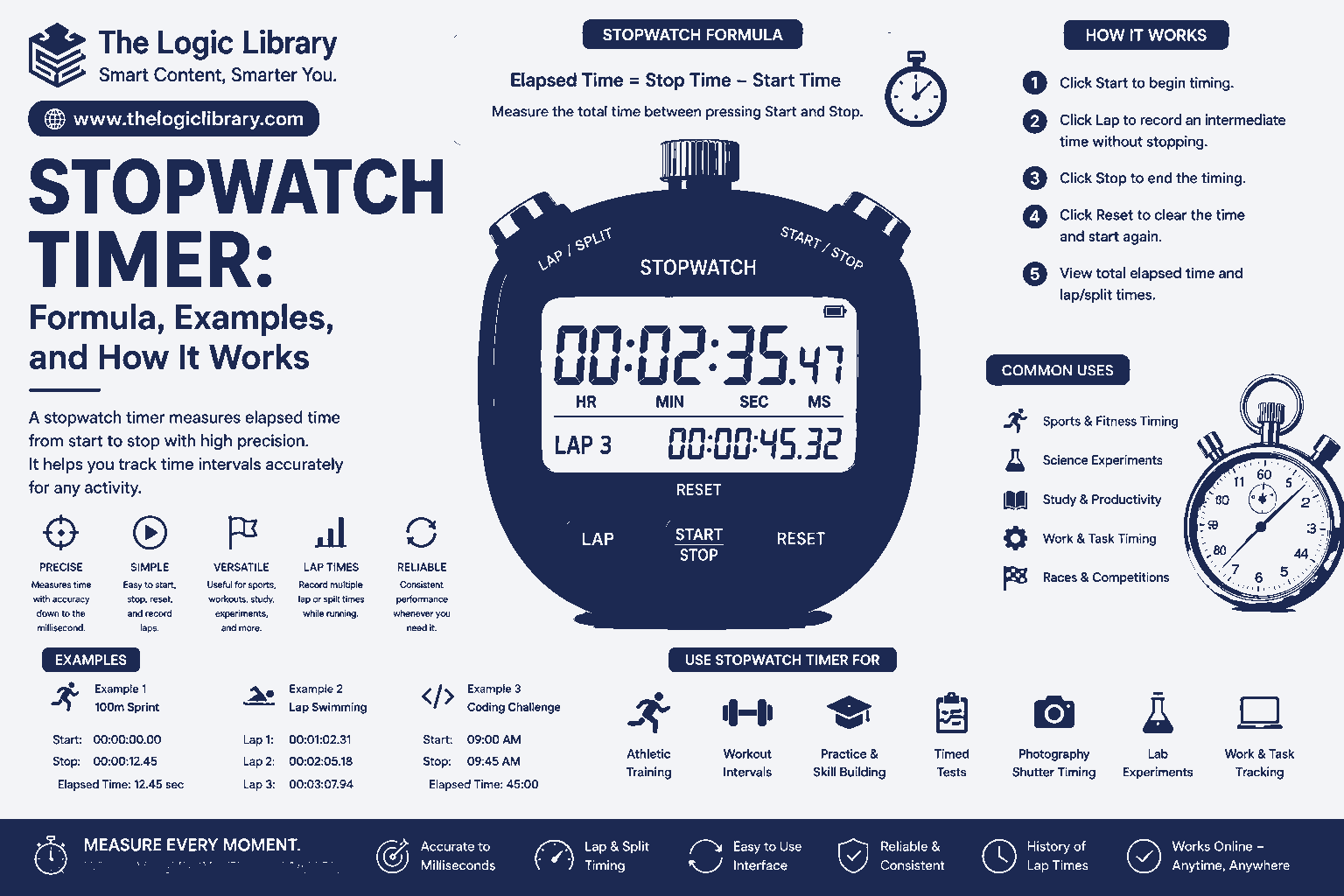
A Stopwatch Timer is one of the most commonly used time-measurement tools in the world. From sports competitions and fitness training to scientific experiments and workplace productivity tracking, a Stopwatch Timer helps measure the amount of time that has elapsed between a start point and an end point. Unlike a countdown timer, which counts backward toward zero, a Stopwatch Timer counts upward from zero, recording the exact duration of an activity.
Whether you’re timing a race, monitoring a workout, tracking study sessions, or measuring project performance, understanding how a Stopwatch Timer works can help you use it more effectively. In this guide, you’ll learn the Stopwatch Timer formula, practical examples, benefits, applications, and the science behind accurate time measurement.
What Is a Stopwatch Timer?
A Stopwatch Timer is a device or software application that measures elapsed time. When started, the timer begins counting from zero and continues increasing until it is stopped.
A Stopwatch Timer typically displays:
- Hours
- Minutes
- Seconds
- Milliseconds
The purpose of a Stopwatch Timer is to accurately determine how much time has passed during an event or activity.
For example:
- Measuring a runner’s race time
- Tracking workout duration
- Timing cooking activities
- Recording laboratory experiments
- Monitoring productivity sessions
Because of its accuracy and simplicity, the Stopwatch Timer is used across numerous industries and daily activities.
How a Stopwatch Timer Works
A Stopwatch Timer works by recording the exact time when the timer starts and comparing it to the current time while it runs.
The process is straightforward:
- Press the Start button.
- The timer begins counting from zero.
- Time continuously increases.
- Press Stop when the activity ends.
- The timer displays the total elapsed time.
Modern digital Stopwatch Timers rely on highly accurate internal clocks that update time measurements multiple times per second.
Stopwatch Timer Formula
The fundamental Stopwatch Timer formula is:
Elapsed Time = End Time − Start Time
This formula calculates the duration between two moments.
Standard Stopwatch Timer Formula
Elapsed Time = Finish Time − Start Time
Where:
- Start Time = The moment timing begins
- Finish Time = The moment timing ends
The difference between the two values equals the elapsed time.
Example of the Stopwatch Timer Formula
Suppose a runner starts a race at:
9:00:00 AM
The runner finishes at:
9:15:30 AM
Using the formula:
Elapsed Time = 9:15:30 − 9:00:00
Result:
15 Minutes 30 Seconds
The Stopwatch Timer would display:
00:15:30
This indicates the runner completed the race in 15 minutes and 30 seconds.
Components of a Stopwatch Timer
Most Stopwatch Timers display time using four units.
Hours
Tracks long-duration activities.
Example:
02:15:30
The first number represents hours.
Minutes
Measures time intervals within each hour.
Example:
00:45:10
This indicates 45 minutes.
Seconds
Measures smaller time increments.
Example:
00:00:25
This indicates 25 seconds.
Milliseconds
Provides greater accuracy for sports and scientific measurements.
Example:
00:10:25.350
The value “.350” represents milliseconds.
History of the Stopwatch Timer
The concept of measuring elapsed time dates back centuries. Early civilizations used sundials, water clocks, and mechanical devices to estimate durations.
The first mechanical stopwatches appeared in the eighteenth century and became widely used in scientific research and sports competitions.
Today, Stopwatch Timers are available as:
- Physical stopwatches
- Smartphone apps
- Smartwatches
- Fitness trackers
- Online stopwatch tools
- Computer software
Modern digital versions offer exceptional accuracy and convenience.
Why Stopwatch Timers Are Important
A Stopwatch Timer provides precise time measurement, which is essential in many situations.
Key benefits include:
- Improved accuracy
- Better performance tracking
- Enhanced productivity
- Objective measurement
- Time management support
- Scientific precision
Without accurate timing tools, evaluating performance and progress would be significantly more difficult.
Stopwatch Timer Example for Sports
Sports competitions rely heavily on Stopwatch Timers.
Imagine a swimmer competing in a race.
Start:
0 Seconds
Finish:
58.75 Seconds
The Stopwatch Timer records:
00:58.75
This precise measurement determines rankings and competition results.
Sports that frequently use Stopwatch Timers include:
- Running
- Swimming
- Cycling
- Rowing
- Skating
- Motorsport
Stopwatch Timer Example for Fitness Workouts
Fitness enthusiasts use Stopwatch Timers to monitor exercise duration.
Workout:
30 Minutes Cardio Session
Start:
6:00 PM
End:
6:30 PM
Formula:
Elapsed Time = 6:30 − 6:00
Result:
30 Minutes
Tracking workout duration helps measure consistency and progress.
Stopwatch Timer Example for Studying
Students often use Stopwatch Timers to monitor focused study sessions.
Example:
Study Start:
7:00 PM
Study End:
8:20 PM
Calculation:
Elapsed Time = 80 Minutes
The student can record study durations and evaluate productivity over time.
Stopwatch Timer Example for Scientific Experiments
Scientists use Stopwatch Timers to measure reaction times and experimental processes.
Example:
Chemical reaction begins:
10:15:00
Reaction completes:
10:18:45
Formula:
Elapsed Time = 3 Minutes 45 Seconds
Accurate timing ensures reliable and repeatable results.
Stopwatch Timer Example for Workplace Productivity
Businesses often use Stopwatch Timers to track task durations.
Task:
Prepare Monthly Report
Start:
9:00 AM
End:
10:45 AM
Result:
1 Hour 45 Minutes
Managers can use this information to estimate future project timelines more accurately.
Types of Stopwatch Timers
Different Stopwatch Timers serve different purposes.
Analog Stopwatch Timer
Traditional mechanical stopwatch operated manually.
Features:
- Rotating hands
- Mechanical movement
- No batteries required
Common in historical sports timing.
Digital Stopwatch Timer
Electronic stopwatch with digital display.
Features:
- High precision
- Easy readability
- Lap timing
- Split timing
Most modern users prefer digital versions.
Online Stopwatch Timer
Web-based stopwatch accessed through browsers.
Benefits:
- No installation required
- Works on multiple devices
- Free and convenient
Mobile Stopwatch Timer
Built into smartphones and smartwatches.
Features:
- Portable
- Easy access
- Integrated with other apps
Widely used for personal timing tasks.
Stopwatch Timer Functions
Modern Stopwatch Timers often include additional features.
Start
Begins time measurement.
Stop
Ends timing and freezes the display.
Reset
Returns the timer to zero.
Lap Function
Records intermediate times without stopping the timer.
Split Time Function
Displays elapsed time at specific checkpoints.
These features improve usability for complex timing activities.
Stopwatch Timer Calculations
Time calculations often require converting between units.
Seconds to Minutes
Formula:
Minutes = Seconds ÷ 60
Example:
300 Seconds ÷ 60 = 5 Minutes
Minutes to Hours
Formula:
Hours = Minutes ÷ 60
Example:
120 Minutes ÷ 60 = 2 Hours
Hours to Seconds
Formula:
Seconds = Hours × 3600
Example:
2 Hours × 3600 = 7200 Seconds
These calculations help interpret Stopwatch Timer results more effectively.
Advantages of Using a Stopwatch Timer
Accurate Time Measurement
Stopwatch Timers provide highly precise duration tracking.
Better Performance Analysis
Athletes, students, and professionals can measure improvement over time.
Increased Productivity
Tracking task durations helps identify inefficiencies.
Easy Goal Setting
Time-based goals become easier to establish and monitor.
Universal Applications
Stopwatch Timers work across sports, education, business, science, and personal productivity.
Common Mistakes When Using a Stopwatch Timer
Forgetting to Start the Timer
This is one of the most common timing errors.
Stopping Too Early
Ending the timer before task completion leads to inaccurate measurements.
Ignoring Milliseconds
For competitive sports, milliseconds can significantly affect results.
Failing to Reset
Starting a new timing session without resetting can create confusion.
Proper stopwatch management ensures accurate data collection.
Stopwatch Timer vs Countdown Timer
| Feature | Stopwatch Timer | Countdown Timer |
|---|---|---|
| Direction | Counts Up | Counts Down |
| Starting Point | Zero | Predefined Duration |
| Purpose | Measure Elapsed Time | Measure Remaining Time |
| Sports Timing | Excellent | Limited |
| Deadline Tracking | Limited | Excellent |
| Productivity Tracking | Good | Excellent |
Both tools serve important purposes, but they are designed for different timing needs.
Stopwatch Timer Applications
A Stopwatch Timer is commonly used in:
- Sports competitions
- Fitness training
- Educational activities
- Scientific research
- Manufacturing processes
- Productivity tracking
- Cooking and baking
- Gaming challenges
- Public speaking practice
- Project management
Its versatility makes it one of the most valuable timing tools available.
Frequently Asked Questions
What is a Stopwatch Timer?
A Stopwatch Timer is a device or software tool that measures elapsed time by counting upward from zero.
What is the Stopwatch Timer formula?
The formula is:
Elapsed Time = End Time − Start Time
How accurate is a Stopwatch Timer?
Modern digital Stopwatch Timers can measure time to milliseconds or even smaller fractions of a second.
What is the difference between a Stopwatch Timer and a Countdown Timer?
A Stopwatch Timer measures elapsed time, while a Countdown Timer measures remaining time until a specific endpoint.
Can a Stopwatch Timer record laps?
Yes. Many modern Stopwatch Timers include lap and split-time functions.
Where is a Stopwatch Timer used?
It is widely used in sports, fitness, education, business, research, and personal productivity.
Conclusion
A Stopwatch Timer is an essential time-measurement tool used to track elapsed time accurately. Using the simple formula Elapsed Time = End Time − Start Time, it provides precise duration measurements for sports, fitness, education, science, business, and everyday activities. Whether you’re timing a race, measuring a workout, monitoring a study session, or evaluating workplace productivity, a Stopwatch Timer delivers reliable and actionable timing data. Its ease of use, accuracy, and versatility have made it one of the most widely used timing tools in the modern world, helping individuals and organizations measure performance, improve efficiency, and achieve their goals.