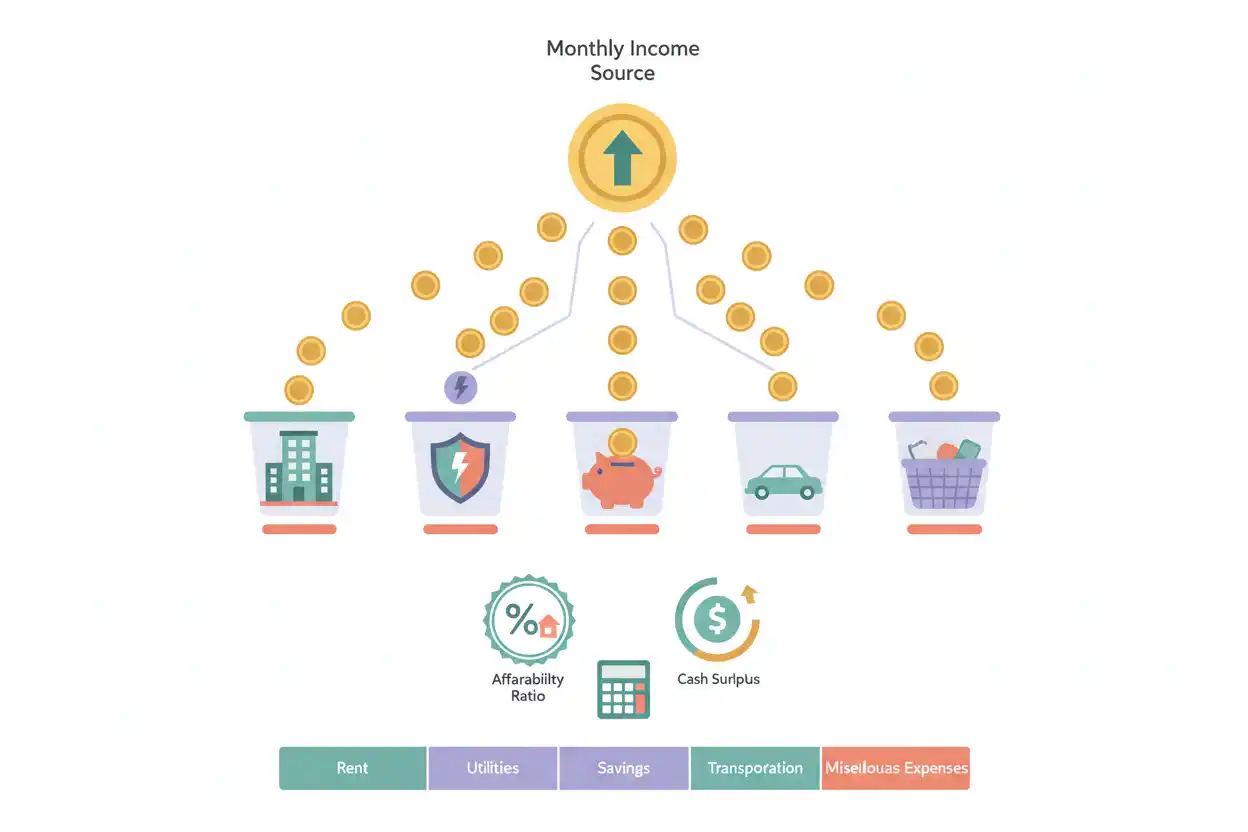
Rent affordability measures whether monthly housing costs fit within a household’s income and broader financial obligations.
A common starting guideline is to compare rent with gross monthly income. For example, 30% of $6,000 gross monthly income is $1,800.
That does not mean $1,800 is automatically affordable for every household.
Two people earning the same $6,000 can have very different student-loan payments, childcare costs, transportation expenses, taxes, savings goals, healthcare costs, and debt.
A stronger rent affordability calculation uses both an income ratio and a complete cash-flow budget.
What Does Rent Affordability Mean?
Rent affordability asks:
How much housing cost can the household sustain while still paying other necessary expenses and meeting financial goals?
The calculation can include:
- base rent;
- utilities;
- renter’s insurance;
- parking;
- mandatory service charges;
- transportation changes;
- other recurring housing-related costs.
Base rent alone may understate the actual monthly housing burden.
Gross-Income Rent Formula
A commonly used budgeting starting point is:
Target Rent = Gross Monthly Income × Target Housing Percentage
Suppose:
- gross monthly income = $6,000;
- target = 30%.
Then:
Target Rent = $6,000 × 0.30
Target Rent = $1,800
Under the 30% guideline, $1,800 is the starting rent figure.
This is a rule of thumb, not a universal landlord qualification standard or a guarantee of affordability.
Housing Cost Ratio
The ratio can also be calculated from a known rent amount.
Housing Cost Ratio = Monthly Housing Cost ÷ Gross Monthly Income × 100
Suppose rent is $1,800 and gross income is $6,000.
$1,800 ÷ $6,000 × 100
= 30%
Rent consumes 30% of gross income.
Gross Income vs Take-Home Pay
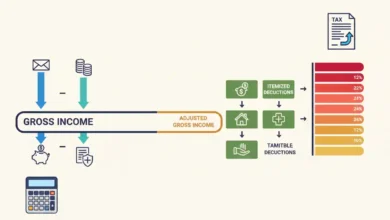
Gross income is income before taxes and other payroll deductions.
Take-home pay is what actually reaches the household.
Suppose:
- gross income = $6,000;
- take-home income = $4,500;
- rent = $1,800.
Gross-income ratio:
$1,800 ÷ $6,000 = 30%
Take-home-pay ratio:
$1,800 ÷ $4,500 = 40%
The same rent consumes 30% of gross income but 40% of spendable take-home income.
This is why a gross-income rule should be checked against actual cash flow.
All-In Housing Cost
Suppose:
- base rent = $1,800;
- utilities = $220;
- renter’s insurance = $25;
- parking = $100;
- mandatory building fee = $30.
Total monthly housing cost:
$1,800 + $220 + $25 + $100 + $30
= $2,175
Housing-cost ratio relative to $6,000 gross income:
$2,175 ÷ $6,000 × 100
= 36.25%
The apartment that appears to cost 30% of gross income actually consumes 36.25% after the modeled recurring housing expenses are included.
Budget-Based Rent Formula
A more personalized approach begins with take-home income.
Affordable All-In Housing = Take-Home Income − Nonhousing Essentials − Debt/Savings Goals − Other Planned Spending
Suppose:
- take-home pay = $4,700;
- nonhousing essentials = $1,900;
- debt payments and savings goals = $900.
Then:
Available for Housing = $4,700 − $1,900 − $900
Available for Housing = $1,900
If non-rent housing costs are expected to be $375:
Affordable Base Rent = $1,900 − $375
Affordable Base Rent = $1,525
This household-specific budget suggests $1,525 of base rent, even though a 30%-of-gross rule on $6,000 would allow $1,800.
Why Two Households With the Same Income Can Afford Different Rent
Consider two households earning $6,000 gross monthly.
Household A:
- no debt;
- low transportation cost;
- modest insurance costs.
Household B:
- $700 student-loan payment;
- $900 childcare expense;
- expensive commute.
The same percentage guideline cannot capture these differences.
Affordability depends on remaining cash after required spending, not only income.
Residual-Income Method
Another way to test affordability is to calculate what remains after housing.
Residual Income = Take-Home Income − Housing Costs − Other Required Expenses
Suppose:
- take-home income = $5,000;
- all-in housing = $2,000;
- other essential spending = $2,200.
Then:
Residual Income = $5,000 − $2,000 − $2,200
Residual Income = $800
That $800 must cover remaining discretionary spending, additional savings, and unexpected costs.
The residual amount can be more informative than a percentage alone.
Rent Affordability Example
Suppose:
- gross income = $7,000;
- take-home income = $5,300;
- base rent = $1,900;
- utilities/insurance/parking = $350;
- other required monthly expenses = $2,000;
- planned saving = $700.
All-in housing:
$1,900 + $350 = $2,250
Gross housing ratio:
$2,250 ÷ $7,000 ≈ 32.14%
Remaining take-home pay:
$5,300 − $2,250 − $2,000 − $700
= $350
Although the housing ratio is only a little above 30%, the household has just $350 of unallocated monthly cash.
That may be too thin for its needs.
Housing Budget With a Larger Cushion
Suppose the same household chooses an all-in housing target of $1,900.
Remaining cash becomes:
$5,300 − $1,900 − $2,000 − $700
= $700
The additional $350 monthly margin can provide greater flexibility for irregular expenses.
This is why “maximum qualifying rent” and “comfortable rent” are not necessarily the same number.
Rent Increase Calculation
Suppose rent rises from $1,800 by 5%.
Increase:
$1,800 × 0.05 = $90
New rent:
$1,800 + $90 = $1,890
Or directly:
$1,800 × 1.05 = $1,890
A 5% increase adds $1,080 per year:
$90 × 12 = $1,080
Multi-Year Rent Growth
Suppose $1,800 rent increases 4% annually for five years.
Future Rent = $1,800 × 1.04⁵
Future Rent ≈ $2,189.97
Monthly increase:
$2,189.97 − $1,800
≈ $389.97
Annualized housing cost rises by approximately:
$389.97 × 12 ≈ $4,679.64
Small annual increases can compound into a meaningful long-term budget change.
Income Must Keep Pace Too
Suppose:
- rent grows 5%;
- income grows 2%.
Even though both numbers rise, rent consumes a larger share of income.
This resembles the logic behind real return: nominal growth does not automatically improve financial position if relevant costs are increasing faster.
Annual Rent-to-Income Ratio
The monthly ratio and annual ratio are equivalent when income and rent are stable.
Suppose:
Monthly Rent = $1,800
Annual rent:
$1,800 × 12 = $21,600
Gross annual income:
$6,000 × 12 = $72,000
Then:
$21,600 ÷ $72,000 = 30%
The result matches the monthly calculation.
Variable Income
For freelancers, contractors, commission workers, or other households with variable earnings, one strong month can overstate sustainable affordability.
A more conservative budget may use:
- a multi-month average;
- a lower baseline income;
- stable recurring income;
- larger cash reserves.
The appropriate method depends on how volatile income is.
Rent and Irregular Expenses
A monthly budget can look comfortable until irregular costs appear.
Examples include:
- vehicle repair;
- medical expenses;
- travel;
- annual insurance payments;
- gifts;
- professional expenses.
Converting irregular annual costs into monthly equivalents can improve the rent budget.
Suppose annual irregular expenses total $3,600:
Monthly Reserve = $3,600 ÷ 12
= $300
That $300 should be considered before deciding how much rent is truly comfortable.
Move-In Cash Requirement
Affordability also has an upfront-cash dimension.
A rental move can involve combinations of:
- first month’s rent;
- security deposit;
- application or administrative costs;
- moving expenses;
- utility setup;
- furnishings.
Suppose a household estimates:
- first month’s rent = $1,800;
- refundable deposit = $1,800;
- moving/setup costs = $1,000.
Estimated cash needed:
$1,800 + $1,800 + $1,000
= $4,600
The exact amounts depend on the property, jurisdiction, and agreement.
Emergency Savings After Moving
A household should distinguish between money available for move-in costs and money intended to remain available for emergencies.
If all liquid savings are consumed by the move, a monthly rent that appears affordable on paper can still create financial fragility.
A useful budget therefore considers both:
- ongoing monthly affordability;
- post-move liquidity.
Rent Affordability and Investment Required Return
Suppose a household is considering drawing investment income to cover part of rent.
The required rate of return needed to generate a target amount can help show whether the expectation is realistic.
For example, expecting a $100,000 portfolio to reliably produce $20,000 every year implies:
$20,000 ÷ $100,000 = 20%
before considering taxes, volatility, and principal risk.
A rent budget should not depend on an unrealistic investment-return assumption.
Rent Affordability in Retirement
Retirees may fund housing from a combination of:
- pension income;
- investment withdrawals;
- Social Security or other benefits where applicable;
- cash reserves.
If retirement accounts are subject to required minimum distributions under applicable rules, the required distribution amount is not automatically the same as the amount that should be spent on rent.
Housing affordability should still be based on sustainable after-tax cash flow and broader financial needs.
Rent Affordability vs Real Estate Deal Math
The renter asks:
Can I afford this housing payment?
The property investor asks:
Does this rental property produce acceptable investment economics?
Those are different questions.
Real estate deal math focuses on NOI, cap rate, financing, cash flow, and investor returns.
Rent affordability focuses on the tenant’s household budget.
Quick Finance Math for Rent Decisions
The underlying quick finance math is straightforward:
Housing Ratio = Housing Cost ÷ Income
Future Rent = Current Rent × (1 + Increase Rate)^Years
Remaining Cash = Take-Home Income − Total Spending
The difficult part is choosing realistic inputs rather than performing the arithmetic.
Commuting Can Change the True Cost
A cheaper apartment farther from work may increase:
- fuel;
- transit;
- parking;
- vehicle wear;
- commuting time.
Suppose one apartment saves $300 in rent but increases transportation costs by $220.
Net monthly savings:
$300 − $220 = $80
The headline rent difference overstates the household’s true savings.
Utilities Can Reverse a Rent Comparison
Apartment A:
- rent = $1,700;
- utilities = $350.
All-in:
$2,050
Apartment B:
- rent = $1,850;
- utilities = $150.
All-in:
$2,000
The higher-rent apartment is actually $50 cheaper per month under these assumptions.
Compare total recurring housing costs rather than rent alone.
Roommates and Shared Costs
Suppose total rent is $2,400 and two roommates split it equally.
Rent per Person = $2,400 ÷ 2
= $1,200
But utilities and shared expenses may not divide in exactly the same way.
Affordability should use the individual’s actual expected share of each expense.
Debt and Rent Affordability
A person with substantial fixed debt payments has less cash available for housing even if gross income is high.
Suppose:
- take-home pay = $5,000;
- required debt payments = $1,500;
- essential nonhousing spending = $1,800.
Before rent:
Remaining = $5,000 − $1,500 − $1,800
= $1,700
A $2,000 housing budget would create a monthly deficit before discretionary spending.
Savings Goals Belong in the Budget
Rent is technically payable even if a household saves nothing.
That does not necessarily make it financially sustainable.
If a household intends to save $500 monthly, include it when estimating comfortable rent.
Otherwise, housing can crowd out every long-term goal.
Common Rent Affordability Mistakes
One mistake is treating the 30% rule as a universal answer.
Another is calculating only base rent while ignoring utilities, insurance, parking, and transportation effects.
People can also use gross income without checking actual take-home cash flow.
A further mistake is setting rent at the maximum possible level and leaving no margin for irregular expenses or savings.
Frequently Asked Questions
What is rent affordability?
Rent affordability measures how well housing costs fit within household income and other financial obligations.
How do I calculate rent as a percentage of income?
Rent Ratio = Monthly Rent ÷ Monthly Income × 100
What is 30% of $6,000 monthly income?
$6,000 × 0.30 = $1,800
Is 30% always the correct rent budget?
No. It is a general starting guideline, not a personalized affordability answer.
Should I use gross or net income?
Gross income is useful for ratio comparisons, but take-home income is essential for testing actual monthly cash flow.
What costs should I include beyond rent?
Utilities, renter’s insurance, parking, mandatory fees, commuting changes, and other recurring housing-related costs can matter.
How do I calculate all-in affordable housing from my budget?
Take-Home Income − Other Required Spending − Savings Goals = Available Housing Budget
How do I calculate a rent increase?
New Rent = Current Rent × (1 + Increase Rate)
Does cheaper rent always mean cheaper housing?
No. Utilities, commuting, parking, and other costs can offset the rent difference.
Should I include savings goals when deciding rent?
Yes, if those savings are part of the household’s financial plan.
Is landlord qualification the same as personal affordability?
No. A landlord’s screening standard and a household’s comfortable budget can differ.
Why calculate rent affordability carefully?
Housing is often one of the largest recurring expenses, so a realistic budget can protect liquidity and preserve room for broader Savings & Investing goals.