
Required rate of return is the minimum investment return needed to satisfy a particular financial objective or compensate an investor for taking a specified level of risk.
The term can be used in more than one way.
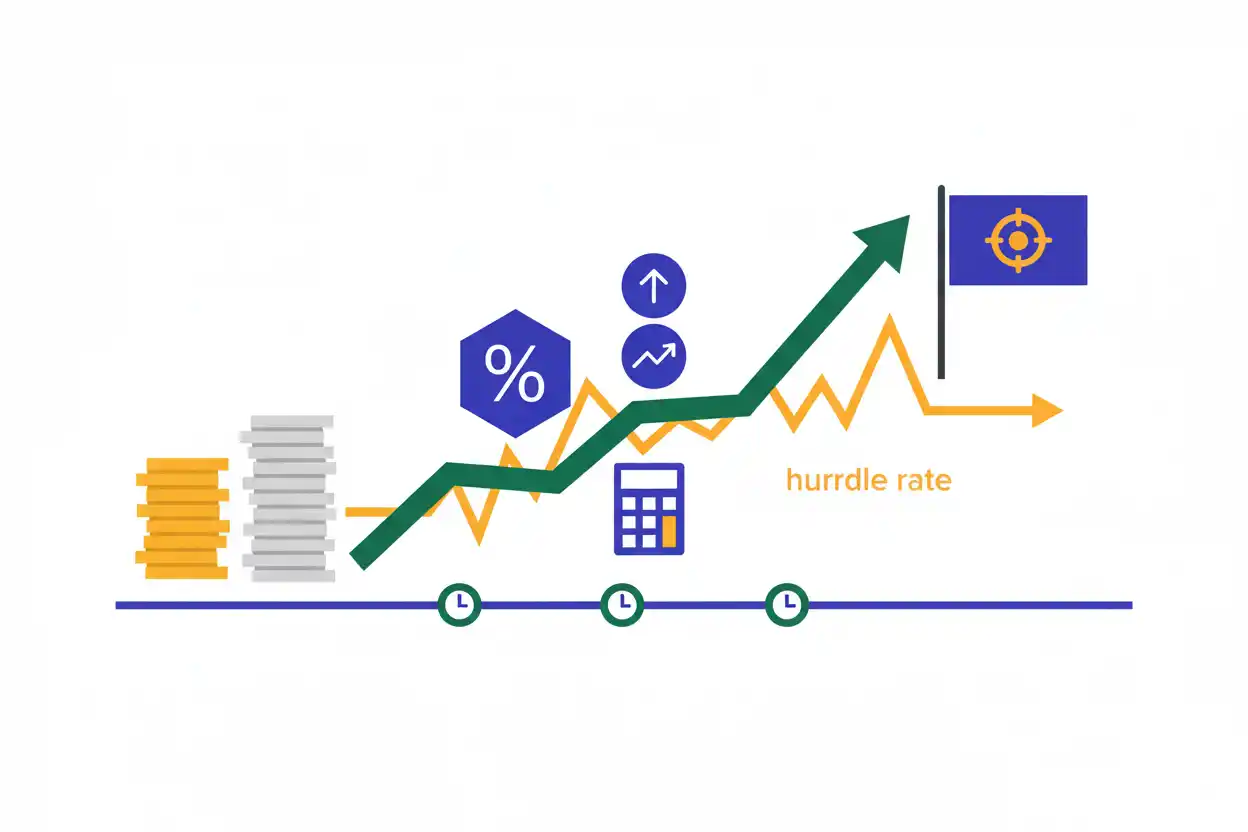
For goal planning, required rate of return can mean the compound annual growth needed to turn today’s money into a future target. In investment valuation, it can mean a hurdle rate used to discount expected cash flows or judge whether an investment offers adequate compensation for risk.
If $100,000 must become $180,000 in 10 years, the required compounded return is approximately 6.05% per year.
That does not mean an investment capable of guaranteeing 6.05% necessarily exists. The calculation identifies the return the goal requires; investment analysis determines whether seeking that return is realistic.
Required Rate of Return Formula for a Future Goal
When present value, future value, and time are known:
Required Return = (Future Value ÷ Present Value)^(1 ÷ Years) − 1
This is the same compound-rate relationship used in CAGR calculations, but the interpretation is forward-looking.
The question is:
What annual compounded return would be required to reach this target?
Required Rate of Return Example
Suppose:
- current portfolio = $100,000;
- future target = $180,000;
- time available = 10 years.
Use:
Required Return = ($180,000 ÷ $100,000)^(1/10) − 1
First:
$180,000 ÷ $100,000 = 1.8
Then:
1.8^(1/10) − 1 ≈ 0.06054
Convert to a percentage:
Required Rate of Return ≈ 6.05%
The portfolio must compound at approximately 6.05% per year under the no-contribution assumption to reach $180,000.
Verify the Result
Future Value = $100,000 × 1.06054¹⁰
≈ $180,000
This confirms that the calculated rate connects the current portfolio with the future target.
Contributions Lower the Required Investment Return
Suppose the investor can also contribute money regularly.
Then the portfolio does not need to generate the entire difference through investment growth.
For example:
- starting portfolio = $100,000;
- target = $180,000;
- contributions = $5,000 annually;
- horizon = 10 years.
The required return would be substantially lower than 6.05% because contributions supply additional capital.
A complete calculation must value both:
- the current lump sum;
- future contributions.
Required Return With No Growth
Sometimes contributions alone can reach the target.
Suppose:
- current savings = $100,000;
- annual contribution = $8,000;
- 10 years;
- target = $180,000.
Ignoring return:
Ending Amount = $100,000 + ($8,000 × 10)
Ending Amount = $180,000
Required investment return:
0%
The target can be reached through savings alone under these simplified assumptions.
Required Return vs Expected Return
These are not the same concept.
Required return: what the goal or investment decision demands.
Expected return: what you estimate the investment may actually earn.
Suppose:
Required Return = 8%
but:
Expected Return = 5%
The investment strategy, contribution plan, target, or time horizon may need to change.
The required rate does not force the market to deliver the desired result.
Required Return as a Hurdle Rate
Businesses and investors can use a required return as a hurdle rate.
Suppose an investment is expected to earn:
9%
while the required return is:
11%
The expected return falls short by:
11% − 9% = 2 percentage points
Under that hurdle-rate framework, the investment would not meet the stated return requirement.
Risk and Required Return
Investors generally require more compensation for assuming additional uncertainty.
A simplified framework is:
Required Return = Risk-Free Component + Risk Premium
Suppose:
- risk-free component = 4%;
- required risk premium = 5%.
Then:
Required Return = 4% + 5%
Required Return = 9%
The risk premium is not guaranteed profit. It represents additional return demanded for accepting risk.
CAPM Required Return
One widely known model is the Capital Asset Pricing Model:
Required Return = Risk-Free Rate + Beta × (Market Return − Risk-Free Rate)
Suppose:
- risk-free rate = 4%;
- beta = 1.2;
- expected market return = 9%.
Market risk premium:
9% − 4% = 5%
Beta-adjusted premium:
1.2 × 5% = 6%
Required return:
4% + 6% = 10%
Under those assumptions, CAPM produces a required return of 10%.
Required Return and Beta
Beta changes the market-risk component of CAPM.
If all other assumptions remain unchanged:
Beta = 0.8:
4% + 0.8 × 5% = 8%
Beta = 1.0:
4% + 1.0 × 5% = 9%
Beta = 1.5:
4% + 1.5 × 5% = 11.5%
A higher beta raises the model’s required return because the investment is assumed to have greater sensitivity to market movements.
Required Return and Inflation
A long-term return target should distinguish nominal and real returns.
Suppose an investor requires:
4% Real Return
and expects:
3% Inflation
The exact nominal rate required is:
Nominal Required Return = (1 + Real Return)(1 + Inflation) − 1
= 1.04 × 1.03 − 1
= 7.12%
Simply adding:
4% + 3% = 7%
provides a close approximation, but the exact result is 7.12%.
The distinction is covered more directly under real return.
Required Return and Rent Affordability
A household should not set rent affordability based on unrealistic investment-return expectations.
Suppose $100,000 of investments is expected to cover $20,000 of annual rent indefinitely.
The implied annual cash need relative to the portfolio is:
$20,000 ÷ $100,000 = 20%
A plan requiring consistent 20% annual portfolio returns should immediately be stress-tested for realism and risk.
Housing expenses should generally be planned from sustainable cash flow rather than an aggressive return assumption.
Required Return and RMDs
Required minimum distributions determine how much must leave certain retirement accounts under tax rules.
Required rate of return determines how much investment growth is needed for a goal.
The words “required” appear in both, but they are unrelated formulas.
For example, an RMD may equal roughly 4% of an account while the portfolio’s long-term required return is 6%.
Neither number automatically determines the other.
Required Return and Retirement Income Gap
A retirement income gap can create a required return problem.
Suppose a household has:
- retirement portfolio = $700,000;
- future annual income gap = $35,000.
If investment growth is expected to help preserve the portfolio while withdrawals occur, the required rate depends on:
- withdrawal timing;
- inflation;
- retirement duration;
- additional income;
- target ending balance.
Simply dividing $35,000 by $700,000 does not produce a complete required-return calculation.
Required Return and Replacement Ratio
A retirement replacement ratio can help estimate target retirement income.
Once that target is known, the required return can be calculated from the portfolio size, future contributions, and time available.
The process is:
- estimate desired retirement income;
- subtract reliable retirement income;
- estimate the portfolio need;
- compare current assets with that target;
- calculate the return required to close the difference.
Longer Time Reduces Required Return
Suppose $100,000 must become $200,000.
In 10 years:
Required Return = 2^(1/10) − 1
≈ 7.18%
In 20 years:
Required Return = 2^(1/20) − 1
≈ 3.53%
Doubling the time horizon reduces the annual return required substantially.
Time can therefore be as important as portfolio selection.
Larger Starting Capital Reduces Required Return
Suppose the future target is $500,000 in 15 years.
Starting with $150,000 requires a higher return than starting with $300,000.
The goal stays unchanged, but the capital gap is smaller when more money is already invested.
This is why saving more today can reduce dependence on uncertain future investment returns.
Lowering the Goal Reduces Required Return
If the required return becomes unrealistic, another option is changing the target.
Suppose:
Required Return = 11%
but a realistic portfolio assumption is substantially lower.
Possible adjustments include:
- reducing the future spending target;
- increasing contributions;
- extending the time horizon;
- delaying withdrawals;
- combining several adjustments.
Taking more investment risk is not the only way to solve a return shortfall.
Required Return After Fees
If an investor needs a 6% net return and investment costs total 0.75% annually in a simplified model:
Required Gross Return ≈ 6% + 0.75%
≈ 6.75%
The exact relationship can be more complex depending on how fees are charged, but costs should not be ignored.
A plan modeled using gross market returns while the investor receives net-of-fee returns will overstate expected progress.
Required Return After Taxes
A taxable investment may also need a higher pre-tax return to produce the required after-tax result.
Suppose the target after-tax return is 5%.
If taxes consume a portion of investment income, the required pre-tax return can be higher.
The exact calculation depends on:
- account type;
- tax rate;
- return source;
- realization timing.
The return target should therefore specify whether it is gross, net, pre-tax, after-tax, nominal, or real.
Negative Required Return
A required return can mathematically be negative.
Suppose:
- current assets = $200,000;
- target in five years = $180,000;
- no withdrawals or contributions.
Then:
Required Return = ($180,000 ÷ $200,000)^(1/5) − 1
The result is negative because the goal can still be reached even if the capital declines modestly.
That does not mean an investor should intentionally seek losses. It means the financial target does not require positive growth.
Required Return Is Not a Forecast
This distinction is fundamental.
Suppose your retirement spreadsheet says:
Required Return = 9%
That does not mean:
Expected Market Return = 9%
The first number is generated by your financial target.
The second must come from an independent, realistic investment assumption.
If required return materially exceeds plausible expected return, the plan needs adjustment.
Common Required Rate of Return Mistakes
One mistake is treating required return as though it were guaranteed.
Another is ignoring contributions.
People may also mix nominal and real returns or use gross returns when the goal requires net returns.
A further mistake is responding to an unrealistic required return only by increasing investment risk rather than reconsidering the goal, savings rate, or time horizon.
Frequently Asked Questions
What is required rate of return?
It is the minimum return needed to satisfy a financial objective or compensate for a specified level of investment risk.
How do I calculate the return needed to reach a future goal?
Required Return = (Future Value ÷ Present Value)^(1 ÷ Years) − 1
What return is needed to grow $100,000 to $180,000 in 10 years?
Approximately 6.05% per year compounded.
Is required return the same as expected return?
No. Required return comes from the goal or valuation framework; expected return is an estimate of what an investment may actually earn.
Do contributions reduce the required return?
Yes. Additional savings reduce the amount of growth that must come from investment performance.
Does more time reduce the return requirement?
Usually yes, because the capital receives more compounding periods.
What is a hurdle rate?
It is a minimum return threshold used to evaluate whether an investment meets specified requirements.
How is inflation incorporated?
Nominal Required Return = (1 + Real Required Return)(1 + Inflation) − 1
Does a high required return mean I should take more risk?
Not automatically. It may indicate that the goal, savings rate, or time horizon should be reconsidered.
Does an RMD determine required investment return?
No. RMDs are tax-rule distributions, while required return is a financial-planning or valuation concept.
Should required return be measured before or after fees?
The calculation should match the actual objective. If the target is net wealth, fees and other costs should be reflected consistently.
Why calculate required return?
It reveals whether financial targets are compatible with current savings, contributions, time horizon, and a realistic Savings & Investing strategy.