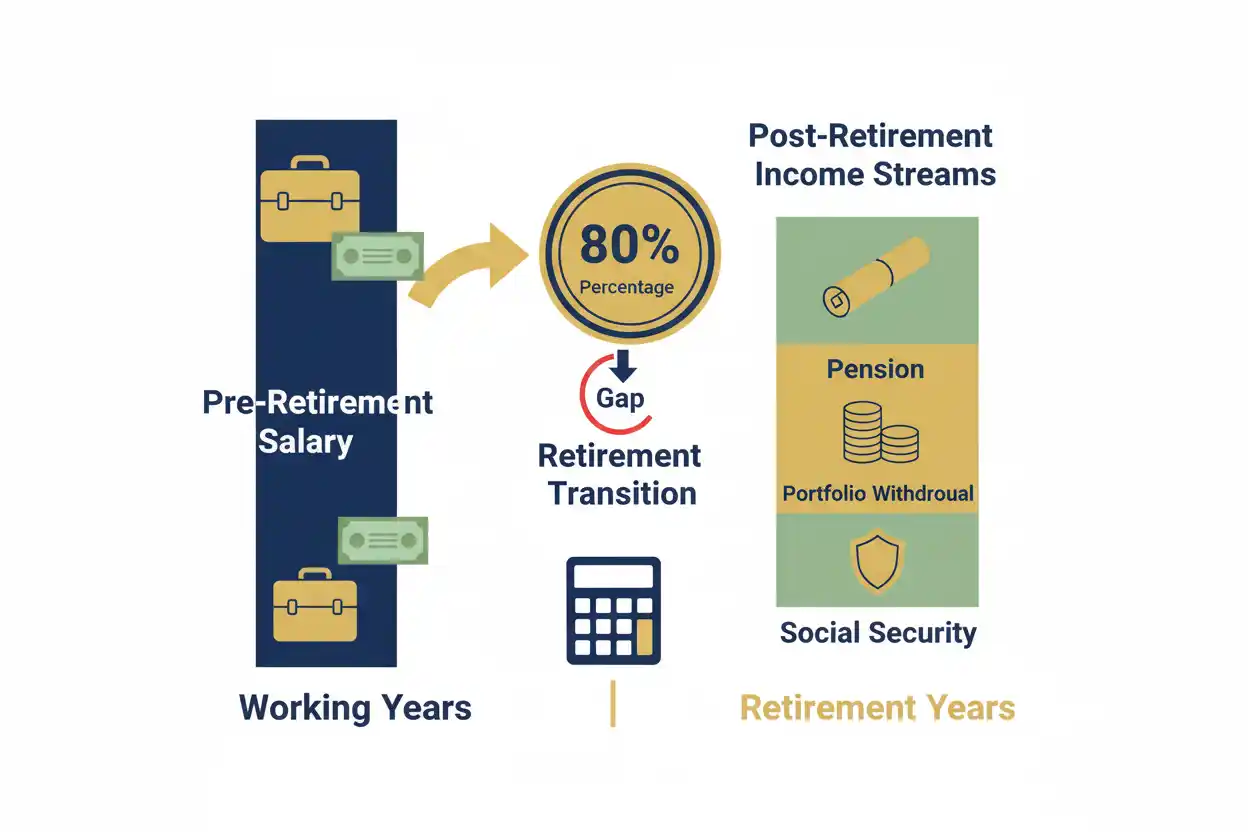

The retirement replacement ratio measures retirement income as a percentage of pre-retirement income.
If someone earns $100,000 before retirement and expects $75,000 of annual retirement income, the replacement ratio is 75%.
The measure provides a quick way to compare working income with retirement income, but it should not be treated as a universal target.
A household that saves aggressively, pays off a mortgage before retirement, or no longer has work-related expenses may need less gross income than before. Another household facing high healthcare, rent, taxes, or travel costs may need more.
What Is a Retirement Replacement Ratio?
The formula is:
Retirement Replacement Ratio = Retirement Income ÷ Pre-Retirement Income × 100
The ratio answers:
What percentage of pre-retirement income is expected to be replaced after retirement?
The numerator can include the retirement-income sources chosen for the analysis, such as:
- pension income;
- retirement-account withdrawals;
- annuity income;
- other retirement cash flow.
The definition should remain consistent across comparisons.
Retirement Replacement Ratio Example
Suppose:
- pre-retirement income = $100,000;
- expected retirement income = $75,000.
Then:
Replacement Ratio = $75,000 ÷ $100,000 × 100
Replacement Ratio = 75%
The plan replaces 75% of pre-retirement income.
Breaking Down the Retirement Income
Suppose the $75,000 consists of:
- pension = $30,000;
- other retirement benefit income = $25,000;
- planned portfolio withdrawals = $20,000.
Total:
$30,000 + $25,000 + $20,000 = $75,000
Replacement ratio:
$75,000 ÷ $100,000 = 75%
This decomposition shows where the replacement income comes from rather than treating $75,000 as one unexplained number.
Replacement Ratio From Multiple Income Sources
Suppose:
- pre-retirement income = $120,000;
- pension = $35,000;
- other reliable income = $28,000;
- planned withdrawals = $25,000.
Total retirement income:
$35,000 + $28,000 + $25,000
= $88,000
Replacement ratio:
$88,000 ÷ $120,000 × 100
≈ 73.33%
The projected replacement ratio is approximately 73.33%.
Why 100% Replacement May Not Be Necessary
Pre-retirement income often funds items that may change or disappear after retirement.
Examples can include:
- retirement-plan contributions;
- commuting;
- payroll taxes tied to employment;
- work clothing;
- professional expenses;
- mortgage payments that may end;
- savings for retirement itself.
Suppose $15,000 of a $100,000 salary is currently saved for retirement.
Once retired, replacing that $15,000 contribution as spending may be unnecessary.
This can reduce the income required to maintain the same lifestyle.
Why Some Households May Need Close to 100%
Retirement can also create or preserve substantial expenses.
Examples include:
- rent;
- healthcare;
- travel;
- supporting family members;
- debt;
- taxes;
- home maintenance.
If most pre-retirement income is already consumed by expenses that continue into retirement, the required replacement ratio could remain high.
There is no universal percentage that automatically applies to every household.
Spending-Based Replacement Ratio
A more personalized approach starts with expected retirement spending.
Suppose:
- pre-retirement income = $100,000;
- retirement spending target = $68,000.
Implied replacement ratio:
$68,000 ÷ $100,000 × 100
= 68%
If the expense forecast is reliable, the 68% ratio is more informative than adopting an arbitrary target first.
Replacement Ratio and Retirement Income Gap
Once a target replacement ratio establishes desired income, calculate the retirement income gap.
Suppose:
Target Retirement Income = $75,000
but dependable income sources provide:
$52,000
Gap:
$75,000 − $52,000
= $23,000
The replacement ratio sets the target.
The income-gap calculation identifies the amount still missing.
Replacement Ratio and Retirement Savings
Retirement savings can help fund the portion of target income not covered by pensions and other sources.
Suppose the $23,000 annual gap is expected to come from investments.
The portfolio required depends on:
- retirement duration;
- investment return;
- inflation;
- withdrawal strategy;
- desired ending balance.
The replacement ratio alone cannot determine how much retirement wealth is required.
Replacement Ratio and Required Rate of Return
A required rate of return can be calculated after the retirement-income target is translated into a portfolio goal.
For example:
- calculate target retirement income;
- subtract reliable income;
- estimate the portfolio needed;
- compare target portfolio with current savings;
- determine the return required to close the gap.
This keeps income planning separate from investment-return assumptions.
Replacement Ratio and Retirement Withdrawals
Retirement withdrawals supply part of retirement income when investment assets are used for spending.
Suppose:
- pre-retirement income = $100,000;
- pension and other income = $55,000;
- portfolio withdrawal = $20,000.
Total:
$75,000
Replacement ratio:
75%
If portfolio withdrawals later need to be reduced, the replacement ratio can decline unless another income source increases.
Replacement Ratio and RMDs
Required minimum distributions can contribute to retirement cash flow, but they are not designed to produce a specific replacement ratio.
Suppose:
- target retirement income = $75,000;
- other income = $55,000;
- RMD = $25,000.
Total available gross income may be:
$80,000
which exceeds the target.
The fact that tax rules require $25,000 to leave the retirement account does not mean all $25,000 must be consumed.
Gross Replacement Ratio
A gross replacement ratio compares gross retirement income with gross pre-retirement income.
Example:
Gross Retirement Income = $75,000
Gross Pre-Retirement Income = $100,000
Gross Replacement Ratio = 75%
This is easy to calculate but may not accurately represent spendable income.
Net Replacement Ratio
A net replacement ratio compares after-tax retirement income with after-tax pre-retirement income.
Suppose:
- pre-retirement take-home income = $72,000;
- retirement after-tax income = $60,000.
Then:
Net Replacement Ratio = $60,000 ÷ $72,000
≈ 83.33%
The gross and net ratios can differ significantly because taxes and payroll deductions change after retirement.
Why Gross and Net Ratios Should Not Be Mixed
Suppose someone compares:
$60,000 after-tax retirement income
with:
$100,000 gross pre-retirement salary
The resulting 60% ratio mixes unlike measurements.
A meaningful ratio should compare:
Gross with Gross
or:
Net with Net
Consistency matters more than which version is chosen.
Housing and Replacement Ratio
Housing often determines whether a lower replacement ratio is realistic.
Household A enters retirement mortgage-free.
Household B continues paying $2,000 monthly rent.
Household B has annual housing costs of:
$2,000 × 12 = $24,000
before utilities and related expenses.
That difference can materially increase the retirement income required.
Healthcare and Replacement Ratio
Healthcare spending can also rise even when work-related expenses disappear.
A household using a broad replacement-ratio shortcut without explicitly estimating healthcare can underestimate retirement income needs.
A detailed budget should therefore validate the percentage target.
Inflation and Replacement Ratios
Suppose retirement begins with:
- income = $75,000;
- pre-retirement reference income = $100,000;
- initial ratio = 75%.
If the retirement income remains fixed while costs increase, the initial 75% nominal replacement ratio does not preserve the same purchasing power indefinitely.
Income sources should be analyzed for inflation adjustment rather than assuming the starting ratio remains economically constant.
Replacement Ratio Over Time
A retirement-income plan can have different replacement ratios at different ages.
For example:
Early Retirement
Income = $60,000
Reference Income = $100,000
Ratio = 60%
Later Retirement After Another Benefit Begins
Income = $75,000
Ratio = 75%
A single lifetime ratio can hide meaningful changes in income timing.
Temporary Work Income
Suppose part-time work provides $20,000 annually during the first five years of retirement.
That income may temporarily raise the replacement ratio.
When work ends, retirement assets may need to cover more of the target.
Modeling separate retirement phases avoids assuming temporary income lasts forever.
Replacement Ratio Is Not a Savings Rate
Suppose someone saves 25% of income before retirement.
That does not mean the replacement ratio should automatically be:
100% − 25% = 75%
because other expenses and taxes also change.
The 75% figure may be a useful starting intuition, but a detailed retirement budget is needed to validate it.
Replacement Ratio Is Not a Withdrawal Rate
A 75% replacement ratio does not mean withdrawing 75% of the investment portfolio.
Suppose:
Replacement Income Needed From Portfolio = $25,000
and:
Portfolio = $700,000
Withdrawal percentage:
$25,000 ÷ $700,000
≈ 3.57%
Income replacement and portfolio withdrawal rates use different denominators.
Retirement Replacement Ratio and Lifestyle Changes
Retirement spending can change intentionally.
Some households expect:
- more travel early in retirement;
- less commuting;
- lower housing expenses later;
- higher healthcare spending at older ages.
A flexible income target can therefore be more realistic than one fixed percentage for every retirement year.
Common Retirement Replacement Ratio Mistakes
One mistake is treating one generic percentage as universally correct.
Another is comparing gross income with net income.
People may also forget that retirement contributions themselves stop after retirement.
A further mistake is assuming a target replacement ratio automatically determines the amount of savings required without considering other retirement income.
Frequently Asked Questions
What is a retirement replacement ratio?
It is retirement income expressed as a percentage of pre-retirement income.
What is the formula?
Retirement Replacement Ratio = Retirement Income ÷ Pre-Retirement Income × 100
What does a 75% replacement ratio mean?
It means projected retirement income equals 75% of the pre-retirement income measure used.
Is 75% the correct target for everyone?
No. The appropriate target depends on spending, taxes, housing, healthcare, savings patterns, and lifestyle.
Should I use gross or net income?
Either can be used, but the numerator and denominator should be measured consistently.
Can my retirement replacement ratio exceed 100%?
Yes. Retirement income can exceed pre-retirement income.
How is the ratio related to the retirement income gap?
The replacement ratio can set the target income; the income gap measures how much of that target remains unfunded.
Is replacement ratio the same as withdrawal rate?
No. Replacement ratio compares income with prior income; withdrawal rate compares portfolio withdrawals with portfolio assets.
Does an RMD determine my replacement ratio?
No. RMDs are mandatory account distributions, not personalized retirement-income targets.
Does inflation matter?
Yes. Fixed retirement income can lose purchasing power over time even if the original replacement ratio appeared adequate.
Why calculate a replacement ratio?
It gives a quick benchmark for comparing retirement income with working income before building a more detailed budget.
What should I do after calculating it?
Validate the target against actual expenses, reliable income, and projected Savings & Investing resources.