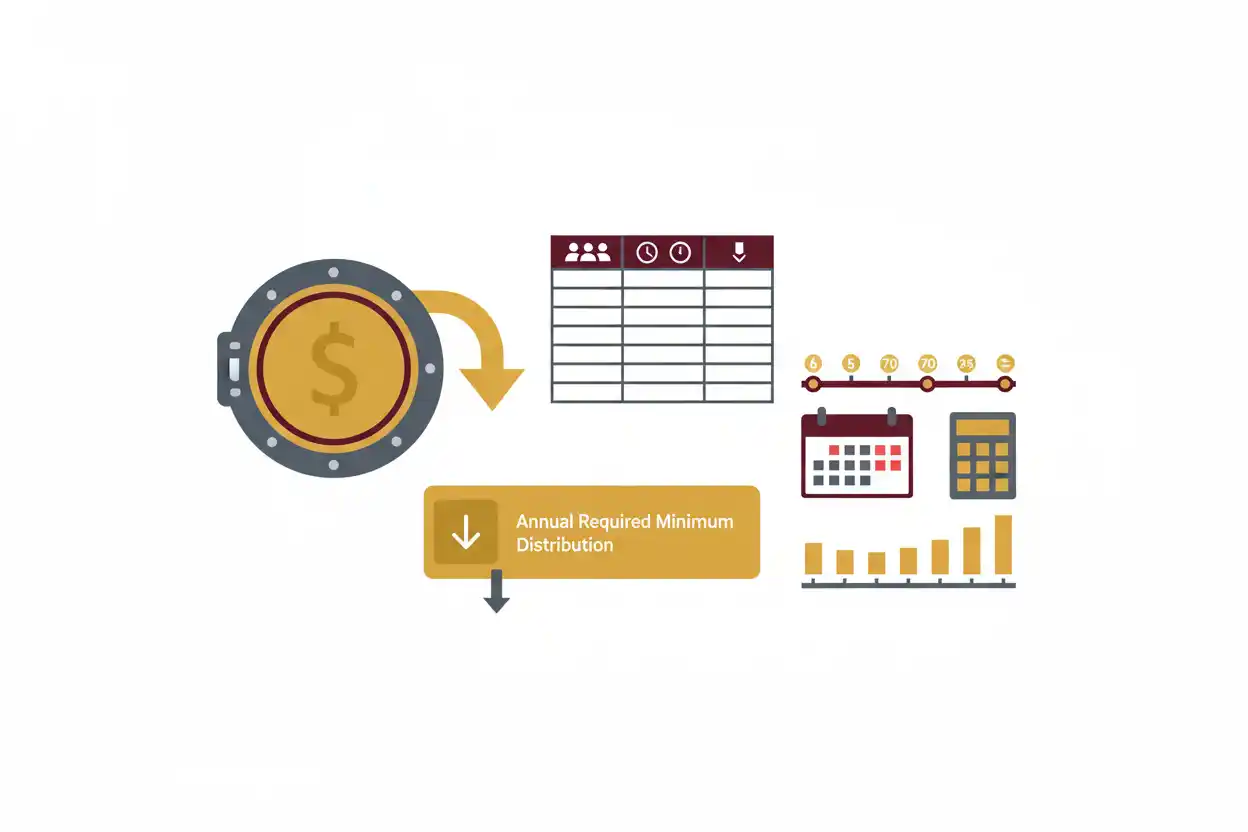

Required minimum distributions, commonly called RMDs, are minimum amounts that certain retirement-account owners must withdraw each year after reaching the applicable starting age.
The basic calculation divides the prior December 31 account balance by an IRS life-expectancy factor.
For example, if a traditional IRA has a prior-year-end balance of $500,000 and the applicable distribution factor is 24.6, the calculated RMD is approximately $20,325.20.
RMD rules are tax rules, not retirement-spending recommendations. A retiree may need more or less cash than the required amount for living expenses, and the required distribution can differ substantially from a sustainable portfolio-withdrawal plan.
What Are Required Minimum Distributions?
Required minimum distributions are mandatory withdrawals from retirement accounts that are subject to federal RMD rules.
For an IRA owner, the calculation generally starts with:
RMD = Prior December 31 Account Balance ÷ Applicable Distribution Period
The distribution period comes from the appropriate IRS life-expectancy table.
The most commonly used table for an IRA owner is the Uniform Lifetime Table, although a different table can apply when the owner’s spouse is the sole beneficiary and is more than 10 years younger.
Which Retirement Accounts Can Have RMDs?
RMD rules can apply to retirement arrangements such as:
- traditional IRAs;
- SEP IRAs;
- SIMPLE IRAs;
- 401(k) plans;
- 403(b) plans;
- certain other employer retirement plans.
Roth IRAs owned by the original owner do not require lifetime RMDs under current federal rules. Designated Roth accounts in employer plans also no longer have lifetime RMDs for the owner.
Inherited retirement accounts have separate beneficiary rules and should not automatically be analyzed using the owner’s ordinary RMD schedule.
When Do RMDs Start?
Under current rules in 2026, age 73 is the relevant required beginning age for people entering the RMD system now.
Federal law also schedules a later transition to age 75 for later birth cohorts, so someone planning many years ahead should verify the age applicable to their date of birth rather than assuming today’s age threshold will apply unchanged.
For traditional IRA owners, the first RMD is generally associated with the calendar year in which the applicable starting age is reached.
First RMD Deadline
The first RMD can generally be delayed until:
April 1 of the following calendar year
However, delaying the first RMD does not delay the second one.
The next RMD is generally due by:
December 31 of that same following year
This can cause two taxable RMDs in one calendar year.
Two-RMD-Year Example
Suppose an IRA owner reaches the applicable RMD age in Year 1.
The first distribution can generally be taken:
By April 1 of Year 2
The Year 2 RMD must generally still be taken:
By December 31 of Year 2
If the first distribution is delayed, Year 2 can therefore contain:
- the delayed Year 1 RMD;
- the regular Year 2 RMD.
That can increase taxable income for that calendar year.
RMD Formula
The standard owner calculation is:
Required Minimum Distribution = Prior-Year December 31 Balance ÷ IRS Distribution Period
Suppose:
- December 31, 2025 IRA balance = $500,000;
- applicable 2026 distribution factor = 24.6.
Then:
RMD = $500,000 ÷ 24.6
RMD ≈ $20,325.20
The required minimum distribution is approximately $20,325.20.
Why the Prior-Year Balance Is Used
A 2026 RMD generally begins with the account value measured on:
December 31, 2025
not the balance on the day the withdrawal is actually made.
If the market rises or falls during 2026, that does not ordinarily replace the prior-year-end balance used in the original RMD calculation.
The current account value matters for portfolio management, but the RMD formula uses the required tax-rule measurement date.
Life-Expectancy Factors
The denominator declines as age increases.
A smaller denominator applied to the same account balance produces a larger required percentage withdrawal.
For example:
$500,000 ÷ 25 = $20,000
while:
$500,000 ÷ 20 = $25,000
The second calculation requires a larger distribution because the denominator is smaller.
RMD as an Implied Percentage
The distribution factor can also be converted into an approximate withdrawal percentage.
For a factor of 24.6:
Implied Percentage = 1 ÷ 24.6
≈ 4.065%
Therefore, a $500,000 account with that factor produces:
$500,000 × 4.065% ≈ $20,325
The official calculation is still based on dividing by the applicable factor.
Multiple Traditional IRAs
If someone owns several traditional IRAs, the RMD generally needs to be calculated separately for each account.
Suppose:
- IRA A RMD = $8,000;
- IRA B RMD = $6,000;
- IRA C RMD = $4,000.
Total:
Total IRA RMD = $8,000 + $6,000 + $4,000
Total IRA RMD = $18,000
For qualifying IRA aggregation, that total may generally be withdrawn from one or more of those IRAs rather than taking the exact calculated amount from each individual IRA.
Employer-plan aggregation rules differ, so the IRA approach should not automatically be applied to every retirement account.
Example of IRA Aggregation
Suppose three traditional IRAs have combined required distributions totaling $18,000.
The owner could potentially take:
- $18,000 from one IRA;
- $9,000 from two IRAs;
- another combination totaling $18,000.
The important point is satisfying the total requirement under the applicable aggregation rules.
The owner still needs to calculate each individual IRA’s RMD before determining the total.
Taking More Than the RMD
An account owner can generally withdraw more than the required minimum.
Suppose:
Required RMD = $20,325
but the owner withdraws:
$30,000
The current year’s RMD has been satisfied.
However, the extra:
$30,000 − $20,325 = $9,675
does not normally reduce the required minimum distribution for the following year.
Each year’s RMD is calculated separately.
Can an RMD Be Rolled Over?
A required minimum distribution is generally not eligible to be rolled over into another tax-deferred retirement account.
That means the RMD portion should generally be separated from any otherwise rollover-eligible distribution.
For someone moving retirement assets between accounts, identifying the required amount first can prevent an attempted rollover of money that was required to be distributed.
How RMDs Are Taxed
Traditional retirement-account RMDs are generally included in taxable income to the extent the distribution consists of taxable amounts.
An account with nondeductible basis can have different tax treatment for part of the distribution.
The tax calculation is therefore not always:
RMD × Marginal Tax Rate
without further analysis.
The distribution amount and the taxable portion are related but distinct.
Roth IRA RMD Rules
An original Roth IRA owner does not have lifetime RMDs under current federal rules.
That makes Roth IRA distribution planning different from traditional IRA distribution planning.
However, Roth beneficiaries can be subject to inherited-account distribution rules after the owner’s death.
“Roth has no RMD” should therefore be understood as an owner-lifetime rule, not a universal rule applying to every inherited Roth account.
Employer Plan Still-Working Rule
Certain employer retirement plans can allow a participant to postpone RMD commencement until retirement if the plan permits and the participant qualifies for the exception.
Traditional IRAs do not generally receive the same still-working postponement.
Plan documents matter because employer plans can impose requirements beyond the broad federal timing framework.
The 5% Owner Exception
Certain owners of more than 5% of the business sponsoring a qualified retirement plan generally cannot use the same still-working delay that may be available to other employees.
This is another reason IRA and employer-plan RMD rules should not be treated as identical.
Missed RMD Example
Suppose:
Required RMD = $20,000
but only:
$15,000
is withdrawn by the deadline.
Shortfall:
$20,000 − $15,000 = $5,000
The potential excise tax applies to the amount that should have been distributed but was not, subject to current correction and relief provisions.
Current federal rules generally provide a 25% excise-tax rate on an RMD shortfall, with a reduced 10% rate potentially available when the shortfall is corrected within the applicable correction window.
Why Missing an RMD Can Be Expensive
Using the $5,000 shortfall example:
At 25%:
Potential Excise Tax = $5,000 × 25%
= $1,250
At a reduced 10% rate, where requirements are met:
$5,000 × 10% = $500
Because tax rules include correction procedures and possible waiver provisions for reasonable error, an actual missed-RMD situation should be addressed promptly rather than assumed to produce one automatic penalty amount.
RMDs and Retirement Income Gap
A required distribution can help cover a retirement income gap, but the two numbers are not designed to match.
Suppose:
- annual retirement spending need = $70,000;
- pension and other reliable income = $45,000.
Income gap:
$70,000 − $45,000 = $25,000
If the RMD is only $20,325, the household still needs another:
$25,000 − $20,325 = $4,675
from other resources.
Conversely, the RMD could exceed the amount actually needed for spending.
RMDs and Required Rate of Return
A required rate of return answers how much investment growth is needed to reach a target.
An RMD answers how much must be distributed under retirement-account tax rules.
A retiree should not assume a portfolio must earn a return equal to the RMD percentage every year.
Portfolio sustainability depends on:
- withdrawals;
- investment returns;
- inflation;
- taxes;
- time horizon;
- asset allocation.
RMDs and Real Return
Real return measures investment performance after inflation.
RMD amounts are calculated from account values and regulatory distribution factors, not from the account’s real return.
A portfolio can have:
- a required distribution of 4%;
- a real return of −2%;
in the same year.
That combination would reduce real account value more sharply than a strong-return year.
RMDs and Rent Affordability
A retiree might use retirement-account withdrawals to cover housing costs, including rent affordability needs.
However, the amount legally required to leave an account should not be treated automatically as a comfortable housing budget.
Rent decisions should still be based on:
- after-tax income;
- other essential expenses;
- portfolio sustainability;
- emergency liquidity.
RMDs and Real Estate Income
A retiree receiving income from rental property may use real estate deal math to estimate NOI and cash flow.
That external income can reduce reliance on retirement-account withdrawals for spending.
It does not generally reduce the RMD itself.
RMD rules are based on covered retirement-account balances and applicable distribution factors rather than the retiree’s outside cash-flow needs.
RMDs and Retirement Planning
RMD planning can affect:
- taxable income;
- account balances;
- asset allocation;
- charitable-giving strategies where applicable;
- withdrawal sequencing;
- cash reserves.
A retiree who waits until the deadline to think about the distribution can lose flexibility.
Calculating the required amount early in the year provides more time to decide which assets to sell or distribute.
Market Declines and RMDs
Suppose a retirement account was worth $500,000 on December 31.
The following year it falls to $400,000 before the RMD is taken.
If the RMD was calculated as $20,325 from the prior-year-end balance, withdrawing the required amount now represents:
$20,325 ÷ $400,000
≈ 5.08%
of the lower current balance.
This illustrates how market declines can make RMD withdrawals feel larger relative to current wealth.
RMDs Do Not Determine Spending
A retiree can distribute an RMD from a traditional retirement account without necessarily spending every dollar.
After satisfying the distribution requirement and applicable taxes, unused money can potentially remain in ordinary savings or be invested in a taxable account according to the person’s plan.
The requirement is to distribute the money from the covered retirement account—not necessarily to consume it.
RMDs and Withholding
Retirement distributions can be subject to income-tax withholding.
A retiree may use withholding from retirement distributions as part of tax-payment planning.
The gross RMD, tax withholding, and net cash received should be distinguished.
For example:
Gross Distribution = $20,000
Tax Withheld = $4,000
Net Cash Received = $16,000
The gross distribution amount, not merely the net deposit to the bank account, is relevant to satisfying the distribution requirement.
Inherited Accounts Are Different
Inherited IRA and retirement-plan RMD rules depend on details such as:
- whether the beneficiary is a spouse;
- whether the beneficiary qualifies as an eligible designated beneficiary;
- the owner’s date of death;
- whether death occurred before or after the required beginning date;
- account type.
The beneficiary rules should therefore be analyzed separately rather than assuming the original owner’s lifetime formula continues unchanged.
Common RMD Mistakes
A common mistake is using the current account balance rather than the required prior-year-end balance.
Another is assuming excess distributions this year reduce next year’s RMD.
People can also mistakenly roll over an RMD or assume every retirement account can be aggregated together.
A further mistake is delaying the first RMD until April without recognizing that another RMD may still be due by December 31 of the same year.
Frequently Asked Questions
What are required minimum distributions?
Required minimum distributions are minimum withdrawals that must be taken from certain retirement accounts under federal tax rules.
What is the basic RMD formula?
RMD = Prior December 31 Account Balance ÷ Applicable IRS Distribution Period
When do RMDs currently start?
For people entering the RMD system under current 2026 rules, age 73 is the relevant starting age. Federal law schedules a later transition to age 75 for later cohorts.
When is the first RMD due?
The first RMD can generally be delayed until April 1 of the following year.
When are later RMDs due?
Subsequent RMDs are generally due by December 31 each year.
Can delaying the first RMD create two distributions in one year?
Yes. The delayed first RMD and the following year’s RMD can both fall in the same calendar year.
Do Roth IRAs have lifetime RMDs?
Not for the original Roth IRA owner under current federal rules. Inherited Roth accounts have separate beneficiary rules.
Can I take more than my RMD?
Yes, but the excess generally does not count toward a future year’s RMD.
Can I roll an RMD into another retirement account?
The required distribution amount is generally not rollover eligible.
What happens if I miss an RMD?
A shortfall can be subject to an excise tax. Current rules generally use a 25% rate, potentially reduced to 10% when correction requirements are satisfied.
Does my RMD equal the amount I should spend?
No. RMD rules determine mandatory distributions, not a personalized spending level.
Why are RMDs important in retirement planning?
They can affect taxes, withdrawals, asset sales, and portfolio cash flow throughout a broader Savings & Investing plan.