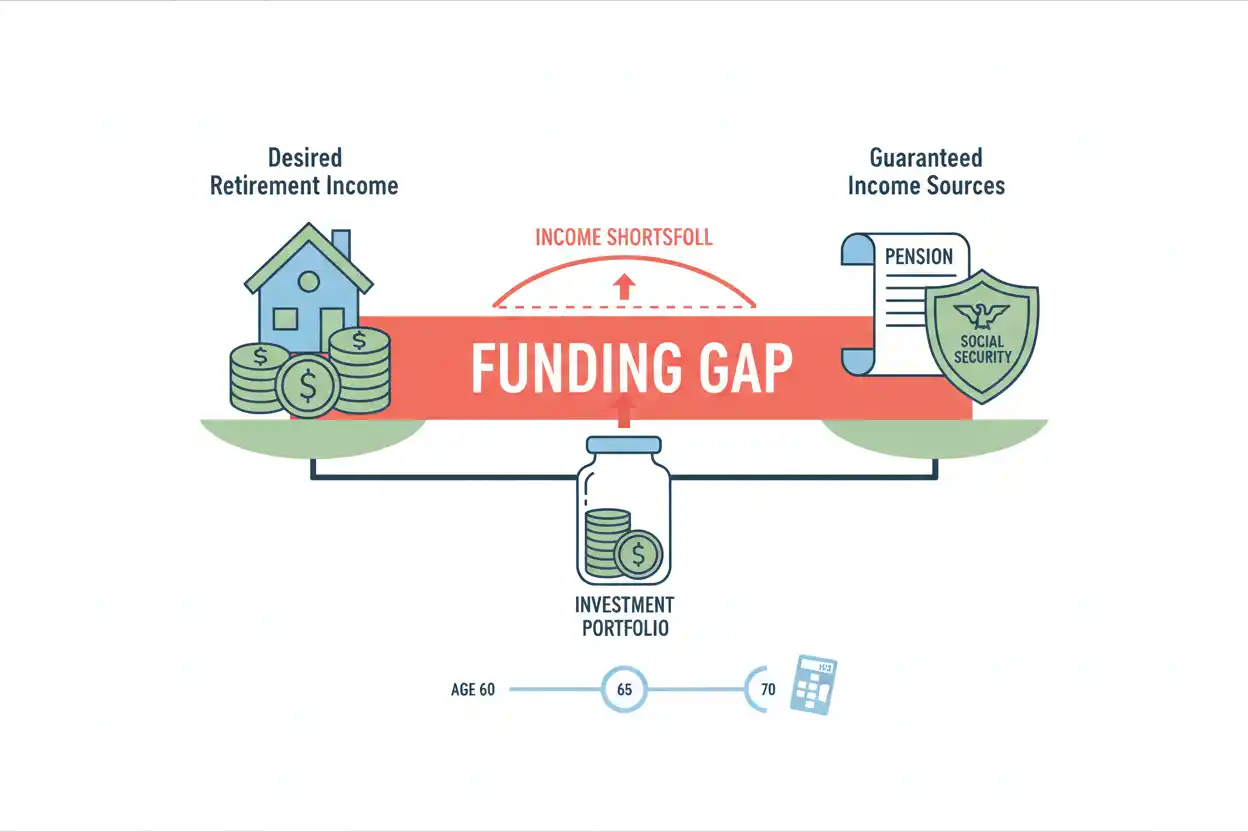

A retirement income gap is the difference between the income you expect to need in retirement and the reliable or planned income expected from sources outside the investment portfolio being analyzed.
Suppose a household wants $67,500 of annual retirement income but expects $42,000 from pensions and other dependable sources.
The retirement income gap is:
$67,500 − $42,000 = $25,500 per year
That $25,500 shortfall must be addressed through retirement savings, additional income, lower spending, or a combination of strategies.
What Is a Retirement Income Gap?
The retirement income gap answers:
How much annual retirement spending is not already covered by expected income?
The basic formula is:
Retirement Income Gap = Target Retirement Income − Expected Retirement Income
If expected income exceeds the target:
Retirement Income Gap = $0
for basic shortfall planning, although the household would instead have projected surplus income.
Retirement Income Gap Example
Suppose:
- pre-retirement income = $90,000;
- target retirement replacement ratio = 75%.
Target retirement income:
$90,000 × 75% = $67,500
Expected annual income:
- pension = $24,000;
- other reliable income = $18,000.
Total:
$24,000 + $18,000 = $42,000
Income gap:
$67,500 − $42,000 = $25,500
The household needs approximately $25,500 per year from other resources to reach its target.
Monthly Retirement Income Gap
Convert the annual gap to a monthly amount:
Monthly Gap = Annual Gap ÷ 12
$25,500 ÷ 12
= $2,125
The household needs approximately $2,125 per month beyond the expected $42,000 annual income.
Retirement Income Gap vs Replacement Ratio
The retirement replacement ratio helps estimate how much retirement income is desired relative to pre-retirement income.
The retirement income gap begins after that target has been established.
The sequence is:
Pre-Retirement Income → Target Retirement Income → Expected Income → Income Gap
The two calculations should not be collapsed into one.
Spending-Based Income Gap
A replacement ratio is not the only way to establish target retirement income.
A household can instead build a retirement budget directly.
Suppose expected annual retirement expenses are:
- housing = $24,000;
- food = $10,000;
- transportation = $6,000;
- healthcare = $12,000;
- taxes = $8,000;
- travel and discretionary spending = $10,000.
Total:
Target Spending = $70,000
If reliable annual income is $45,000:
Income Gap = $70,000 − $45,000
Income Gap = $25,000
A spending-based calculation can be more personalized than applying one broad replacement percentage.
Gross vs After-Tax Income Gap
Income and spending should be measured consistently.
Suppose retirement spending requires:
$60,000 after tax
but pension income of:
$40,000
is quoted before tax.
Subtracting:
$60,000 − $40,000
mixes net and gross numbers.
A better analysis either converts both to:
- pre-tax terms; or
- after-tax terms.
Tax consistency can materially change the retirement income gap.
Inflation and the Income Gap
Suppose the current estimated annual gap is:
$25,500
and the gap grows with 3% inflation for 15 years.
Future nominal gap:
$25,500 × 1.03¹⁵
≈ $39,728.39
A gap measured in today’s dollars can become much larger in nominal future dollars.
Retirement planning should therefore distinguish between:
- today’s purchasing power;
- future nominal spending.
Income Sources That May Reduce the Gap
Depending on the household, expected retirement income can include:
- pension benefits;
- annuity income;
- government retirement benefits;
- rental income;
- part-time employment;
- other dependable cash flows.
The reliability, inflation protection, tax treatment, and duration of each source matter.
A temporary income stream should not automatically be treated as lifelong retirement income.
Pension Income Example
Suppose annual target income is:
$75,000
and pension income is:
$30,000
Other reliable income is:
$20,000
Total reliable income:
$50,000
Gap:
$75,000 − $50,000
= $25,000
If the pension has no inflation adjustment while expenses rise, the gap can widen over time.
Portfolio Needed to Cover the Gap
A quick planning estimate divides the annual gap by an assumed initial withdrawal percentage.
Suppose:
- annual gap = $25,500;
- illustrative withdrawal assumption = 4%.
Then:
Estimated Portfolio = $25,500 ÷ 0.04
Estimated Portfolio = $637,500
This is a rough planning estimate, not a guarantee that $637,500 will fund the gap indefinitely.
Investment returns, inflation, taxes, retirement length, and withdrawal timing all matter.
Portfolio Estimate at Different Withdrawal Assumptions
For a $25,500 annual gap:
At 5%:
$25,500 ÷ 0.05 = $510,000
At 4%:
$637,500
At 3.5%:
$25,500 ÷ 0.035 ≈ $728,571
At 3%:
$25,500 ÷ 0.03 = $850,000
A lower withdrawal assumption requires a larger portfolio.
This sensitivity should be visible in retirement planning rather than hidden behind one number.
Retirement Income Gap and Retirement Savings
Once the target portfolio has been estimated, compare it with projected retirement savings.
Suppose:
Target Portfolio = $637,500
and projected savings at retirement are:
$520,000
Funding shortfall:
$637,500 − $520,000
= $117,500
The plan can then evaluate additional contributions, more time, lower spending, or a different retirement date.
Income Gap vs Savings Gap
These are different:
Income gap: annual retirement cash-flow shortfall.
Savings gap: difference between projected retirement assets and the assets estimated to support the desired income.
For example:
Income Gap = $25,500 per year
might correspond under one planning assumption to:
Savings Gap = $117,500
Both numbers are useful, but they should not be used interchangeably.
Required Rate of Return to Close the Savings Gap
A required rate of return can show how much investment growth is needed to reach the portfolio target.
Suppose:
- current retirement assets = $350,000;
- target = $637,500;
- 10 years remain;
- no additional contributions.
Required return:
Required Return = ($637,500 ÷ $350,000)^(1/10) − 1
The result is approximately 6.17% per year.
If that requirement is too aggressive for the chosen portfolio, additional savings or plan changes may be needed.
Contributions Can Close the Gap Without Extreme Returns
Suppose the required rate appears too high.
Instead of taking more risk, a household could:
- increase annual retirement contributions;
- delay retirement;
- reduce target spending;
- increase part-time income;
- pay down major expenses before retirement.
The goal is not to maximize required return.
It is to create a plan that can plausibly fund the desired lifestyle.
Required Minimum Distributions and Income Gap
Required minimum distributions can provide retirement cash flow, but they are determined by tax rules rather than spending needs.
Suppose:
- annual income gap = $25,500;
- RMD = $20,000.
The RMD covers most but not all of the gap.
Remaining amount:
$25,500 − $20,000 = $5,500
If the RMD exceeds the spending gap, the retiree is not necessarily required to spend the excess.
Rent Affordability and Retirement Income Gap
Housing can be a major driver of the gap.
If retirement includes renting, rent affordability should be modeled using future housing costs rather than simply copying today’s rent.
Suppose future rent increases by $500 per month relative to the original plan.
Annual increase:
$500 × 12 = $6,000
The retirement income gap rises by $6,000 unless another expense or income source changes.
Debt at Retirement
A mortgage, vehicle loan, or other debt can increase required retirement income.
Suppose a household’s retirement budget includes $1,200 of monthly debt payments.
Annual amount:
$1,200 × 12 = $14,400
If the debt can be repaid before retirement without compromising other goals, the required retirement income might decline materially.
The tradeoff depends on interest rates, liquidity, taxes, and available assets.
Healthcare Costs
Healthcare can create a retirement income gap even when other living expenses decline.
A strong budget should consider:
- insurance premiums;
- deductibles;
- ongoing treatment;
- dental and vision expenses;
- long-term-care risk where relevant.
Using one replacement ratio without checking these costs can underestimate the actual gap.
Income That Ends Later
Suppose part-time income of $15,000 per year is expected for the first five years of retirement.
During those years:
Gap = Target Income − Pension − Part-Time Income − Other Income
After the part-time work ends, the gap increases by $15,000.
Retirement should therefore be modeled as multiple phases when income sources change over time.
Income That Starts Later
The reverse can also happen.
Suppose pension benefits begin immediately but another retirement-income source does not begin for several years.
The early-retirement income gap can be larger than the later gap.
A single lifetime-average gap can hide this timing problem.
Retirement Income Gap and Inflation Protection
Two $30,000 annual income sources are not economically identical if:
- one rises with inflation;
- the other remains fixed.
Over a long retirement, the fixed payment loses purchasing power.
Income-gap planning should therefore examine whether each income source is:
- fixed;
- inflation-adjusted;
- market-dependent.
Sequence Risk
Even when average investment returns appear sufficient, poor returns early in retirement can make portfolio withdrawals more difficult to sustain.
The gap must be funded every year regardless of market performance.
This is one reason the simple:
Gap ÷ Withdrawal Rate
calculation should be treated as a starting estimate rather than a complete retirement model.
Retirement Income Surplus
Suppose:
- target retirement income = $60,000;
- reliable income = $68,000.
Then:
Income Gap = $60,000 − $68,000
= −$8,000
For practical gap reporting, this can be described as:
$0 Gap and $8,000 Projected Surplus
The surplus can potentially support saving, gifting, discretionary spending, or a larger emergency reserve.
Common Retirement Income Gap Mistakes
One mistake is comparing after-tax spending with pre-tax income.
Another is ignoring inflation.
People can also assume every income source begins at retirement and continues unchanged for life.
A further mistake is treating a rough portfolio-multiple rule as a guarantee instead of stress-testing the plan.
Frequently Asked Questions
What is a retirement income gap?
It is the difference between target retirement income and the income expected from other sources.
What is the formula?
Retirement Income Gap = Target Retirement Income − Expected Retirement Income
How do I calculate the monthly gap?
Monthly Gap = Annual Gap ÷ 12
What if expected income exceeds my target?
There is no income shortfall; the difference can be treated as projected surplus.
Should I use a replacement ratio or retirement budget?
Either can establish a starting target, but a detailed expense budget is generally more personalized.
How do I estimate the portfolio needed for the gap?
A rough model is:
Portfolio Estimate = Annual Gap ÷ Assumed Withdrawal Rate
but the result should be stress-tested.
Does an RMD equal my retirement income gap?
No. RMDs are tax-rule withdrawals and can be higher or lower than spending needs.
Does inflation increase the gap?
It can, especially when expenses rise while some retirement income remains fixed.
Do taxes matter?
Yes. Compare retirement income and spending on a consistent pre-tax or after-tax basis.
Can working longer reduce the income gap?
Yes. It can add savings, shorten the withdrawal period, and potentially increase some retirement benefits.
Can paying off debt reduce the gap?
Yes, if doing so sustainably reduces future retirement expenses.
Why calculate the gap?
It converts a broad retirement goal into a specific annual cash-flow need that can guide the wider Savings & Investing plan.