
A Roth IRA is a U.S. individual retirement arrangement funded with nondeductible contributions that can provide tax-free qualified distributions when applicable requirements are satisfied.
The account itself does not generate a specific rate of return. Growth depends on the investments held inside it.
For 2026, the combined contribution limit across traditional and Roth IRAs is $7,500, or $8,600 for someone age 50 or older, subject to taxable compensation and Roth IRA income-eligibility rules.
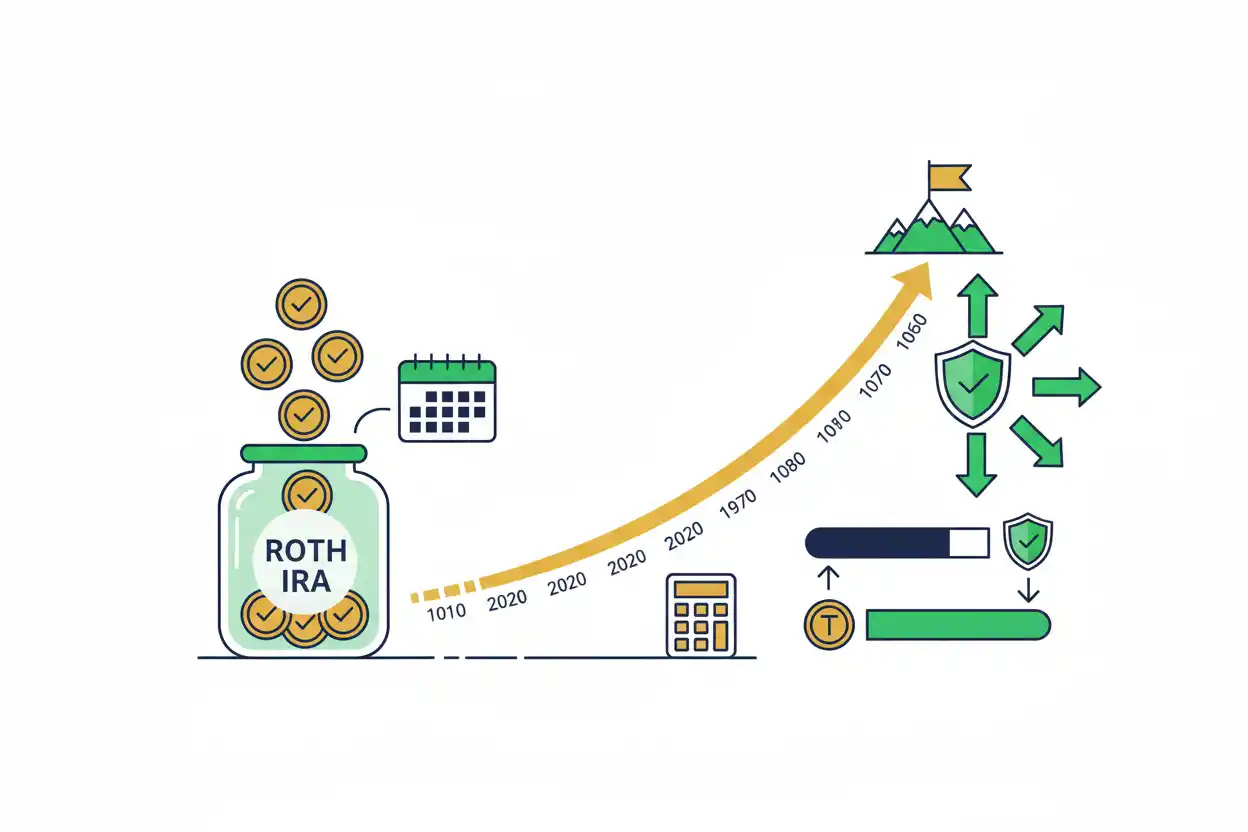
If $7,500 is contributed at the end of every year for 30 years and earns a hypothetical 7% annual return, the contributions grow to approximately $708,456.
What Is a Roth IRA?
A Roth IRA is an individual retirement account with a different tax structure from a traditional IRA.
Regular Roth IRA contributions are generally made with money that has already been taxed and are not deductible.
When a Roth IRA distribution qualifies under federal rules, both eligible contributions and investment earnings can be distributed tax-free.
That makes tax treatment one of the account’s defining characteristics.
A Roth IRA Is Not an Investment
Opening a Roth IRA does not automatically invest the contribution.
Money inside the account may potentially be allocated to investments offered or permitted through the account provider.
Therefore:
Roth IRA = Account Structure
while:
Stocks, Bonds, Funds, Cash, etc. = Investments Held Inside the Account
An uninvested contribution sitting in cash will not produce the same growth as a diversified investment portfolio merely because it is inside a Roth IRA.
2026 Roth IRA Contribution Limit
For 2026, the total contribution across an individual’s traditional and Roth IRAs is generally limited to the lesser of:
$7,500
or:
Taxable Compensation for the Year
For someone age 50 or older, the 2026 IRA catch-up contribution is $1,100, producing a combined maximum of:
$8,600
subject to the applicable rules.
The Limit Is Shared Across Traditional and Roth IRAs
Suppose someone under age 50 contributes in 2026:
$3,000 to a Traditional IRA
The remaining amount available under the $7,500 combined IRA limit is:
$7,500 − $3,000
= $4,500
assuming the individual otherwise qualifies to make the Roth contribution.
The person generally cannot contribute $7,500 to each account separately.
Roth IRA Income Limits for 2026
Direct Roth IRA contribution eligibility is also affected by modified adjusted gross income and filing status.
For 2026, the IRS Roth IRA contribution phaseout range is:
- $153,000 to $168,000 for single taxpayers and heads of household;
- $242,000 to $252,000 for married couples filing jointly;
- $0 to $10,000 for married individuals filing separately who lived with a spouse during the year.
Above the applicable phaseout ceiling, a direct Roth IRA contribution is not permitted under the ordinary contribution rules.
Why Income Phaseouts Matter
Suppose a single taxpayer has modified AGI below the applicable lower threshold and sufficient taxable compensation.
The full contribution may be available.
Inside the phaseout range, the maximum Roth contribution is reduced.
At or above the upper threshold, the permitted direct Roth contribution falls to zero.
Therefore:
Annual IRA Limit ≠ Automatically Permitted Roth Contribution
Both the general limit and Roth-specific income eligibility must be checked.
Roth IRA Growth Formula
A single existing balance can be projected using:
Future Value = Current Balance × (1 + Return)^Years
Suppose:
- Roth IRA balance = $50,000;
- hypothetical return = 7%;
- period = 25 years.
Then:
Future Value = $50,000 × 1.07²⁵
Future Value ≈ $271,371.63
The existing $50,000 grows to approximately $271,372 under the constant-return assumption.
Growth of Annual Contributions
For equal end-of-year contributions:
FV = Contribution × [(1 + r)^n − 1] ÷ r
Suppose $7,500 is contributed annually for 30 years at a hypothetical 7%.
FV = $7,500 × [(1.07)³⁰ − 1] ÷ 0.07
FV ≈ $708,455.90
Total contributions:
$7,500 × 30 = $225,000
Modeled growth:
$708,455.90 − $225,000
≈ $483,455.90
Compounding produces more than twice the amount directly contributed under these assumptions.
20-Year Contribution Example
At $7,500 annually for 20 years and 7%:
Future Value ≈ $307,466.19
Total contributions:
$7,500 × 20 = $150,000
Modeled investment growth:
$307,466.19 − $150,000
≈ $157,466.19
The length of the investment period strongly affects the proportion of the final balance created by compounding.
40-Year Contribution Example
At the same $7,500 contribution and 7% hypothetical return for 40 years:
Future Value ≈ $1,497,263.34
Total contributions:
$7,500 × 40 = $300,000
Modeled growth:
≈ $1,197,263.34
This does not imply that a future Roth IRA will actually earn 7% every year or that contribution limits will remain $7,500 for four decades.
The calculation isolates the compounding effect.
Existing Balance Plus Contributions
Suppose:
- existing Roth balance = $50,000;
- annual contribution = $7,500;
- years = 25;
- hypothetical annual return = 7%.
Existing balance future value:
$50,000 × 1.07²⁵ ≈ $271,371.63
Future value of contributions:
≈ $474,367.78
Combined:
$271,371.63 + $474,367.78
≈ $745,739.41
The modeled ending Roth IRA is approximately $745,739.
Contribution Timing Matters
The annuity examples assume contributions occur at the end of each year.
If the same contribution is made at the beginning of each year, every payment gets one extra year of growth.
At a positive return:
Beginning-of-Year FV = End-of-Year FV × (1 + r)
Earlier contributions generally have more time to compound.
Roth IRA Contributions vs Earnings
It is important to distinguish:
Regular contributions: money originally contributed.
Conversions: amounts moved into Roth status from eligible pre-tax or other retirement arrangements.
Earnings: investment growth generated inside the account.
These categories can receive different distribution treatment under federal rules.
Qualified Roth IRA Distributions
A Roth IRA distribution is generally qualified when the applicable five-year requirement has been satisfied and the distribution meets an additional qualifying condition, such as being made at or after age 59½, because of disability, after death, or for a qualifying first-home distribution within the applicable lifetime limit.
Qualified distributions are generally not included in gross income.
The Five-Year Rule
For qualified-distribution purposes, the Roth IRA five-year period generally begins with the first tax year for which a contribution was made to a Roth IRA for the owner.
The rule applies alongside the qualifying-event requirement.
Reaching age 59½ alone does not necessarily make Roth IRA earnings tax-free if the five-year condition has not been satisfied.
Access to Regular Contributions
IRS distribution ordering rules generally treat regular Roth IRA contributions as coming out before conversions and earnings.
A distribution representing a return of regular Roth IRA contributions is generally not included in gross income because those contributions were already made with after-tax money.
Conversions and investment earnings can have additional tax rules, so “Roth money can always be withdrawn freely” is too broad.
Conversion Five-Year Rules
Roth conversions have their own five-year considerations for the additional tax on early distributions.
This is separate from the five-year period used to determine whether earnings are part of a qualified Roth IRA distribution.
Multiple five-year concepts can therefore apply to one Roth IRA.
Keeping regular contributions, conversions, and earnings separate is important when planning early withdrawals.
Roth IRA and Required Minimum Distributions
The original Roth IRA owner is not required to take lifetime required minimum distributions under current federal rules.
Beneficiaries after the owner’s death can be subject to RMD requirements.
This lifetime-owner treatment distinguishes Roth IRAs from traditional IRAs that become subject to RMD rules at the applicable age.
Roth IRA and Risk-Reward Ratio
The risk-reward ratio can be used for individual trading decisions, but a Roth IRA does not need to be a trading account.
High-risk trades can permanently reduce tax-advantaged retirement capital.
The account’s tax benefits do not compensate for poor investment decisions.
Roth IRA and Risk-Adjusted Return
Risk-adjusted return can help compare investments held inside a Roth IRA.
For example, two funds with similar raw returns may have very different volatility.
The Roth structure affects taxation, while the investment selection determines:
- return;
- volatility;
- drawdowns;
- diversification.
Roth IRA and Retirement Withdrawals
A Roth IRA can potentially become one source of retirement withdrawals.
Its tax characteristics can make withdrawal sequencing different from taxable or traditional retirement accounts.
However, an account’s tax treatment does not determine a sustainable spending rate.
Portfolio longevity must still be modeled separately.
Roth IRA and Rule of 69
The Rule of 69 estimates doubling time under continuous compounding.
It can illustrate the effect of long-term growth, but actual Roth IRA investments do not necessarily compound continuously at one constant rate.
For retirement projections, standard future-value calculations generally provide greater precision.
Roth IRA and Rule of 72
The Rule of 72 provides another quick doubling-time approximation.
At a 6% annual return:
72 ÷ 6 = 12 years
This is useful for mental math.
A complete Roth IRA projection should still incorporate:
- contributions;
- changing returns;
- time horizon;
- fees.
Contributions Do Not Guarantee Growth
Suppose someone contributes $7,500 to a Roth IRA but invests it in an asset that loses 30%.
The market value becomes:
$7,500 × 0.70
= $5,250
Tax-advantaged account status does not guarantee principal protection.
Fees Matter Inside Roth IRAs
Suppose two investments have identical gross performance but one costs 1 percentage point more annually.
Over decades, the higher cost leaves less tax-advantaged capital available to compound.
Because Roth growth can potentially remain in the account for long periods, recurring investment expenses can have substantial long-term consequences.
Roth IRA vs Traditional IRA
The fundamental tax distinction is:
Traditional IRA: contributions can potentially be deductible depending on circumstances; taxable amounts are generally taxed when distributed.
Roth IRA: regular contributions are nondeductible; qualified distributions can be tax-free.
Which account is preferable depends on individual tax circumstances, eligibility, and expectations.
Roth IRA vs Roth 401(k)
A Roth IRA and a designated Roth account inside an employer plan are not the same account type.
They can have different:
- contribution limits;
- eligibility rules;
- investment menus;
- plan provisions.
The word “Roth” describes a tax treatment, not one universal retirement account.
Contribution Deadline
IRA contributions for a tax year can generally be made up to the tax-return filing deadline for that year, excluding extensions.
When contributing after January 1 for the prior tax year, the contribution should be coded for the correct year by the account provider.
Excess Contributions
Contributing more than permitted can create tax consequences if the excess is not corrected under applicable rules.
Potential causes include:
- exceeding the combined IRA limit;
- insufficient taxable compensation;
- Roth income limits.
Contribution eligibility should therefore be verified before maximizing the account.
Common Roth IRA Mistakes
One mistake is assuming the annual limit applies separately to Roth and traditional IRAs.
Another is ignoring Roth income phaseouts.
People may also deposit money but leave it uninvested unintentionally.
A further mistake is assuming every Roth IRA withdrawal follows the same tax treatment regardless of whether the money represents contributions, conversions, or earnings.
Frequently Asked Questions
What is a Roth IRA?
A Roth IRA is an individual retirement arrangement funded with nondeductible contributions that can provide tax-free qualified distributions.
What is the 2026 IRA contribution limit?
The combined traditional and Roth IRA contribution limit is $7,500 for 2026, or $8,600 for someone age 50 or older, subject to compensation and eligibility rules.
Can I contribute $7,500 to both a traditional and Roth IRA in 2026?
Not as separate full limits. The annual IRA contribution limit is generally shared across traditional and Roth IRA contributions.
Does income affect Roth IRA contributions?
Yes. Direct Roth contributions are reduced and eventually eliminated across filing-status-specific modified-AGI phaseout ranges.
Are Roth IRA contributions tax deductible?
Regular Roth IRA contributions are generally nondeductible.
Are qualified Roth IRA withdrawals taxable?
Qualified distributions are generally tax-free under federal rules.
Can regular Roth IRA contributions be withdrawn?
IRS ordering rules generally treat regular contributions as distributed before conversions and earnings, and returns of regular contributions are generally not included in gross income.
Does a Roth IRA have lifetime RMDs for the original owner?
No under current federal rules. Beneficiary rules apply after death.
Does a Roth IRA guarantee investment growth?
No. Returns depend on the investments held.
How do I estimate long-term Roth IRA growth?
Use future-value formulas for the existing balance and recurring contributions, with realistic assumptions for return and costs.
Is a Roth IRA the same as a Roth 401(k)?
No. They are separate account structures with different rules and contribution limits.
Why use a Roth IRA?
When eligibility and tax circumstances make it appropriate, it can provide a tax-advantaged structure for long-term retirement assets within a broader Savings & Investing strategy.