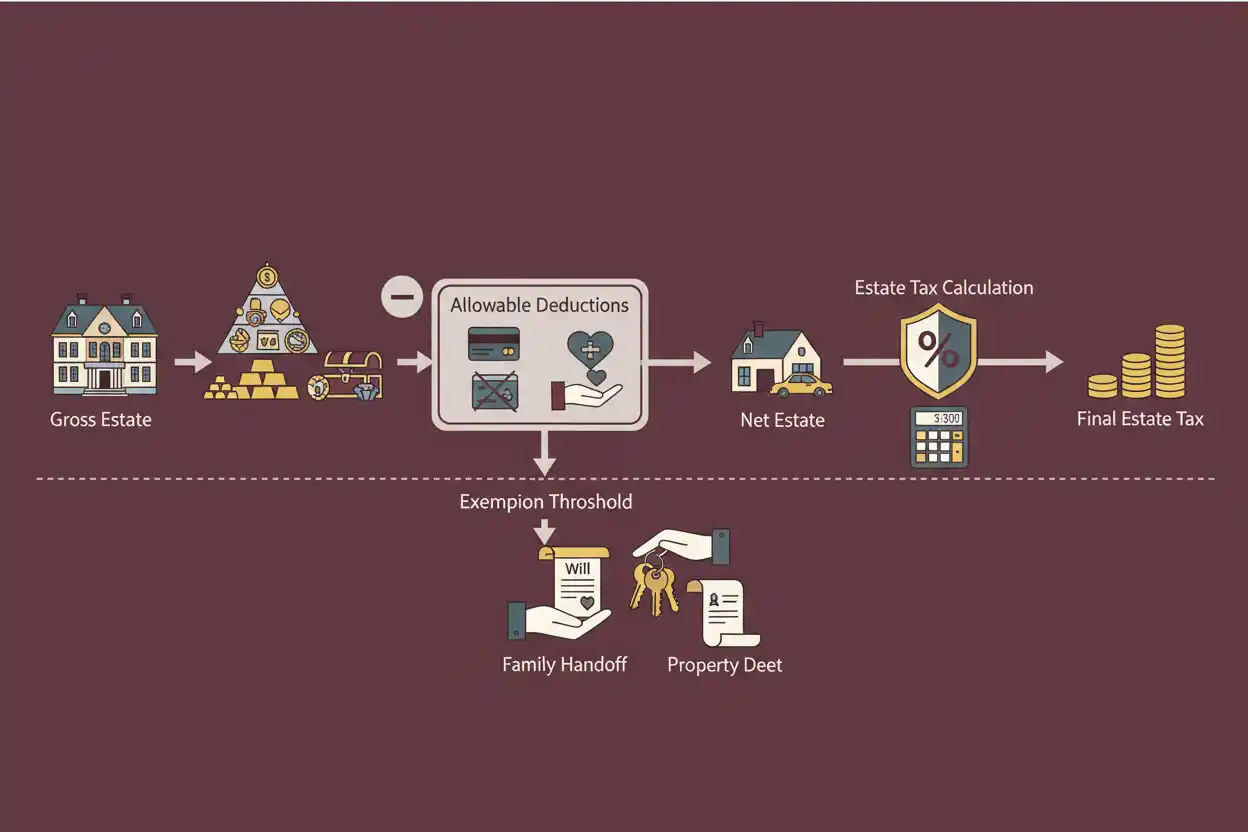

Estate tax is a tax calculation associated with transferring a taxable estate after a person’s death. The important number is generally not the estate’s gross value alone. The calculation can involve deductions, an applicable exemption or exclusion threshold, prior taxable transfers, credits, and the tax rates in force for the relevant year and jurisdiction.
Suppose a simplified estate is worth $15 million, qualifying deductions reduce the amount by $2 million, and an illustrative exemption of $10 million applies. The amount exposed to the simplified tax calculation would be $3 million.
If an illustrative 40% rate applied to that entire taxable excess, the estimated estate tax would be $1.2 million.
Those threshold and rate figures are deliberately hypothetical. Actual estate-tax exemptions, credits, thresholds, and rates can change with law and should be verified for the applicable year.
What Is Estate Tax?
Estate tax is fundamentally different from ordinary income tax. Instead of calculating tax from wages or annual earnings, the calculation starts with assets and liabilities associated with an estate.
A simplified structure is:
Taxable Estate Before Exemption = Gross Estate − Allowable Deductions
The next conceptual step is:
Taxable Excess = Taxable Estate Before Exemption − Applicable Exemption
If the result is below zero, the taxable excess under the simplified model is zero.
A simplified tax estimate can then be expressed as:
Estimated Estate Tax = Taxable Excess × Applicable Tax Rate
Actual estate-tax systems can be more complicated because tax brackets, credits, prior gifts, elections, and other provisions can change the result.
Estate Tax Example
Assume a hypothetical estate contains assets with a total value of:
Gross Estate = $15,000,000
Suppose qualifying deductions total:
Deductions = $2,000,000
Then:
Taxable Estate Before Exemption = $15,000,000 − $2,000,000
= $13,000,000
Now assume an illustrative exemption threshold of:
$10,000,000
Taxable excess:
$13,000,000 − $10,000,000
= $3,000,000
If an illustrative 40% tax rate applies:
Estimated Estate Tax = $3,000,000 × 40%
= $1,200,000
The simplified estimated tax is $1.2 million.
Why the Exemption Matters
An exemption determines how much value can be removed from the taxable calculation before the remaining amount is subjected to the relevant rate structure.
Consider the same $13 million taxable estate before the exemption.
With a $10 million illustrative exemption:
Taxable Excess = $3,000,000
With a $12 million illustrative exemption:
Taxable Excess = $1,000,000
With a $15 million illustrative exemption:
Taxable Excess = $0
A change in the exemption can therefore have a substantial effect even when the estate itself does not change in value.
Estate Value Above a Threshold Does Not Mean the Entire Estate Is Taxed
Suppose the applicable exemption is hypothetically $10 million and the estate after deductions is $10.5 million.
The amount above the threshold is:
$10,500,000 − $10,000,000
= $500,000
Under the simplified model, the calculation focuses on the $500,000 taxable excess rather than applying the estate-tax rate to the entire $10.5 million.
This is conceptually similar to why an effective tax rate can differ from a headline marginal rate.
Gross Estate vs Taxable Estate
Gross estate refers broadly to assets included in the initial valuation.
Taxable estate is the amount remaining after applicable deductions under the relevant rules.
For example:
Gross Estate = $8,000,000
Allowable Deductions = $1,500,000
Then:
Taxable Estate Before Exemption = $6,500,000
The difference of $1.5 million matters before any exemption threshold is considered.
Estate Liabilities and Deductions
An estate can own substantial assets while also having significant liabilities or qualifying expenses.
Suppose:
Assets = $12,000,000
and applicable deductions equal:
$2,500,000
Then:
Net Amount Before Exemption = $9,500,000
A calculation based only on the $12 million headline asset value would overstate the simplified taxable amount by $2.5 million.
The exact deductions allowed are governed by the applicable estate-tax rules rather than ordinary household accounting.
Exemption vs Deduction
These terms should not be treated as interchangeable.
A deduction generally reduces the estate before the exemption is applied in a simplified framework.
An exemption protects an additional amount from the estate-tax calculation.
For example:
Gross Estate = $14,000,000
Deductions = $2,000,000
Estate After Deductions = $12,000,000
If the illustrative exemption is $10 million:
Taxable Excess = $2,000,000
Both deductions and the exemption reduce the amount exposed to tax, but they enter the calculation differently.
Estate Tax vs Income Tax
Estate tax should not be estimated from the deceased person’s effective tax rate.
Suppose a taxpayer had an 18% effective income-tax rate while alive. That does not imply:
Estate Tax Rate = 18%
Estate tax uses its own tax base, exemptions, credits, and applicable rate structure.
Income-tax percentages and estate-tax percentages answer different questions.
Estate Tax and Estimated Taxes
Estimated taxes generally concern periodic prepayments toward an expected annual tax liability, particularly where ordinary withholding is insufficient.
Estate tax instead arises from an estate-transfer calculation.
Although both involve estimating taxes, the formulas, timing, taxpayers, and tax bases differ substantially.
Estate Tax and Employment Pay
Employee double-time pay increases compensation for qualifying hours.
That additional compensation can affect annual income, but it should not be inserted directly into an estate-tax rate formula.
The value of assets remaining in an estate at death is a different measurement from gross wages earned during life.
Estate Tax and Business Assets
An estate can include ownership interests in businesses as well as cash, securities, or property.
Valuation therefore becomes critical.
Suppose an estate owns a business interest valued at:
$4,000,000
If the final accepted value is instead:
$3,500,000
the gross estate changes by:
$500,000
Because thresholds can create large differences in tax exposure, valuation assumptions can materially affect the calculation.
Estate Tax and Export Duty
Export duty is a transactional tax or charge associated with exporting qualifying goods under a jurisdiction’s customs rules.
Estate tax has no direct mathematical relationship with export duty.
The distinction illustrates why tax calculations must start by identifying the correct taxable event and tax base before applying a percentage.
Estate Tax and Commission Income
Likewise, employee commissions are compensation earned under a sales plan.
A commission rate of 8% has nothing to do with an estate-tax rate.
A percentage is only meaningful when its denominator and tax or compensation base are clearly defined.
Progressive Estate-Tax Structures
If an estate-tax system uses progressive rates, the highest rate does not necessarily apply to every dollar of taxable estate.
Suppose a purely illustrative system taxes the first $1 million of taxable excess at 20% and the next $2 million at 30%.
For $3 million of taxable excess:
First portion:
$1,000,000 × 20% = $200,000
Remaining portion:
$2,000,000 × 30% = $600,000
Total:
$800,000
Effective rate on the $3 million taxable excess:
$800,000 ÷ $3,000,000
≈ 26.67%
The marginal rate is 30%, while the effective rate on the taxable excess is approximately 26.67%.
Threshold Planning
Suppose a simplified taxable estate before exemption is projected at $9 million today but could grow to $14 million over time.
Whether that creates estate-tax exposure depends partly on the exemption available when the tax event occurs.
This is one reason long-term estate projections should not assume today’s threshold will remain unchanged indefinitely.
Asset growth and tax-law changes can both affect future exposure.
Asset Growth Example
Suppose an estate is worth $8 million today and grows at 5% annually for 10 years.
Future Estate Value = $8,000,000 × 1.05¹⁰
≈ $13,031,158
Ignoring spending, gifts, liabilities, taxes, and other changes, the estate would grow by more than $5 million.
A household below a current exemption threshold can therefore still have future estate-tax planning considerations if asset values grow materially.
Estate Tax and Liquidity
A taxable estate can be asset-rich without holding much cash.
Suppose most wealth consists of:
- a private business;
- real estate;
- illiquid investments.
If tax becomes due, liquidity can become a practical issue even when the estate’s total valuation is high.
The tax formula and the ability to fund the resulting liability are separate planning problems.
Tax Rate vs Tax Liability
A high tax rate does not automatically mean a high dollar liability if taxable excess is small.
Suppose:
Taxable Excess = $100,000
and illustrative rate:
40%
Estimated tax:
$40,000
Now suppose taxable excess is:
$5,000,000
at the same rate:
Estimated Tax = $2,000,000
The taxable base matters just as much as the percentage.
Estate Tax Thresholds Change
Estate-tax law is especially sensitive to effective dates, legislation, filing status of the estate, elections, prior transfers, and other circumstances.
For evergreen calculations, it is safer to separate:
Mathematical Framework
from:
Current-Year Legal Inputs
The framework remains stable even when the exemption or rates change.
Common Estate Tax Calculation Mistakes
A common error is multiplying the gross estate by a headline estate-tax rate without first considering deductions or exemptions.
Another is assuming the entire estate becomes taxable as soon as it exceeds an exemption threshold.
People also confuse income-tax rates with estate-tax rates or use a threshold from the wrong year.
Frequently Asked Questions
What is estate tax?
Estate tax is a tax calculation associated with the transfer of a taxable estate after death under the applicable law.
What is the basic estate-tax formula?
A simplified structure is:
Taxable Excess = Gross Estate − Deductions − Applicable Exemption
followed by the applicable tax-rate calculation.
Is the entire estate taxed when it exceeds the exemption?
Not necessarily. In a simplified exemption model, the amount above the exemption is the relevant taxable excess.
What is a gross estate?
It is the initial value of assets included in the estate calculation before applicable deductions.
What is a taxable estate?
It is the estate amount remaining after applicable deductions, before or after other tax adjustments depending on the specific legal definition used.
Is an exemption the same as a deduction?
No. They enter the calculation differently.
Is estate tax the same as inheritance tax?
No. They can impose tax on different parties or events depending on jurisdiction.
Does an individual’s income-tax rate determine estate tax?
No.
Can an estate below today’s threshold face estate tax later?
Potentially, because asset values and tax-law thresholds can change.
Why does valuation matter?
Estate tax depends on the value assigned to assets included in the tax base.
Can an estate owe tax even if it lacks cash?
Potentially. Asset value and liquidity are different issues.
Why should current thresholds be verified?
Estate-tax exemptions and rates can change by year and jurisdiction, while the broader calculation belongs within the Taxes & Pay framework.