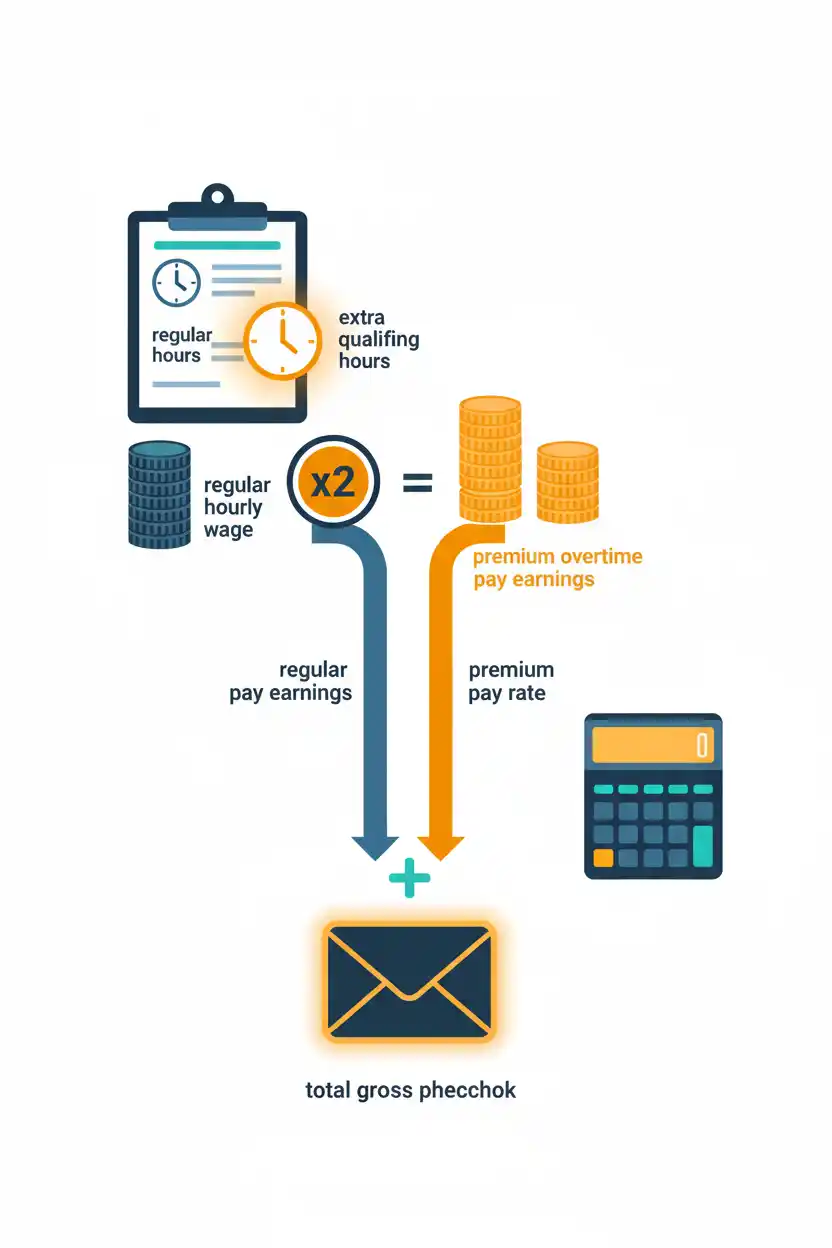

Double-time pay means compensation at twice the employee’s applicable regular hourly rate for the hours that qualify for double time under the governing agreement, policy, or law.
If the applicable rate is $24 per hour and six hours qualify for double-time pay:
Double-Time Rate = $24 × 2 = $48 per hour
Then:
Double-Time Pay = $48 × 6 = $288
The $288 represents pay for those six qualifying hours before taxes or other payroll deductions.
The calculation is simple. Determining which hours legally or contractually qualify can be more complicated.
Double-Time Pay Formula
The basic rate formula is:
Double-Time Rate = Regular Hourly Rate × 2
Then:
Double-Time Pay = Double-Time Rate × Qualifying Hours
Combined:
Double-Time Pay = Regular Hourly Rate × 2 × Double-Time Hours
Double-Time Pay Example
Suppose:
Regular Hourly Rate = $24
and:
Double-Time Hours = 6
Double-time hourly rate:
$24 × 2 = $48
Pay for six hours:
$48 × 6 = $288
The employee earns $288 from the double-time hours.
Regular Pay Plus Double-Time Pay
Suppose the employee also works:
40 Regular Hours
Regular pay:
$24 × 40 = $960
Double-time pay:
$288
Simplified total gross pay:
$960 + $288
= $1,248
This assumes the six double-time hours are separate from the 40 regular hours and no other premium-pay rules apply.
Double Time vs Time-and-a-Half
Time-and-a-half uses:
1.5 × Regular Rate
Double time uses:
2 × Regular Rate
At $24 per hour:
Time-and-a-half:
$24 × 1.5 = $36
Double time:
$24 × 2 = $48
Difference:
$12 per hour
For six hours, double time produces:
$12 × 6 = $72
more than time-and-a-half.
Federal FLSA and Double Time
Under the federal Fair Labor Standards Act, there is no general requirement for double-time pay. Federal overtime rules for covered nonexempt employees generally require at least one-and-one-half times the regular rate for hours worked over 40 in a workweek.
Double-time obligations can instead arise from state law, collective bargaining agreements, employment contracts, or employer policies.
Therefore, the double-time formula should not be used to decide whether particular hours legally qualify.
Weekend Work Does Not Automatically Mean Double Time
Working on Saturday or Sunday does not by itself create a federal double-time requirement.
Suppose an employee works eight hours on Sunday.
The arithmetic:
Hourly Rate × 2 × 8
is appropriate only if the Sunday hours actually qualify for double time under the applicable rules or agreement.
The day of the week alone is not enough to establish that under federal law.
Holiday Work
The same principle applies to holidays.
Some employers voluntarily provide:
- time-and-a-half;
- double time;
- another premium.
But the calculation should follow the employee’s actual policy or governing law rather than assuming every holiday hour automatically receives twice the regular rate.
Double-Time Pay With Multiple Rate Categories
Suppose an employee works in one pay period:
32 Regular Hours at $20
8 Hours at $30 Time-and-a-Half
4 Hours at $40 Double Time
Regular:
32 × $20 = $640
Time-and-a-half:
8 × $30 = $240
Double time:
4 × $40 = $160
Total:
$640 + $240 + $160
= $1,040
Separating rate categories prevents premium hours from being counted incorrectly.
Solve for Double-Time Hours
If the rate and double-time pay are known:
Double-Time Hours = Double-Time Pay ÷ Double-Time Rate
Suppose:
Regular Rate = $25
Double-time rate:
$50
Double-time pay:
$400
Then:
Hours = $400 ÷ $50
= 8 Hours
Solve for Regular Hourly Rate
Suppose:
Double-Time Rate = $44 per hour
Then:
Regular Rate = $44 ÷ 2
= $22 per hour
Again, this is the mathematical rate relationship, not a determination of an employee’s legally defined regular rate for overtime purposes.
Double Time and Commissions
Employees earning commissions can have more complex premium-pay calculations than simply multiplying a nominal base wage by two.
Under federal overtime rules, the regular rate can include certain remuneration beyond the stated hourly wage.
That is why employees with commissions, bonuses, or multiple rates may need a proper regular-rate calculation before premium pay can be determined.
Double Time and Commission Pay
Commission pay measures performance-based compensation.
Double-time pay measures compensation for qualifying hours at an enhanced hourly rate.
An employee might receive both during the same pay period.
They should not be combined into one percentage formula.
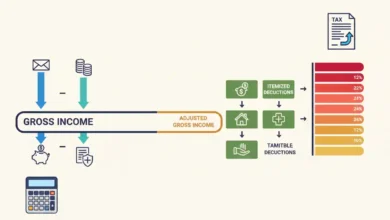
Double-Time Pay and Effective Tax Rate
A double-time paycheck can increase taxable compensation for the period, but it does not mean the employee’s entire income is suddenly taxed at one new rate.
The effective tax rate measures overall tax relative to an income base.
Pay rate and tax rate are unrelated percentages.
A 100% pay premium does not imply a 100% tax increase.
Double Time and Capital Gains Tax
Employment compensation and capital gains tax calculations should remain separate.
Suppose an employee receives $500 of double-time pay and also realizes a $500 capital gain.
The amounts match, but one is wage compensation while the other comes from an asset transaction.
They can enter the tax system differently.
Double Time and Estate Tax
Estate tax concerns transfers associated with an estate rather than employee wage premiums.
The terms “tax rate” and “pay rate” can appear in both financial topics, but the calculations are unrelated.
This is why double-time pay should remain focused on payroll mathematics.
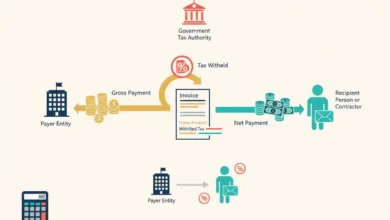
Gross Pay vs Take-Home Pay
Suppose:
Double-Time Gross Pay = $288
After payroll withholding and other deductions, the employee may receive less than $288 as additional net cash.
Therefore:
Double-Time Pay Calculation = Gross Compensation Calculation
unless the problem explicitly asks for net pay.
Example With $18 Hourly Rate
Double-time rate:
$18 × 2 = $36
If five qualifying hours are worked:
$36 × 5 = $180
If the employee also earns $720 of regular pay:
Total Gross Pay = $720 + $180
= $900
Example With $32.50 Hourly Rate
Double-time rate:
$32.50 × 2
= $65
For three qualifying hours:
$65 × 3
= $195
Decimals do not change the formula.
Premium Portion vs Total Double-Time Pay
Sometimes it is useful to separate the regular value of the hours from the additional premium.
At a $24 regular rate for six hours:
Regular value:
$24 × 6 = $144
Additional double-time premium:
$144
Total double-time compensation:
$144 + $144 = $288
This makes it clear why double time equals twice the ordinary amount.
Pay Period Conversion
Suppose an employee earns $288 of double-time compensation in one biweekly period.
That does not mean:
Annual Double-Time Pay = $288 × 26
unless the employee works the same qualifying hours in every pay period.
Premium hours are often irregular, so annualization should reflect actual or expected frequency.
Double-Time Pay and Overtime Are Not Synonyms
All double-time pay is premium pay, but federal overtime does not normally mean double time.
For most covered nonexempt workers subject to the ordinary federal rule:
Federal Overtime Minimum = 1.5 × Regular Rate
rather than:
2 × Regular Rate
State or contractual provisions can be more generous.
Common Double-Time Pay Mistakes
A common error is multiplying all hours by two instead of only qualifying double-time hours.
Another is confusing time-and-a-half with double time.
Employees can also assume weekend or holiday work always triggers double-time pay or annualize occasional premium hours as though they recur every pay period.
Frequently Asked Questions
What is double-time pay?
It is compensation at twice the applicable regular hourly rate for hours that qualify for double time.
What is the formula?
Double-Time Pay = Regular Hourly Rate × 2 × Qualifying Hours
What is double time for $24 per hour?
$24 × 2 = $48 per hour
What is six hours of double time at $24?
$48 × 6 = $288
Is double time the same as overtime?
No. Federal overtime for covered nonexempt workers is generally at least 1.5 times the regular rate after 40 hours in a workweek.
Does federal law require double time?
The FLSA does not generally require double-time pay.
Does Sunday work automatically qualify?
Not under the FLSA merely because it occurs on Sunday.
Does holiday work automatically qualify?
Not under the FLSA merely because it is a holiday, though other laws or employer agreements may provide premium pay.
Can commission employees receive premium pay?
Potentially, depending on classification, hours, regular-rate calculations, and applicable rules.
Is double-time pay a gross or net amount?
The standard formula calculates gross compensation.
Can I annualize one double-time paycheck?
Only if the same premium hours are reasonably expected to recur.
Why check the governing rule before calculating double time?
The formula determines the amount only after the qualifying hours and applicable rate have been established.