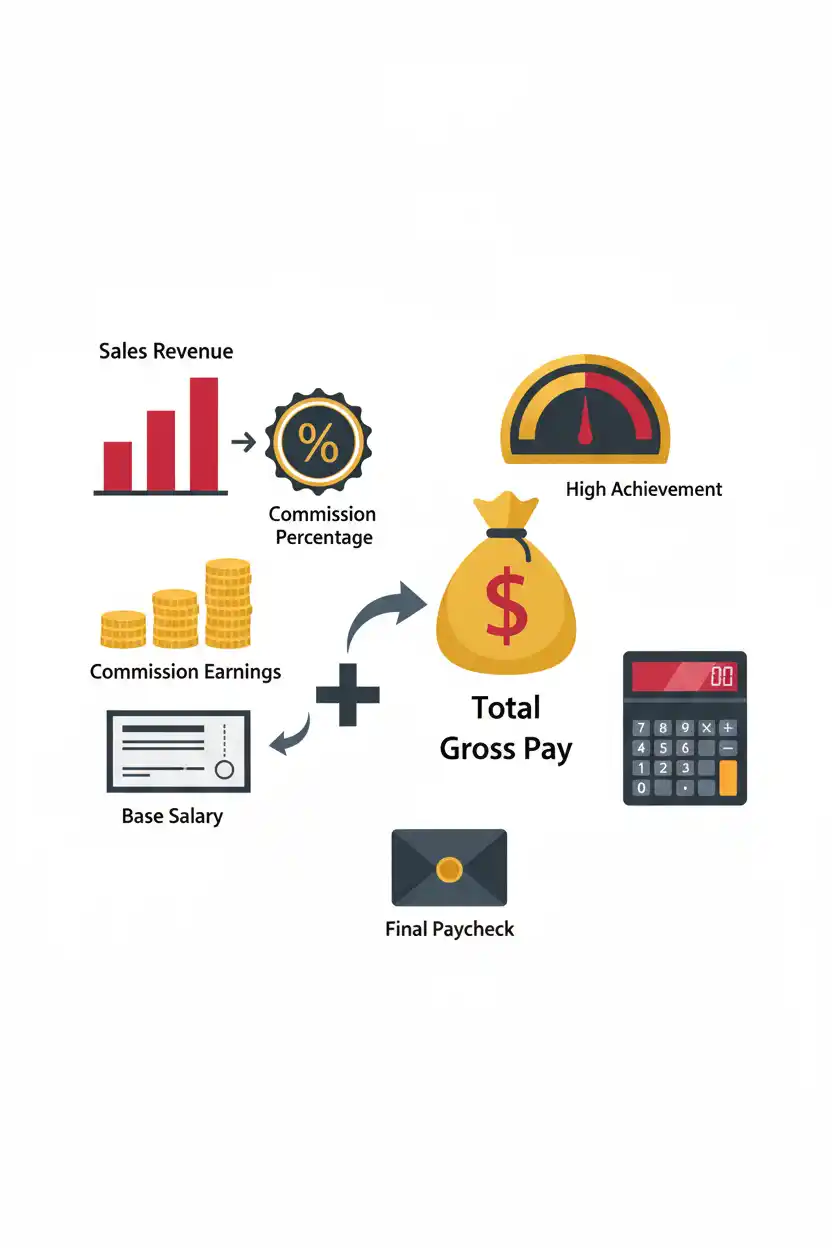

Commission pay is compensation linked to sales, revenue, units, profit, or another measurable performance result.
If an employee earns a 4% commission on $85,000 of eligible sales, commission pay is $3,400.
If the employee also receives $2,500 of base pay for the same period, simplified gross compensation becomes $5,900.
The central calculation is straightforward, but real compensation plans can introduce thresholds, tiers, different product rates, draws, caps, accelerators, and eligibility rules.
Commission Pay Formula
For a flat percentage commission:
Commission Pay = Eligible Sales × Commission Rate
Suppose:
Eligible Sales = $85,000
Commission Rate = 4%
Then:
Commission Pay = $85,000 × 0.04
= $3,400
The employee earns $3,400 of commission for the period.
Total Pay With Base Salary
Some employees receive both fixed and variable compensation.
Gross Pay = Base Pay + Commission Pay
If base pay is:
$2,500
and commission is:
$3,400
then:
Gross Pay = $2,500 + $3,400
= $5,900
Other pay components can change the final payroll amount.
Commission Rate From Commission Dollars
Suppose:
Sales = $120,000
Commission Earned = $6,000
Then:
Commission Rate = Commission ÷ Sales × 100
$6,000 ÷ $120,000 × 100
= 5%
The effective flat commission rate is 5% for the example.
Sales Required for a Target Commission
Rearrange the formula:
Required Sales = Target Commission ÷ Commission Rate
Suppose the employee wants to earn:
$8,000 Commission
at a rate of:
5%
Then:
Required Sales = $8,000 ÷ 0.05
= $160,000
The employee needs $160,000 of eligible sales under a simple flat-rate plan.
Commission Pay vs Commission Structure
This page focuses on the employee’s pay calculation.
The broader commissions calculation becomes more important when rates change across thresholds.
For example, a compensation plan may pay one rate on the first $50,000 of sales and another rate above that level.
In that case, applying one percentage to every dollar can produce the wrong paycheck.
Base Plus Commission Example
Suppose monthly compensation consists of:
Base Pay = $3,000
and:
Commission Rate = 6%
Monthly eligible sales are:
$70,000
Commission:
$70,000 × 6% = $4,200
Gross compensation:
$3,000 + $4,200
= $7,200
Commission represents:
$4,200 ÷ $7,200 × 100
≈ 58.33%
of the simplified monthly gross compensation.
Commission-Only Compensation
Some arrangements may pay primarily or entirely through commission, subject to applicable employment requirements.
Suppose commission-only compensation pays 8% on $60,000 of eligible sales:
$60,000 × 8% = $4,800
The employee’s gross commission is $4,800 before applicable payroll deductions.
Revenue vs Profit Commission
A plan based on revenue and a plan based on profit can produce very different results.
Suppose a $100,000 sale produces $30,000 of gross profit.
At 5% of revenue:
$100,000 × 5% = $5,000
At 5% of gross profit:
$30,000 × 5% = $1,500
Both plans advertise a 5% rate, yet pay differs by $3,500 because the calculation base differs.
Commission per Unit
Commission can also be a fixed amount per unit rather than a percentage.
Suppose:
Commission per Sale = $75
and:
Sales Completed = 40
Then:
Commission Pay = $75 × 40
= $3,000
The word “commission” does not imply the formula must use a percentage.
Commission and Bonus Pay
Commission and bonus pay are both forms of variable compensation but can be structured differently.
Suppose:
Commission = $4,000
and a quarterly performance bonus adds:
$2,000
Total variable pay:
$6,000
If base compensation is $8,000 for the quarter:
Total Gross Compensation = $14,000
Each component should remain identifiable so employees can verify the plan calculation.
Commission and Double-Time Pay
An employee receiving commissions can also potentially have wage calculations involving double-time pay where an applicable agreement or rule provides it.
The commission formula does not automatically determine the employee’s hourly premium rate.
Commission earnings, regular rate calculations, overtime treatment, and double-time provisions can interact differently depending on the employment arrangement and governing rules.
Commission Income and Capital Gains
A $5,000 commission and a $5,000 capital gain are different categories of income.
Commission pay comes from performing work under a compensation arrangement.
A capital gain arises from disposing of an asset for more than basis.
Using the same tax assumption for both simply because the dollar amounts match can produce an incorrect estimate.
Commission Pay and Budgeting
Variable pay can complicate budgeting because one month’s income may not resemble the next.
Suppose monthly net commission-related income over six months is:
$4,000, $6,200, $3,800, $5,400, $7,000, $4,600
Average:
$31,000 ÷ 6
≈ $5,166.67
A household with highly variable income may choose recurring obligations based on a more conservative amount than the strongest sales month.
Recoverable Draw
Some commission plans provide a draw against future commissions.
Suppose an employee receives:
$3,000 Draw
and later earns:
$4,500 Commission
Under a simplified recoverable-draw structure:
Commission Above Draw = $4,500 − $3,000
= $1,500
Actual draw agreements can differ materially, so the compensation contract controls.
Nonrecoverable Draw
A nonrecoverable draw is conceptually different because the advance may not need to be repaid through future commissions in the same manner.
The economic effect depends on the specific plan.
Employees should not assume “draw” has one universal formula.
Commission Cap
Suppose a plan pays 10% commission but caps commission pay at:
$15,000 per quarter
If eligible sales would otherwise produce:
$180,000 × 10% = $18,000
the cap limits commission to:
$15,000
The headline 10% rate no longer describes the effective rate on all sales.
Effective commission rate:
$15,000 ÷ $180,000
≈ 8.33%
Commission Accelerator
An accelerator increases the commission rate after a target is reached.
Suppose the plan pays:
5% up to target
and:
8% after target
Sales above the threshold therefore generate more commission per dollar.
Accelerators reward performance beyond the specified goal but require tier-by-tier arithmetic.
Commission Decelerator
A plan can also pay a lower rate until a threshold is met.
For example:
2% Before Threshold
5% After Threshold
This changes the relationship between early sales and later sales.
Whether the higher rate applies only to incremental sales or retroactively to all sales depends on the plan.
Chargebacks
Some commission plans reduce future pay when a transaction is canceled, refunded, or otherwise reversed.
Suppose:
Previously Paid Commission = $500
and the agreement requires a full chargeback.
The future commission statement may include:
−$500 Adjustment
This means gross sales alone may not explain the employee’s actual commission payment.
Commission Withholding vs Final Tax
Commission compensation can be treated as supplemental wages for federal withholding purposes in applicable U.S. payroll situations.
However, the amount withheld from a commission paycheck is not automatically the employee’s final income-tax rate.
Final tax depends on the employee’s complete annual tax situation.
This is the same reason a large commission check can appear to have unusually heavy withholding without proving the compensation is ultimately taxed at that exact percentage.
Effective Commission Rate
Tiered or capped plans can be summarized after the fact using:
Effective Commission Rate = Total Commission ÷ Total Eligible Sales × 100
Suppose:
Total Commission = $8,000
Sales = $120,000
Then:
Effective Rate = $8,000 ÷ $120,000
≈ 6.67%
This helps compare a complex compensation plan with a simple flat-rate alternative.
Common Commission Pay Mistakes
A frequent mistake is applying the advertised percentage to gross sales when the plan actually uses profit or eligible revenue.
Another is ignoring thresholds, caps, chargebacks, or draws.
Employees can also confuse gross commission with net paycheck cash or assume commission withholding equals final tax.
Frequently Asked Questions
What is commission pay?
Commission pay is compensation linked to sales, revenue, profit, units, or another performance measure.
What is the basic formula?
Commission Pay = Eligible Sales × Commission Rate
What is 5% commission on $100,000?
$100,000 × 5% = $5,000
How do I calculate the commission rate?
Commission Rate = Commission Pay ÷ Eligible Sales × 100
How do I calculate sales needed for a target commission?
Required Sales = Target Commission ÷ Commission Rate
Can commission be based on profit instead of revenue?
Yes, depending on the compensation plan.
Is commission the same as bonus pay?
No. Both are variable compensation, but their formulas and conditions can differ.
What is a commission draw?
It is an advance or guaranteed amount associated with future commission earnings, subject to the plan’s terms.
What is a commission cap?
It limits the maximum commission payable over the relevant period.
What is an accelerator?
It increases commission rates after specified performance thresholds are reached.
Is commission withholding the same as final income tax?
No.
Why calculate commission pay carefully?
Small differences in the commission base, rate, tiers, and adjustments can materially change compensation within the broader Taxes & Pay framework.