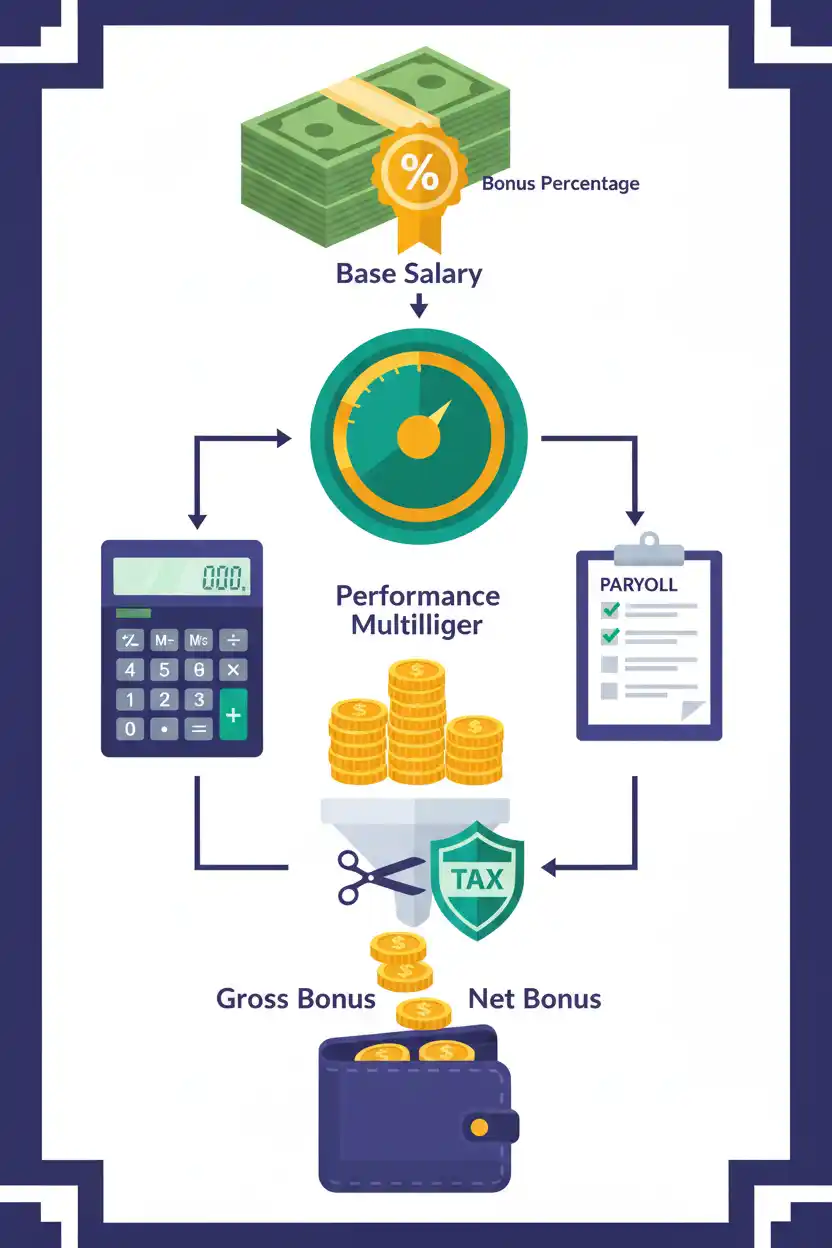

Bonus pay is compensation paid in addition to an employee’s ordinary salary or wages.
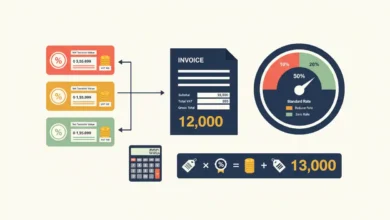
If an employee earns an $80,000 annual salary and receives a bonus equal to 12% of salary, the gross bonus is $9,600.
Total salary plus bonus becomes $89,600 before considering other compensation, taxes, or payroll deductions.
Bonus formulas can be simple percentages of salary or more complex calculations based on performance, targets, company results, or multiple factors.
What Is Bonus Pay?
Bonus pay is variable compensation beyond regular base pay.
A bonus can be structured as a percentage of salary, a fixed dollar amount, or an amount tied to performance.
The most basic percentage formula is:
Bonus Pay = Base Salary × Bonus Percentage
The result is normally a gross amount before withholding and other applicable payroll deductions.
Bonus Pay Example
Suppose:
Annual Salary = $80,000
and:
Bonus Percentage = 12%
Then:
Bonus = $80,000 × 0.12
Bonus = $9,600
Salary plus bonus:
$80,000 + $9,600
= $89,600
The employee’s simplified gross cash compensation is $89,600 before considering other compensation items.
Calculate Bonus Percentage From a Dollar Amount
Suppose:
Annual Salary = $90,000
Bonus = $13,500
Then:
Bonus Percentage = Bonus ÷ Salary × 100
Bonus Percentage = $13,500 ÷ $90,000 × 100
= 15%
The bonus equals 15% of base salary.
Calculate Total Compensation
For salary and bonus only:
Salary + Bonus = Gross Salary-and-Bonus Compensation
If annual salary is $95,000 and bonus is $10,000:
$95,000 + $10,000 = $105,000
This still may not represent complete total compensation if benefits, equity, commissions, or employer contributions exist.
Fixed-Dollar Bonus
Not every bonus is expressed as a percentage.
Suppose an employer provides:
$5,000 Annual Bonus
regardless of salary.
If salary is:
$75,000
then total salary plus bonus is:
$80,000
The implied bonus percentage is:
$5,000 ÷ $75,000 × 100
≈ 6.67%
Target Bonus
Some compensation plans define a target bonus percentage.
Suppose:
Base Salary = $100,000
Target Bonus = 15%
Target bonus amount:
$15,000
However, a target bonus is not necessarily the same as a guaranteed bonus.
Actual payment can depend on the plan’s conditions.
Performance Multiplier
Suppose:
- salary = $100,000;
- target bonus = 15%;
- performance multiplier = 120%.
First calculate target bonus:
$100,000 × 15% = $15,000
Then apply performance:
Actual Bonus = $15,000 × 120%
= $18,000
The employee receives 120% of the target bonus.
Bonus Below Target
Using the same $15,000 target, suppose performance results in a 70% payout.
Actual Bonus = $15,000 × 70%
= $10,500
The employee receives:
$15,000 − $10,500 = $4,500
less than target.
Bonus Above 100% of Target
A payout above target can occur if the plan permits it.
Suppose:
Target Bonus = $20,000
and performance payout is:
150%
Then:
Actual Bonus = $20,000 × 1.50
= $30,000
The bonus is 150% of target, not 150% of salary.
Prorated Bonus
An employee who works only part of the bonus period may receive a prorated amount when the compensation plan provides for it.
Suppose:
- annual target bonus = $12,000;
- employee is eligible for nine months out of 12.
Simplified proration:
Prorated Bonus = $12,000 × 9 ÷ 12
= $9,000
Actual plans can use specific eligibility dates or rules rather than a simple monthly fraction.
Bonus and Biweekly Pay
A bonus can be included in a regular biweekly paycheck or paid separately.
Suppose:
Normal Biweekly Gross Pay = $3,000
and bonus added to that paycheck is:
$5,000
Gross payroll amount:
$8,000
The unusually large check does not mean the employee’s regular biweekly salary increased to $8,000.
The $5,000 is a separate compensation component.
Gross Bonus vs Net Bonus
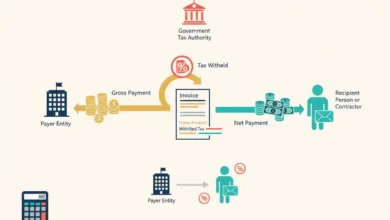
Gross bonus is the amount awarded before payroll withholding and deductions.
Net bonus is the amount ultimately received as cash.
Suppose:
Gross Bonus = $10,000
and the simplified combined withholding and other deductions from that payment total:
$2,700
Then:
Net Bonus = $10,000 − $2,700
= $7,300
The $2,700 difference should not automatically be interpreted as the employee’s final tax liability on the bonus.
Withholding Is Not the Same as Final Tax
Payroll systems may withhold taxes from bonus compensation according to applicable payroll rules.
Final tax liability is determined from the individual’s overall annual tax situation.
Therefore:
Amount Withheld From Bonus ≠ Automatically Final Tax on Bonus
A larger-than-usual withholding percentage on a bonus paycheck does not necessarily mean the bonus is ultimately taxed at that exact percentage.
Bonus and Adjusted Gross Income
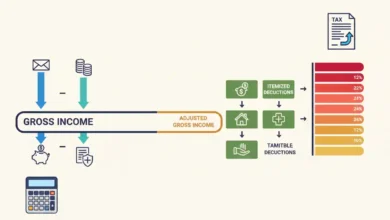
A taxable bonus can contribute to the income feeding into adjusted gross income.
For example:
Salary = $80,000
Bonus = $10,000
Simplified compensation:
$90,000
AGI can still differ from $90,000 because other income and eligible adjustments can affect the tax calculation.
Bonus and Budgeting
Because bonus compensation can be uncertain, budgeting recurring monthly expenses entirely around an expected bonus can create risk.
Suppose a household expects:
$12,000 Annual Bonus
and commits to $1,000 of additional monthly recurring expenses.
If the bonus is reduced or not paid, those expenses remain.
A more conservative budget can base recurring obligations primarily on dependable income and treat bonus cash separately when received.
Bonus Allocation Example
Suppose net bonus cash is:
$7,300
A household might decide to direct:
$4,000 to savings
$2,000 to debt reduction
$1,300 to discretionary spending
The specific allocation is personal.
What matters mathematically is that the categories total:
$7,300
Bonus and Capital Gains Tax
Compensation from an employer and profits from selling investments are different income categories.
The tax rules governing an investment sale belong under capital gains tax.
A $10,000 bonus and a $10,000 investment gain can therefore have different tax characteristics even though the dollar amount is identical.
Bonus as a Percentage of Total Cash Compensation
Suppose:
Salary = $80,000
Bonus = $20,000
Total salary-plus-bonus compensation:
$100,000
Bonus as a percentage of total:
$20,000 ÷ $100,000 × 100
= 20%
Notice this differs from bonus as a percentage of salary:
$20,000 ÷ $80,000 = 25%
The denominator determines the result.
Salary Needed for a Target Bonus
Suppose an employee wants a target bonus of:
$15,000
and the bonus rate is:
12% of salary
Then:
Required Salary = Bonus ÷ Bonus Rate
$15,000 ÷ 0.12
= $125,000
At a 12% target rate, $125,000 of base salary generates a $15,000 target bonus.
Commission vs Bonus
Commission is usually connected directly to sales or production according to a formula.
Bonus compensation may depend on broader:
- individual performance;
- team results;
- company performance;
- discretionary decisions.
Both are variable compensation, but they are not necessarily calculated the same way.
Sign-On Bonus
A sign-on bonus is paid in connection with joining an employer.
Suppose:
Annual Salary = $75,000
Sign-On Bonus = $10,000
First-year salary-plus-sign-on amount:
$85,000
If the sign-on bonus occurs only once, it should not be treated as recurring annual compensation when comparing future years.
Retention Bonus
A retention bonus may depend on remaining employed through a specified date or period.
If the employee leaves before satisfying the terms, payment may not occur or repayment provisions may apply depending on the agreement.
The headline bonus amount should therefore be read together with the contractual conditions.
Bonus Growth
Suppose bonus increases:
$8,000 → $10,000
Dollar increase:
$2,000
Percentage increase:
$2,000 ÷ $8,000 × 100
= 25%
A $2,000 increase represents a 25% improvement relative to the original bonus.
Common Bonus Pay Mistakes
A common mistake is assuming a target bonus is guaranteed.
Another is confusing bonus percentage of salary with bonus percentage of total compensation.
People also treat bonus withholding as final tax or build permanent spending around uncertain variable compensation.
Frequently Asked Questions
What is bonus pay?
Bonus pay is compensation paid in addition to regular salary or wages.
How do I calculate a percentage bonus?
Bonus = Salary × Bonus Percentage
What is a 12% bonus on $80,000?
$80,000 × 12% = $9,600
How do I calculate the bonus percentage?
Bonus Percentage = Bonus ÷ Salary × 100
Is a target bonus guaranteed?
Not necessarily. It depends on the compensation plan.
Can a bonus exceed its target?
Yes, if the plan allows performance above target.
What is a prorated bonus?
It is a bonus adjusted for part of the eligible performance period.
Is gross bonus the amount I receive in my bank account?
Usually not. Withholding and other applicable deductions can reduce the net cash payment.
Is bonus withholding the same as final bonus tax?
Not necessarily.
Does bonus pay count as annual salary?
It is usually separate from base salary, though both can contribute to total compensation.
Should recurring expenses depend on a bonus?
That increases budget risk when the bonus is variable or uncertain.
Why calculate bonus pay separately?
It makes fixed and variable compensation easier to compare within the broader Taxes & Pay framework.