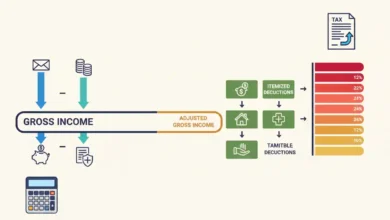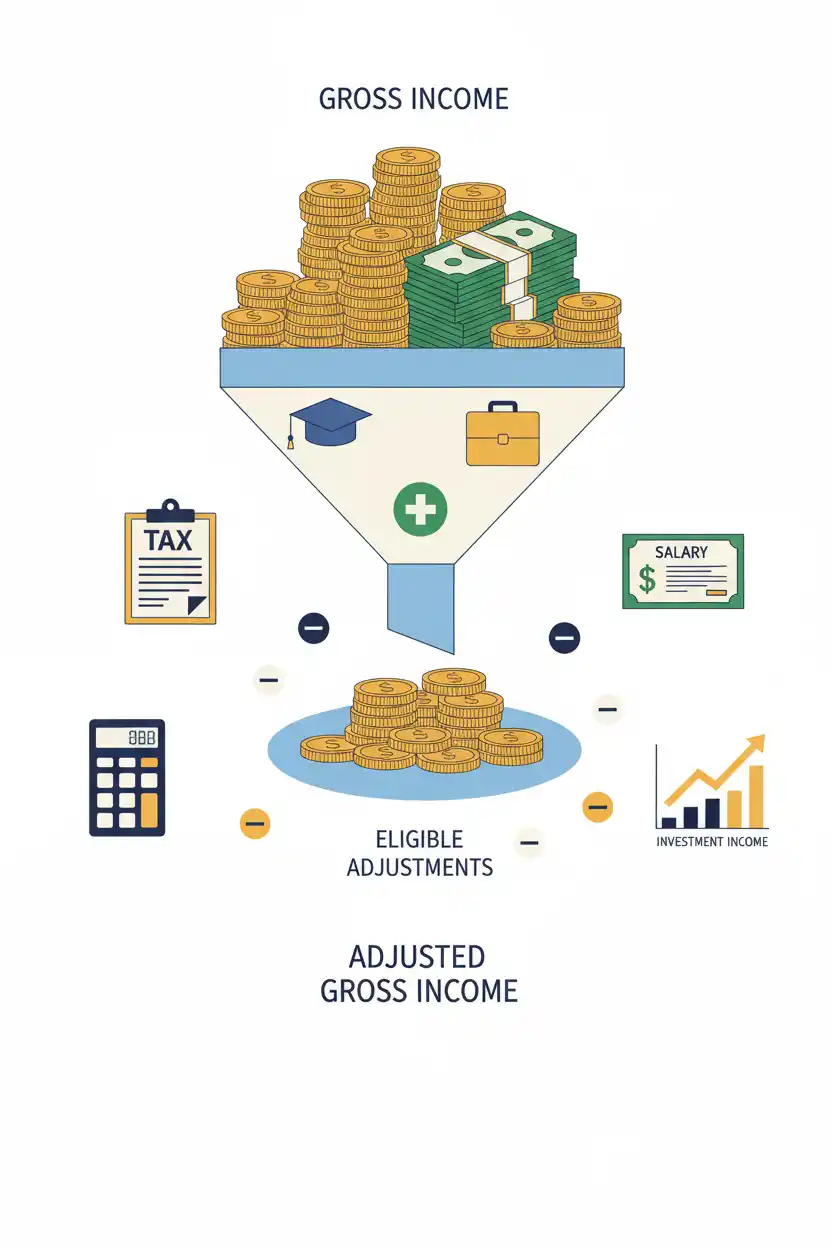

Adjusted gross income, usually shortened to AGI, is a U.S. federal tax measure that starts with gross income and subtracts qualifying adjustments allowed under applicable tax rules.
If gross income is $95,000 and qualifying adjustments total $5,000, adjusted gross income is $90,000.
AGI is important because many later tax calculations begin with or depend on this figure. However, AGI is not the same as annual salary, taxable income, take-home pay, or net worth.
What Is Adjusted Gross Income?
Adjusted gross income represents income after certain permitted adjustments have been subtracted from gross income.
The simplified relationship is:
Adjusted Gross Income = Gross Income − Eligible Adjustments
Using symbols:
AGI = Gross Income − Adjustments
The word adjusted is important. Gross income is the starting point, while AGI reflects specific tax adjustments made before later deductions and other parts of the income-tax calculation.
Adjusted Gross Income Example
Suppose a taxpayer has $95,000 of gross income and $5,000 of qualifying adjustments.
AGI = $95,000 − $5,000
AGI = $90,000
Adjusted gross income is $90,000.
The $5,000 difference does not necessarily represent ordinary household spending. Only adjustments recognized under the applicable tax rules belong in this formula.
What Can Be Included in Gross Income?
Gross income can come from several sources rather than one paycheck alone.
For example, someone may receive employment compensation plus taxable investment or other income during the year.
Suppose the simplified income picture is:
Salary:
$80,000
Bonus:
$8,000
Other gross income:
$7,000
Total gross income:
$80,000 + $8,000 + $7,000 = $95,000
If qualifying adjustments then total $5,000:
AGI = $95,000 − $5,000 = $90,000
This example shows why AGI cannot always be found by looking only at one employee’s base salary.
AGI vs Annual Salary
Your annual salary is compensation associated with employment.
Adjusted gross income is a tax measure that can incorporate several income sources and qualifying adjustments.
Suppose:
Annual Salary = $80,000
but the taxpayer also receives a $10,000 bonus and $5,000 of other included income.
Gross income might be:
$95,000
If adjustments are $5,000:
AGI = $90,000
Therefore:
Annual Salary = $80,000
AGI = $90,000
Both figures can be correct because they measure different things.
AGI vs Biweekly Pay
A biweekly pay calculation converts compensation into a two-week paycheck amount.
For example, a $78,000 salary divided across 26 ordinary biweekly pay periods is:
$78,000 ÷ 26 = $3,000 gross per biweekly paycheck
That $3,000 is a payroll-period amount.
AGI is generally calculated across the tax year after considering relevant income and qualifying adjustments.
One should not be substituted for the other.
AGI vs Bonus Pay
Bonus pay can increase gross compensation.
Suppose:
Base Salary = $80,000
Bonus = $10,000
Simplified employment compensation:
$90,000
The bonus can therefore affect the income flowing into the broader AGI calculation, but AGI still depends on all applicable income and adjustment items.
A bonus paycheck’s withholding also does not by itself determine final AGI.
AGI vs Taxable Income
One of the most common mistakes is treating AGI and taxable income as identical.
Conceptually, the calculation can continue beyond AGI:
Gross Income → Adjusted Gross Income → Further Applicable Deductions → Taxable Income
Therefore:
AGI ≠ Automatically Taxable Income
Taxable income may be lower than AGI after the deductions and rules applicable to the taxpayer.
AGI vs Take-Home Pay
Take-home pay is cash remaining from a paycheck after withholding and payroll deductions.
Suppose:
Gross Paycheck = $3,000
and taxes plus employee deductions total:
$850
Net paycheck:
$3,000 − $850 = $2,150
That $2,150 is spendable paycheck cash.
It is not AGI.
AGI is calculated using tax-income definitions, while net pay is a payroll cash-flow measure.
Adjustments Are Not the Same as Every Expense
Suppose a household spends:
$24,000 annually on rent
That does not mean:
AGI = Gross Income − $24,000
Ordinary personal expenses do not automatically become AGI adjustments.
The calculation only subtracts adjustments recognized under applicable tax rules.
This distinction prevents household budgeting from being confused with tax accounting.
AGI and Budgeting
A household budget should generally focus on actual cash available for expenses, savings, and debt payments.
AGI can be important for tax planning, but it may not equal spendable income.
For example:
AGI = $90,000
does not imply the household has:
$7,500 per month
available to spend.
Taxes, payroll deductions, benefit contributions, and other cash flows still matter.
Gross Income Percentage Remaining After Adjustments
In the earlier example:
Gross Income = $95,000
AGI = $90,000
AGI as a percentage of gross income is:
$90,000 ÷ $95,000 × 100
≈ 94.74%
The adjustments reduced the starting gross-income figure by approximately:
100% − 94.74% = 5.26%
This percentage is descriptive only. It does not represent a tax rate.
Solve for Gross Income
If AGI and total qualifying adjustments are known:
Gross Income = AGI + Adjustments
Suppose:
AGI = $82,000
and adjustments are:
$3,500
Then:
Gross Income = $82,000 + $3,500
= $85,500
Solve for Adjustments
If gross income and AGI are known:
Adjustments = Gross Income − AGI
Suppose:
Gross Income = $105,000
AGI = $99,000
Then:
Adjustments = $105,000 − $99,000
= $6,000
Again, this arithmetic identifies the difference. Determining whether each underlying amount qualifies requires the applicable tax rules.
AGI and Investment Income
Some investment-related income can be part of the broader income calculation.
However, the tax treatment of investment gains is its own topic.
For example, capital gains tax depends on the nature of the gain, holding period, taxable-income context, and other factors.
AGI should therefore remain focused on the adjusted-income calculation rather than being used as a shortcut for calculating tax on a specific asset sale.
AGI and Modified Adjusted Gross Income
Modified adjusted gross income, or MAGI, is another tax concept.
It often begins with AGI and then applies modifications required for a particular tax provision.
There is not necessarily one universal MAGI formula that works for every tax rule.
Therefore:
MAGI ≠ Always AGI
and:
One MAGI Calculation ≠ Automatically Every MAGI Calculation
The relevant provision determines which modifications apply.
Why AGI Matters
AGI can influence calculations and eligibility rules elsewhere in the federal tax system.
This makes an AGI error capable of affecting more than one line of a return.
For that reason, the correct approach is to build the figure from the underlying income and adjustment items rather than estimating it from take-home pay or salary alone.
AGI Can Be Higher Than Salary
Suppose:
Salary = $70,000
and additional included income totals:
$15,000
while adjustments total:
$3,000
Then:
AGI = $70,000 + $15,000 − $3,000
= $82,000
AGI exceeds the salary because additional income outweighs the adjustments.
AGI Can Be Lower Than Salary
Suppose:
Salary = $80,000
there is no additional included income in the simplified example, and qualifying adjustments equal:
$6,000
Then:
AGI = $80,000 − $6,000
= $74,000
Whether that simplified scenario matches a real taxpayer depends on the actual income and adjustment rules.
Why AGI Should Not Be Estimated From a Tax Refund
A tax refund reflects the relationship between amounts already paid or credited and the final tax calculation.
It does not directly reveal AGI.
Two taxpayers can have the same AGI but receive different refunds because their withholding, credits, filing circumstances, and other tax variables differ.
AGI and Withholding
Payroll withholding can affect how much cash is sent to tax authorities during the year.
It does not normally change gross income simply because more or less was withheld from the paycheck.
Therefore, increasing withholding may reduce net pay without directly reducing AGI.
Tax withholding and tax-income measurement are different processes.
AGI and Payroll Deductions
Payroll deductions need to be classified correctly.
Some may influence tax calculations, while others may simply reduce the net paycheck after tax.
A pay stub can therefore show several deductions without every deduction becoming an AGI adjustment.
The tax treatment of the underlying benefit determines its effect.
Common Adjusted Gross Income Mistakes
A frequent mistake is treating annual salary as AGI.
Another is subtracting ordinary household expenses from gross income.
People also confuse AGI with taxable income or assume paycheck withholding determines AGI.
The reliable structure is to begin with the tax-law gross-income figure, apply eligible adjustments, and keep later deductions separate.
Frequently Asked Questions
What is adjusted gross income?
Adjusted gross income is gross income reduced by qualifying tax adjustments.
What is the basic AGI formula?
AGI = Gross Income − Eligible Adjustments
Is AGI the same as salary?
No. Salary is one possible income source, while AGI can reflect multiple income sources and tax adjustments.
Is AGI the same as taxable income?
No. Taxable income can involve additional deductions or rules after AGI is calculated.
Is AGI the same as take-home pay?
No. Take-home pay is paycheck cash after withholding and deductions.
Can a bonus affect AGI?
A taxable bonus can contribute to the broader gross-income calculation.
Can AGI be higher than annual salary?
Yes, when additional included income exceeds qualifying adjustments.
Can AGI be lower than salary?
Yes, depending on the income and qualifying adjustments involved.
Do personal living expenses reduce AGI?
Ordinary personal spending does not automatically qualify as an AGI adjustment.
Is MAGI the same as AGI?
Not always. MAGI can modify AGI differently depending on the tax provision involved.
Does a larger tax refund mean lower AGI?
Not necessarily. Refunds depend on the overall tax calculation and amounts already paid or credited.
Why is AGI important?
It is a central income measure within the broader Taxes & Pay framework and can affect later tax calculations.