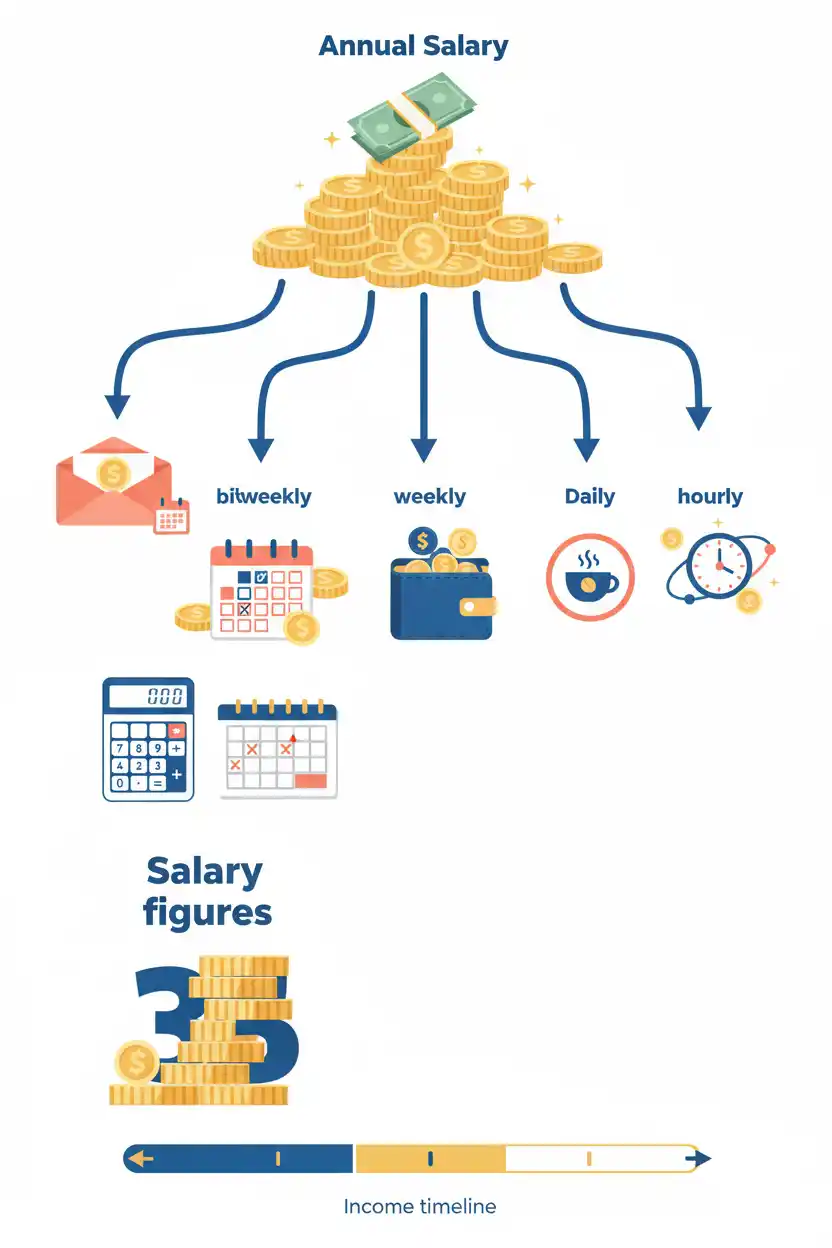

Annual salary is the amount of fixed compensation associated with a full year of employment before considering the employee’s specific tax withholding and many payroll deductions.
If salary is $78,000 per year, its simple gross equivalents are $6,500 per month, $3,000 per ordinary biweekly paycheck, and $1,500 per week.
Annual salary is useful for comparing jobs and converting compensation across pay periods, but it should not be confused with take-home pay or total compensation.
What Is Annual Salary?
Annual salary expresses recurring employment pay on a yearly basis.
A salary is typically stated before taxes and employee payroll deductions.
For example:
Annual Salary = $78,000
does not mean the employee receives $78,000 in spendable cash.
The actual amount deposited into the employee’s account can be lower after withholding and deductions.
Annual Salary From Monthly Pay
If monthly gross salary is known:
Annual Salary = Monthly Gross Pay × 12
Suppose:
Monthly Gross Pay = $6,500
Then:
Annual Salary = $6,500 × 12
= $78,000
Monthly Pay From Annual Salary
Reverse the calculation:
Monthly Gross Pay = Annual Salary ÷ 12
For $78,000:
$78,000 ÷ 12 = $6,500
The monthly figure is a gross salary equivalent.
Annual Salary From Weekly Pay
Annual Salary = Weekly Pay × 52
Suppose gross weekly pay is:
$1,500
Then:
$1,500 × 52 = $78,000
This assumes the compensation structure supports 52 paid weeks.
Weekly Pay From Annual Salary
Weekly Gross Pay = Annual Salary ÷ 52
For $78,000:
$78,000 ÷ 52 = $1,500
Annual Salary From Biweekly Pay
A standard biweekly pay schedule normally contains 26 pay periods.
Therefore:
Annual Salary = Biweekly Gross Pay × 26
Suppose:
Biweekly Gross Pay = $3,000
Then:
Annual Salary = $3,000 × 26
= $78,000
Biweekly Pay From Annual Salary
Biweekly Gross Pay = Annual Salary ÷ 26
For $78,000:
$78,000 ÷ 26
= $3,000
Using 24 as the divisor would describe a semimonthly schedule, not a standard 26-period biweekly schedule.
Annual Salary From Semimonthly Pay
Semimonthly employees normally receive 24 regular paychecks in a year.
Annual Salary = Semimonthly Pay × 24
For a $78,000 salary:
Semimonthly Pay = $78,000 ÷ 24
= $3,250
Notice that this is higher than the $3,000 biweekly check because the semimonthly schedule has fewer pay periods.
Annual Salary From Hourly Pay
For an hourly worker:
Annual Pay = Hourly Rate × Hours per Week × Paid Weeks per Year
Suppose:
- hourly rate = $27.50;
- hours = 40 per week;
- paid weeks = 52.
Then:
Annual Pay = $27.50 × 40 × 52
= $57,200
This is an annualized pay calculation rather than proof that every hourly employee is guaranteed exactly 2,080 paid hours.
Salary to Hourly Equivalent
A common full-time conversion assumes:
40 Hours × 52 Weeks = 2,080 Hours
Then:
Hourly Equivalent = Annual Salary ÷ 2,080
For $78,000:
$78,000 ÷ 2,080
= $37.50 per hour
This is a comparison tool. A salaried worker’s actual compensation arrangement may not be legally or operationally defined as $37.50 for every hour worked.
Annual Salary vs Total Compensation
Salary is only one possible component of total compensation.
An employee may also receive:
- bonus compensation;
- employer benefits;
- retirement contributions;
- equity compensation;
- commissions or incentives.
For example, if annual salary is $80,000 and bonus pay is $10,000:
Salary + Bonus = $90,000
That does not necessarily mean total compensation is exactly $90,000 if additional benefits exist.
Salary Increase Formula
Suppose salary rises from:
$78,000 to $85,800
Dollar increase:
$85,800 − $78,000 = $7,800
Percentage raise:
$7,800 ÷ $78,000 × 100
= 10%
The employee received a 10% salary increase.
Calculate New Salary After a Raise
New Salary = Old Salary × (1 + Raise Percentage)
For a 10% raise on $78,000:
New Salary = $78,000 × 1.10
= $85,800
Reverse a Salary Increase
Suppose the new annual salary is $85,800 after a 10% raise.
Old Salary = New Salary ÷ (1 + Raise Rate)
Old Salary = $85,800 ÷ 1.10
= $78,000
Subtracting 10% from $85,800 would not correctly reverse the original increase.
Salary Reduction Example
Suppose annual salary decreases from:
$80,000 to $72,000
Reduction:
$8,000
Percentage decrease:
$8,000 ÷ $80,000 × 100
= 10%
The new salary is 90% of the old salary.
Gross Salary vs Take-Home Pay
Annual salary usually refers to gross compensation.
Take-home income depends on taxes and payroll deductions.
Suppose:
Annual Salary = $78,000
and average net pay across the year is:
$58,500
Take-home percentage:
$58,500 ÷ $78,000 × 100
= 75%
The remaining 25% represents the combined effect of the modeled withholding and deductions, not one single tax rate.
Annual Salary and AGI
Adjusted gross income is a tax measure rather than a salary measure.
Someone earning an $80,000 salary can have AGI above or below $80,000 depending on additional income and qualifying adjustments.
Annual salary should therefore be used to describe employment compensation, not substituted for a tax-return income line.
Annual Salary and Budgeting
A household budget should generally be built around the money actually available for spending and saving.
If salary is:
$78,000
monthly gross equivalent is:
$6,500
But if monthly take-home pay is $4,900, planning recurring expenses around $6,500 would overstate available cash by:
$6,500 − $4,900 = $1,600 per month
Gross salary is useful for compensation comparison; net cash flow is more useful for monthly spending decisions.
Annual Salary and Capital Gains
Investment profits are not part of annual salary simply because they increase annual income.
The tax treatment of asset-sale gains belongs under capital gains tax.
Keeping salary and investment gains separate makes compensation analysis clearer.
Salary Plus Commission
Suppose:
Annual Salary = $50,000
and commissions total:
$18,000
Total gross employment compensation in the simplified example:
$68,000
The base salary remains $50,000.
Variable commissions should not be added to the stated salary when comparing fixed compensation unless the label clearly says total compensation.
Salary Plus Bonus Percentage
Suppose:
Salary = $90,000
and target bonus is:
15%
Bonus:
$90,000 × 15%
= $13,500
Target salary-plus-bonus compensation:
$103,500
A target bonus is not necessarily guaranteed, so job comparisons should distinguish fixed and variable compensation.
Daily Salary Equivalent
If a comparison assumes 260 working days:
Daily Salary Equivalent = Annual Salary ÷ 260
For $78,000:
$78,000 ÷ 260 = $300
Again, this is an analytical conversion rather than a universal payroll rule.
Salary for Part of a Year
Suppose annual salary is $72,000 but employment lasts six months under a simple proportional assumption.
Six-Month Gross Pay = $72,000 × 6 ÷ 12
= $36,000
Actual payroll can differ depending on exact start dates, pay periods, unpaid leave, and employer practices.
Comparing Two Job Offers
Suppose:
Offer A
Salary = $90,000
Offer B
Salary = $85,000
At first glance, Offer A pays $5,000 more.
But if Offer B includes stronger guaranteed benefits or lower employee costs, the financial comparison can change.
Annual salary is a central input, not the entire employment package.
Common Annual Salary Mistakes
A common mistake is treating annual salary as take-home pay.
Another is multiplying biweekly pay by 24 rather than 26.
People may also include a variable bonus inside salary without labeling it separately or use a 2,080-hour assumption when the actual work schedule differs.
Frequently Asked Questions
What is annual salary?
Annual salary is fixed employment compensation expressed over one year, usually before taxes and employee deductions.
How do I calculate annual salary from monthly pay?
Annual Salary = Monthly Pay × 12
How do I calculate annual salary from biweekly pay?
Annual Salary = Biweekly Pay × 26
for a standard biweekly schedule.
How do I calculate annual salary from weekly pay?
Annual Salary = Weekly Pay × 52
How do I estimate annual pay from an hourly wage?
Hourly Rate × Hours per Week × Paid Weeks
How many hours are commonly used for a full-time salary conversion?
A common comparison assumption is 2,080 hours, based on 40 hours × 52 weeks.
Is annual salary the same as take-home pay?
No.
Is annual salary the same as total compensation?
No. Bonuses, benefits, commissions, or other compensation can exist outside base salary.
How do I calculate a raise?
Raise % = (New Salary − Old Salary) ÷ Old Salary × 100
Can AGI differ from salary?
Yes.
Should I use salary or net pay for budgeting?
Net take-home cash is generally more useful for monthly spending decisions.
Why calculate annual salary?
It provides a consistent basis for comparing compensation and converting pay periods within the wider Taxes & Pay framework.