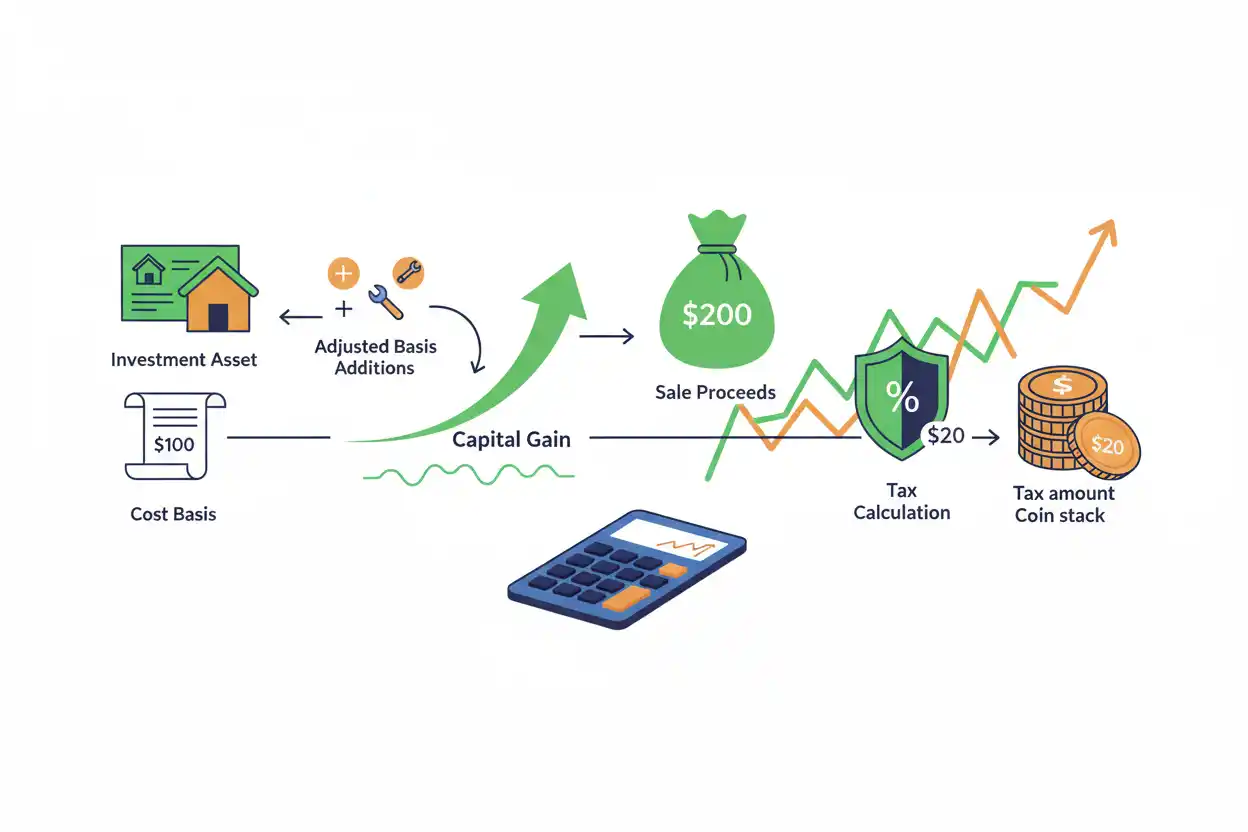

Capital gains tax is associated with the profit recognized when a capital asset is sold for more than its tax basis.
If an investment has an adjusted basis of $21,500 and produces $31,500 of net sale proceeds, the capital gain is $10,000.
The tax is not normally calculated from the entire $31,500 received. The starting point is the gain, which reflects the difference between what is received and the asset’s adjusted basis.
The eventual tax treatment can depend on the asset, holding period, taxpayer’s broader income, losses, and other tax rules.
Capital Gain Formula
The basic calculation is:
Capital Gain or Loss = Amount Realized − Adjusted Basis
If the result is positive, there is a gain.
If the result is negative, there is a loss.
For a simplified transaction in which selling costs reduce the amount received:
Net Sale Proceeds = Sale Price − Selling Costs
Then:
Capital Gain = Net Sale Proceeds − Adjusted Basis
Capital Gains Tax Example
Suppose an investor originally acquired an asset for $20,000 and later has an adjusted basis of $21,500 after applicable basis adjustments.
The asset is sold for:
$32,000
Selling costs are:
$500
Net sale proceeds:
$32,000 − $500 = $31,500
Capital gain:
$31,500 − $21,500 = $10,000
The calculated capital gain is $10,000.
If an illustrative tax rate of 15% applied to that entire gain:
Estimated Tax = $10,000 × 15%
= $1,500
The 15% figure is only an example rate. The actual federal tax treatment depends on the circumstances surrounding the gain.
Sale Price Is Not the Same as Capital Gain
Suppose an investment is sold for $50,000.
If its adjusted basis is $40,000:
Gain = $50,000 − $40,000
= $10,000
Taxing the entire $50,000 as though it were profit would ignore the capital already invested in the asset.
Basis is therefore central to capital gains tax calculations.
What Is Adjusted Basis?
Basis generally starts with the amount associated with acquiring the asset and can change over time depending on the asset and applicable tax rules.
For a simple investment example:
Original Cost = $25,000
Suppose qualifying basis adjustments increase basis by:
$2,000
Then:
Adjusted Basis = $27,000
If net proceeds are $35,000:
Capital Gain = $35,000 − $27,000
= $8,000
Correct basis records can materially change the gain reported.
Capital Loss Example
Suppose:
Adjusted Basis = $30,000
and net proceeds are:
$24,000
Then:
Capital Gain or Loss = $24,000 − $30,000
= −$6,000
The transaction produced a $6,000 capital loss rather than a gain.
Capital losses can interact with capital gains under tax rules, so they should not simply be ignored because the transaction did not produce taxable profit.
Short-Term vs Long-Term Capital Gains
For U.S. federal income-tax classification, the holding period generally separates capital gains and losses into short-term and long-term categories. Assets held for more than one year are generally long-term; one year or less is generally short-term.
This distinction matters because the federal tax treatment of long-term capital gains can differ from the treatment of short-term gains.
The correct sequence is therefore not simply:
Gain × One Universal Capital Gains Rate
Instead, identify the gain, determine its tax classification, account for relevant gains and losses, and then apply the tax rules appropriate to the taxpayer.
Holding Period Example
Suppose two investors each realize:
$10,000 Gain
Investor A held the asset for eight months.
Investor B held an otherwise comparable asset for three years.
The dollar gain is identical:
$10,000
but the federal holding-period classification differs.
This is why the tax amount cannot be determined from the gain alone.
Gross Gain vs Net Capital Gain
Suppose a taxpayer realizes:
$14,000 Gain on Asset A
and:
$5,000 Loss on Asset B
Before considering more detailed tax classification rules, the simple economic net is:
$14,000 − $5,000 = $9,000
The tax system contains specific rules for netting short-term and long-term gains and losses, so the final taxable capital-gain amount can require more than subtracting every loss from every gain in one step.
Capital Gain Percentage
The investment gain itself can be expressed as a return percentage.
Suppose:
Adjusted Basis = $40,000
Net Proceeds = $50,000
Gain:
$10,000
Gain relative to basis:
$10,000 ÷ $40,000 × 100
= 25%
A 25% investment gain does not mean the tax rate is 25%.
Investment return and tax rate are different percentages.
Estimating Capital Gains Tax
Once the taxable gain and applicable rate are known, a basic estimate is:
Estimated Capital Gains Tax = Taxable Capital Gain × Applicable Tax Rate
Suppose:
Taxable Gain = $20,000
and an illustrative applicable rate is:
15%
Then:
Estimated Tax = $20,000 × 0.15
= $3,000
The arithmetic is easy. Determining the correct taxable gain and rate is usually the more important part.
After-Tax Gain
A useful extension is:
After-Tax Gain = Capital Gain − Estimated Tax
Using the $20,000 gain and $3,000 illustrative tax:
After-Tax Gain = $20,000 − $3,000
= $17,000
This is still a simplified estimate because other taxes or transaction costs may apply.
Effective Tax Rate on the Gain
Suppose the final tax attributed to a $20,000 gain is $3,000.
Effective Tax Rate on Gain = $3,000 ÷ $20,000 × 100
= 15%
This is a transaction-specific ratio.
It should not automatically be confused with the taxpayer’s broader effective tax rate across all taxable income.
Capital Gains and Commission Income
Income from commission pay is compensation for work rather than profit from selling a capital asset.
Suppose an employee earns a $10,000 sales commission and separately realizes a $10,000 investment gain.
The amounts are numerically identical, but they arise from different sources and can receive different tax treatment.
That is why total annual cash receipts should not be assigned one tax formula without classification.
Commissions vs Capital Gains
A broader commissions structure may determine how sales compensation changes at different revenue levels.
For example:
5% Commission on $100,000 Sales = $5,000
That $5,000 is pay generated by work under a compensation formula.
A $5,000 capital gain is generated by disposing of an asset for more than basis.
The source of income matters.
Capital Gains and Bonus Pay
The same distinction applies to bonus pay.
A $15,000 employee bonus is not turned into a capital gain because the employee invests the cash later.
If the employee subsequently purchases an investment for $15,000 and sells it for $20,000:
Capital Gain = $20,000 − $15,000
= $5,000
The bonus and later investment gain are separate events.
Capital Gains and Biweekly Pay
Regular biweekly pay is employment compensation received on a two-week payroll schedule.
Capital gains are not normally inserted into biweekly salary calculations.
Keeping payroll income and investment transactions separate makes both budgeting and tax estimates more reliable.
Capital Gains in a Household Budget
A household budget should distinguish recurring income from one-time investment gains.
Suppose monthly living costs rely on $5,000 of dependable take-home pay while a $25,000 investment gain occurs once.
Treating the gain as though it provides:
$25,000 ÷ 12 ≈ $2,083 per month
of permanent recurring income can overstate sustainable household cash flow.
One-time gains and ordinary income have different planning roles.
Loss Does Not Always Mean Tax Savings Equal to the Loss
Suppose an investor realizes a $10,000 capital loss.
That does not mean:
Tax Savings = $10,000
The loss is an amount entering the tax calculation.
Any actual tax benefit depends on how tax rules allow the loss to offset gains or other income and on the taxpayer’s circumstances.
Dollar loss and dollar tax savings should never be assumed to be identical.
Unrealized Gain vs Realized Gain
Suppose an investment purchased for $20,000 rises in market value to $30,000 but is not sold.
Economic unrealized gain:
$30,000 − $20,000 = $10,000
If the asset has not been disposed of, the tax treatment can differ from a realized sale.
A rising market price by itself should therefore not automatically be treated as a completed taxable capital-gain transaction.
Selling Costs
Suppose:
Sale Price = $100,000
Selling Costs = $2,000
Net amount realized in a simplified example:
$98,000
If adjusted basis is $70,000:
Gain = $98,000 − $70,000
= $28,000
Ignoring transaction costs would overstate the gain in this simplified setup by $2,000.
Capital Gains and Inflation
Suppose an asset rises from $100,000 to $130,000 over many years.
Nominal gain:
$30,000
Part of that increase may reflect broad inflation rather than a full increase in real purchasing power.
Tax calculation and real-return analysis are separate.
A nominal taxable gain does not automatically equal the investor’s real economic gain after inflation.
Why Recordkeeping Matters
An investor who knows the sale price but cannot establish correct basis can have difficulty calculating the gain accurately.
Useful records can include acquisition information, transaction costs, reinvestments, and other basis adjustments relevant to the asset.
The exact record requirements depend on the transaction, but the mathematical reason is simple:
Wrong Basis → Wrong Gain
Common Capital Gains Tax Mistakes
A frequent error is calculating tax from gross sale proceeds instead of the gain.
Another is confusing investment return percentage with tax rate.
Investors can also ignore holding period, fail to account for capital losses, or assume all capital gains receive one universal tax rate.
Frequently Asked Questions
What is a capital gain?
A capital gain generally occurs when the amount realized from disposing of a capital asset exceeds its adjusted basis.
What is the basic formula?
Capital Gain = Amount Realized − Adjusted Basis
Is capital gains tax calculated from the entire sale price?
Generally, the gain rather than the entire gross sale price is the starting point.
What happens when basis exceeds sale proceeds?
The transaction can produce a capital loss.
What is adjusted basis?
It is the asset’s tax basis after applicable increases or decreases.
Are all capital gains taxed at the same rate?
No. Tax treatment can vary with holding period, income, asset type, and other rules.
What is a long-term capital gain?
For U.S. federal classification, a gain on an asset generally held for more than one year is long-term.
Is commission income a capital gain?
No. Employee commissions are compensation rather than investment-sale gains.
Does a $10,000 capital loss create $10,000 of tax savings?
No. The tax effect depends on applicable loss rules and the taxpayer’s situation.
Is an unrealized gain the same as a realized sale gain?
No. A market-value increase without a sale is economically different from a completed disposition.
Why does basis matter so much?
Because gain or loss is measured relative to adjusted basis.
Can capital gains affect a household’s tax burden?
Yes, which is why capital-gain calculations should be considered alongside the broader Taxes & Pay picture.