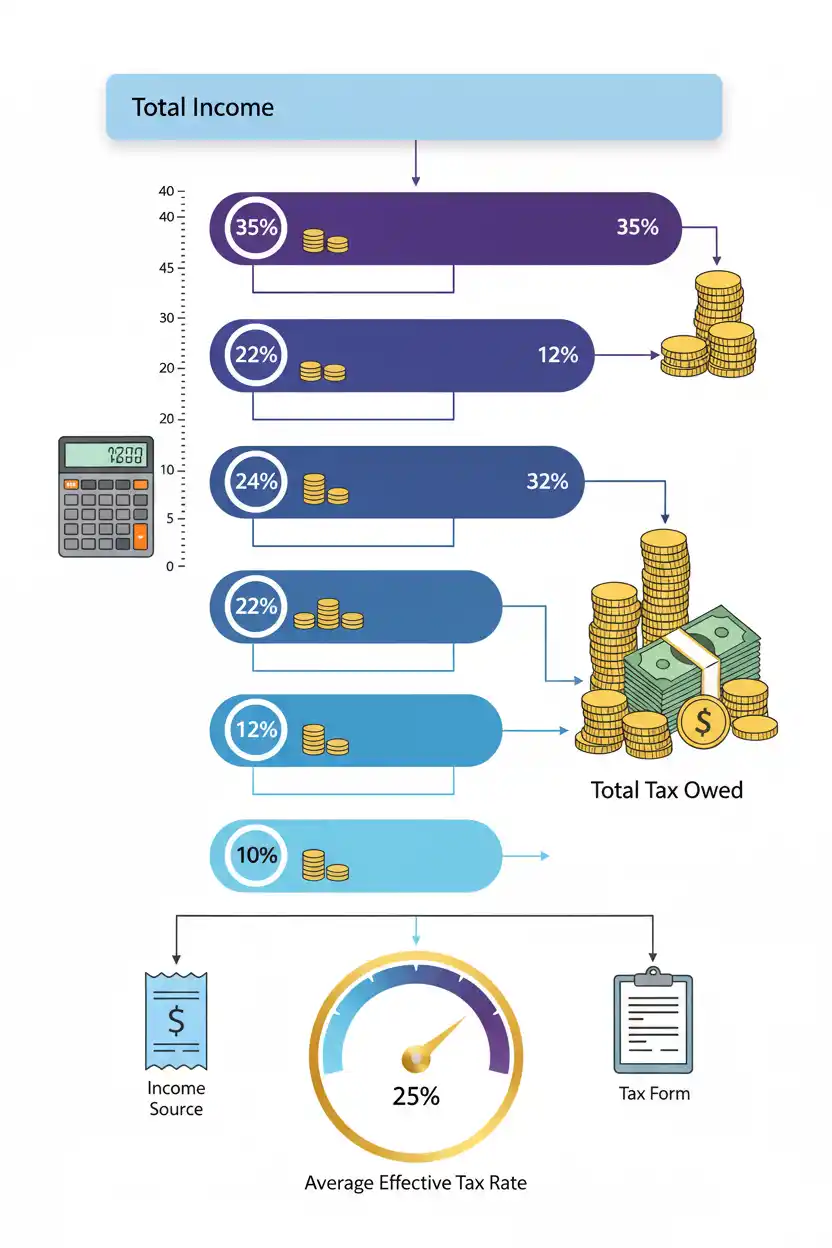

Effective tax rate measures total tax as a percentage of a defined income amount.
If $17,307.50 of tax is calculated on $100,000 of taxable income in a hypothetical progressive system:
Effective Tax Rate = $17,307.50 ÷ $100,000
= 17.31%
The highest marginal rate used in the calculation might be 22%, yet the effective rate is only 17.31% because not every dollar is taxed at 22%.
This difference between average tax burden and marginal tax rate is central to understanding progressive taxation.
Effective Tax Rate Formula
The general formula is:
Effective Tax Rate = Total Tax ÷ Income Base × 100
The denominator must be clearly defined.
Possible income bases include:
- taxable income;
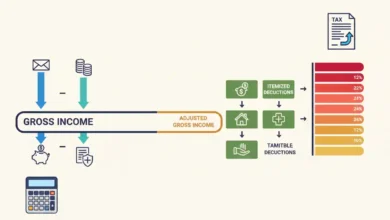
- gross income;
- adjusted gross income;
- another stated measure.
Changing the denominator changes the percentage.
Basic Effective Tax Rate Example
Suppose:
Total Tax = $12,000
and:
Taxable Income = $80,000
Then:
Effective Tax Rate = $12,000 ÷ $80,000 × 100
= 15%
The taxpayer paid tax equal to 15% of the taxable-income base used in the calculation.
Progressive Tax Example
Consider a purely hypothetical tax structure in which $100,000 of taxable income is divided as follows:
The first $11,000 is taxed at 10%:
$11,000 × 10% = $1,100
The next $33,725 is taxed at 12%:
$33,725 × 12% = $4,047
The remaining $55,275 is taxed at 22%:
$55,275 × 22% = $12,160.50
Total tax:
$1,100 + $4,047 + $12,160.50
= $17,307.50
Effective tax rate:
$17,307.50 ÷ $100,000
= 17.3075%
≈ 17.31%
The hypothetical highest marginal rate is 22%, while the effective rate is 17.31%.
Why the Highest Bracket Does Not Apply to All Income
The mistake would be:
$100,000 × 22% = $22,000
That overstates tax in the hypothetical example by:
$22,000 − $17,307.50
= $4,692.50
Only the dollars inside the top portion of the hypothetical bracket structure are taxed at 22%.
Earlier dollars remain taxed at their respective lower rates.
Marginal Tax Rate
Marginal tax rate describes the rate associated with the next dollar of taxable income within the bracket structure.
In the hypothetical $100,000 example:
Marginal Rate = 22%
because the final portion falls in the 22% bracket.
The effective rate remains:
17.31%
The two rates measure different things.
Effective Rate vs Marginal Rate
Suppose a taxpayer’s figures are:
Marginal Rate = 24%
Effective Rate = 18%
This does not indicate an error.
It means the taxpayer’s total tax averaged 18% of the stated income base even though the next applicable taxable dollars fall within a 24% marginal band.
Effective Rate Depends on the Denominator
Suppose:
Tax = $15,000
Taxable Income = $80,000
Gross Income = $100,000
Effective rate on taxable income:
$15,000 ÷ $80,000
= 18.75%
Effective rate on gross income:
$15,000 ÷ $100,000
= 15%
Both calculations are mathematically correct but answer different questions.
A reported effective tax rate without a denominator can therefore be ambiguous.
Solve for Total Tax
If the effective rate and income base are known:
Total Tax = Income Base × Effective Tax Rate
Suppose:
Income Base = $90,000
Effective Rate = 16%
Then:
Total Tax = $90,000 × 0.16
= $14,400
Solve for Income Base
If total tax and effective rate are known:
Income Base = Total Tax ÷ Effective Tax Rate
Suppose:
Total Tax = $18,000
Effective Rate = 20%
Then:
Income Base = $18,000 ÷ 0.20
= $90,000
The result is valid only if the effective rate was originally defined using that same income base.
Effective Tax Rate and Commission Income
High commission pay can increase annual taxable income, potentially changing the taxpayer’s overall tax calculation.
Suppose an employee earns an additional $20,000 of commission.
That does not mean:
All Existing Income Is Retaxed at the Highest New Marginal Rate
A progressive system applies rates to portions of taxable income according to its rules.
The effective rate can rise gradually as total tax changes.
Effective Tax Rate and Commission Tiers
Commission rates and tiers have no direct relationship with tax brackets.
Suppose a salesperson moves from a 5% commission tier to 10%.
That 10% is a compensation rate.
It is not the employee’s tax rate.
Likewise, a 22% tax bracket is not a commission percentage.
Keeping the percentages labeled prevents major calculation errors.
Effective Tax Rate and Double-Time Pay
Double-time pay can increase gross wages for the relevant pay period.
Suppose an employee earns an extra $400 in double-time compensation.
That $400 can contribute to annual income, but earning it does not mean every dollar already earned is suddenly taxed at a new top rate.
A larger paycheck can also show higher withholding without proving the employee’s final effective rate is equal to the paycheck’s withholding percentage.
Effective Tax Rate and Estimated Taxes
Estimated taxes are payments made toward expected tax liability under applicable rules.
Suppose a taxpayer pays $4,000 each quarter:
$4,000 × 4 = $16,000
Those payments are amounts paid toward the tax obligation.
They do not define the effective tax rate by themselves.
The final rate depends on actual total tax divided by the chosen income base.
Effective Tax Rate and Estate Tax
Estate tax uses a different tax base and set of rules from individual income tax.
An effective income-tax rate should therefore not be applied to an estate merely because both calculations involve taxes.
Tax type and tax base must match.
Effective Tax Rate and Withholding
Suppose:
Annual Federal Withholding = $20,000
but final calculated income tax is:
$17,000
Using $20,000 as “total tax” would overstate the effective tax rate.
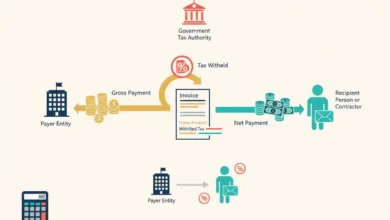
Withholding is a prepayment mechanism.
Final tax liability is the amount relevant to an effective-tax-rate calculation unless the analysis explicitly asks for withholding as a percentage of income.
Withholding Rate Example
Suppose:
Gross Pay = $5,000
and:
Tax Withholding = $1,000
Withholding percentage:
$1,000 ÷ $5,000 = 20%
That is a paycheck withholding ratio.
It does not establish:
Annual Effective Tax Rate = 20%
The annual tax return may produce a different result.
Effective Rate After a Tax Credit
Suppose a simplified tax calculation before credits is:
$15,000
and a $2,000 credit reduces final tax to:
$13,000
If taxable income is $80,000:
Before credit:
$15,000 ÷ $80,000 = 18.75%
After credit:
$13,000 ÷ $80,000 = 16.25%
Credits can therefore reduce the effective tax rate when final tax is used in the numerator.
Deduction vs Credit Effect
A deduction generally changes the income amount entering part of the tax calculation.
A credit generally reduces tax itself, subject to the rules governing that credit.
Because they operate at different stages, a $1,000 deduction and a $1,000 credit should not be assumed to provide the same tax benefit.
Combined Tax Rate
Sometimes people calculate an overall burden from several taxes.
Suppose:
Income Tax = $12,000
Other Included Taxes = $6,000
Total included tax:
$18,000
If income base is $100,000:
Combined Effective Rate = $18,000 ÷ $100,000
= 18%
The label must state which taxes are included.
Otherwise, comparing the result with an income-tax-only effective rate is misleading.
Effective Tax Rate for Businesses
A similar concept can be used for companies:
Effective Corporate Tax Rate = Income Tax Expense ÷ Pretax Income
However, accounting tax expense and cash taxes paid can differ.
An individual-tax effective rate and an accounting corporate tax rate therefore should not be compared without understanding their definitions.
Negative Effective Tax Rate
Certain tax calculations can produce unusual results when refundable credits or other provisions exceed pre-credit tax.
If the numerator becomes negative, a mathematical effective rate can also become negative.
Such a result requires explanation rather than interpreting it like a conventional positive tax burden.
Effective Rate Over Several Years
Suppose annual taxable income and tax vary.
Instead of averaging annual effective rates, a multi-year effective rate can be calculated from totals:
Multi-Year Effective Rate = Total Tax Across Years ÷ Total Income Base Across Years
This correctly weights years with different income amounts.
Why Averaging Percentages Can Be Wrong
Suppose:
Year 1:
$10,000 Income at 10% Effective Rate = $1,000 Tax
Year 2:
$90,000 Income at 20% Effective Rate = $18,000 Tax
Simple average of rates:
(10% + 20%) ÷ 2 = 15%
But combined effective rate:
($1,000 + $18,000) ÷ ($10,000 + $90,000)
= $19,000 ÷ $100,000
= 19%
The 19% figure correctly weights the larger-income year.
Common Effective Tax Rate Mistakes
One of the biggest mistakes is multiplying all taxable income by the highest marginal rate.
Another is using withholding as though it were final tax liability.
People can also compare effective rates that use different income denominators or average annual rates without weighting them by income.
Frequently Asked Questions
What is effective tax rate?
It is total tax divided by a defined income base.
What is the formula?
Effective Tax Rate = Total Tax ÷ Income Base × 100
Is effective tax rate the same as marginal tax rate?
No.
Why is effective rate often below the highest marginal rate?
In a progressive system, lower portions of income can be taxed at lower rates.
Does entering a higher bracket raise the tax rate on every prior dollar?
Not in a progressive bracket system.
Should I use gross income or taxable income in the denominator?
Either may be used for a defined analytical purpose, but the result must clearly state which denominator was chosen.
Is withholding the same as total tax?
No.
Can commission income raise my effective rate?
It can change total taxable income and therefore change the overall tax calculation.
Is a commission rate a tax rate?
No.
Are estimated tax payments the same as effective tax rate?
No. Estimated payments are payments toward expected liability.
Can tax credits lower the effective rate?
Yes, when they reduce the final tax amount used in the numerator.
Why calculate effective tax rate?
It shows the average tax burden relative to the chosen income base and provides more context than looking only at a marginal bracket.