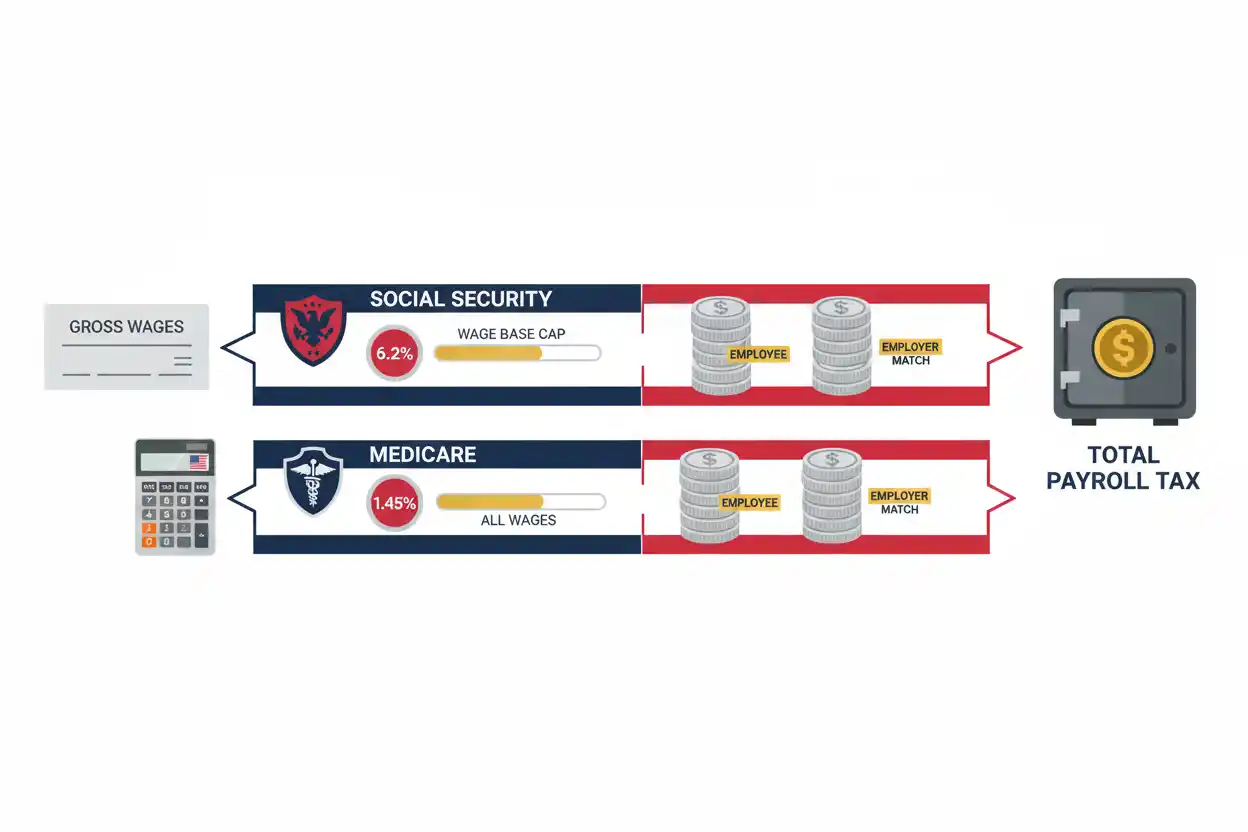

FICA tax is the U.S. payroll-tax framework associated with Social Security and Medicare taxes on covered wages.
The employee calculation has two core components:
Employee FICA = Social Security Tax + Medicare Tax
For a simple illustrative paycheck of $4,000, assume a 6.2% Social Security component and a 1.45% Medicare component.
Social Security tax would be $248, Medicare tax would be $58, and combined employee FICA would be $306.
Actual payroll calculations must use the rates, Social Security wage base, Additional Medicare Tax rules, and other requirements applicable to the payroll year. Wage limits and thresholds can change, so current payroll tables should always control.
What Does FICA Mean?
FICA stands for the Federal Insurance Contributions Act.
In ordinary employee payroll calculations, FICA is commonly discussed as two separate taxes: Social Security and Medicare.
The simplified structure is:
FICA Tax = Social Security Portion + Medicare Portion
The two components need to remain separate because their wage limits and additional-tax rules are not identical.
FICA Tax Formula
For wages below any applicable Social Security wage limit and below any additional Medicare withholding threshold, a simplified employee formula is:
Employee FICA = Gross FICA Wages × Social Security Rate + Gross Medicare Wages × Medicare Rate
When the same wage base applies to both portions for the paycheck:
Employee FICA = Wages × (Social Security Rate + Medicare Rate)
This shortcut should only be used when the relevant wages are subject to both components in the same way.
FICA Tax Example
Assume:
Gross FICA Wages = $4,000
For this illustrative example, use:
Social Security Rate = 6.2%
Medicare Rate = 1.45%
Social Security portion:
$4,000 × 6.2%
= $248
Medicare portion:
$4,000 × 1.45%
= $58
Combined:
$248 + $58
= $306
The illustrative employee FICA amount is $306.
Net Pay After FICA Only
If FICA were the only deduction in the simplified example:
Gross Pay = $4,000
FICA = $306
Then:
Pay After FICA = $4,000 − $306
= $3,694
Real take-home pay can be lower because federal income-tax withholding, state or local taxes, benefits, retirement contributions, and other deductions may also apply.
FICA vs Gross Income
Gross income is an income concept.
FICA tax is a payroll-tax calculation.
Suppose gross wages are:
$4,000
That number can be an input into payroll-tax calculations, but it is not itself a tax.
The relationship is:
Taxable Wage Base × Payroll Tax Rate = Tax Amount
not:
Gross Income = FICA Tax
FICA vs Gross Pay
Gross pay is compensation before payroll deductions.
Suppose gross pay is $3,000 and employee FICA under a simplified calculation equals $229.50.
Gross pay remains:
$3,000
The FICA deduction reduces net pay rather than changing the original gross-pay figure.
FICA and Estimated Taxes
Estimated taxes are generally forward-looking payments toward expected tax liability when withholding may be insufficient.
Employee FICA is normally handled through payroll withholding on covered wages.
The existence of FICA withholding does not mean a taxpayer has automatically satisfied all income-tax obligations.
FICA and Export Duty
Export duty is based on exported goods or customs value.
FICA is based on covered payroll compensation.
They can both use percentage formulas, but the tax bases are unrelated.
This distinction is essential whenever financial calculations involve several different taxes.
FICA and Estate Tax
Estate tax is connected with a taxable estate rather than wages.
A payroll-tax rate should never be applied to estate value.
The correct tax calculation always begins with the correct legal tax base.
Social Security Wage Limit
The Social Security component does not necessarily apply without limit to every dollar of annual wages.
A year-specific wage base caps the amount of earnings subject to that component.
Suppose, purely as a hypothetical example, an annual wage base were $180,000.
If an employee earned $200,000:
Social Security-Taxable Wages = $180,000
rather than:
$200,000
The actual wage base must be checked for the payroll year.
Wage-Base Example
Using the hypothetical $180,000 wage cap and a 6.2% illustrative rate:
Maximum Social Security Employee Tax = $180,000 × 6.2%
= $11,160
Once annual covered wages reach the hypothetical cap, additional wages would not create additional Social Security tax under that example.
This does not mean Medicare tax stops at the same point.
Medicare Has a Different Structure
The Medicare portion does not use the same annual wage cap as the Social Security portion.
That means high-income payroll calculations cannot simply apply one combined FICA rate to unlimited wages.
The two components should be calculated separately when thresholds become relevant.
Additional Medicare Tax
Higher earned income can become subject to an additional Medicare withholding component after the applicable threshold is crossed.
The exact threshold and rate should be checked for the relevant year and taxpayer situation.
This is another reason a simple combined percentage works best only for ordinary wages below the relevant thresholds.
Employer FICA
Employers can also have matching or related payroll-tax obligations.
Employee withholding and employer payroll cost should not be confused.
Suppose employee FICA is $306 on a paycheck.
That does not automatically mean:
Employee Take-Home Reduction = $612
The employer portion is generally an employer cost rather than an additional employee paycheck deduction.
Employee vs Employer Cost
Suppose gross wages are:
$4,000
Employee FICA:
$306
If an employer has a matching $306 obligation in the simplified example, total employer payroll cost before other benefits and taxes becomes:
$4,000 + $306
= $4,306
Employee gross pay remains $4,000.
Employer cost and employee compensation are different measurements.
Annual FICA Example
Suppose covered annual wages are:
$60,000
and the entire amount is below the applicable Social Security wage limit.
Using illustrative rates of 6.2% and 1.45%:
Social Security:
$60,000 × 6.2% = $3,720
Medicare:
$60,000 × 1.45% = $870
Combined:
$4,590
Again, actual payroll should use current-year rules.
Monthly FICA Example
If monthly covered wages are:
$5,000
using the same illustrative ordinary rates:
Social Security:
$310
Medicare:
$72.50
Combined:
$382.50
The calculation can be performed per pay period as payroll is processed.
Biweekly FICA Example
Suppose gross biweekly wages are:
$2,500
Social Security portion:
$2,500 × 6.2% = $155
Medicare:
$2,500 × 1.45% = $36.25
Combined:
$191.25
Net pay still requires other payroll deductions to be included.
FICA Effective Percentage
For ordinary wages subject to both illustrative components:
Combined Rate = 6.2% + 1.45%
= 7.65%
On a $4,000 paycheck:
$306 ÷ $4,000
= 7.65%
This is a payroll-tax percentage, not the employee’s overall effective tax rate across federal income tax and other taxes.
FICA vs Income-Tax Withholding
Suppose a paycheck shows:
FICA = $306
and federal income-tax withholding of:
$500
Total of those two deductions:
$806
The $306 and $500 should not be combined and called “the FICA rate.”
Only the Social Security and Medicare components belong in the FICA calculation.
Pretax Payroll Deductions
Certain employee benefits can affect some tax bases differently.
A deduction that reduces federal taxable wages does not necessarily reduce Social Security or Medicare wages in the same way.
Therefore, payroll calculations should use the specific wage boxes or taxable bases applicable to each tax rather than assuming every pretax deduction reduces every tax identically.
Self-Employment Is Different
Self-employed individuals can face Social Security and Medicare taxes through a different mechanism from ordinary employee paycheck withholding.
A wage-earner’s FICA calculation should therefore not automatically be copied into a self-employment tax calculation.
The underlying programs are related, but the calculation structure differs.
Common FICA Tax Mistakes
A common mistake is treating FICA as one unlimited percentage applied to all annual wages.
Another is confusing the employer portion with an employee deduction.
People also combine federal income-tax withholding with FICA or assume the Social Security wage limit also caps Medicare tax.
Frequently Asked Questions
What is FICA tax?
FICA is the U.S. payroll-tax framework associated with Social Security and Medicare taxes on covered wages.
What is the basic formula?
FICA = Social Security Tax + Medicare Tax
Is FICA the same as federal income tax?
No.
Does Social Security tax apply to unlimited wages?
No. A year-specific wage base limits the Social Security portion.
Does Medicare use the same wage cap?
No.
Can higher wages trigger an additional Medicare component?
Yes, when the applicable threshold rules are met.
Does the employer also pay FICA-related taxes?
Employers generally have their own corresponding payroll-tax obligations.
Is the employer portion deducted from employee net pay?
It is generally an employer payroll cost rather than an additional employee paycheck deduction.
Can pretax deductions affect FICA wages?
Potentially, depending on the type of deduction and tax rules.
Is FICA included in gross pay?
No. FICA is calculated from applicable wages and deducted separately.
Is FICA the same for self-employed workers?
No. Self-employment tax uses a different calculation framework.
Why must current rates and wage limits be checked?
Payroll rates, wage bases, and thresholds are year-specific inputs within the larger Taxes & Pay calculation.