
Import duty is a customs charge imposed on qualifying goods entering a country or customs territory.
If imported goods have a dutiable customs value of $80,000 and an illustrative duty rate of 7.5%:
Import Duty = $80,000 × 7.5%
= $6,000
The arithmetic is simple once the correct customs value and tariff rate are known. Determining those inputs can be more complicated because product classification, country of origin, valuation rules, exemptions, trade agreements, quantities, and current tariff schedules can all affect the result.
Import Duty Formula
For an ad valorem tariff:
Import Duty = Dutiable Customs Value × Import Duty Rate
Suppose:
Customs Value = $150,000
and:
Duty Rate = 4%
Then:
Duty = $150,000 × 0.04
= $6,000
The importer owes $6,000 under the simplified example before considering any additional customs taxes, fees, or charges.
What Is Dutiable Customs Value?
The duty base is not always identical to the commercial invoice total.
Customs rules can specify whether particular amounts such as freight, insurance, assists, royalties, or other transaction elements belong in the customs value.
Suppose:
Invoice Amount = $100,000
but the applicable customs valuation produces:
Dutiable Value = $110,000
At 5%:
Using invoice value:
$100,000 × 5% = $5,000
Using the required customs value:
$110,000 × 5% = $5,500
Difference:
$500
Correct valuation is therefore essential.
Specific Import Duty
Some tariffs are based on quantity rather than value.
Suppose duty is:
$3 per Unit
and the importer brings in:
8,000 Units
Then:
Import Duty = 8,000 × $3
= $24,000
The market value of the merchandise does not enter this particular specific-duty formula.
Ad Valorem vs Specific Duty
Suppose 8,000 units have a customs value of $200,000.
At a 5% ad valorem rate:
$200,000 × 5% = $10,000
At $3 per unit:
8,000 × $3 = $24,000
The specific duty is much larger in this example.
Knowing whether the tariff is percentage-based or quantity-based is critical.
Combined Import Duty
A tariff can theoretically include both components.
Suppose:
Customs Value = $100,000
Ad Valorem Rate = 3%
Quantity = 5,000 Units
Specific Duty = $1 per Unit
Ad valorem component:
$100,000 × 3% = $3,000
Specific component:
5,000 × $1 = $5,000
Combined duty:
$8,000
The actual tariff schedule determines whether and how these components are combined.
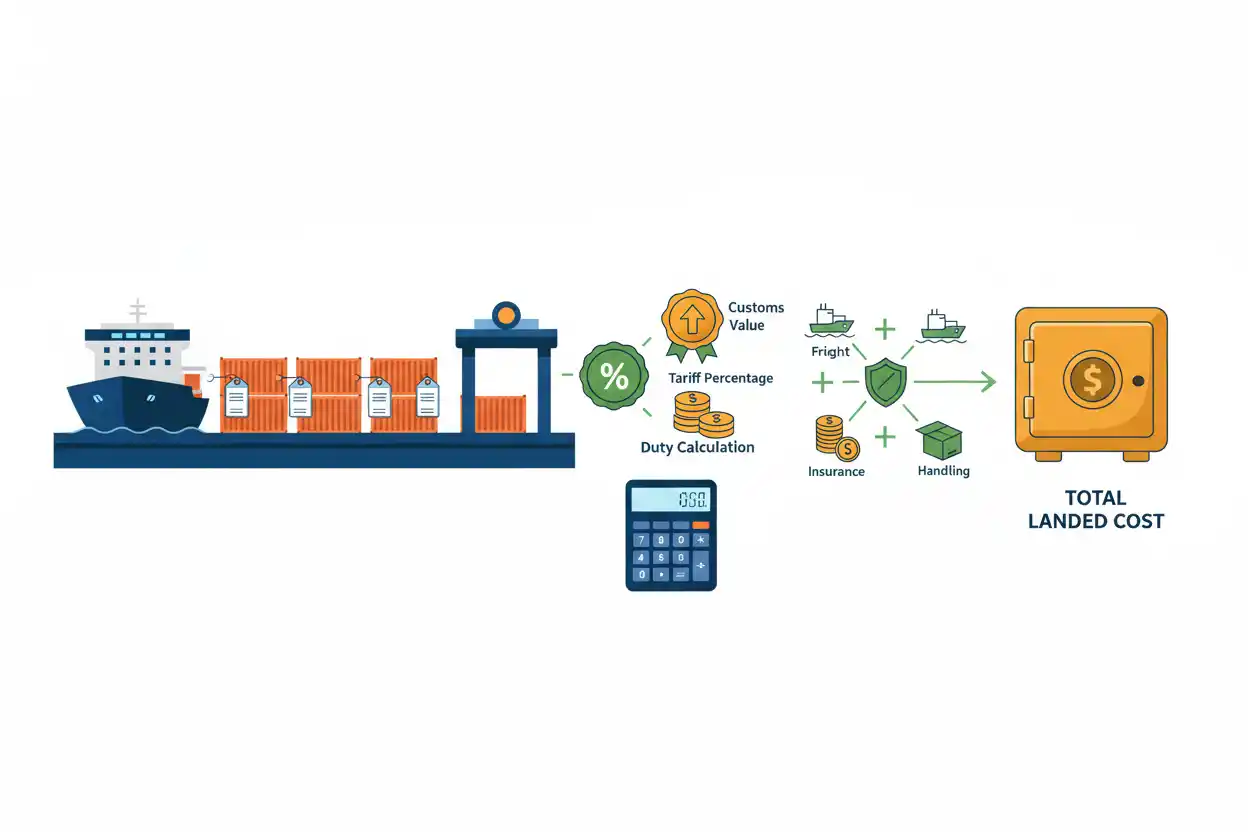
Landed Cost
Import duty is often one part of the total landed cost.
A simplified framework is:
Landed Cost = Purchase Cost + Freight + Insurance + Import Duty + Other Applicable Import Costs
Suppose:
Goods = $80,000
Freight and Insurance = $7,000
Import Duty = $6,000
Other Applicable Costs = $2,000
Then:
Landed Cost = $80,000 + $7,000 + $6,000 + $2,000
= $95,000
The $6,000 duty is only one component of getting the merchandise into usable inventory.
Duty as a Percentage of Purchase Price
Using the same example:
Duty = $6,000
Purchase Price = $80,000
Duty burden relative to purchase price:
$6,000 ÷ $80,000 × 100
= 7.5%
If the customs base differs from purchase price, this descriptive percentage can differ from the statutory tariff rate.
Import Duty vs Export Duty
Export duty applies to qualifying goods leaving a jurisdiction.
Import duty applies when goods enter.
A product can therefore face very different tax treatment depending on:
- origin;
- destination;
- product classification;
- transaction direction.
Import and export duty should not be treated as one interchangeable tax.
Import Duty and Hourly Wage
An employee’s hourly wage is based on hours worked.
Import duty is based on customs value or quantity.
A business can face both labor and import costs, but multiplying imported merchandise by an hourly-pay rate has no economic meaning.
Import Duty and Gross Pay
The same separation applies to gross pay.
Suppose a company pays $50,000 of wages and $20,000 of import duties during a period.
Both are business costs in a broad sense, but they arise from different transactions and use different formulas.
Import Duty and Gross Income
Gross income is an income measure, while import duty is a customs charge.
If goods costing $100,000 incur $10,000 of duty, the duty may affect the economics of the merchandise.
It does not automatically mean:
Gross Income = Revenue − $10,000
The accounting or tax treatment must first identify where the duty belongs.
Import Duty and Income Tax
Income tax basics begin from income and deductions.
Import duty begins from imported goods.
The percentage-rate appearance can be similar, but the taxable event is entirely different.
Currency Conversion
Suppose merchandise has a customs value of:
€60,000
and the required customs exchange rate converts it to:
$66,000
At 8%:
Import Duty = $66,000 × 8%
= $5,280
Using an arbitrary exchange rate rather than the customs authority’s required conversion method can change the calculation.
Country of Origin
Tariff treatment can depend on the origin of the goods rather than merely the country from which they were shipped.
For example, goods routed through an intermediate country do not necessarily acquire that country’s origin.
Origin can affect whether preferential or additional tariff treatment applies.
The calculation should therefore use the classification and origin recognized by the relevant customs authority.
Tariff Classification
Different products can carry different tariff rates.
Suppose Product A is classified at 5% and Product B at 12%.
On $50,000 of customs value each:
Product A:
$50,000 × 5% = $2,500
Product B:
$50,000 × 12% = $6,000
A classification difference creates:
$3,500
of additional duty.
Preferential Rate Example
Suppose the normal tariff rate is:
10%
but qualifying goods receive a preferential rate of:
4%
On $100,000 of dutiable value:
Normal duty:
$10,000
Preferential duty:
$4,000
Difference:
$6,000
Eligibility requirements must actually be met before applying a preferential rate.
Duty-Free Treatment
A 0% duty rate means:
Import Duty = Customs Value × 0% = $0
That does not necessarily mean the shipment has no import-related costs.
Customs processing fees, domestic taxes, inspections, brokerage, freight, or other charges can still exist.
Tiered Duty Example
Suppose a hypothetical tariff applies:
3% on the First $100,000
and:
7% on Value Above $100,000
For a $160,000 customs value:
First tier:
$100,000 × 3% = $3,000
Second tier:
$60,000 × 7% = $4,200
Total:
$7,200
Applying 7% to all $160,000 would incorrectly produce $11,200.
Import Duty and Profit Margin
Suppose an importer expects a $30,000 gross commercial margin before duty, and import duty is $9,000.
Duty consumes:
$9,000 ÷ $30,000 × 100
= 30%
of the pre-duty margin.
A tariff that appears modest relative to merchandise value can therefore have a much larger effect on profit.
Passing Duty Through to Customers
Suppose import duty raises cost by $9,000.
If the importer wants to recover the entire amount through sales pricing, revenue must increase by at least $9,000 before considering the effects of other percentage-based costs or taxes.
Whether customers will accept the higher price is a commercial issue rather than a customs calculation.
Common Import Duty Mistakes
A common mistake is applying the tariff rate to the commercial invoice without confirming customs value.
Importers also confuse country of shipment with country of origin, use the wrong product classification, overlook quantity-based tariffs, or treat duty-free status as meaning the shipment has no other border costs.
Frequently Asked Questions
What is import duty?
Import duty is a customs charge on qualifying goods entering a country or customs territory.
What is the basic formula?
Import Duty = Dutiable Customs Value × Duty Rate
for an ad valorem tariff.
What is an ad valorem duty?
It is a duty calculated as a percentage of customs value.
What is a specific duty?
It is a fixed amount based on quantity, such as dollars per unit or kilogram.
Is invoice value always customs value?
No.
Can country of origin change the rate?
Yes, depending on the tariff rules and applicable trade arrangements.
Can import duty be zero?
Yes, some qualifying goods can have a 0% duty rate.
Does zero duty mean zero import cost?
No.
Can multiple duty methods apply?
Potentially, depending on the relevant tariff schedule.
How does import duty affect landed cost?
It generally increases the cost associated with bringing the merchandise into the destination market.
Is import duty an income tax?
No.
Why should the current tariff schedule be checked?
Classification, valuation, country-of-origin rules, preferential rates, and tariffs can change.