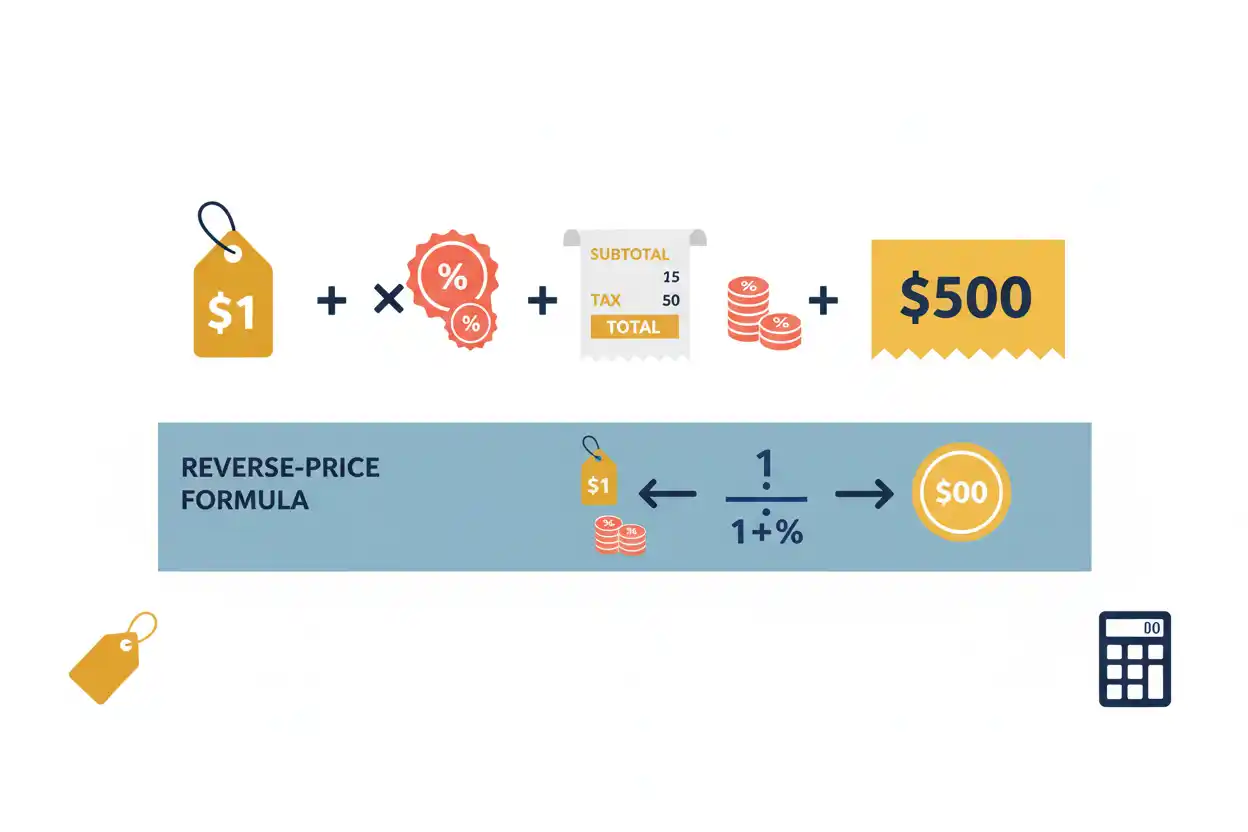
A tax-exclusive price is a price stated before the applicable transaction tax is added.
If a product has a tax-exclusive price of $250 and an 8% tax applies:
Tax = $250 × 8%
= $20
The customer pays:
Tax-Inclusive Total = $250 + $20
= $270
The $250 is the tax-exclusive price, $20 is the tax amount, and $270 is the final tax-inclusive price.
Tax-Exclusive Price Formula
When the tax-exclusive price and tax rate are known:
Tax Amount = Tax-Exclusive Price × Tax Rate
Then:
Tax-Inclusive Price = Tax-Exclusive Price × (1 + Tax Rate)
For $250 at 8%:
$250 × 1.08
= $270
Basic Example
Suppose:
Tax-Exclusive Price = $120
Tax Rate = 7.5%
Tax:
$120 × 0.075
= $9
Final price:
$120 + $9
= $129
A shopper comparing prices should determine whether the displayed amount is before or after tax before assuming $120 is the final checkout cost.
Reverse a Tax-Inclusive Price
If the final tax-inclusive price is known:
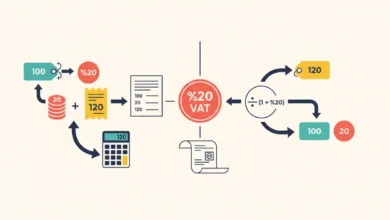
Tax-Exclusive Price = Tax-Inclusive Price ÷ (1 + Tax Rate)
Suppose:
Tax-Inclusive Price = $216
Tax Rate = 8%
Then:
Tax-Exclusive Price = $216 ÷ 1.08
= $200
Tax amount:
$216 − $200
= $16
Why Subtracting 8% Is Wrong
Starting with $216:
$216 × 92%
= $198.72
That is not the original $200 price.
The tax was calculated as 8% of $200.
Subtracting 8% from $216 instead calculates 8% of a larger base.
To reverse a percentage increase, divide by the growth factor.
Find the Tax Rate
If pre-tax price and tax are known:
Tax Rate = Tax Amount ÷ Tax-Exclusive Price × 100
Suppose:
Price Before Tax = $500
Tax = $40
Then:
$40 ÷ $500 × 100
= 8%
Find the Tax-Exclusive Price From Tax Amount
If tax and rate are known:
Tax-Exclusive Price = Tax Amount ÷ Tax Rate
Suppose:
Tax Amount = $24
Rate = 6%
Then:
Tax-Exclusive Price = $24 ÷ 0.06
= $400
Final tax-inclusive price:
$424
Tax-Exclusive vs Tax-Inclusive Pricing
Tax-exclusive pricing separates the base price from transaction tax:
$100 + $8 Tax = $108
Tax-inclusive pricing presents the final amount:
$108 Including $8 Tax
Economically, both can describe the same transaction.
The difference is how the price is presented.
Tax Component as a Percentage of Final Price
Suppose:
Pre-Tax Price = $100
Tax Rate = 8%
Tax = $8
Final Price = $108
The tax represents:
$8 ÷ $108 × 100
≈ 7.41%
of the final price.
This does not mean the tax rate is 7.41%.
The statutory or specified tax rate in the example remains 8% of the pre-tax base.
Multiple Items
Suppose three taxable products have tax-exclusive prices of:
$50 + $80 + $120
Subtotal:
$250
At 6%:
Tax = $250 × 6%
= $15
Final total:
$265
When all items use the same tax treatment, calculating tax from the combined subtotal is straightforward.
Mixed Taxability
Suppose a transaction contains:
$200 Taxable Amount
and:
$100 Non-Taxable Amount
Total pre-tax merchandise:
$300
If the specified tax applies only to the $200 portion at 8%:
Tax = $200 × 8%
= $16
Final transaction total:
$316
Applying 8% to the entire $300 would overstate the tax under this example.
Multiple Rates
Suppose:
Item A = $100 at 5%
Item B = $200 at 8%
Tax A:
$5
Tax B:
$16
Total tax:
$21
Final price:
$321
A single percentage should not be applied to the full subtotal when different items use different rates.
Tax-Exclusive Price and Tax Deduction
A tax deduction reduces an income base used in an income-tax calculation.
Tax-exclusive price describes a commercial amount before transaction tax.
The fact that a purchase shows $20 of tax separately does not automatically make the $20 deductible for income-tax purposes.
The two concepts should remain separate.
Tax-Exclusive Price and Tax Credit
A tax credit reduces a qualifying tax liability under the rules for that credit.
Suppose a product costs:
$500 Before Transaction Tax
and the buyer happens to qualify for a $1,000 personal income-tax credit.
The purchase price remains $500 before tax.
The unrelated credit should not simply be subtracted at checkout unless a specific program actually structures it that way.
Tax-Exclusive Price and Standard Deduction
The federal standard deduction concerns taxable income rather than consumer price presentation.
A taxpayer’s standard deduction does not turn a $108 tax-inclusive retail price into a $92 price.
Income-tax deductions and transaction-price formulas use different bases.
Tax-Exclusive Price and Tax-Loss Harvesting
Tax-loss harvesting concerns realizing investment losses as part of tax-aware portfolio management.
A tax-exclusive retail price is unrelated to an investment’s capital-loss calculation.
Both subjects involve taxes, but one is transaction pricing while the other concerns investment gains and losses.
Discount Before Tax Example
Suppose:
List Price = $200
Discount = 20%
Discount:
$40
Tax-exclusive discounted price:
$160
If the specified tax rate is 8% on the discounted amount:
Tax = $12.80
Final price:
$172.80
The order of operations matters.
Tax Then Discount vs Discount Then Tax
Suppose an artificial pricing problem asks you to apply an 8% tax and then a 20% discount to the final amount.
Starting from $200:
Tax-inclusive:
$200 × 1.08 = $216
Then discount:
$216 × 0.80 = $172.80
This happens to equal:
$200 × 0.80 × 1.08
because multiplication is commutative.
However, actual transaction rules determine which amount is legally taxable. The arithmetic alone does not establish the correct commercial or tax treatment.
Markup and Tax Are Different
Suppose cost is:
$100
Merchant markup:
40%
Selling price before tax:
$100 × 1.40
= $140
Then 8% transaction tax:
$140 × 8%
= $11.20
Customer total:
$151.20
The 40% markup increases business selling price.
The 8% tax is then calculated from the specified taxable price.
Margin vs Tax
If the seller buys an item for $100 and sells it tax-exclusive for $140:
Gross profit before other costs:
$40
Tax collected:
$11.20
The $11.20 should not automatically be treated as additional gross profit.
Transaction tax and operating margin are different economic quantities.
Target Final Price
Suppose a retailer wants the customer-facing tax-inclusive price to be exactly:
$100
at an 8% tax rate.
Maximum tax-exclusive price:
$100 ÷ 1.08
≈ $92.59
Tax:
≈ $7.41
This formula is useful when pricing backward from a desired checkout total.
Target Tax Amount
Suppose the business wants the tax amount to be:
$30
at a 7.5% rate.
Required tax-exclusive price:
$30 ÷ 0.075
= $400
Final price:
$430
Percentage Increase From Tax
An 8% transaction tax raises a $100 tax-exclusive price to $108.
Percentage increase in checkout price:
($108 − $100) ÷ $100
= 8%
If multiple charges are applied sequentially, however, the combined percentage can differ from simply adding their percentages.
Two Sequential Percentage Charges
Suppose a $100 price receives one 5% charge and then another 3% charge calculated from the already increased amount.
First:
$100 × 1.05 = $105
Second:
$105 × 1.03 = $108.15
Combined increase:
8.15%
not exactly 8%.
The exact transaction structure determines whether rates are additive or compounded.
Common Tax-Exclusive Price Mistakes
The biggest mistake is subtracting the tax rate directly from a tax-inclusive price to recover the pre-tax amount.
Another is applying tax to exempt items or assuming one rate applies across products with different tax treatment.
People also confuse transaction tax with income-tax deductions and credits.
Frequently Asked Questions
What is a tax-exclusive price?
It is a price stated before the applicable transaction tax is added.
What is the tax formula?
Tax = Tax-Exclusive Price × Tax Rate
How do I calculate the final price?
Tax-Inclusive Price = Tax-Exclusive Price × (1 + Tax Rate)
What is $250 plus 8% tax?
$270
How do I reverse a tax-inclusive price?
Tax-Exclusive Price = Tax-Inclusive Price ÷ (1 + Tax Rate)
Why can’t I simply subtract the tax percentage?
Because the original tax percentage was calculated from the smaller pre-tax base.
How do I calculate the tax rate?
Tax Rate = Tax ÷ Tax-Exclusive Price × 100
Can some items be excluded from the taxable base?
Yes within a calculation where those items are defined as non-taxable.
Is transaction tax the same as a tax deduction?
No.
Is a tax credit subtracted from the retail price?
Not unless a specific program explicitly operates that way.
Can I calculate pricing backward from a target final price?
Yes, by dividing the target total by the applicable tax factor.
Why identify the tax base first?
Because the correct rate applied to the wrong base still produces the wrong tax amount.