
A logarithmic equation is an equation in which the unknown appears inside a logarithm. Solving one usually requires converting logarithmic form to exponential form, combining logarithms with log rules, or rewriting both sides with compatible logarithmic expressions.
For example:
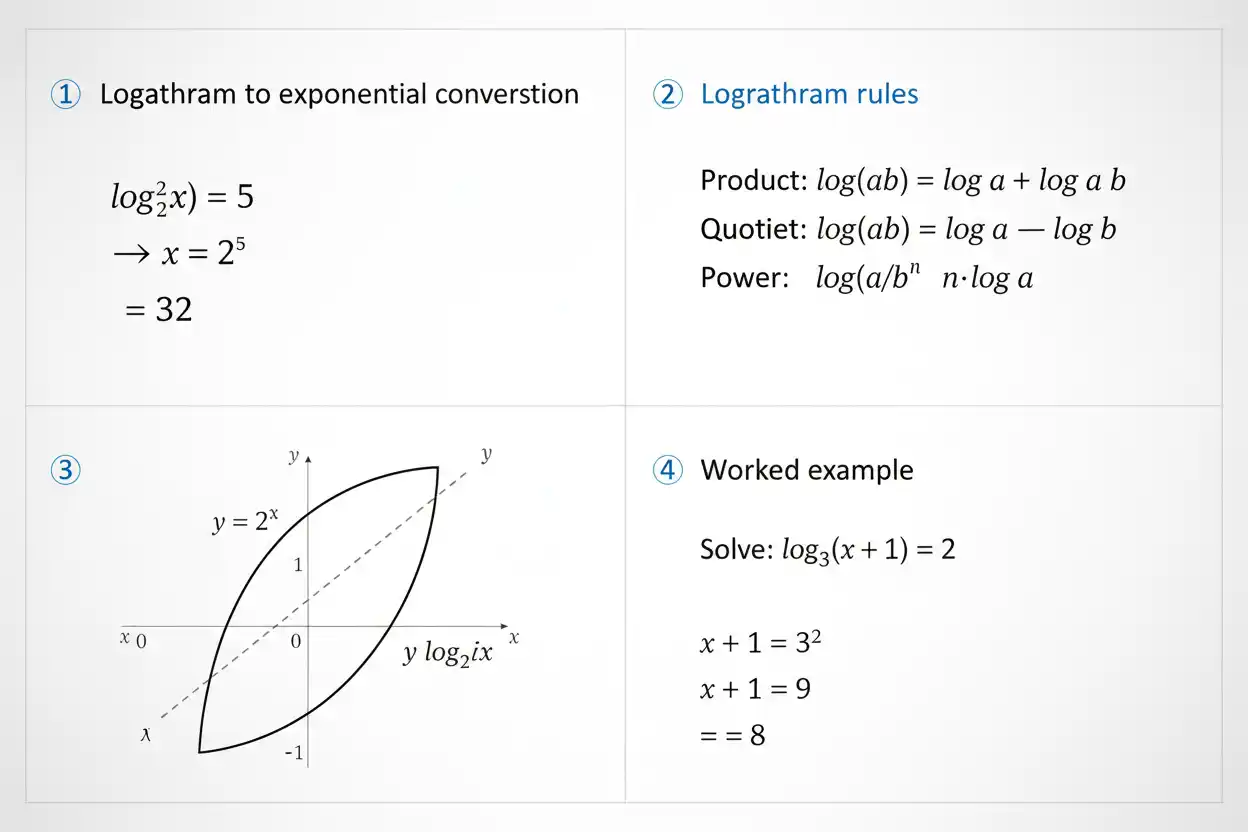
log₂(x) = 5
means:
2^5 = x
Therefore:
x = 32
The most important condition is that every logarithm must have a positive argument. A candidate answer that makes any logarithm undefined must be rejected.
Logarithmic equations are part of algebra and are closely connected to exponential equations because logarithms and exponentiation are inverse operations.
What Is a Logarithmic Equation?
A logarithmic equation contains one or more logarithmic expressions involving an unknown.
Examples include:
log₂(x) = 4
log(x – 3) = 2
ln(x) + ln(x – 1) = ln(6)
log₃(x + 4) – log₃(x) = 1
The objective is to find every value of the variable that makes the original equation true and keeps each logarithm defined.
A logarithm:
log_b(x)
is defined in the real numbers when:
b > 0
b ≠ 1
x > 0
The condition x > 0 is especially important when solving equations because algebraic manipulation can sometimes produce solutions outside the logarithm’s domain.
Logarithmic and Exponential Forms
The fundamental relationship is:
log_b(a) = c
if and only if:
b^c = a
For example:
log₂(8) = 3
because:
2³ = 8
Likewise:
log₅(x) = 3
becomes:
5³ = x
so:
x = 125
Converting between these forms is often the fastest method when a logarithmic equation contains a single logarithm.
Basic Logarithmic Equation Formula
For:
log_b(f(x)) = c
convert to exponential form:
f(x) = b^c
Then solve the resulting equation.
For example:
log₃(x + 2) = 4
becomes:
x + 2 = 3^4
x + 2 = 81
x = 79
Check the logarithm’s argument:
79 + 2 = 81 > 0
So x = 79 is valid.
How to Solve a Logarithmic Equation
The exact method depends on the equation’s structure, but the underlying process is consistent.
First identify the logarithm’s domain restrictions. Then simplify or combine logarithms where necessary. Convert the logarithmic relationship into exponential form, solve the resulting algebraic equation, and finally substitute each candidate solution into the original equation.
That final check is essential. Logarithmic equations can generate extraneous solutions when algebraic steps produce values that make an original logarithm’s argument zero or negative.
Example 1: Single Logarithm
Solve:
log₂(x) = 6
Convert to exponential form:
x = 2^6
x = 64
Since:
64 > 0
the answer is valid.
Therefore:
x = 64
Example 2: Logarithm of a Linear Expression
Solve:
log₅(2x – 1) = 2
Convert to exponential form:
2x – 1 = 5²
2x – 1 = 25
Add 1:
2x = 26
Divide by 2:
x = 13
Check the argument:
2(13) – 1 = 25
which is positive.
Therefore:
x = 13
After converting from logarithmic form, this problem reduces to a linear equation.
Common Logarithm and Natural Logarithm
When a logarithm is written simply as:
log(x)
it commonly means base 10:
log₁₀(x)
The natural logarithm is written:
ln(x)
and has base e.
The same fundamental solving rules apply.
For example:
ln(x) = 3
means:
x = e³
Likewise:
log(x) = 4
means:
x = 10^4
x = 10000
Product Rule for Logarithms
The product rule is:
log_b(M) + log_b(N) = log_b(MN)
provided M > 0 and N > 0.
This allows two logarithms with the same base to be combined.
For example:
log₂(x) + log₂(x – 2) = 3
Combine:
log₂(x(x – 2)) = 3
Convert to exponential form:
x(x – 2) = 2³
x² – 2x = 8
x² – 2x – 8 = 0
Factor:
(x – 4)(x + 2) = 0
Candidate solutions are:
x = 4
and:
x = -2
But the original logarithms require:
x > 0
and:
x – 2 > 0
so:
x > 2
Therefore x = -2 is invalid.
The only solution is:
x = 4
Quotient Rule for Logarithms
The quotient rule is:
log_b(M) – log_b(N) = log_b(M/N)
provided both logarithmic arguments are positive.
Consider:
log₂(x) – log₂(x – 2) = 2
Combine:
log₂(x/(x – 2)) = 2
Convert to exponential form:
x/(x – 2) = 4
Multiply by x – 2:
x = 4(x – 2)
x = 4x – 8
8 = 3x
x = 8/3
Check the arguments:
8/3 > 0
and:
8/3 – 2 = 2/3 > 0
So:
x = 8/3
is valid.
Power Rule for Logarithms
The power rule is:
log_b(M^p) = p log_b(M)
For example:
2log₃(x) = 4
Divide by 2:
log₃(x) = 2
Convert:
x = 3²
x = 9
Alternatively, the power rule can be used in reverse:
2log₃(x) = log₃(x²)
Either route produces the same result when the domain is handled correctly.
Equations With the Same Logarithm on Both Sides
If:
log_b(M) = log_b(N)
and both arguments are valid, then:
M = N
because a logarithmic function with a valid base is one-to-one.
For example:
log₇(3x – 2) = log₇(x + 6)
Set the arguments equal:
3x – 2 = x + 6
Subtract x:
2x – 2 = 6
Add 2:
2x = 8
x = 4
Check:
3(4) – 2 = 10 > 0
4 + 6 = 10 > 0
Therefore:
x = 4
Example With Natural Logarithms
Solve:
ln(x + 1) = ln(7)
Because the logarithms have the same base:
x + 1 = 7
x = 6
Check:
6 + 1 = 7 > 0
So the solution is valid.
Combining Multiple Logarithms
Solve:
log(x) + log(x – 9) = 1
Assume log means base 10.
Use the product rule:
log(x(x – 9)) = 1
Convert to exponential form:
x(x – 9) = 10¹
x² – 9x = 10
x² – 9x – 10 = 0
Factor:
(x – 10)(x + 1) = 0
Candidates:
x = 10
or:
x = -1
The original equation requires:
x > 0
and:
x – 9 > 0
Therefore:
x > 9
Only:
x = 10
is valid.
Why Logarithmic Equations Produce Extraneous Solutions
Algebraic transformations can remove the visible logarithms, but they do not remove the domain restrictions imposed by the original equation.
Consider:
ln(x) + ln(x – 3) = ln(4)
The original equation requires:
x > 0
and:
x – 3 > 0
Therefore:
x > 3
Combine:
ln(x(x – 3)) = ln(4)
Set arguments equal:
x(x – 3) = 4
x² – 3x – 4 = 0
Factor:
(x – 4)(x + 1) = 0
Candidates are 4 and -1.
Only x = 4 satisfies x > 3.
So:
x = 4
A negative algebraic root is not automatically wrong in every equation, but it cannot be used if it makes a logarithm’s argument nonpositive.
Domain Restrictions in Logarithmic Equations
For every logarithm:
log_b(expression)
require:
expression > 0
Suppose:
log₂(x – 5)
appears in an equation.
Then:
x – 5 > 0
so:
x > 5
This is an inequality restriction on the possible solutions.
If several logarithms appear, every argument must be positive simultaneously.
For:
log(x – 2) + log(8 – x)
the conditions are:
x – 2 > 0
and:
8 – x > 0
which combine to:
2 < x < 8
The interval representation of such a restriction is:
(2, 8)
using the conventions explained under inequalities.
Logarithmic Equation With a Quadratic Result
A logarithmic equation can turn into a quadratic equation after the logarithms are combined.
For example:
log₂(x) + log₂(x + 2) = 3
Combine:
log₂(x(x + 2)) = 3
Convert:
x(x + 2) = 8
x² + 2x – 8 = 0
Factor:
(x + 4)(x – 2) = 0
Candidates:
x = -4
x = 2
The original equation requires x > 0.
Therefore:
x = 2
is the only valid solution.
Logarithmic Equation vs Exponential Equation
A logarithmic equation places the variable inside a logarithm:
log₂(x) = 5
An exponential equation places the variable in an exponent:
2^x = 32
The two equation types are closely connected because logarithms and exponentials reverse one another.
For example:
2^x = 20
can be solved by taking logarithms:
x = ln(20) / ln(2)
Conversely:
ln(x) = 4
is solved by exponentiating:
x = e^4
The equation’s original structure determines which method is primary.
Change-of-Base Formula
When a logarithm has an inconvenient base, use:
log_b(x) = ln(x) / ln(b)
or:
log_b(x) = log(x) / log(b)
For example:
log₂(10) = ln(10) / ln(2)
This formula is particularly useful with calculators that provide only log and ln buttons.
Equations With Logarithms on Only One Side
Consider:
ln(2x + 1) = 5
Exponentiate both sides using base e:
2x + 1 = e^5
Then:
2x = e^5 – 1
x = (e^5 – 1) / 2
The exact answer is often preferable unless a decimal approximation is specifically needed.
Logarithmic Equations in Variation Problems
Logarithms may appear when a variation model contains an unknown exponent.
For example, a generalized relationship might contain:
z = kx^n y
After known values are substituted and the exponential factor is isolated, finding n may require logarithms.
That can occur in extensions of relationships such as joint variation or inverse variation, but the logarithmic equation remains the tool used to recover the unknown exponent.
Common Logarithmic Equation Mistakes
Forgetting the Domain
A real logarithm requires a positive argument.
For:
log(x – 3)
you must have:
x > 3
A candidate outside that range cannot be accepted.
Using the Product Rule Incorrectly
Correct:
log(M) + log(N) = log(MN)
Incorrect:
log(M + N)
The sum of logarithms corresponds to a product of arguments, not their sum.
Using the Quotient Rule Incorrectly
Correct:
log(M) – log(N) = log(M/N)
The subtraction occurs between logarithms, while division occurs between their arguments.
Moving a Coefficient Incorrectly
Correct:
p log(M) = log(M^p)
A coefficient becomes an exponent on the argument.
Assuming log(M) = log(N) Without Matching Bases
The rule:
log_b(M) = log_b(N) ⇒ M = N
requires logarithms with the same valid base.
Keeping Every Algebraic Root
Any candidate that makes an original logarithm undefined must be removed.
Worked Logarithmic Equation Example
Solve:
log₂(x – 1) + log₂(x – 3) = 3
First establish the domain.
The arguments require:
x – 1 > 0
and:
x – 3 > 0
Therefore:
x > 3
Combine the logarithms:
log₂((x – 1)(x – 3)) = 3
Convert to exponential form:
(x – 1)(x – 3) = 2³
(x – 1)(x – 3) = 8
Expand:
x² – 4x + 3 = 8
x² – 4x – 5 = 0
Factor:
(x – 5)(x + 1) = 0
Candidates:
x = 5
or:
x = -1
The domain requires x > 3, so -1 is rejected.
Check x = 5:
log₂(4) + log₂(2) = 2 + 1 = 3
Therefore:
x = 5
Frequently Asked Questions
What is a logarithmic equation?
A logarithmic equation is an equation in which the unknown appears inside one or more logarithmic expressions.
What is the basic rule for solving log_b(x) = c?
Convert it to exponential form:
x = b^c
What is the relationship between logarithmic and exponential form?
The equivalent forms are:
log_b(a) = c
and:
b^c = a
Why must logarithm arguments be positive?
Real logarithms are defined only for positive arguments. Therefore every solution must make each logarithmic argument greater than zero.
How do you solve two logarithms added together?
If they have the same base, the product rule can combine them:
log_b(M) + log_b(N) = log_b(MN)
Then solve the resulting equation and check the domain.
How do you solve logarithms being subtracted?
Use:
log_b(M) – log_b(N) = log_b(M/N)
when both arguments are positive.
Can a logarithmic equation have an extraneous solution?
Yes. Algebraic manipulation may produce a candidate that makes an original logarithm’s argument zero or negative. Such a candidate must be rejected.
Is ln different from log?
ln is the natural logarithm with base e. When log is used without an indicated base, it commonly denotes base 10. The same core logarithmic rules apply.
How do you check a logarithmic equation answer?
Substitute the candidate into the original equation. Confirm that every logarithmic argument is positive and that both sides evaluate equally.
What is the change-of-base formula?
A logarithm can be rewritten as:
log_b(x) = ln(x) / ln(b)
This is useful when the required base is not directly available on a calculator.