
A system of linear equations is a set of two or more linear equations that must be satisfied simultaneously.
For two variables, a common form is:
a₁x + b₁y = c₁
a₂x + b₂y = c₂
A solution is an ordered pair:
(x, y)
that makes both equations true at the same time.
For example:
x + y = 7
x – y = 1
Add the equations:
2x = 8
x = 4
Substitute into:
x + y = 7
to get:
4 + y = 7
y = 3
Therefore the solution is:
(4, 3)
A two-variable linear system can have exactly one solution, no solution, or infinitely many solutions.
What Is a System of Linear Equations?
A system of linear equations contains multiple first-degree equations involving the same variables.
For example:
2x + y = 8
x – y = 1
Both equations are linear because x and y appear only to the first power and are not multiplied together.
The goal is not to solve either equation independently. The goal is to identify values that satisfy every equation in the system simultaneously.
If:
x = 3
and:
y = 2
then check both equations:
First:
2(3) + 2 = 8
8 = 8
Second:
3 – 2 = 1
1 = 1
Therefore:
(3, 2)
is the system’s solution.
General Formula for Two Linear Equations
Consider:
a₁x + b₁y = c₁
a₂x + b₂y = c₂
Define:
D = a₁b₂ – a₂b₁
If:
D ≠ 0
the system has one unique solution:
x = (c₁b₂ – c₂b₁) / D
y = (a₁c₂ – a₂c₁) / D
These formulas are a two-variable form of Cramer’s rule.
For many practical systems, substitution or elimination is simpler to perform by hand, but the formulas show exactly when a unique solution exists.
Example Using the Formula
Solve:
2x + 3y = 13
x – y = 1
Identify:
a₁ = 2
b₁ = 3
c₁ = 13
a₂ = 1
b₂ = -1
c₂ = 1
Calculate:
D = 2(-1) – 1(3)
D = -2 – 3
D = -5
Now:
x = [13(-1) – 1(3)] / (-5)
x = (-13 – 3)/(-5)
x = 16/5
For y:
y = [2(1) – 1(13)] / (-5)
y = (2 – 13)/(-5)
y = 11/5
Therefore:
(x, y) = (16/5, 11/5)
Check the first equation:
2(16/5) + 3(11/5)
= 32/5 + 33/5
= 65/5
= 13
The pair is correct.
Three Main Methods for Solving Linear Systems
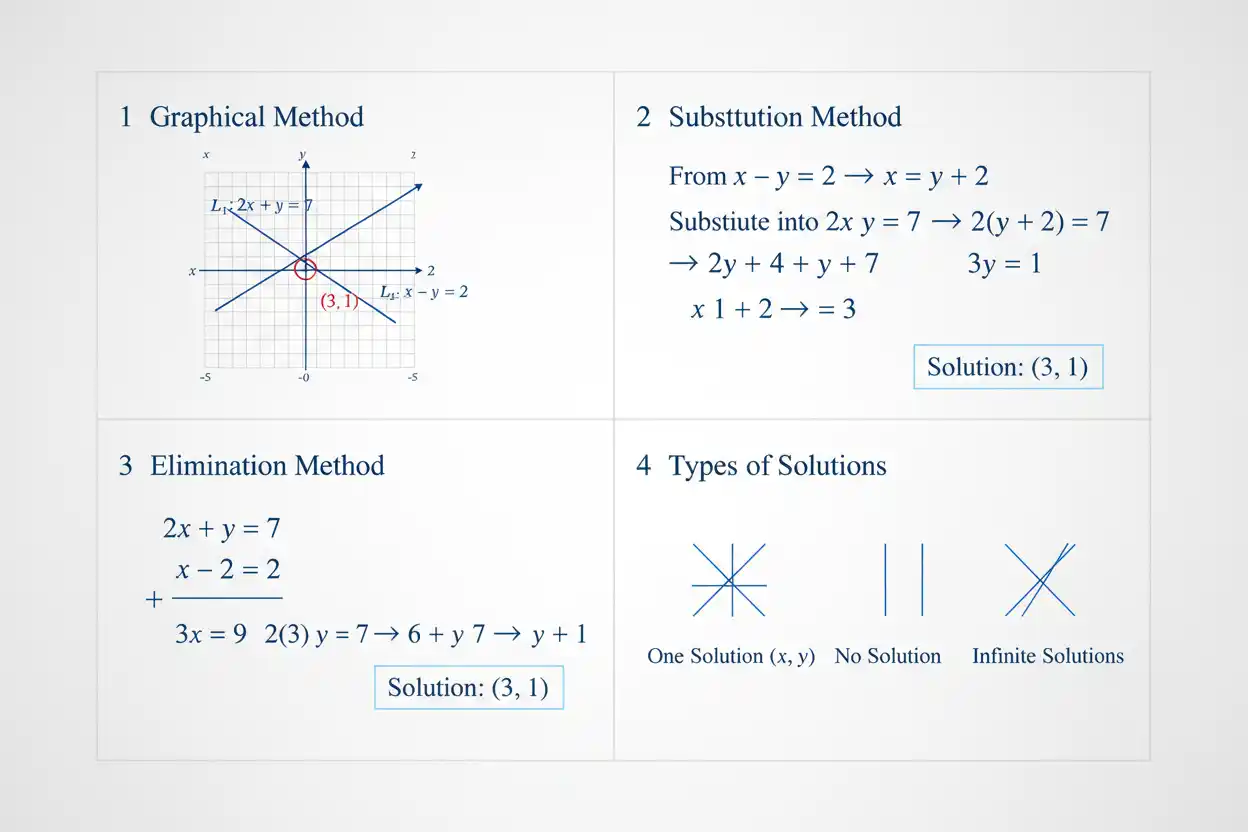
The most common methods are graphing, substitution, and elimination.
Graphing identifies the intersection of the lines.
Substitution solves one equation for a variable and substitutes that expression into another equation.
Elimination adds or subtracts equations so that one variable disappears.
All three methods seek the same solution. The best choice depends on how the equations are written.
Solving by Substitution
Substitution is especially convenient when one equation already has a variable isolated.
Consider:
y = 2x + 1
3x + y = 11
The first equation gives an expression for y.
Substitute it into the second:
3x + (2x + 1) = 11
Combine:
5x + 1 = 11
Subtract 1:
5x = 10
x = 2
Now substitute x = 2 into:
y = 2x + 1
y = 2(2) + 1
y = 5
Therefore:
(x, y) = (2, 5)
Why Substitution Works
If two expressions both equal y, then those expressions equal each other.
For example:
y = 2x + 1
and:
y = 8 – x
imply:
2x + 1 = 8 – x
Solve:
3x = 7
x = 7/3
Then substitute back to obtain y.
Substitution converts a two-variable system into a one-variable equation.
Example 1: Substitution
Solve:
x + y = 9
y = 2x
Substitute y = 2x into the first equation:
x + 2x = 9
3x = 9
x = 3
Then:
y = 2(3)
y = 6
Therefore:
(3, 6)
Check:
3 + 6 = 9
and:
6 = 2(3)
Both equations are satisfied.
Solving by Elimination
Elimination works by combining equations so that one variable cancels.
Consider:
2x + 3y = 13
4x – 3y = 5
Add the equations:
6x = 18
x = 3
Substitute into the first equation:
2(3) + 3y = 13
6 + 3y = 13
3y = 7
y = 7/3
Therefore:
(x, y) = (3, 7/3)
The opposite y-coefficients make elimination immediate.
Why Standard Form Helps With Elimination
Elimination is easiest when the equations are aligned as:
Ax + By = C
That is the standard form of a line.
For example:
2x + 5y = 17
3x – 5y = 8
places like variables in matching columns.
Adding the equations cancels y:
5x = 25
x = 5
Organizing equations consistently reduces sign and alignment errors.
Multiplying an Equation Before Elimination
Sometimes no coefficients cancel immediately.
Consider:
2x + 3y = 7
5x + 2y = 4
To eliminate y, multiply the first equation by 2:
4x + 6y = 14
Multiply the second equation by -3:
-15x – 6y = -12
Add:
-11x = 2
x = -2/11
Then substitute into either original equation to find y.
Multiplying an entire equation by a nonzero constant does not change its solution set.
Example 2: Eliminate x
Solve:
3x + 2y = 12
3x – 4y = 0
Subtract the second equation from the first:
(3x + 2y) – (3x – 4y) = 12 – 0
6y = 12
y = 2
Substitute:
3x + 2(2) = 12
3x + 4 = 12
3x = 8
x = 8/3
Therefore:
(x, y) = (8/3, 2)
Solving by Graphing
Each equation in a two-variable linear system represents a straight line.
The system’s solution is the point where the lines intersect.
For example:
y = x + 1
y = -x + 5
At the intersection:
x + 1 = -x + 5
2x = 4
x = 2
Then:
y = 3
So the lines intersect at:
(2, 3)
and that point solves both equations.
Using Y-Intercepts to Graph a System
When equations are written as:
y = mx + b
the value b identifies where each line crosses the y-axis.
For:
y = 2x + 3
the y-intercept is:
(0, 3)
For:
y = -x + 6
the y-intercept is:
(0, 6)
Plotting the intercept and using each slope allows the two lines to be drawn. Their intersection represents the system’s solution.
Graphing is particularly useful for understanding the geometry of a system, although exact algebraic methods are preferable when the intersection has inconvenient fractional coordinates.
One Solution
A linear system has one unique solution when its lines intersect exactly once.
For two nonvertical lines, this occurs when their slopes are different.
Example:
y = 2x + 1
y = -x + 7
The slopes are:
2
and:
-1
Because the slopes differ, the lines intersect once.
Set the expressions equal:
2x + 1 = -x + 7
3x = 6
x = 2
Then:
y = 5
So the unique solution is:
(2, 5)
No Solution
A linear system has no solution when the equations represent distinct parallel lines.
Consider:
y = 3x + 2
y = 3x – 5
Both have slope:
m = 3
but different y-intercepts.
The lines never intersect.
Therefore:
No solution
Algebraically, elimination or substitution produces a contradiction.
Example of No Solution Algebraically
Solve:
2x + y = 5
4x + 2y = 14
Multiply the first equation by 2:
4x + 2y = 10
But the second equation says:
4x + 2y = 14
Subtracting gives:
0 = 4
which is false.
Therefore the system is inconsistent and has no solution.
Infinitely Many Solutions
A system has infinitely many solutions when the equations represent the same line.
For example:
x + 2y = 6
2x + 4y = 12
The second equation is exactly twice the first.
Every point satisfying one equation also satisfies the other.
Therefore the system has:
Infinitely many solutions
Algebraically, elimination produces an identity such as:
0 = 0
Example of Infinitely Many Solutions
Consider:
3x – y = 7
6x – 2y = 14
Multiply the first equation by 2:
6x – 2y = 14
This exactly matches the second equation.
Therefore both equations describe the same line.
The solution set is every point on that line.
Determinant Test for a Two-Variable Linear System
For:
a₁x + b₁y = c₁
a₂x + b₂y = c₂
calculate:
D = a₁b₂ – a₂b₁
If:
D ≠ 0
there is exactly one solution.
If:
D = 0
the system does not have a unique solution. It may have no solution or infinitely many solutions.
Additional comparison of the equations is required to distinguish those two cases.
Example: Determinant Test
Consider:
2x + 3y = 7
4x + 6y = 14
Here:
D = 2(6) – 4(3)
D = 12 – 12
D = 0
There is no unique solution.
Because the second equation is twice the first, the system has infinitely many solutions.
Now change the second equation to:
4x + 6y = 20
The same determinant remains zero, but the equations are inconsistent.
Therefore the new system has no solution.
How to Check a System Solution
Substitute the proposed ordered pair into every equation.
Suppose:
x + 2y = 8
3x – y = 3
and the proposed solution is:
(2, 3)
First equation:
2 + 2(3) = 8
8 = 8
Second equation:
3(2) – 3 = 3
3 = 3
Both are true.
Therefore:
(2, 3)
is a valid solution.
Checking only one equation is not enough.
Choosing Between Substitution and Elimination
Use substitution when one variable is already isolated or can be isolated with very little work.
For example:
y = 4x – 1
is ready for substitution.
Use elimination when the equations are already aligned and one pair of coefficients is equal or opposite.
For example:
3x + 2y = 7
5x – 2y = 9
is immediately suited to elimination because +2y and -2y cancel.
Neither method is mathematically more correct. The best choice is the one that minimizes unnecessary algebra.
Fractional Solutions Are Valid
A system does not need integer coordinates.
Consider:
x + y = 2
2x – y = 1
Add:
3x = 3
x = 1
Here the answer is integral.
But a system such as:
2x + y = 3
x – 2y = 4
can produce fractional values.
Fractions are normal exact solutions and should not be rounded unless the application requires an approximation.
Linear Systems With Three Variables
A system can contain more than two variables.
For example:
x + y + z = 6
2x – y + z = 3
x + 2y – z = 2
A solution is an ordered triple:
(x, y, z)
that satisfies all three equations.
Elimination can be extended by combining equations to reduce the three-variable system to two equations in two variables, then continuing until every variable is determined.
The underlying principle remains simultaneous satisfaction of all linear equations.
Example: Three-Variable Elimination Structure
Suppose:
x + y + z = 6
x – y + z = 2
Subtract the second equation from the first:
2y = 4
y = 2
That information can then be combined with the remaining equations to determine x and z.
The full calculation depends on all equations in the system, but the elimination idea is the same as in two variables.
System of Linear Equations vs Systems of Equations
A system of linear equations contains only linear equations.
For example:
2x + y = 7
x – 3y = 4
The broader systems of equations topic can include systems containing nonlinear equations as well.
For example, a system containing:
y = x²
and:
y = 2x + 3
is a system of equations, but not a system composed entirely of linear equations.
This page therefore remains focused specifically on simultaneous first-degree equations.
Linear Systems vs Polynomial Techniques
Polynomial techniques solve different structures.
For example, synthetic division divides a polynomial by a suitable linear factor, while sum and difference of cubes factor special cubic expressions.
A system of linear equations instead combines several first-degree equations and seeks values satisfying all of them simultaneously.
These methods may appear in the same broader algebra course, but they answer different questions.
Systems and Slope-Intercept Form
A linear system may be rewritten so each equation has the form:
y = mx + b
For example:
2x + y = 7
becomes:
y = -2x + 7
The second equation:
x – y = 2
becomes:
y = x – 2
This makes the slopes and intercepts visible and allows graphical comparison.
The details of interpreting:
y = mx + b
belong to slope-intercept form.
Word Problem Example
Suppose two numbers have a sum of 20 and a difference of 4.
Let the numbers be x and y.
Write:
x + y = 20
x – y = 4
Add:
2x = 24
x = 12
Substitute:
12 + y = 20
y = 8
Therefore the numbers are:
12 and 8
Check:
12 + 8 = 20
and:
12 – 8 = 4
Cost Comparison Example
Suppose Plan A costs:
A = 20 + 4x
and Plan B costs:
B = 8 + 6x
To find when the costs are equal:
20 + 4x = 8 + 6x
Subtract 8:
12 + 4x = 6x
Subtract 4x:
12 = 2x
x = 6
At x = 6:
A = 20 + 4(6) = 44
B = 8 + 6(6) = 44
The intersection:
(6, 44)
represents the point where the two linear relationships have the same value.
Common System of Linear Equations Mistakes
Solving Only One Equation
A valid solution must satisfy every equation in the system.
Substituting Into the Wrong Expression
When one variable is isolated, substitute the entire expression in place of that variable.
Multiplying Only Part of an Equation
If an equation is multiplied by -2 for elimination, every term on both sides must be multiplied by -2.
Adding or Subtracting Signs Incorrectly
When subtracting one equation from another, distribute the subtraction across every term.
Assuming Every System Has One Solution
Parallel lines give no solution. Identical lines give infinitely many solutions.
Ignoring Fractional Answers
Fractional coordinates can be exact and fully valid.
Confusing a Linear System With a General System
If one equation contains x², xy, 1/x, or another nonlinear structure, the system is no longer purely linear.
Worked System of Linear Equations Example
Solve:
3x + 2y = 16
5x – 2y = 8
The y-coefficients are opposites, so add the equations:
8x = 24
Divide:
x = 3
Substitute into the first equation:
3(3) + 2y = 16
9 + 2y = 16
2y = 7
y = 7/2
Therefore:
(x, y) = (3, 7/2)
Check the second equation:
5(3) – 2(7/2)
= 15 – 7
= 8
The solution is correct.
Frequently Asked Questions
What is a system of linear equations?
A system of linear equations is a collection of two or more linear equations involving the same variables that must be satisfied simultaneously.
What is the general form of a two-variable linear system?
A common form is:
a₁x + b₁y = c₁
a₂x + b₂y = c₂
What is the solution of a linear system?
The solution is the ordered pair or tuple that makes every equation in the system true.
What methods solve a system of linear equations?
The most common methods are graphing, substitution, and elimination.
When is substitution easiest?
Substitution is usually convenient when one equation already has a variable isolated or can be rearranged easily.
When is elimination easiest?
Elimination is convenient when corresponding variable coefficients are already equal, opposite, or easily made equal or opposite.
How many solutions can two linear equations have?
A two-variable linear system can have exactly one solution, no solution, or infinitely many solutions.
What does one solution mean graphically?
The two lines intersect at exactly one point.
What does no solution mean graphically?
The equations represent distinct parallel lines that never intersect.
What do infinitely many solutions mean graphically?
The equations represent the same line.
How can you check a system solution?
Substitute the proposed values into every original equation. Every equation must be true.
What is the difference between a system of linear equations and systems of equations generally?
A system of linear equations contains only first-degree linear equations. A general system of equations can include nonlinear equations such as quadratics, rational equations, or other function types.