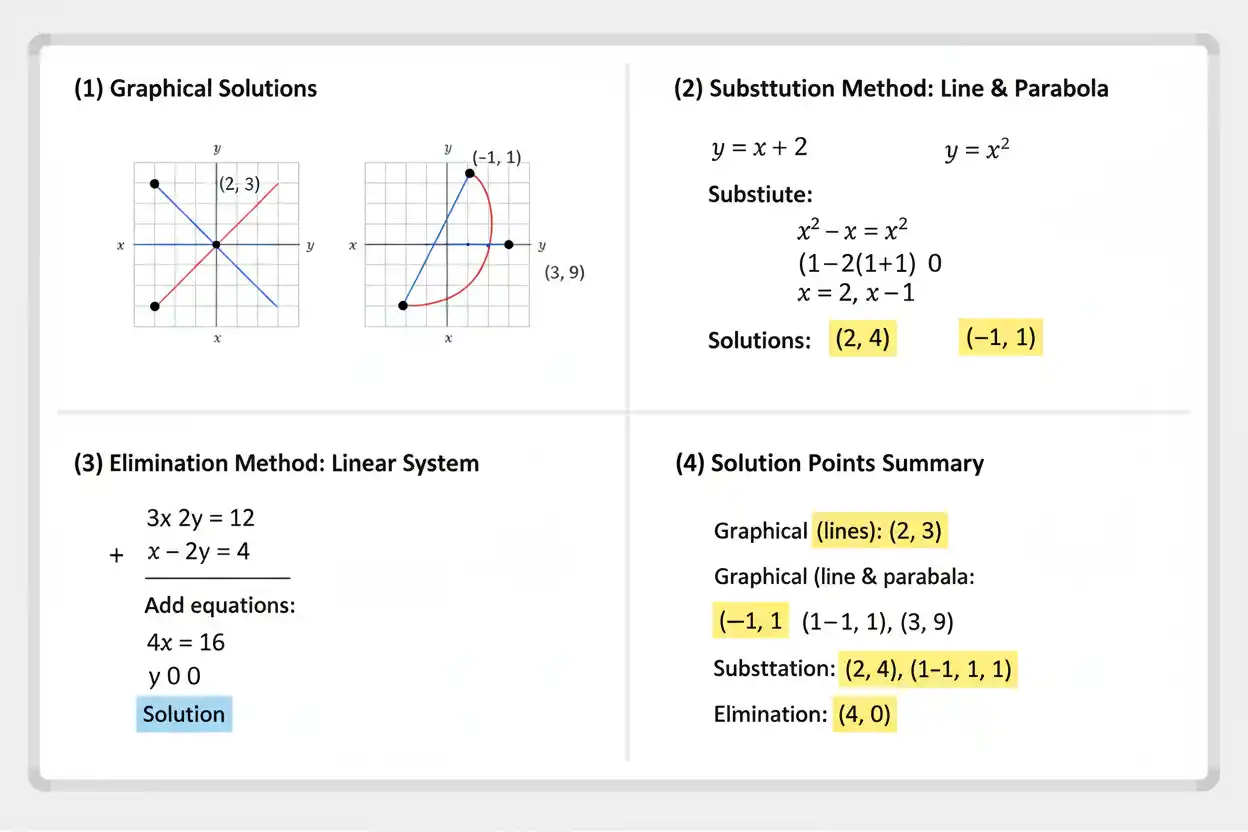

Systems of equations are sets of two or more equations that must be satisfied by the same values of the variables.
For example:
x + y = 7
x – y = 1
The solution must make both equations true simultaneously.
Add the equations:
2x = 8
x = 4
Substitute x = 4 into:
x + y = 7
Then:
4 + y = 7
y = 3
Therefore the system has the solution:
(x, y) = (4, 3)
Systems can contain linear equations, nonlinear equations, or a combination of different equation types. The method used depends on the structure of the equations.
What Are Systems of Equations?
A system of equations is a collection such as:
Equation 1
Equation 2
Equation 3
where the variables must take values that make every equation in the collection true.
For two variables x and y, a general system can be written conceptually as:
F(x, y) = 0
G(x, y) = 0
The solution consists of all ordered pairs:
(x, y)
that satisfy both equations.
If every equation is first degree, the problem is specifically a system of linear equations. Systems of equations more broadly can also contain quadratics, circles, rational relationships, exponentials, or other nonlinear equations.
What Is a Solution to a System?
A solution must work in every equation simultaneously.
Suppose:
x + y = 5
2x – y = 1
Test:
(2, 3)
First equation:
2 + 3 = 5
True.
Second equation:
2(2) – 3 = 1
4 – 3 = 1
True.
Therefore:
(2, 3)
is a solution.
Now test:
(3, 2)
The first equation is true:
3 + 2 = 5
but the second gives:
2(3) – 2 = 4
not 1.
Therefore (3, 2) is not a solution of the system.
Satisfying only one equation is not enough.
Is There One Formula for Systems of Equations?
There is no single formula that solves every possible system of equations.
Different structures require different techniques.
Common methods include:
- substitution;
- elimination;
- graphing;
- factoring after substitution;
- specialized numerical or algebraic methods for more complicated nonlinear systems.
A two-variable linear system has direct coefficient formulas, but those belong to the narrower linear-system case.
The broader strategy is to reduce the number of variables, find candidate values, and verify those values in every original equation.
Main Types of Systems of Equations
Systems can be classified by the kinds of equations they contain.
A linear system might be:
2x + y = 8
x – y = 1
A linear-quadratic system might be:
y = x + 1
y = x² – 3x + 5
A system can also contain two nonlinear equations, such as:
x² + y² = 13
x + y = 5
Even though the second equation is linear, the first is not, so the complete system is nonlinear.
Recognizing the equation types helps determine which method will be efficient.
Method 1: Substitution
Substitution replaces one variable with an equivalent expression from another equation.
Consider:
y = 3x – 2
x + y = 10
Because y is already isolated, substitute:
y = 3x – 2
into the second equation:
x + (3x – 2) = 10
Combine:
4x – 2 = 10
Add 2:
4x = 12
x = 3
Now find y:
y = 3(3) – 2
y = 7
Therefore:
(x, y) = (3, 7)
Check:
3 + 7 = 10
and:
7 = 3(3) – 2
Both equations are satisfied.
When Is Substitution Best?
Substitution is usually efficient when one equation already has the form:
x = expression
or:
y = expression
It is also useful in nonlinear systems because a variable can sometimes be replaced directly inside a quadratic or other equation.
For example:
y = x + 2
x² + y² = 20
allows y to be replaced by x + 2:
x² + (x + 2)² = 20
The system has then been reduced to one equation in one variable.
Method 2: Elimination
Elimination combines equations so that one variable disappears.
Consider:
3x + 2y = 12
5x – 2y = 8
Add the equations:
8x = 20
x = 5/2
Substitute into the first equation:
3(5/2) + 2y = 12
15/2 + 2y = 12
Write 12 as 24/2:
15/2 + 2y = 24/2
2y = 9/2
y = 9/4
Therefore:
(x, y) = (5/2, 9/4)
Elimination is especially convenient when linear equations are arranged in standard form of a line:
Ax + By = C
because corresponding variable terms can be aligned vertically.
Multiplying Before Elimination
Sometimes neither variable cancels immediately.
Consider:
2x + 3y = 11
5x + 2y = 16
To eliminate y, multiply the first equation by 2:
4x + 6y = 22
Multiply the second by -3:
-15x – 6y = -48
Add:
-11x = -26
Therefore:
x = 26/11
Then substitute this value into either original equation to determine y.
Multiplying an entire equation by the same nonzero constant preserves its solutions.
Method 3: Graphing
Each equation defines a set of points on a graph.
A solution to the system is a point belonging to all of those graphs.
Consider:
y = x + 1
y = -x + 5
The two lines intersect where their y-values are equal:
x + 1 = -x + 5
2x = 4
x = 2
Then:
y = 3
So the intersection is:
(2, 3)
Graphically, this point lies on both lines.
For linear equations, information such as the y-intercept can make the graphs quicker to construct.
Graphing vs Algebraic Methods
Graphing is excellent for visualizing how many solutions a system appears to have.
However, a graph may show only an approximate intersection.
For example, an exact solution might be:
(7/3, 11/5)
A hand-drawn graph may not identify those fractions precisely.
Substitution and elimination are therefore preferable when an exact algebraic answer is required.
Graphing is particularly useful for understanding the structure of the solution set.
Linear Systems: One Solution
Two nonparallel straight lines intersect once.
For example:
y = 2x + 1
y = -x + 7
Set them equal:
2x + 1 = -x + 7
3x = 6
x = 2
Then:
y = 5
Therefore:
(2, 5)
is the unique solution.
Linear Systems: No Solution
Consider:
y = 3x + 2
y = 3x – 4
The equations have the same slope but different intercepts.
They represent distinct parallel lines.
Because the lines never meet:
No solution
Algebraically, attempting substitution gives:
3x + 2 = 3x – 4
Subtract 3x:
2 = -4
which is false.
Linear Systems: Infinitely Many Solutions
Consider:
x + 2y = 6
2x + 4y = 12
The second equation is twice the first.
Therefore they represent the same line.
Every solution of the first equation is also a solution of the second.
The system has:
Infinitely many solutions
Algebraically, elimination eventually gives an identity such as:
0 = 0
Nonlinear Systems Can Have Multiple Solutions
A nonlinear system may intersect at more than one point.
Consider:
x + y = 5
x² + y² = 13
From the first equation:
y = 5 – x
Substitute into the second:
x² + (5 – x)² = 13
Expand:
x² + 25 – 10x + x² = 13
2x² – 10x + 12 = 0
Divide by 2:
x² – 5x + 6 = 0
Factor:
(x – 2)(x – 3) = 0
Therefore:
x = 2
or:
x = 3
If x = 2:
y = 3
If x = 3:
y = 2
So the system has two solutions:
(2, 3)
and:
(3, 2)
Geometrically, the line intersects the circle at two points.
Linear-Quadratic System Example
Solve:
y = x + 1
y = x² – 3x + 5
Because both expressions equal y, set them equal:
x + 1 = x² – 3x + 5
Move everything to one side:
x² – 4x + 4 = 0
Factor:
(x – 2)² = 0
Therefore:
x = 2
Then:
y = 2 + 1
y = 3
The only solution is:
(2, 3)
Because the quadratic equation has a repeated root, the line touches the parabola at one point rather than crossing it twice.
A Nonlinear System With No Real Solution
Consider:
y = x² + 1
y = -2
Set them equal:
x² + 1 = -2
x² = -3
There is no real value of x satisfying this equation.
Therefore the system has:
No real solution
Graphically, the parabola y = x² + 1 never reaches the horizontal line y = -2.
In the complex number system, the algebraic equation has non-real values, but those do not correspond to real-coordinate graph intersections.
A Nonlinear System With Infinitely Many Solutions
Consider:
y = x²
2y = 2x²
Divide the second equation by 2:
y = x²
Both equations are identical.
Therefore every point on:
y = x²
satisfies both equations.
The system has infinitely many solutions.
Infinite solution sets are therefore not limited to coincident straight lines.
Solving a Nonlinear System by Elimination
Elimination can sometimes work directly even when the equations are nonlinear.
Consider:
x² + y² = 25
x² – y² = 7
Add the equations:
2x² = 32
x² = 16
Therefore:
x = ±4
Substitute into:
x² + y² = 25
Since x² = 16:
16 + y² = 25
y² = 9
y = ±3
Every sign combination must be checked against both equations.
For this system:
(4, 3)
(4, -3)
(-4, 3)
(-4, -3)
all satisfy both equations because only x² and y² appear.
Therefore the system has four real solutions.
Why Checking Matters
Solving a system can involve operations that introduce candidate solutions not present in the original equations.
Squaring, clearing variable denominators, or other nonreversible transformations can change the apparent solution set.
Every final candidate should therefore be checked in all original equations when there is any possibility of an extraneous value.
Even when substitution or elimination uses only reversible operations, checking is an efficient way to catch arithmetic mistakes.
Systems With Domain Restrictions
Suppose:
y = 1/x
y = x – 2
The first equation requires:
x ≠ 0
Set the equations equal:
1/x = x – 2
Multiply by x:
1 = x² – 2x
x² – 2x – 1 = 0
Any roots obtained must still satisfy:
x ≠ 0
The original domain restrictions do not disappear when denominators are cleared.
Systems Containing Radical Equations
Consider:
y = √x
y = x – 2
Because:
√x
is real only when:
x ≥ 0
that restriction belongs to the system from the start.
Set:
√x = x – 2
Solving may require squaring, which can create extraneous candidates.
Any resulting ordered pair must therefore be checked against both original equations.
The system-solving method and the specialist rules of the contained equation type work together.
Systems Containing Polynomial Equations
A nonlinear system may produce a higher-degree polynomial after substitution.
For example, eliminating one variable might produce:
x³ – 4x² + x + 6 = 0
If one root is known, synthetic division can reduce that polynomial to a lower degree.
That polynomial technique does not solve the entire system by itself. It handles the one-variable equation produced during the system-solving process, after which the remaining variable must still be recovered and every ordered pair checked.
Cube Factorizations Inside a System
A substitution can also produce an expression such as:
x³ – 8 = 0
Recognizing sum and difference of cubes gives:
x³ – 2³ = (x – 2)(x² + 2x + 4)
This determines possible x-values for that stage of the calculation.
Again, factorization is an embedded algebraic step; the final system solution still consists of values satisfying all original equations simultaneously.
Solving Systems From Tables
A pair of tables can represent two relationships.
Suppose the first relation contains:
| x | y |
|---|---|
| 0 | 2 |
| 1 | 4 |
| 2 | 6 |
| 3 | 8 |
and the second contains:
| x | y |
|---|---|
| 0 | 8 |
| 1 | 6 |
| 2 | 4 |
| 3 | 2 |
The two tables share:
(x, y) = (2, 6)?
No—the second table gives y = 4 when x = 2.
Check row by row instead.
At x = 1:
First table:
y = 4
Second table:
y = 6
At x = 3:
First:
y = 8
Second:
y = 2
There is no shared listed ordered pair in these rows.
If the tables represent complete linear patterns rather than only isolated data, derive the equations before determining whether an intersection occurs between listed x-values.
Word Problem Example
Suppose adult tickets cost $12 and child tickets cost $7. A total of 20 tickets were sold for $190.
Let:
a = number of adult tickets
c = number of child tickets
The number of tickets gives:
a + c = 20
The revenue gives:
12a + 7c = 190
From the first equation:
c = 20 – a
Substitute:
12a + 7(20 – a) = 190
Expand:
12a + 140 – 7a = 190
5a + 140 = 190
5a = 50
a = 10
Then:
c = 10
Check:
10 + 10 = 20
and:
12(10) + 7(10) = 190
Therefore 10 adult tickets and 10 child tickets were sold.
Translating a Problem Into a System
The most difficult part of an application problem is often writing the equations correctly.
A useful approach is to define each variable first, identify two independent relationships, translate each relationship into an equation, and then solve the resulting system.
For example, if two quantities have both a known total and a known weighted total, those two facts naturally produce two equations.
The solution method comes after the model has been constructed correctly.
Systems of Equations and Intersections
Geometrically, solving a system means finding common points.
Two lines may intersect once.
A line and a circle may intersect zero, one, or two times.
Two curves may have several intersections.
Two equations describing the same curve may share infinitely many points.
This geometric interpretation explains why systems of equations can have different numbers of solutions depending on their structure.
Common Systems of Equations Mistakes
Solving Each Equation Separately Without Comparing Solutions
A system requires common values that work in all equations.
Substituting Only Part of an Expression
If:
y = 3x – 4
then replace y with the entire expression:
(3x – 4)
Multiplying Only Part of an Equation
When preparing for elimination, multiply every term on both sides by the chosen factor.
Forgetting to Find the Second Variable
Finding x alone does not complete a two-variable system. Substitute back to determine y.
Assuming Every System Is Linear
A system containing x², xy, √x, 1/x, or another nonlinear structure requires appropriate nonlinear algebra.
Assuming Two Equations Mean Two Solutions
The number of equations does not determine the number of solutions.
Forgetting Domain Restrictions
Rational, radical, and logarithmic components may exclude otherwise plausible candidates.
Failing to Check Candidate Pairs
A proposed pair must satisfy every original equation.
Worked Systems of Equations Example
Solve:
x + y = 5
x² + y² = 13
From:
x + y = 5
solve for y:
y = 5 – x
Substitute into the second equation:
x² + (5 – x)² = 13
Expand:
x² + 25 – 10x + x² = 13
Combine:
2x² – 10x + 25 = 13
Subtract 13:
2x² – 10x + 12 = 0
Divide by 2:
x² – 5x + 6 = 0
Factor:
(x – 2)(x – 3) = 0
Therefore:
x = 2
or:
x = 3
When x = 2:
y = 5 – 2 = 3
When x = 3:
y = 5 – 3 = 2
Therefore:
(2, 3)
and:
(3, 2)
are the two solutions.
Check:
2 + 3 = 5
2² + 3² = 4 + 9 = 13
and the reversed pair gives the same results.
Frequently Asked Questions
What are systems of equations?
Systems of equations are collections of two or more equations whose variables must have values that satisfy all equations simultaneously.
What is a solution to a system?
A solution is an ordered pair, ordered triple, or other tuple that makes every equation in the system true.
What methods solve systems of equations?
Common methods include substitution, elimination, and graphing. Nonlinear systems may additionally require factoring or specialist equation-solving methods.
Is there one formula for every system of equations?
No. The appropriate method depends on the types and structures of the equations.
What is substitution?
Substitution replaces a variable with an equivalent expression from another equation, reducing the number of unknowns.
What is elimination?
Elimination combines equations so that one variable cancels, reducing the system to fewer variables.
What does graphing a system show?
The solutions are the common intersection points of the graphs.
Can a system have no solution?
Yes. If the graphs have no common point in the relevant number system, the system has no solution.
Can a system have multiple solutions?
Yes. Nonlinear graphs can intersect in multiple points, producing multiple solutions.
Can a system have infinitely many solutions?
Yes. If the equations represent the same relationship, every point on that shared graph may satisfy the system.
What is the difference between systems of equations and a system of linear equations?
A system of linear equations contains only linear equations. Systems of equations generally may also contain nonlinear equations such as quadratics, circles, rational equations, or other relationships.
How do you check a system solution?
Substitute the candidate values into every original equation. The candidate is valid only if all equations are true.