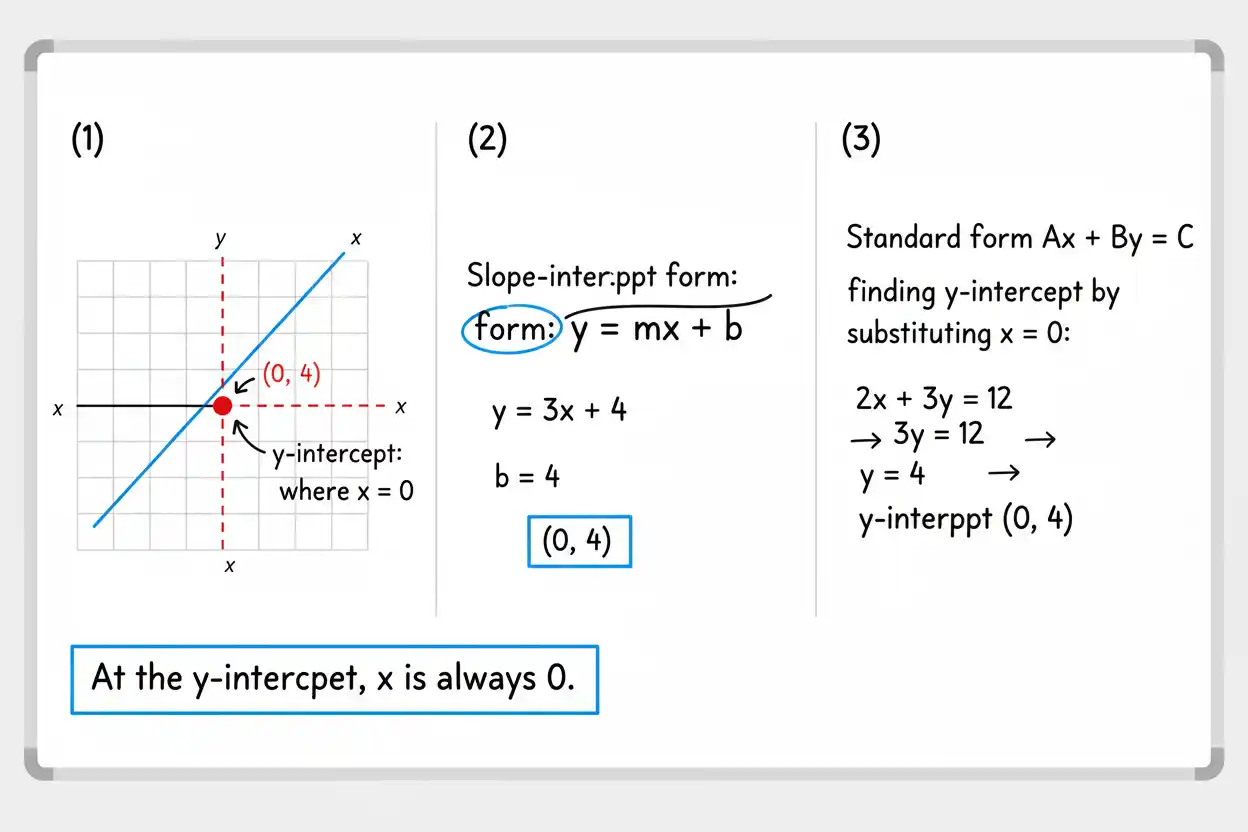

The y-intercept is the point where a graph meets the y-axis. Because every point on the y-axis has:
x = 0
you can usually find a y-intercept by setting x equal to zero and solving for y.
For a function:
y = f(x)
the y-intercept is:
(0, f(0))
provided f(0) is defined.
For a line written in slope-intercept form:
y = mx + b
the y-intercept is simply:
(0, b)
For example:
y = 3x – 5
has:
b = -5
so its y-intercept is:
(0, -5)
The central rule is simple: set x = 0 and determine the corresponding y-value.
What Is a Y-Intercept?
A y-intercept is a point where a graph intersects the vertical y-axis.
Every point on that axis has the coordinate form:
(0, y)
Therefore a y-intercept must always have an x-coordinate of zero.
For example:
(0, 7)
is a possible y-intercept.
The point:
(7, 0)
is not a y-intercept. It lies on the x-axis and is an x-intercept.
This distinction is one of the most important basic rules when reading coordinates from graphs.
Y-Intercept Formula
For a function:
y = f(x)
set:
x = 0
Then:
y = f(0)
So the y-intercept is:
(0, f(0))
provided 0 belongs to the function’s domain.
This rule works for linear, quadratic, polynomial, rational, absolute-value, and many other functions.
The expression may change, but the y-axis condition remains:
x = 0
Y-Intercept in Slope-Intercept Form
A line written in slope-intercept form is:
y = mx + b
Set x = 0:
y = m(0) + b
y = b
Therefore:
Y-intercept = (0, b)
This explains why b is called the y-intercept in slope-intercept form.
For:
y = 4x + 9
the y-intercept is:
(0, 9)
For:
y = -2x – 3
the y-intercept is:
(0, -3)
Example 1: Find the Y-Intercept From y = mx + b
Find the y-intercept of:
y = 5x + 6
Identify:
b = 6
Therefore:
Y-intercept = (0, 6)
You can verify by setting x = 0:
y = 5(0) + 6
y = 6
Example 2: Negative Y-Intercept
Find the y-intercept of:
y = 3x – 11
Set x = 0:
y = 3(0) – 11
y = -11
Therefore:
(0, -11)
The negative sign means the graph crosses the y-axis below the origin.
Y-Intercept From Standard Form
A line in standard form of a line is:
Ax + By = C
To find the y-intercept, set:
x = 0
Then:
B y = C
so:
y = C/B
provided:
B ≠ 0
Therefore:
Y-intercept = (0, C/B)
This is the direct y-intercept formula for standard form.
Example 3: Standard Form
Find the y-intercept of:
3x + 4y = 20
Set:
x = 0
Then:
4y = 20
y = 5
Therefore:
Y-intercept = (0, 5)
Example 4: Fractional Y-Intercept
Find the y-intercept of:
5x + 3y = 7
Set x = 0:
3y = 7
y = 7/3
Therefore:
Y-intercept = (0, 7/3)
A y-intercept does not need to be an integer.
Finding the Y-Intercept of a Function
For:
f(x) = expression
calculate:
f(0)
For example:
f(x) = x² – 4x + 7
Then:
f(0) = 0² – 4(0) + 7
f(0) = 7
Therefore:
Y-intercept = (0, 7)
This same rule applies regardless of the polynomial’s degree.
Y-Intercept of a Quadratic Function
Consider:
y = 2x² – 5x – 3
Set:
x = 0
Then:
y = 2(0²) – 5(0) – 3
y = -3
Therefore:
(0, -3)
is the y-intercept.
For a quadratic written:
y = ax² + bx + c
the y-intercept is:
(0, c)
because all terms containing x become zero when x = 0.
Y-Intercept of a Polynomial
For:
P(x) = aₙx^n + … + a₂x² + a₁x + a₀
evaluate at x = 0:
P(0) = a₀
Therefore the y-intercept is:
(0, a₀)
provided the polynomial is graphed as:
y = P(x)
The constant term determines the y-intercept because every positive power of zero equals zero.
Example 5: Higher-Degree Polynomial
Find the y-intercept of:
y = 4x⁵ – 3x³ + 7x – 12
Set x = 0:
y = 4(0)⁵ – 3(0)³ + 7(0) – 12
y = -12
Therefore:
Y-intercept = (0, -12)
No polynomial factoring is required.
Y-Intercept of a Rational Function
Consider:
y = (x + 2)/(x – 3)
Set x = 0:
y = (0 + 2)/(0 – 3)
y = -2/3
Therefore:
Y-intercept = (0, -2/3)
This works because x = 0 is allowed in the domain.
If setting x = 0 makes the denominator zero, the function has no y-intercept at that x-value.
Example: Rational Function With No Y-Intercept
Consider:
y = 1/x
Set x = 0:
y = 1/0
Division by zero is undefined.
Therefore:
No y-intercept
The graph approaches the y-axis but never crosses it.
The key question is not merely whether an equation has a constant term; it is whether the function is actually defined at x = 0.
Y-Intercept of a Radical Function
Consider:
y = √(x + 4)
Set x = 0:
y = √4
y = 2
Therefore:
Y-intercept = (0, 2)
Now consider:
y = √(x – 1)
At x = 0:
√(-1)
is not real.
Therefore the real graph has:
No y-intercept
because x = 0 is outside the real domain.
Y-Intercept of an Absolute-Value Function
Consider:
y = |x| – 6
Set x = 0:
y = |0| – 6
y = -6
Therefore:
Y-intercept = (0, -6)
The same x = 0 rule works even though the graph has a V-shape rather than being a straight line.
Y-Intercept of an Exponential Function
Consider:
y = 3^x
At x = 0:
y = 3^0
y = 1
Therefore:
Y-intercept = (0, 1)
More generally, for:
y = ab^x
the y-intercept is:
(0, a)
because:
b^0 = 1
for nonzero b in the usual real-valued exponential setting.
Y-Intercept of a Logarithmic Function
Consider:
y = log(x)
The logarithm is not defined at:
x = 0
Therefore the basic logarithmic function has:
No y-intercept
A shifted logarithmic function may have one.
For example:
y = log(x + 1)
at x = 0 gives:
y = log(1)
y = 0
so the y-intercept is:
(0, 0)
Domain always matters.
Y-Intercept From a Table
A table reveals the y-intercept directly if it includes the row where:
x = 0
Suppose:
| x | y |
|---|---|
| -2 | -3 |
| -1 | -1 |
| 0 | 1 |
| 1 | 3 |
| 2 | 5 |
At:
x = 0
we have:
y = 1
Therefore:
Y-intercept = (0, 1)
If the table does not include x = 0, you may need to determine the equation or pattern first.
Y-Intercept From a Graph
To identify a y-intercept visually, find where the graph crosses or touches the vertical axis.
Then read the y-coordinate.
If the graph meets the y-axis at:
y = -4
the intercept is:
(0, -4)
Do not report only -4 when the question asks for an intercept point. The complete coordinate is:
(0, -4)
Y-Intercept vs X-Intercept
The y-intercept occurs where:
x = 0
The x-intercept occurs where:
y = 0
For:
y = 2x – 6
find the y-intercept by setting x = 0:
y = -6
So:
Y-intercept = (0, -6)
Find the x-intercept by setting y = 0:
0 = 2x – 6
x = 3
So:
X-intercept = (3, 0)
The coordinate positions are reversed because they lie on different axes.
Can the Y-Intercept Be Zero?
Yes.
If:
b = 0
in:
y = mx + b
then:
y = mx
At x = 0:
y = 0
Therefore the y-intercept is:
(0, 0)
The graph passes through the origin.
Can a Function Have More Than One Y-Intercept?
A function can have at most one y-intercept.
Every y-intercept requires:
x = 0
A function can assign only one output to the input x = 0.
Therefore, if f(0) is defined, the function has exactly one y-intercept:
(0, f(0))
If f(0) is undefined, it has none.
Can a Non-Function Relation Have Multiple Y-Intercepts?
Yes.
Consider the circle:
x² + y² = 4
Set x = 0:
y² = 4
Therefore:
y = ±2
The circle has two y-intercepts:
(0, 2)
and:
(0, -2)
This does not violate the function rule because a circle is not a function of x over its full graph: the same x-value can correspond to two y-values.
Horizontal Lines
Consider:
y = 5
Every point has y-coordinate 5.
At x = 0:
(0, 5)
is on the line.
Therefore its y-intercept is:
(0, 5)
Every nonempty horizontal line y = c has exactly one ordinary y-intercept:
(0, c)
Vertical Lines
Consider:
x = 4
Every point on the line has x-coordinate 4.
Because no point has x = 0:
No y-intercept
Now consider:
x = 0
This line is the y-axis itself.
Rather than meeting the y-axis at one isolated point, it coincides with it. Therefore it does not have one unique y-intercept in the usual point-intercept sense.
This is an important special case.
Finding a Missing Constant From the Y-Intercept
Suppose:
y = 3x + b
and you know the y-intercept is:
(0, -7)
Then:
b = -7
so the equation is:
y = 3x – 7
The y-intercept therefore provides the constant term directly in slope-intercept form.
Finding a Line From Slope and Y-Intercept
Suppose the slope is:
m = 4
and the y-intercept is:
(0, -2)
Use:
y = mx + b
Substitute:
m = 4
b = -2
Therefore:
y = 4x – 2
The line can now be graphed by starting at (0, -2) and applying the slope.
Y-Intercept and Systems of Equations
When graphing systems of equations, y-intercepts can help position each graph quickly.
Suppose two lines are:
y = 2x + 1
y = -x + 4
Their y-intercepts are:
(0, 1)
and:
(0, 4)
These points help draw the two lines before locating their intersection.
The y-intercepts themselves are not automatically the system solution; the solution is where the two graphs intersect each other.
Y-Intercept in a Linear System
In a system of linear equations, comparing y-intercepts can help determine whether two lines are distinct.
For example:
y = 3x + 2
y = 3x – 5
have the same slope but different y-intercepts.
Therefore they are distinct parallel lines and the system has no solution.
If both slope and y-intercept were identical, the equations would represent the same line.
Y-Intercept Does Not Require Factoring
Suppose:
y = x³ – 8
To find the y-intercept, simply set x = 0:
y = -8
So:
(0, -8)
You do not need to factor the difference of cubes.
The sum and difference of cubes formula answers a different question: how to factor expressions such as x³ – 8.
This distinction keeps intercept finding separate from polynomial factorization.
Y-Intercept Does Not Require Synthetic Division
Consider:
y = x³ – 4x² + x + 6
Its y-intercept is found immediately:
y(0) = 6
so:
(0, 6)
Synthetic division is useful for dividing a polynomial by a suitable linear factor or testing roots. It is unnecessary when the only goal is to calculate the graph’s value at x = 0.
Y-Intercept and the Constant Term
For many common polynomial forms, the constant term is the y-intercept value.
For:
y = ax + b
the constant term is b.
For:
y = ax² + bx + c
the constant term is c.
For:
y = ax³ + bx² + cx + d
the constant term is d.
This works because all positive powers of x vanish at:
x = 0
However, the shortcut should not be applied blindly to expressions with denominators, radicals, or domain restrictions without first checking whether x = 0 is permitted.
Y-Intercept and Function Transformations
Suppose:
f(x) = (x – 2)² + 3
The y-intercept is not automatically the vertical shift 3.
Set x = 0:
f(0) = (0 – 2)² + 3
= 4 + 3
= 7
Therefore:
Y-intercept = (0, 7)
A parameter visible in a transformed function may have a different geometric role than the y-intercept.
The universal method remains evaluating the function at x = 0.
Common Y-Intercept Mistakes
Setting y = 0
Setting y = 0 finds an x-intercept, not a y-intercept.
For a y-intercept:
Set x = 0
Writing the Coordinates Backward
If the intercept value is 5, the y-intercept point is:
(0, 5)
not:
(5, 0)
Ignoring a Negative Sign
For:
y = 2x – 7
the y-intercept is:
(0, -7)
Assuming Every Graph Has a Y-Intercept
A function such as:
y = 1/x
is undefined at x = 0, so it has no y-intercept.
Assuming Every Graph Has Only One Y-Intercept
A function has at most one, but a relation that is not a function may intersect the y-axis at multiple points.
Confusing the Y-Intercept With the Slope
In:
y = mx + b
m is the slope and b is the y-intercept value.
Using Factoring When Substitution Is Enough
To find the y-intercept, substitute x = 0. Finding roots or factors is usually unnecessary.
Worked Y-Intercept Example
Find the y-intercept of:
6x – 4y = 18
Set:
x = 0
Then:
6(0) – 4y = 18
-4y = 18
Divide by -4:
y = -18/4
Simplify:
y = -9/2
Therefore:
Y-intercept = (0, -9/2)
Check by converting the equation into slope-intercept form:
6x – 4y = 18
Subtract 6x:
-4y = -6x + 18
Divide by -4:
y = (3/2)x – 9/2
The constant term confirms:
b = -9/2
so the y-intercept is:
(0, -9/2)
Frequently Asked Questions
What is a y-intercept?
A y-intercept is a point where a graph meets the y-axis.
How do you find the y-intercept?
Set:
x = 0
and solve for y.
What is the y-intercept formula for a function?
For:
y = f(x)
the y-intercept is:
(0, f(0))
provided f(0) exists.
What is the y-intercept in y = mx + b?
It is:
(0, b)
What is the y-intercept of Ax + By = C?
When B ≠ 0:
Y-intercept = (0, C/B)
What is the difference between an x-intercept and a y-intercept?
For an x-intercept, set y = 0. For a y-intercept, set x = 0.
Can a y-intercept be negative?
Yes. For y = 2x – 5, the y-intercept is:
(0, -5)
Can the y-intercept be zero?
Yes. If a graph passes through the origin, its y-intercept is:
(0, 0)
Can a function have two y-intercepts?
No. A function can assign only one output to x = 0, so it can have at most one y-intercept.
Can a relation have two y-intercepts?
Yes. A relation that is not a function may intersect the y-axis more than once. A circle centered at the origin is a common example.
Why does y = 1/x have no y-intercept?
At x = 0, the expression requires division by zero, so the function is undefined there.
Is the constant term always the y-intercept?
For a polynomial written as y = P(x), yes: the constant term equals P(0). For more general functions, evaluate at x = 0 and first confirm that the function is defined there.