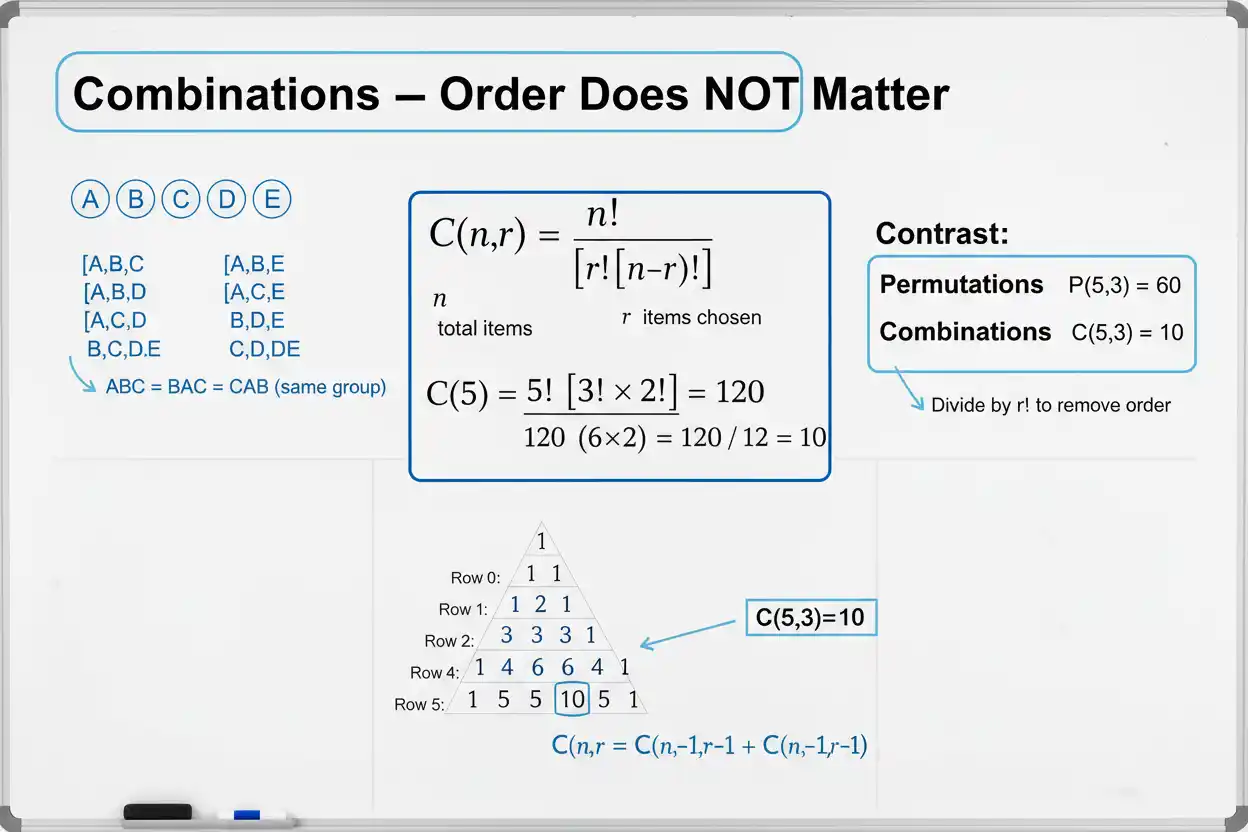
Combinations count how many ways r objects can be selected from n distinct objects when the order of selection does not matter.
The standard formula is:
C(n,r) = n! / [r!(n-r)!]
The same quantity may be written:
nCr
or:
(n choose r)
For example, the number of ways to choose 2 people from a group of 5 is:
C(5,2) = 5! / [2!(5-2)!]
= 5! / (2!3!)
= 10
Therefore:
C(5,2) = 10
Choosing Alice and Ben is the same combination as choosing Ben and Alice. That is the defining feature: order does not create a new selection.
What Are Combinations?
A combination is an unordered selection from a collection of distinct objects.
Suppose there are four objects:
A, B, C, D
Choose two.
The possible combinations are:
AB
AC
AD
BC
BD
CD
There are:
6 combinations
Notice that BA is not listed separately from AB because both contain the same two objects.
Therefore:
C(4,2) = 6
Combinations are one of the core counting tools in combinatorics.
Combination Formula
For nonnegative integers n and r with:
0 ≤ r ≤ n
the combination formula is:
C(n,r) = n! / [r!(n-r)!]
where:
n = total number of distinct objects
r = number selected
and:
! = factorial
For example:
C(8,3) = 8! / [3!5!]
The factorial terms account for the number of possible arrangements and then remove arrangements that represent the same unordered selection.
Factorial Reminder
For a positive integer n:
n! = n × (n – 1) × … × 2 × 1
and:
0! = 1
For example:
5! = 5 × 4 × 3 × 2 × 1
= 120
Also:
3! = 6
and:
2! = 2
So:
C(5,2) = 120 / (2 × 6)
= 120/12
= 10
Why Order Does Not Matter
Suppose you choose 2 people from:
A, B, C
If order mattered, the possible ordered selections would include:
AB
BA
AC
CA
BC
CB
There are six ordered results.
But for combinations:
AB = BA
AC = CA
BC = CB
so only three distinct groups remain:
AB, AC, BC
Therefore:
C(3,2) = 3
The formula divides out the internal arrangements that do not produce new groups.
Combination vs Permutation
The simplest distinction is:
Combination: order does not matter
Permutation: order matters
Suppose three finalists are:
A, B, C
Choosing two members for a committee is a combination.
Choosing a first-place and second-place winner is an ordered arrangement, so it is not the same counting problem.
For a selection of r distinct objects:
Permutations = Combinations × r!
or:
P(n,r) = C(n,r) × r!
Therefore:
C(n,r) = P(n,r)/r!
The factor r! removes the different orders of each chosen group.
Example 1: Choose 3 From 5
Calculate:
C(5,3)
Use:
C(5,3) = 5! / [3!2!]
Expand:
5! = 120
3! = 6
2! = 2
Therefore:
C(5,3) = 120/(6 × 2)
= 120/12
= 10
So there are:
10 ways
to choose 3 objects from 5 distinct objects.
Example 2: Choose 3 From 10
Calculate:
C(10,3)
Use:
C(10,3) = 10! / [3!7!]
Cancel 7!:
C(10,3) = (10 × 9 × 8)/(3 × 2 × 1)
= 720/6
= 120
Therefore:
C(10,3) = 120
Expanding 10! and 7! completely is unnecessary.
Efficient Combination Formula
Instead of computing enormous factorials, use:
C(n,r) = n(n-1)(n-2)…(n-r+1) / r!
For:
C(20,3)
calculate:
20 × 19 × 18 / (3 × 2 × 1)
= 6840/6
= 1140
This is usually easier than evaluating:
20!/(3!17!)
directly.
Use the Smaller of r and n – r
Because:
C(n,r) = C(n,n-r)
you can often reduce the amount of arithmetic.
For example:
C(100,98) = C(100,2)
Then:
C(100,2) = 100 × 99 / 2
= 4950
This is much easier than working directly with 98 factorial.
Symmetry Rule
The identity:
C(n,r) = C(n,n-r)
has a simple interpretation.
Choosing r items to include automatically determines which:
n – r
items are excluded.
For example, choosing 2 people from a group of 7 uniquely determines the 5 people not chosen.
Therefore:
C(7,2) = C(7,5)
Both equal:
21
Choosing Zero Objects
There is exactly one way to choose nothing from n objects: choose the empty set.
Therefore:
C(n,0) = 1
The formula agrees:
C(n,0) = n!/[0!n!]
Since:
0! = 1
we get:
C(n,0) = 1
Choosing Every Object
There is exactly one way to choose all n objects.
Therefore:
C(n,n) = 1
For example:
C(12,12) = 1
because the only possible selection contains all 12 objects.
Choosing One Object
There are n ways to choose one object from n objects:
C(n,1) = n
For example:
C(8,1) = 8
This provides another useful boundary identity.
Choosing n – 1 Objects
By symmetry:
C(n,n-1) = C(n,1)
Therefore:
C(n,n-1) = n
Choosing which n – 1 objects to keep is equivalent to choosing the single object to leave out.
Example: Committee Selection
A company has:
12 employees
and needs a committee of:
4 employees
If every employee is eligible and committee roles are not distinguished, calculate:
C(12,4)
Use:
C(12,4) = 12!/[4!8!]
Cancel:
= (12 × 11 × 10 × 9)/(4 × 3 × 2 × 1)
= 11,880/24
= 495
Therefore:
495 different committees
can be formed.
Why Committee Roles Change the Problem
Suppose the same four selected people must receive different roles:
chair
vice chair
secretary
treasurer
Now order or assignment matters.
The initial group can be chosen with a combination, but each group can then be assigned roles in:
4! = 24
ways.
Therefore the count would be:
C(12,4) × 4!
= 495 × 24
= 11,880
The wording of the problem determines whether order matters.
Card-Hand Example
A standard 52-card deck contains 52 distinct cards.
The number of different 5-card hands is:
C(52,5)
Calculate:
C(52,5) = 52!/[5!47!]
Cancel 47!:
= (52 × 51 × 50 × 49 × 48)/(5 × 4 × 3 × 2 × 1)
This gives:
2,598,960
Therefore there are:
2,598,960 distinct 5-card hands
The order in which the cards are dealt does not matter when the final hand is the only object being counted.
Lottery Example
Suppose a lottery asks a player to choose:
6 numbers from 49
and the order of the six numbers does not matter.
The number of possible selections is:
C(49,6)
which equals:
13,983,816
If exactly one combination is the winning set, the chance of matching all six with one distinct ticket under that simplified model is:
1 / 13,983,816
This illustrates why combinations appear naturally in probability.
Probability Using Combinations
When outcomes are equally likely, combinations can help calculate:
Probability = Favorable combinations / Total combinations
Suppose 3 objects are selected from 10, of which 4 are special.
What is the probability that all 3 selected objects are special?
Favorable selections:
C(4,3)
Total selections:
C(10,3)
Therefore:
P = C(4,3)/C(10,3)
Calculate:
C(4,3) = 4
C(10,3) = 120
So:
P = 4/120
= 1/30
Combinations in the Birthday Paradox
The birthday paradox becomes easier to understand when you count how many pairs exist in a group.
The number of distinct pairs among n people is:
C(n,2)
Using the formula:
C(n,2) = n!/[2!(n-2)!]
which simplifies to:
C(n,2) = n(n – 1)/2
For 23 people:
C(23,2) = 23 × 22 / 2
= 253
So a group of only 23 people contains:
253 different pairs
that could potentially share a birthday.
Pair Formula
The special combination:
C(n,2)
has the useful formula:
C(n,2) = n(n – 1)/2
For 100 people:
C(100,2) = 100 × 99 / 2
= 4950
Therefore there are:
4950 distinct pairs
among 100 people.
Pascal’s Identity
Combinations satisfy:
C(n,r) = C(n-1,r-1) + C(n-1,r)
This is known as Pascal’s identity.
Its interpretation is based on one distinguished object.
Every r-object selection from n objects either:
- includes that distinguished object, or
- excludes it.
If it is included, choose the remaining r – 1 objects from n – 1:
C(n-1,r-1)
If it is excluded, choose all r from the remaining n – 1:
C(n-1,r)
Adding the two cases produces:
C(n,r)
Example of Pascal’s Identity
Find:
C(6,3)
using:
C(6,3) = C(5,2) + C(5,3)
Calculate:
C(5,2) = 10
and:
C(5,3) = 10
Therefore:
C(6,3) = 20
Check directly:
6!/[3!3!] = 20
Pascal Triangle
The entries of Pascal’s triangle are combination values.
For example:
1
1 1
1 2 1
1 3 3 1
1 4 6 4 1
The row:
1 4 6 4 1
corresponds to:
C(4,0), C(4,1), C(4,2), C(4,3), C(4,4)
Each interior entry equals the sum of the two entries above it, reflecting Pascal’s identity.
Sum of All Combinations
A fundamental identity is:
C(n,0) + C(n,1) + … + C(n,n) = 2^n
Why?
Each of n distinct objects has two choices:
included
or:
not included
Therefore there are:
2^n
possible subsets.
Grouping those subsets by size gives:
C(n,0) + C(n,1) + … + C(n,n)
so the two expressions must be equal.
Binary Interpretation of Combinations
The subset identity has a natural connection to binary numbers.
For n labeled objects, represent each object with one bit:
1 = included
0 = excluded
For four objects, the pattern:
1010₂
can represent a subset containing the first and third objects.
There are:
2⁴ = 16
possible four-bit patterns, corresponding to all subsets.
The number of patterns containing exactly r ones is:
C(n,r)
For example, the number of 4-bit strings with exactly two ones is:
C(4,2) = 6
The strings are:
1100
1010
1001
0110
0101
0011
This gives a direct combinatorial interpretation of nCr.
Binomial Coefficients
Combination values are also called binomial coefficients because they appear in powers of:
(a + b)^n
For example:
(a + b)³
expands to:
a³ + 3a²b + 3ab² + b³
The coefficients:
1, 3, 3, 1
are:
C(3,0), C(3,1), C(3,2), C(3,3)
In general:
(a + b)^n = Σ C(n,r)a^(n-r)b^r
with r running from 0 to n.
This connection explains the name binomial coefficient.
Why C(n,r) Is Always an Integer
The factorial formula contains division:
C(n,r) = n!/[r!(n-r)!]
yet the result is always an integer when:
0 ≤ r ≤ n
The reason is combinatorial: C(n,r) counts an actual number of distinct subsets.
Algebraically, the factorial factors divide in a way that exactly counts repeated orderings.
When calculating manually, canceling shared factors before multiplication can make that integer structure easier to see. The numerical idea of identifying common factors can help reduce large intermediate values.
Example: Cancel Before Multiplying
Calculate:
C(15,2)
Use:
15 × 14 / (2 × 1)
Cancel:
14/2 = 7
Then:
15 × 7 = 105
Therefore:
C(15,2) = 105
There is no need to calculate 15! in full.
Combinations With Repetition
The ordinary formula:
C(n,r)
assumes selection from distinct objects without replacement when the final group contains no repeated object.
A different formula is used when repetitions are allowed and order still does not matter:
C(n + r – 1, r)
For example, suppose there are 4 types of item and you choose 3 items with repetition allowed.
The number of selections is:
C(4 + 3 – 1, 3)
= C(6,3)
= 20
This is sometimes called combinations with repetition or multiset selection.
Example: Ice Cream Scoops
Suppose there are 5 flavors and you choose 3 scoops, with repeated flavors allowed and scoop order irrelevant.
The number of possible flavor multisets is:
C(5 + 3 – 1, 3)
= C(7,3)
= 35
This differs from choosing 3 distinct flavors, which would be:
C(5,3) = 10
The replacement rule changes the counting model.
Restricted Combination Example
Suppose a committee of 4 must be selected from 7 women and 5 men, with exactly 2 women and 2 men.
Choose the women:
C(7,2)
Choose the men:
C(5,2)
The choices are independent, so multiply:
Total = C(7,2) × C(5,2)
Calculate:
21 × 10
= 210
Therefore:
210 committees
satisfy the requirement.
At Least One Condition
Suppose 4 people are selected from a group of 6 engineers and 3 designers, and the group must contain at least one designer.
A convenient method is the complement.
Total 4-person groups:
C(9,4)
Groups with no designers:
C(6,4)
Therefore:
Valid groups = C(9,4) – C(6,4)
Calculate:
C(9,4) = 126
C(6,4) = 15
So:
Valid groups = 126 – 15
= 111
Complement counting can be much shorter than adding separate cases for one, two, or three designers.
Exactly vs At Least
These phrases lead to different counting structures.
Exactly 2 means count only selections containing precisely two specified-category objects.
At least 2 means count:
2, 3, 4, …
as many as the problem allows.
At most 2 includes:
0, 1, or 2
Careful interpretation of these words is often more important than the factorial arithmetic itself.
Combination Equation Example
Suppose:
C(n,2) = 45
Using:
C(n,2) = n(n – 1)/2
we get:
n(n – 1)/2 = 45
Multiply by 2:
n(n – 1) = 90
Expand:
n² – n – 90 = 0
Factor:
(n – 10)(n + 9) = 0
The mathematical roots are:
n = 10
or:
n = -9
But n represents a number of objects, so:
n = 10
Therefore a set of 10 objects contains:
45 distinct pairs
Large Combination Values
Combination counts can become extremely large.
For example:
C(100,50)
is approximately:
1.0089 × 10²⁹
Even though n is only 100, the number of possible 50-object subsets is enormous.
This rapid growth is a major reason combinatorial search spaces can become difficult to examine exhaustively.
The underlying numerical scale can be interpreted with the same powers and digit-length ideas used for large integers.
nCr on a Calculator
Many calculators provide an nCr function.
To calculate:
C(10,4)
enter n = 10, choose nCr, and enter r = 4.
The result is:
210
A calculator evaluates the same mathematical quantity:
10!/[4!6!]
The important part is deciding that the problem is genuinely a combination problem before using the function.
When to Use Combinations
Use combinations when the problem involves:
- selecting a group;
- choosing a subset;
- forming an unordered committee;
- selecting cards where deal order is irrelevant;
- choosing lottery numbers without rank;
- counting pairs or groups;
- counting subsets of a fixed size.
The essential test is:
Would changing the order produce a genuinely different outcome?
If the answer is no, combinations are usually appropriate.
When Not to Use nCr
Do not use ordinary nCr when order matters.
For example, assigning:
gold, silver, and bronze
to 3 people is ordered.
Choosing:
3 members of a committee
without distinct roles is unordered.
Also, ordinary nCr assumes distinct objects and no repeated selection. If repetition is allowed, a different counting formula may be needed.
Common Combinations Mistakes
Treating Order as Important
For combinations:
AB and BA
are the same selection.
Confusing n and r
n is the total number available.
r is the number selected.
Forgetting the Factorial on n – r
The denominator is:
r!(n-r)!
not:
r!(n-r)
Expanding Huge Factorials Unnecessarily
Cancel common factorial portions first.
Using nCr When Repetition Is Allowed
Ordinary nCr counts selections without repeated objects.
Treating Exactly and At Least as Equivalent
“Exactly 2” and “at least 2” describe different sets of outcomes.
Assuming a Combination Probability Is Automatically Uniform
The ratio:
favorable combinations / total combinations
works directly only when the counted outcomes are equally likely under the model.
Worked Combinations Example
A class has:
8 students
and 3 must be selected for a project team.
How many different teams are possible?
Because team order does not matter:
Number of teams = C(8,3)
Use:
C(8,3) = 8!/[3!5!]
Cancel 5!:
C(8,3) = (8 × 7 × 6)/(3 × 2 × 1)
Calculate:
8 × 7 × 6 = 336
and:
3 × 2 × 1 = 6
Therefore:
C(8,3) = 336/6
= 56
So:
56 different three-student teams
can be selected.
If the same three students were assigned three distinct roles, the ordering of the selected students would matter and the count would be larger.
Frequently Asked Questions
What are combinations in mathematics?
Combinations count selections from a set when the order of the selected objects does not matter.
What is the combinations formula?
For 0 ≤ r ≤ n:
C(n,r) = n!/[r!(n-r)!]
What does nCr mean?
nCr means the number of ways to choose r objects from n distinct objects without regard to order.
What is the difference between combinations and permutations?
In combinations, order does not matter. In permutations, order matters.
What is C(5,2)?
C(5,2) = 10
What is C(n,0)?
C(n,0) = 1
There is one way to choose no objects.
What is C(n,n)?
C(n,n) = 1
There is one way to choose every object.
Why is C(n,r) equal to C(n,n-r)?
Choosing r objects to include uniquely determines the n – r objects that are excluded.
How many pairs are there among n objects?
C(n,2) = n(n – 1)/2
What is Pascal’s identity?
C(n,r) = C(n-1,r-1) + C(n-1,r)
How are combinations related to binary strings?
An n-bit string represents a subset of n positions. The number of n-bit strings containing exactly r ones is:
C(n,r)
What formula is used when repetition is allowed?
For n types and r unordered selections with repetition allowed:
C(n + r – 1, r)