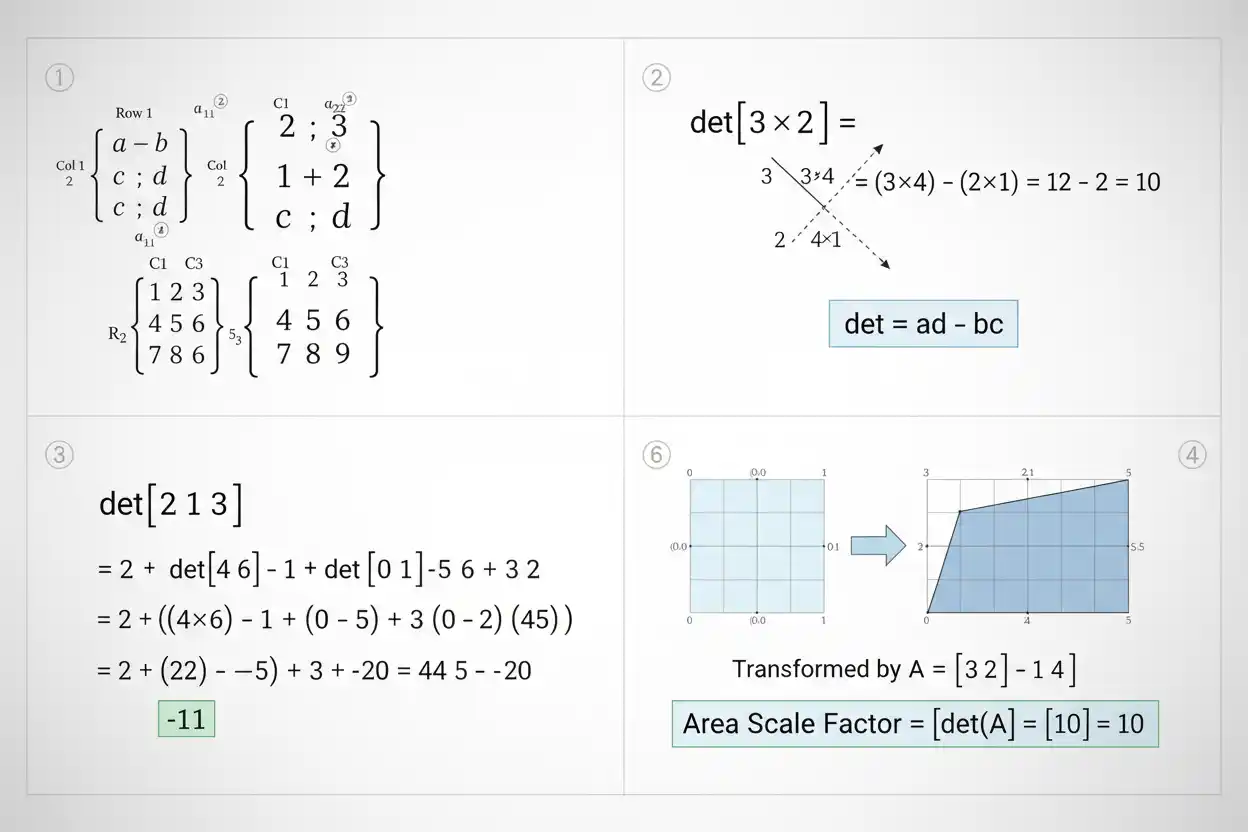
Determinants are numerical values calculated from square matrices. A determinant summarizes important structural information about a matrix, including whether the matrix is invertible, whether a related system of linear equations has a unique solution, and how the matrix scales area or volume.
For a 2 × 2 matrix:
A = [[a, b], [c, d]]
the determinant is:
det(A) = ad – bc
For example, if:
A = [[4, 7], [2, 6]]
then:
det(A) = (4 × 6) – (7 × 2)
det(A) = 24 – 14
det(A) = 10
The determinant of the matrix is 10.
Although determinants are associated primarily with linear algebra, their calculations use familiar operations such as multiplication, subtraction, division, and signed arithmetic.
What Is a Determinant?
A determinant is a single scalar value associated with a square matrix.
A square matrix has the same number of rows and columns, such as:
2 × 2
3 × 3
4 × 4
and so on.
The determinant of a matrix A may be written as:
det(A)
or by placing the entries between vertical bars.
The value depends on the entries of the matrix and their positions. Rearranging rows, multiplying a row by a constant, or making one row dependent on another can change the determinant in predictable ways.
Determinant Formula for a 2 × 2 Matrix
For:
A = [[a, b], [c, d]]
the formula is:
det(A) = ad – bc
This means:
- Multiply the entries on the main diagonal:
a × d. - Multiply the entries on the other diagonal:
b × c. - Subtract the second product from the first.
The order matters:
ad – bc
not:
bc – ad
Reversing the subtraction changes the sign.
Example: 2 × 2 Determinant
Consider:
A = [[5, 3], [2, 4]]
Apply:
det(A) = ad – bc
Substitute:
det(A) = (5 × 4) – (3 × 2)
det(A) = 20 – 6
det(A) = 14
Therefore:
det(A) = 14
Example With a Negative Entry
Consider:
A = [[3, -2], [5, 4]]
Then:
det(A) = (3 × 4) – ((-2) × 5)
det(A) = 12 – (-10)
Subtracting a negative becomes addition:
det(A) = 22
Therefore:
det(A) = 22
Sign handling is one of the most common sources of determinant errors.
Example With Decimal Entries
A matrix does not need integer entries.
Suppose:
A = [[1.5, 2], [0.5, 4]]
Then:
det(A) = (1.5 × 4) – (2 × 0.5)
det(A) = 6 – 1
det(A) = 5
Therefore:
det(A) = 5
The calculation uses ordinary decimal operations. The presence of decimal entries does not change the determinant formula.
Example With Fractional Entries
Consider:
A = [[1/2, 2], [3, 1/4]]
Then:
det(A) = (1/2 × 1/4) – (2 × 3)
det(A) = 1/8 – 6
Write 6 with denominator 8:
6 = 48/8
Therefore:
det(A) = 1/8 – 48/8
det(A) = -47/8
So:
det(A) = -47/8
If matrix entries originally appear as terminating decimals, converting a decimal to fraction form can sometimes make an exact calculation easier to follow.
Determinant Formula for a 3 × 3 Matrix
For:
A = [[a, b, c], [d, e, f], [g, h, i]]
one common expansion is:
det(A) = a(ei – fh) – b(di – fg) + c(dh – eg)
Notice the alternating signs:
+, -, +
Each term uses a 2 × 2 determinant formed after removing the corresponding row and column.
Worked 3 × 3 Determinant
Consider:
A = [[2, 1, 3], [0, 4, 5], [1, -2, 0]]
Use:
det(A) = a(ei – fh) – b(di – fg) + c(dh – eg)
Substitute:
det(A) = 2[(4 × 0) – (5 × -2)] – 1[(0 × 0) – (5 × 1)] + 3[(0 × -2) – (4 × 1)]
Calculate each part.
First term:
2[0 – (-10)] = 20
Second term:
-1[0 – 5] = 5
Third term:
3[0 – 4] = -12
Add:
det(A) = 20 + 5 – 12
det(A) = 13
Therefore:
det(A) = 13
Minors and Cofactors
The 3 × 3 formula is based on minors and cofactors.
A minor is the determinant left after deleting one row and one column from the original matrix.
For a 3 × 3 matrix, deleting one row and one column leaves a 2 × 2 matrix.
A cofactor applies a sign to that minor according to its position.
The sign pattern begins:
This alternating structure is essential when expanding a determinant.
Cofactor Expansion
A determinant can be expanded along any row or column.
For a 3 × 3 matrix:
A = [[a, b, c], [d, e, f], [g, h, i]]
expansion along the first row gives:
det(A) = a(ei – fh) – b(di – fg) + c(dh – eg)
If a row or column contains several zeros, expanding along it can substantially reduce the amount of arithmetic.
Example
Consider:
A = [[4, 0, 0], [2, 3, 1], [5, 6, 2]]
Expanding along the first row leaves only one nonzero term:
det(A) = 4[(3 × 2) – (1 × 6)]
det(A) = 4(6 – 6)
det(A) = 0
Therefore:
det(A) = 0
This zero value has an important structural meaning.
What Does a Zero Determinant Mean?
If:
det(A) = 0
then the square matrix is singular.
A singular matrix does not have an ordinary multiplicative inverse.
A zero determinant also indicates that the matrix transformation collapses dimension in some way. In two dimensions, an area can collapse to a line or point. In three dimensions, a volume can collapse into a lower-dimensional object.
For a system represented by a square coefficient matrix, a zero determinant also means the determinant alone cannot establish a unique solution.
What Does a Nonzero Determinant Mean?
If:
det(A) ≠ 0
the square matrix is nonsingular, or invertible.
For example:
A = [[4, 7], [2, 6]]
has:
det(A) = 10
Since:
10 ≠ 0
the matrix has an inverse.
The detailed construction belongs to the dedicated matrix inverse topic, but the determinant provides the immediate test for whether that ordinary inverse exists.
Determinants and Systems of Linear Equations
Consider a system:
ax + by = e
cx + dy = f
Its coefficient matrix is:
A = [[a, b], [c, d]]
If:
ad – bc ≠ 0
the system has a unique solution.
If:
ad – bc = 0
the equations may instead be dependent or inconsistent.
The full methods for solving a system of linear equations remain separate from the determinant itself. The determinant is valuable here because it reveals whether a unique solution is structurally possible.
Determinants and Matrix Inverses
For a 2 × 2 matrix:
A = [[a, b], [c, d]]
the inverse formula contains the factor:
1 / det(A)
Since division by zero is undefined, an inverse cannot exist when:
det(A) = 0
This explains the direct connection between determinant and invertibility.
The determinant does not replace the full matrix-inverse procedure; it answers the preliminary question:
Is an inverse possible?
Determinants and Matrix Rank
A determinant can also provide information related to matrix rank.
For an n × n matrix:
det(A) ≠ 0
implies that the matrix has full rank:
rank(A) = n
If:
det(A) = 0
the rank is less than n.
However, a zero determinant does not by itself tell you the exact reduced rank. Additional matrix analysis is required.
Determinants and Matrix Multiplication
A particularly important property is:
det(AB) = det(A) × det(B)
This connects determinants with matrix multiplication.
Suppose:
det(A) = 3
and:
det(B) = -4
Then:
det(AB) = 3 × (-4)
det(AB) = -12
The determinant of the product can therefore be found without calculating every entry of AB if the individual determinants are already known.
Determinant of the Identity Matrix
For an identity matrix:
I = [[1, 0], [0, 1]]
the determinant is:
det(I) = (1 × 1) – (0 × 0)
det(I) = 1
More generally:
det(Iₙ) = 1
for every square identity matrix.
This is consistent with the identity transformation because it does not scale area or volume.
Determinant of a Diagonal Matrix
A diagonal matrix has zeros outside its main diagonal.
For:
A = [[a, 0, 0], [0, b, 0], [0, 0, c]]
the determinant is simply:
det(A) = abc
For example:
A = [[2, 0, 0], [0, 5, 0], [0, 0, -3]]
Then:
det(A) = 2 × 5 × (-3)
det(A) = -30
This property extends to triangular matrices as well.
Determinant of a Triangular Matrix
If a square matrix is upper triangular or lower triangular, its determinant equals the product of the diagonal entries.
For example:
A = [[3, 2, 7], [0, 4, 5], [0, 0, 6]]
Then:
det(A) = 3 × 4 × 6
det(A) = 72
There is no need for a full cofactor expansion.
Swapping Two Rows
Swapping two rows reverses the sign of the determinant.
If:
det(A) = 12
and matrix B is obtained by swapping two rows of A, then:
det(B) = -12
Swapping the same two rows again restores the original matrix and the original determinant sign.
Multiplying a Row by a Constant
If one row of a matrix is multiplied by a constant k, the determinant is also multiplied by k.
For example, if:
det(A) = 5
and one row is multiplied by 3, then the new determinant is:
3 × 5 = 15
This property is especially useful when determinants are simplified through row operations.
Adding a Multiple of One Row to Another
Adding a multiple of one row to a different row does not change the determinant.
For instance, an operation such as:
R₂ → R₂ + 4R₁
preserves the determinant.
This makes certain row-reduction strategies useful for simplifying determinant calculations.
Equal Rows Produce a Zero Determinant
If two rows of a matrix are identical, its determinant is zero.
For example:
A = [[2, 5], [2, 5]]
Then:
det(A) = (2 × 5) – (5 × 2)
det(A) = 10 – 10
det(A) = 0
The rows are not independent, so the matrix is singular.
The same conclusion holds if two columns are identical.
Proportional Rows Also Produce Zero
Consider:
A = [[2, 3], [4, 6]]
The second row is twice the first.
Calculate:
det(A) = (2 × 6) – (3 × 4)
det(A) = 12 – 12
det(A) = 0
The rows contain redundant directional information.
Determinants and Area
A 2 × 2 determinant has a geometric interpretation.
For vectors:
u = (a, c)
and:
v = (b, d)
the absolute determinant:
|ad – bc|
gives the area of the parallelogram formed by those two vectors.
For:
u = (4, 2)
v = (1, 3)
the determinant is:
(4 × 3) – (1 × 2) = 10
So the parallelogram has area:
10 square units
The sign contains orientation information, while the absolute value gives physical area.
Determinants and Volume
In three dimensions, the absolute value of a 3 × 3 determinant measures the volume-scaling factor of the associated linear transformation.
If:
det(A) = -6
then the transformation scales volume by a factor of:
|-6| = 6
The negative sign indicates an orientation reversal.
Thus determinant magnitude and determinant sign convey different information.
Geometric Meaning of the Sign
For a 2 × 2 transformation:
det(A) > 0
preserves orientation.
If:
det(A) < 0
orientation is reversed.
If:
det(A) = 0
the transformation collapses area to zero.
This geometric viewpoint explains why determinant zero is such an important dividing line.
Determinant of a Scalar Multiple
For an n × n matrix:
det(kA) = k^n det(A)
This is because multiplying the entire matrix by k multiplies each of its n rows by k.
For a 2 × 2 matrix:
det(kA) = k² det(A)
For a 3 × 3 matrix:
det(kA) = k³ det(A)
This should not be confused with multiplying just one row by k, which multiplies the determinant only once by k.
Determinant of an Inverse
If A is invertible:
det(A⁻¹) = 1 / det(A)
For example, if:
det(A) = 5
then:
det(A⁻¹) = 1/5
This relationship follows from:
AA⁻¹ = I
and:
det(A)det(A⁻¹) = det(I) = 1
Again, the relationship requires:
det(A) ≠ 0
Determinants With Decimal Arithmetic
Suppose:
A = [[2.4, 1.5], [0.8, 3.2]]
Then:
det(A) = (2.4 × 3.2) – (1.5 × 0.8)
Calculate:
2.4 × 3.2 = 7.68
1.5 × 0.8 = 1.20
Therefore:
det(A) = 7.68 – 1.20
det(A) = 6.48
Accurate decimal arithmetic matters because a misplaced decimal can change both the value and conclusions drawn from the determinant.
Divisibility Is a Different Question
A determinant may happen to be an integer, but deciding whether that integer is divisible by another number is a separate arithmetic problem.
For instance, if:
det(A) = 126
then divisibility rules can determine quickly that 126 is divisible by 2, 3, 6, 7, and other factors.
Those tests do not calculate the determinant itself. They analyze the resulting integer after the matrix calculation has been completed.
Common Determinant Mistakes
One frequent mistake is reversing the products in a 2 × 2 determinant.
For:
[[a, b], [c, d]]
the correct expression is:
ad – bc
not:
bc – ad
Another common error is forgetting the alternating sign in a 3 × 3 cofactor expansion.
The first-row pattern is:
+, -, +
Sign errors involving negative matrix entries can compound the problem. Parentheses help:
ad – (bc)
rather than mentally combining multiplication and subtraction without separating the steps.
It is also incorrect to calculate a determinant for an ordinary rectangular matrix such as 2 × 3. Standard determinants are defined for square matrices.
How to Check a 2 × 2 Determinant
Suppose:
A = [[6, 2], [3, 5]]
Calculate:
det(A) = (6 × 5) – (2 × 3)
= 30 – 6
= 24
A useful check is to repeat the diagonal products separately:
Main diagonal:
6 × 5 = 30
Other diagonal:
2 × 3 = 6
Then:
30 – 6 = 24
Separating the products reduces sign and transcription errors.
Frequently Asked Questions
What is a determinant?
A determinant is a scalar value calculated from a square matrix. It provides information about invertibility, linear dependence, geometric scaling, and related systems of equations.
What is the determinant formula for a 2 × 2 matrix?
For:
A = [[a, b], [c, d]]
the determinant is:
det(A) = ad – bc
Can a determinant be negative?
Yes. Determinants may be positive, negative, or zero. A negative determinant indicates orientation reversal in the geometric interpretation.
What does a determinant of zero mean?
A zero determinant means the matrix is singular and has no ordinary multiplicative inverse. For a square coefficient matrix, it also means a unique solution cannot be established through invertibility.
Can a non-square matrix have a determinant?
Not under the ordinary definition. Determinants are defined for square matrices.
What is the determinant of an identity matrix?
det(I) = 1
for every square identity matrix.
What is the determinant of a triangular matrix?
Multiply its diagonal entries.
Does swapping rows change the determinant?
Yes. Swapping two rows multiplies the determinant by -1.
Does matrix multiplication multiply determinants?
Yes:
det(AB) = det(A)det(B)
Why is the determinant important for an inverse matrix?
The inverse contains division by the determinant. If the determinant is zero, that division is undefined and the inverse does not exist.
Final Example
Find the determinant of:
A = [[3, 2, 1], [1, 0, 4], [2, 5, 6]]
Expand along the first row:
det(A) = 3[(0 × 6) – (4 × 5)] – 2[(1 × 6) – (4 × 2)] + 1[(1 × 5) – (0 × 2)]
Calculate:
det(A) = 3(0 – 20) – 2(6 – 8) + (5 – 0)
det(A) = -60 – 2(-2) + 5
det(A) = -60 + 4 + 5
det(A) = -51
Therefore:
det(A) = -51
The determinant reduces an entire square matrix to one number, but that number carries substantial structural information: whether the matrix is invertible, whether it preserves or reverses orientation, and how strongly it scales geometric space.