Parallel and Perpendicular Lines: Definition, Formula & Example

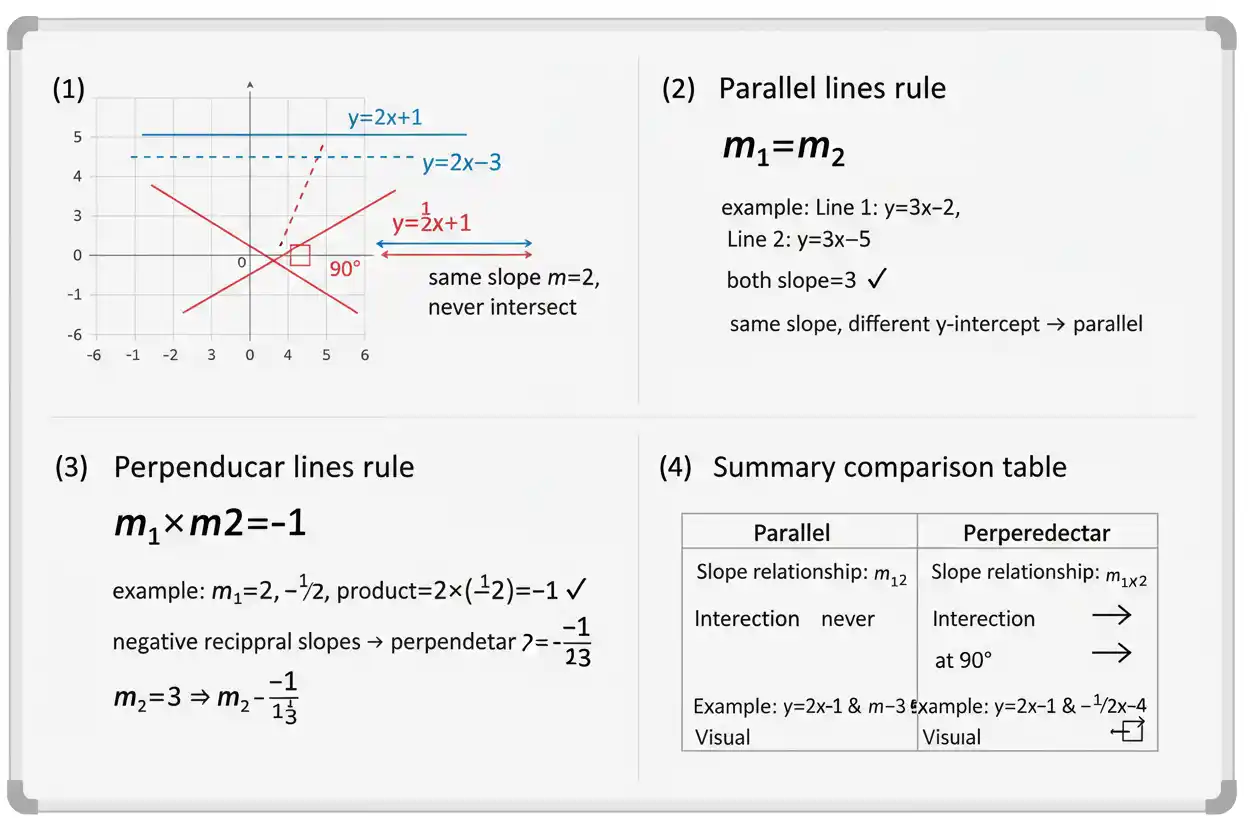
Parallel and perpendicular lines are distinguished by how their directions and slopes relate.
Two distinct nonvertical lines are parallel when they have the same slope:
m₁ = m₂
Two nonvertical, nonhorizontal lines are perpendicular when their slopes are negative reciprocals:
m₂ = -1/m₁
Equivalently:
m₁m₂ = -1
For example:
y = 2x + 3
and:
y = 2x – 5
are parallel because both have slope 2.
Meanwhile:
y = 2x + 3
and:
y = -1/2 x + 4
are perpendicular because:
2 × (-1/2) = -1
The relationships between slopes make it possible to recognize, construct, and verify parallel and perpendicular lines algebraically.
What Are Parallel Lines?
Parallel lines lie in the same plane and never intersect when they are distinct.
For nonvertical lines written as:
y = mx + b
parallel lines have equal slopes:
m₁ = m₂
but different y-intercepts:
b₁ ≠ b₂
For example:
y = 3x + 1
and:
y = 3x – 7
have the same slope:
3
but different intercepts.
Therefore:
the lines are parallel
The slope determines their direction.
What Are Perpendicular Lines?
Perpendicular lines intersect at a right angle:
90°
For two finite, nonzero slopes:
m₁m₂ = -1
This means one slope is the negative reciprocal of the other.
For example, if:
m₁ = 4
then the perpendicular slope is:
m₂ = -1/4
because:
4 × (-1/4) = -1
Therefore any nonvertical line with slope -1/4 is perpendicular to a line with slope 4.
Parallel Lines Formula
For two distinct nonvertical lines:
Line 1: y = m₁x + b₁
Line 2: y = m₂x + b₂
they are parallel when:
m₁ = m₂
and:
b₁ ≠ b₂
If both slope and intercept are equal, the equations represent the same line rather than two distinct parallel lines.
Perpendicular Lines Formula
For two lines whose slopes are finite and nonzero:
m₁m₂ = -1
or:
m₂ = -1/m₁
For example:
m₁ = 3/5
Then:
m₂ = -5/3
Check:
3/5 × (-5/3)
= -15/15
= -1
Therefore the slopes are perpendicular.
Negative Reciprocal Rule
To find the negative reciprocal of a nonzero slope:
- Take the reciprocal.
- Reverse the sign.
For:
m = 2/7
reciprocal:
7/2
reverse the sign:
-7/2
For:
m = -3/4
reciprocal:
-4/3
reverse the sign:
4/3
Therefore:
-3/4
and:
4/3
are perpendicular slopes.
Example: Are Two Lines Parallel?
Consider:
y = 5x + 4
and:
y = 5x – 9
The first slope is:
m₁ = 5
The second slope is:
m₂ = 5
Since:
m₁ = m₂
and the intercepts differ:
4 ≠ -9
the lines are:
parallel
Example: Are Two Lines Perpendicular?
Consider:
y = -3x + 7
and:
y = 1/3 x – 2
Their slopes are:
m₁ = -3
m₂ = 1/3
Multiply:
(-3)(1/3) = -1
Therefore:
the lines are perpendicular
Example: Neither Parallel Nor Perpendicular
Consider:
y = 2x + 1
and:
y = 3x – 4
The slopes are:
2 and 3
They are not equal:
2 ≠ 3
so the lines are not parallel.
Their product is:
2 × 3 = 6
not:
-1
so they are not perpendicular.
Therefore:
the lines are neither parallel nor perpendicular
Slope From Two Points
If a line is given by two points:
(x₁,y₁)
and:
(x₂,y₂)
its slope is:
m = (y₂-y₁)/(x₂-x₁)
provided:
x₂ ≠ x₁
For example, through:
(1,2)
and:
(4,8)
the slope is:
m = (8-2)/(4-1)
= 6/3
= 2
The dedicated slope page covers the calculation more broadly; here the result is used to compare line directions.
Determine Whether Two Point-Defined Lines Are Parallel
Line A passes through:
(1,3)
and:
(5,11)
Its slope is:
(11-3)/(5-1)
= 8/4
= 2
Line B passes through:
(-2,4)
and:
(1,10)
Its slope is:
(10-4)/(1-(-2))
= 6/3
= 2
The slopes are equal.
Therefore:
Line A and Line B are parallel
provided they are distinct lines.
Determine Whether Two Point-Defined Lines Are Perpendicular
Line A passes through:
(0,0)
and:
(3,6)
Its slope is:
6/3 = 2
Line B passes through:
(1,4)
and:
(5,2)
Its slope is:
(2-4)/(5-1)
= -2/4
= -1/2
Multiply:
2 × (-1/2) = -1
Therefore:
the two lines are perpendicular
Slope-Intercept Form
The slope-intercept form is:
y = mx + b
where:
m = slope
b = y-intercept
This form makes parallel and perpendicular relationships easy to see.
For example:
y = 4x + 7
has slope:
4
Any distinct parallel line must also have slope:
4
Any perpendicular line must have slope:
-1/4
Find a Parallel Line Through a Point
Find the equation of the line parallel to:
y = 3x – 8
and passing through:
(2,5)
The original slope is:
3
A parallel line must also have:
m = 3
Use point-slope form:
y – y₁ = m(x – x₁)
Substitute:
y – 5 = 3(x – 2)
Expand:
y – 5 = 3x – 6
Add 5:
y = 3x – 1
Check the slope:
3
It matches the original line, so the lines are parallel.
Point-Slope Form
The point-slope form is:
y – y₁ = m(x – x₁)
It is especially useful when a problem gives:
- a point the new line must pass through;
- a required parallel or perpendicular slope.
Once the slope is determined, substitute the point directly into the formula.
Find a Perpendicular Line Through a Point
Find the line perpendicular to:
y = 2x + 3
and passing through:
(4,1)
The original slope is:
2
The negative reciprocal is:
-1/2
Use point-slope form:
y – 1 = -1/2(x – 4)
Distribute:
y – 1 = -1/2x + 2
Add 1:
y = -1/2x + 3
The slope product is:
2 × (-1/2) = -1
so the new line is perpendicular.
Parallel Lines in Standard Form
A line may be given as:
Ax + By = C
To compare slopes, solve for y when possible.
For example:
2x + 4y = 8
Subtract 2x:
4y = -2x + 8
Divide by 4:
y = -1/2x + 2
So the slope is:
-1/2
Now consider:
3x + 6y = 20
Solve:
6y = -3x + 20
y = -1/2x + 10/3
The slopes are equal.
Therefore:
the lines are parallel
Perpendicular Lines in Standard Form
Consider:
2x + 3y = 6
Solve for y:
3y = -2x + 6
y = -2/3x + 2
So:
m₁ = -2/3
A perpendicular slope is:
m₂ = 3/2
Therefore any line with slope 3/2 is perpendicular to the given line.
Linear Equations and Lines
A two-variable linear equation represents a straight line when expressed in the ordinary Cartesian plane.
For example:
2x – y = 4
can be rewritten:
y = 2x – 4
so its slope is:
2
Once a linear equation is rearranged into a slope-readable form, its relationship to another line can be tested efficiently.
Vertical Parallel Lines
A vertical line has equation:
x = c
Its slope is undefined.
For example:
x = 3
and:
x = -7
are distinct vertical lines.
They never intersect.
Therefore:
all distinct vertical lines are parallel to one another
The ordinary slope equality formula is not directly used because vertical slopes are undefined.
Horizontal Parallel Lines
A horizontal line has equation:
y = c
Its slope is:
0
For example:
y = 4
and:
y = -2
both have slope zero.
Therefore:
the lines are parallel
Vertical and Horizontal Lines Are Perpendicular
A vertical line and a horizontal line intersect at a right angle.
For example:
x = 3
and:
y = 5
meet at:
(3,5)
and are perpendicular.
The product rule:
m₁m₂ = -1
cannot be applied because the vertical slope is undefined.
Therefore vertical-horizontal perpendicularity must be treated as a special case.
Why the Negative Reciprocal Rule Works
A line with slope:
m
changes vertically by m units for each horizontal unit when interpreted as rise over run.
If:
m = a/b
a perpendicular direction can use displacement:
(-a, b)
instead of:
(b,a)
Its slope becomes:
b/(-a)
= -b/a
Therefore:
m_perpendicular = -1/m
The corresponding direction vectors have dot product zero:
(b,a) · (-a,b)
= -ab + ab
= 0
which represents a right angle.
Parallel Direction Vectors
Two lines are parallel when their direction vectors are scalar multiples.
For example:
v₁ = (2,6)
and:
v₂ = (1,3)
satisfy:
v₁ = 2v₂
Their slopes are:
6/2 = 3
and:
3/1 = 3
So they point in the same direction.
This is the vector version of equal slopes.
Perpendicular Direction Vectors
Direction vectors are perpendicular when their dot product is zero.
For:
v₁ = (2,3)
and:
v₂ = (-3,2)
calculate:
2(-3) + 3(2)
= -6 + 6
= 0
Therefore the directions are perpendicular.
Their slopes are:
3/2
and:
2/(-3) = -2/3
Multiply:
3/2 × (-2/3) = -1
The vector and slope tests agree.
Identical Lines vs. Parallel Lines
Consider:
y = 2x + 3
and:
2y = 4x + 6
Simplify the second:
y = 2x + 3
The equations describe the same line.
They should not be described as two distinct parallel lines.
For distinct parallel lines:
same slope
but:
different intercept or different location
is required.
Parallel Lines Do Not Have a Unique Intersection
Two distinct parallel lines do not intersect.
For example:
y = 3x + 2
y = 3x – 5
Set them equal:
3x + 2 = 3x – 5
Subtract 3x:
2 = -5
This contradiction shows that no point satisfies both equations.
Perpendicular Lines Intersect Once
Two noncoincident perpendicular lines intersect at exactly one point.
Consider:
y = x + 1
and:
y = -x + 5
Set equal:
x + 1 = -x + 5
Add x:
2x + 1 = 5
Subtract 1:
2x = 4
x = 2
Then:
y = 2 + 1 = 3
The lines intersect at:
(2,3)
and their slopes:
1 and -1
multiply to:
-1
Order of Operations in Line Calculations
Correct order of operations matters when substituting coordinates into a line.
Suppose:
y = -3x + 8
and:
x = -2
Substitute:
y = -3(-2) + 8
Multiply:
-3(-2) = 6
Then:
6 + 8 = 14
Therefore:
y = 14
Sign errors can make a correct line equation appear incorrect.
Number Sequences and Lines
A number sequence can generate coordinate points on a straight line.
Suppose:
xₙ = n
and:
yₙ = 2n + 1
The points are:
(1,3)
(2,5)
(3,7)
(4,9)
Every pair satisfies:
y = 2x + 1
The y-values themselves form an arithmetic sequence with common difference 2 because equal x-steps along a line of slope 2 produce equal y-changes.
Parallel Lines From Sequences
Suppose one coordinate sequence generates:
y = 2x + 1
and another:
y = 2x – 4
Both have slope:
2
Their y-values differ by a constant amount at every common x-coordinate:
5
Therefore the lines remain the same vertical distance apart and are parallel.
Perpendicular Slopes as Fractions
Many perpendicular slopes involve fractions.
If:
m₁ = 5/7
then:
m₂ = -7/5
This is a reciprocal-and-sign operation.
Accurate fraction operations help when slopes are given as ratios.
Check:
5/7 × (-7/5)
= -35/35
= -1
Simplifying Slopes Before Comparing
Suppose one line has slope:
6/9
and another:
2/3
6/9 = 2/3
Therefore the slopes are equal.
If the lines are distinct:
they are parallel
Comparing unsimplified fractions can obscure an exact slope relationship.
Perpendicular Slopes With Negative Fractions
Suppose:
m₁ = -4/9
The reciprocal is:
-9/4
Reverse the sign:
9/4
Therefore:
m₂ = 9/4
Check:
-4/9 × 9/4
= -36/36
= -1
So:
-4/9 and 9/4 are perpendicular slopes
Parallel and Perpendicular Lines and Nth Roots
The mapped nth roots topic may appear when coordinates or coefficients simplify from radicals, but the classification still depends on the final slopes.
For example, suppose:
m₁ = √16
Then:
m₁ = 4
A perpendicular line therefore has slope:
-1/4
The root calculation determines the numerical slope; the parallel/perpendicular rule is then applied to that value.
Parallel and Perpendicular Lines and Percent Error
The mapped percent error concept can be relevant when experimentally measured slopes are compared with theoretical slopes.
Suppose a theoretical slope is:
2
while a measured slope is:
1.96
A percent-error calculation can quantify the measurement discrepancy.
However, exact mathematical parallelism requires equal slopes, not merely slopes that are close within a percentage.
Likewise, exact perpendicularity requires the relevant slope relationship to be exact unless the problem explicitly allows measurement tolerance.
Percent Off Is a Different Concept
Percent off calculates a reduction from an original value and does not determine whether lines are parallel or perpendicular.
A phrase such as “slope reduced by 20%” might involve a percentage calculation, but the resulting slope must still be compared using:
m₁ = m₂
or:
m₁m₂ = -1
The geometric relationship is determined by slope, not by the discount-style percentage operation.
Example: Find a Parallel Equation
Find a line parallel to:
y = -4x + 9
passing through:
(3,2)
Parallel slope:
m = -4
Use point-slope form:
y – 2 = -4(x – 3)
Expand:
y – 2 = -4x + 12
Add 2:
y = -4x + 14
Check:
Original slope:
-4
New slope:
-4
The intercepts differ, so the lines are distinct and parallel.
Example: Find a Perpendicular Equation
Find a line perpendicular to:
y = -2/3x + 5
through:
(6,1)
Original slope:
-2/3
Negative reciprocal:
3/2
Use:
y – 1 = 3/2(x – 6)
Expand:
y – 1 = 3/2x – 9
Add 1:
y = 3/2x – 8
Check:
(-2/3)(3/2) = -1
Therefore the lines are perpendicular.
Example With an Equation Not Solved for y
Determine whether:
4x – 2y = 6
and:
2x – y = -4
are parallel.
First equation:
-2y = -4x + 6
Divide by -2:
y = 2x – 3
Second equation:
-y = -2x – 4
Multiply by -1:
y = 2x + 4
Both slopes are:
2
The intercepts differ.
Therefore:
the lines are parallel
Example With Perpendicular Standard-Form Lines
Consider:
2x + y = 5
and:
x – 2y = 8
First line:
y = -2x + 5
so:
m₁ = -2
Second:
-2y = -x + 8
y = 1/2x – 4
so:
m₂ = 1/2
Multiply:
(-2)(1/2) = -1
Therefore:
the lines are perpendicular
Common Mistake: Same Intercept Means Parallel
Parallelism depends on slope, not y-intercept.
Consider:
y = 2x + 3
and:
y = -4x + 3
Both have y-intercept:
3
but their slopes differ:
2 and -4
Therefore they are not parallel.
In fact, they intersect at the shared y-intercept point:
(0,3)
Common Mistake: Opposite Slopes Mean Perpendicular
Suppose slopes are:
3 and -3
Their signs are opposite, but:
3 × (-3) = -9
not:
-1
Therefore they are not perpendicular.
The perpendicular slope to 3 is:
-1/3
not -3.
Common Mistake: Taking Only the Reciprocal
If the original slope is:
2/5
its reciprocal is:
5/2
but the perpendicular slope is:
-5/2
You must both reverse numerator and denominator and change the sign.
Common Mistake: Applying the Product Rule to a Vertical Line
The rule:
m₁m₂ = -1
requires finite slopes.
A vertical line’s slope is undefined.
A vertical line is perpendicular to any horizontal line, whose slope is zero.
This special case should be recognized directly rather than forcing undefined values into the slope-product formula.
Common Mistake: Calling the Same Line Parallel
If two equations simplify to exactly the same equation, they describe coincident lines.
For example:
y = 2x + 4
and:
2y = 4x + 8
represent one line.
Distinct parallel lines have equal slopes but different positions.
Common Mistake: Comparing Unsimplified Equations Too Quickly
Consider:
2x + 4y = 8
and:
3x + 6y = 20
The coefficients look different, but solving for y gives:
y = -1/2x + 2
and:
y = -1/2x + 10/3
Their slopes are identical.
Therefore the lines are parallel.
Always determine the actual slopes before classifying the relationship.
How to Check Parallel Lines
Suppose:
y = -3x + 4
and:
y = -3x – 8
Check slopes:
m₁ = -3
m₂ = -3
They match.
Check that the intercepts differ:
4 ≠ -8
Therefore:
the lines are distinct and parallel
How to Check Perpendicular Lines
Suppose:
y = 4/5x + 2
and:
y = -5/4x + 9
Multiply slopes:
4/5 × (-5/4)
= -20/20
= -1
Therefore:
the lines are perpendicular
Frequently Asked Questions
What are parallel lines?
Parallel lines are distinct coplanar lines that never intersect. Nonvertical parallel lines have equal slopes.
What is the formula for parallel slopes?
m₁ = m₂
for distinct nonvertical lines.
What are perpendicular lines?
Perpendicular lines intersect at a right angle of 90°.
What is the perpendicular-slope formula?
For finite nonzero slopes:
m₁m₂ = -1
or:
m₂ = -1/m₁
What is the perpendicular slope to 2?
-1/2
What is the perpendicular slope to -3?
1/3
What is the perpendicular slope to 4/7?
-7/4
Are lines with slopes 5 and 5 parallel?
Yes, if they are distinct lines.
Are lines with slopes 2 and -2 perpendicular?
No.
Their product is:
-4
The perpendicular slope to 2 is:
-1/2
Are vertical lines parallel?
Distinct vertical lines are parallel to one another.
What is perpendicular to a vertical line?
A horizontal line.
Are two horizontal lines parallel?
Yes, if they are distinct.
How do you find a line parallel to another through a point?
Use the same slope as the original line, then substitute the given point into point-slope or another line-equation form.
How do you find a perpendicular line through a point?
Find the negative reciprocal of the original slope, then use that slope with the specified point.
Final Example
Find the equation of the line perpendicular to:
3x – 2y = 8
and passing through:
(4,-1)
First determine the original slope.
Solve for y:
3x – 2y = 8
Subtract 3x:
-2y = -3x + 8
Divide by -2:
y = 3/2x – 4
Therefore:
m₁ = 3/2
The perpendicular slope is the negative reciprocal:
m₂ = -2/3
Now use point-slope form with:
(x₁,y₁) = (4,-1)
y – (-1) = -2/3(x – 4)
So:
y + 1 = -2/3(x – 4)
Expand:
y + 1 = -2/3x + 8/3
Subtract 1:
y = -2/3x + 8/3 – 1
y = -2/3x + 5/3
Therefore:
y = -2/3x + 5/3
Check the slopes:
3/2 × (-2/3)
= -6/6
= -1
Therefore the new line is perpendicular to the original line.
The essential relationships are:
Parallel: m₁ = m₂
and:
Perpendicular: m₁m₂ = -1
with vertical and horizontal lines handled as the important special case. Once each line’s slope is identified correctly, determining whether two lines are parallel, perpendicular, coincident, or neither becomes straightforward.