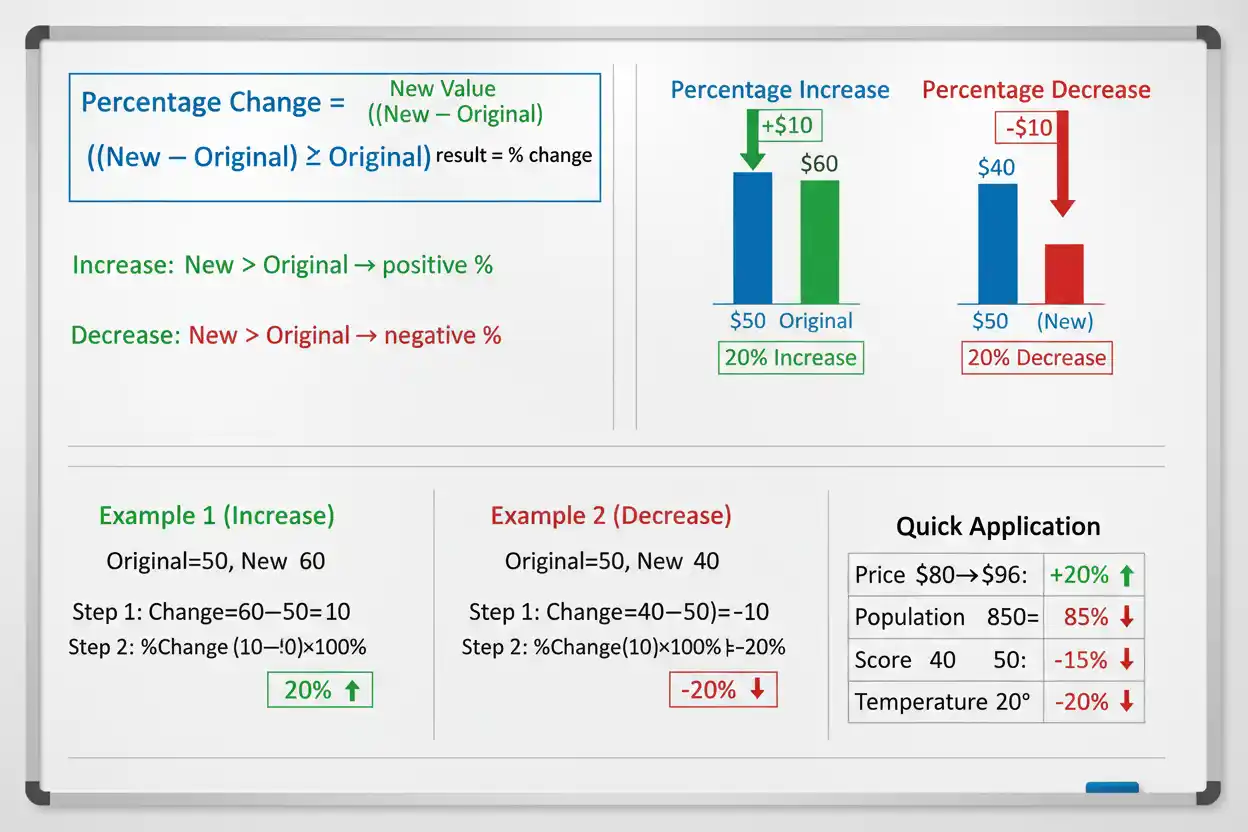
Percentage change measures how much a quantity has increased or decreased relative to its original value.
For a positive, nonzero original value, the standard formula is:
Percentage Change = (New Value – Original Value) / Original Value × 100%
A positive result indicates an increase.
A negative result indicates a decrease.
For example, if a quantity rises from:
80 to 100
the change is:
100 – 80 = 20
Relative to the original:
20/80 = 0.25
Therefore:
Percentage Change = 25%
The value increased by 25%.
Percentage change is a specialized application of the general percentage relationship, with the original value serving as the comparison baseline.
What Is Percentage Change?
Percentage change compares the difference between a new value and an original value with the original value.
Let:
O = original value
N = new value
Δ = absolute change
Then:
Δ = N – O
and, for a positive nonzero original value:
Percentage Change = Δ/O × 100%
If:
N > O
the result is positive.
If:
N < O
the result is negative.
If:
N = O
the result is zero.
Percentage Change Formula
The standard formula is:
Percentage Change = (New – Original) / Original × 100%
For example:
Original = 200
New = 230
Then:
New – Original = 30
Divide:
30/200 = 0.15
Convert:
0.15 × 100% = 15%
Therefore:
Percentage Change = +15%
The quantity increased by 15%.
Percentage Increase Formula
For positive values when the new value is greater than the original:
Percentage Increase = (New – Original) / Original × 100%
For example:
50 → 65
Increase:
65 – 50 = 15
Then:
15/50 × 100%
= 30%
Therefore:
50 to 65 is a 30% increase
The separate percentage growth page focuses specifically on positive growth contexts, while percentage change covers both upward and downward movement.
Percentage Decrease Formula
When a positive quantity decreases, the magnitude of the percentage decrease can be written:
Percentage Decrease = (Original – New) / Original × 100%
For example:
80 → 60
Decrease:
80 – 60 = 20
Then:
20/80 × 100%
= 25%
Therefore:
80 to 60 is a 25% decrease
Using the signed percentage-change formula instead gives:
(60-80)/80 × 100%
= -25%
The negative sign represents the downward direction.
Signed vs. Unsigned Percentage Change
Suppose:
100 → 85
The signed percentage change is:
(85-100)/100 × 100%
= -15%
You can state this as:
Percentage change = -15%
or equivalently:
15% decrease
The first preserves direction numerically. The second reports the decrease magnitude in words.
Step-by-Step Percentage Change
For positive baseline values, the calculation is:
1. Find the change: New – Original
2. Divide by the original value
3. Multiply by 100%
For:
120 → 150
Step 1:
150 – 120 = 30
Step 2:
30/120 = 0.25
Step 3:
0.25 × 100% = 25%
Therefore:
Percentage Change = +25%
Example: 40 to 50
Calculate:
50 – 40 = 10
Then:
10/40 = 0.25
Therefore:
Percentage Change = 25%
The new value is:
125%
of the original.
Example: 50 to 40
Now reverse the values.
Change:
40 – 50 = -10
Divide by the original:
-10/50 = -0.20
Therefore:
Percentage Change = -20%
This is a 20% decrease.
Notice that increasing from 40 to 50 is 25%, while decreasing from 50 to 40 is 20%.
Percentage change is not symmetric because the denominator changes with the starting value.
Why Percentage Change Is Not Symmetric
Compare:
80 → 100
and:
100 → 80
For the increase:
20/80 × 100% = 25%
For the decrease:
-20/100 × 100% = -20%
The absolute difference is 20 in both directions, but the reference values differ.
Therefore:
80 → 100 = 25% increase
while:
100 → 80 = 20% decrease
This asymmetry is one of the most important properties of percentage change.
Example: 250 to 300
Change:
300 – 250 = 50
Divide:
50/250 = 0.20
Therefore:
Percentage Change = +20%
Example: 300 to 250
Change:
250 – 300 = -50
Divide:
-50/300 ≈ -0.166667
Convert:
≈ -16.67%
Therefore:
Percentage Change ≈ -16.67%
Again, reversing the movement changes the percentage.
No Change
If:
Original = 75
New = 75
then:
75 – 75 = 0
Therefore:
0/75 × 100% = 0%
So:
Percentage Change = 0%
A zero percentage change means the new value equals the original value.
Percentage Change With Decimal Values
Suppose:
Original = 2.5
New = 2.8
Change:
2.8 – 2.5 = 0.3
Then:
0.3/2.5 = 0.12
Convert:
12%
Therefore:
Percentage Change = +12%
Accurate decimal arithmetic helps prevent place-value errors in these calculations.
Percentage Change With Large Values
Suppose:
Original = 48,000
New = 51,600
Difference:
51,600 – 48,000 = 3,600
Relative change:
3,600/48,000 = 0.075
Therefore:
Percentage Change = +7.5%
The absolute change is large, but the percentage expresses that increase relative to the size of the starting quantity.
Finding the New Value From Percentage Change
If the original value and percentage change are known:
New = Original × (1 + r)
where r is the signed percentage change written as a decimal.
For an increase of 15%:
r = 0.15
so:
New = Original × 1.15
For a decrease of 15%:
r = -0.15
so:
New = Original × 0.85
Example: Increase 240 by 15%
Use:
New = 240 × 1.15
Calculate:
240 × 1.15 = 276
Therefore:
240 increased by 15% is 276
Check the increase:
276 – 240 = 36
and:
36/240 = 0.15
Example: Decrease 240 by 15%
Use:
New = 240 × 0.85
Calculate:
204
Therefore:
240 decreased by 15% is 204
The decrease amount is:
240 – 204 = 36
which is:
15%
of 240.
Percentage Multiplier
A percentage change can be represented by a multiplier.
For an increase of p%:
Multiplier = 1 + p/100
For a decrease of p%:
Multiplier = 1 – p/100
Examples:
10% increase → ×1.10
25% increase → ×1.25
20% decrease → ×0.80
40% decrease → ×0.60
This method is especially useful for repeated changes.
Finding the Original Value
If:
New = Original × multiplier
then:
Original = New / multiplier
For example, a value is:
138
after a:
15% increase
The multiplier is:
1.15
Therefore:
Original = 138/1.15
= 120
So:
The original value was 120
Reverse a Percentage Decrease
Suppose a value becomes:
72
after a 20% decrease.
A 20% decrease leaves:
80%
of the original.
Therefore:
New = 0.80 × Original
So:
Original = 72/0.80
= 90
Therefore:
The original value was 90
Do not increase 72 by 20%, because:
72 × 1.20 = 86.4
not 90.
Why Equal Increase and Decrease Percentages Do Not Cancel
Suppose:
100
increases by:
20%
New value:
100 × 1.20 = 120
Now decrease 120 by:
20%
Calculate:
120 × 0.80 = 96
The final value is:
96
Therefore the overall percentage change from 100 is:
(96-100)/100 × 100%
= -4%
So:
+20% followed by -20% produces a net 4% decrease
The percentages use different reference values.
General Equal Increase-and-Decrease Rule
Suppose the increase and decrease rate are both:
r
as a decimal.
The combined multiplier is:
(1+r)(1-r)
Use the difference-of-squares identity:
(1+r)(1-r) = 1-r²
Therefore the net result is always below the starting value for:
r ≠ 0
The net decrease is:
r²
For:
r = 0.20
we get:
r² = 0.04
or:
4% decrease
Successive Percentage Increases
Suppose a value rises by:
10%
and then another:
20%
The multipliers are:
1.10
and:
1.20
Combined:
1.10 × 1.20 = 1.32
Therefore the final value is:
132%
of the original.
The total increase is:
32%
not 30%.
Successive Percentage Decreases
Suppose a value decreases by:
10%
and then:
20%
The combined multiplier is:
0.90 × 0.80
= 0.72
Therefore:
72%
of the original remains.
The overall decrease is:
28%
not 30%.
Repeated Percentage Change
If the same rate r is applied repeatedly:
New Value After n Periods = Original × (1+r)^n
for signed decimal r.
For example, a 5% increase repeated three times gives:
Original × 1.05³
This repeated multiplication creates a geometric sequence with common ratio:
1.05
A repeated decrease of 5% instead uses:
0.95^n
Example: Repeated 10% Increase
Start with:
500
Apply 10% growth twice.
After first change:
500 × 1.10 = 550
After second:
550 × 1.10 = 605
Therefore:
500 becomes 605
Overall percentage change:
(605-500)/500 × 100%
= 105/500 × 100%
= 21%
Thus two 10% increases produce:
21% total increase
Example: Repeated 10% Decrease
Start with:
500
After first decrease:
500 × 0.90 = 450
After second:
450 × 0.90 = 405
Overall change:
405 – 500 = -95
Then:
-95/500 × 100%
= -19%
Therefore:
two 10% decreases produce a 19% total decrease
Percentage Change vs. Percentage Difference
Percentage difference is generally used when comparing two values with no natural original/reference direction.
Percentage change is directional:
Original → New
Its denominator is:
Original
This makes:
A → B
different from:
B → A
Percentage difference instead uses a symmetric reference such as the average magnitude of the values, so swapping their order does not change the result.
Percentage Change vs. Percent Error
Percent error compares a measured value with an accepted or reference value and normally uses an absolute difference.
Percentage change tracks movement from an original value to a new value and preserves direction.
For example:
100 → 90
has:
-10%
percentage change.
If 100 were the accepted value and 90 the measurement, the standard percent error would be:
10%
The magnitude matches, but one metric records direction while the other reports error size.
Percentage Change vs. Percent Off
Percent off is a specialized decrease calculation commonly applied to prices or quantities.
If:
$100 → $75
the signed percentage change is:
-25%
while the discount can be stated:
25% off
The same numerical movement is framed differently because percent off conventionally reports the reduction magnitude rather than a negative sign.
Percentage Change vs. Percentage Growth
Percentage growth focuses on increases and growth-oriented applications.
Percentage change is broader because it can be:
positive
zero
or:
negative
A falling quantity still has a percentage change, but describing that movement as “growth” would be inappropriate.
Percentage Points vs. Percentage Change
Suppose a percentage rate moves from:
40%
to:
50%
The percentage-point difference is:
50% – 40% = 10 percentage points
But the percentage change relative to the original 40% is:
(50-40)/40 × 100%
= 25%
Therefore:
40% → 50% is +10 percentage points and +25% percentage change
Percentage points and percentage change should not be used interchangeably.
Percentage Change From 5% to 6%
The percentage-point increase is:
6% – 5% = 1 percentage point
The relative percentage change is:
(6-5)/5 × 100%
= 20%
Therefore:
5% → 6% is a 20% relative increase
even though the direct difference is only one percentage point.
Percentage Change From 50% to 40%
Difference in percentage points:
40% – 50% = -10 percentage points
Relative percentage change:
(40-50)/50 × 100%
= -20%
Therefore:
the rate fell by 10 percentage points, equivalent to a 20% relative decrease
Percentage Change When the Original Value Is Zero
The ordinary formula:
(New – Original)/Original × 100%
cannot be used when:
Original = 0
because it requires division by zero.
For example:
0 → 10
has an absolute increase of:
10
but the usual percentage change is:
undefined
It is not correct to call this an infinite percentage change without defining a specific alternative convention.
Percentage Change With Negative Original Values
Percentage change becomes difficult to interpret when the original value is negative.
For example:
-10 → -5
The ordinary algebraic formula using the signed denominator gives:
(-5 – (-10))/(-10) × 100%
= 5/-10 × 100%
= -50%
Yet intuitively the value has moved upward from -10 to -5.
This conflict shows why conventional percentage change is primarily suited to positive baseline quantities.
When negative values are possible, the context should define the appropriate relative-change measure, or the absolute change may be clearer.
Crossing Zero
A change such as:
-5 → 5
crosses zero.
Using ordinary percentage-change formulas can produce results that are difficult or misleading to interpret because the sign and magnitude of the baseline dominate the denominator.
In such cases, reporting:
Absolute change = 10
together with the starting and ending values is often more informative unless a domain-specific convention specifies another measure.
Percentage Change in Counts
Suppose a count rises from:
400
to:
460
Change:
60
Relative change:
60/400 = 0.15
Therefore:
Percentage Change = +15%
The new value is:
115%
of the original.
Percentage Change in Measurements
Suppose a measured quantity changes from:
2.4 m
to:
2.1 m
Difference:
2.1 – 2.4 = -0.3 m
Percentage change:
-0.3/2.4 × 100%
= -12.5%
Therefore:
The measurement decreased by 12.5%
The units cancel in the ratio, leaving a percentage.
Percentage Change in a Sequence
Suppose consecutive terms of a sequence are:
50, 60, 72, 86.4, …
Each term is:
1.20
times the previous term.
Therefore the percentage change between consecutive terms is:
+20%
This is a geometric sequence with:
r = 1.20
Constant percentage change corresponds to a constant multiplicative ratio.
Percentage Change and Arithmetic Sequences
An arithmetic sequence has a constant absolute difference, not necessarily a constant percentage change.
Consider:
10, 20, 30, 40
Absolute differences are all:
+10
But percentage changes are:
10 → 20 = 100%
20 → 30 = 50%
30 → 40 ≈ 33.33%
Therefore:
constant absolute change does not imply constant percentage change
Percentage Change and Geometric Sequences
A geometric sequence with positive terms has a constant percentage change when its ratio is constant.
If:
aₙ₊₁ = raₙ
then:
Percentage Change = (r-1) × 100%
For:
r = 1.08
the percentage change per step is:
8%
For:
r = 0.92
the percentage change per step is:
-8%
This is the mathematical connection between geometric growth or decay and repeated percentage change.
Finding the Required Change to Reach a Target
Suppose a quantity must move from:
160
to:
200
Required change:
200 – 160 = 40
Relative to the starting value:
40/160 = 0.25
Therefore:
A 25% increase is required
Finding the Required Decrease
Suppose a value must fall from:
250
to:
175
Decrease:
250 – 175 = 75
Relative decrease:
75/250 = 0.30
Therefore:
A 30% decrease is required
Reversing a 50% Decrease
Suppose:
100 → 50
This is a:
50%
decrease.
To return from 50 to 100:
Increase = (100-50)/50 × 100%
= 100%
Therefore:
A 50% decrease requires a 100% increase to reverse
The return percentage is larger because it is applied to the reduced baseline.
Reversing a 25% Decrease
Suppose:
100 → 75
Decrease:
25%
To return:
(100-75)/75 × 100%
= 25/75 × 100%
≈ 33.33%
Therefore:
A 25% decrease requires approximately a 33.33% increase to reverse
General Reversal Formula
If a positive value decreases by decimal fraction d, the remaining multiplier is:
1-d
To return to the original, the required increase rate r satisfies:
(1-d)(1+r) = 1
Therefore:
1+r = 1/(1-d)
and:
r = d/(1-d)
For:
d = 0.20
we get:
r = 0.20/0.80
= 0.25
So a 20% decrease requires a 25% increase to recover.
Reversing an Increase
If a value increases by decimal rate g:
New = Original(1+g)
The percentage decrease required to return to the original is:
d = g/(1+g)
For:
g = 0.25
we get:
d = 0.25/1.25
= 0.20
Therefore:
A 25% increase is reversed by a 20% decrease
This is the reverse of the previous example.
Percentage Change and Order of Operations
The formula:
(New – Original)/Original × 100%
depends on correct order of operations.
The subtraction belongs in the numerator.
For:
Original = 80
New = 100
calculate:
(100-80)/80 × 100%
not:
100 – 80/80 × 100%
Grouping the numerator explicitly prevents ambiguity.
Common Mistake: Dividing by the New Value
For:
80 → 100
the correct calculation is:
20/80 × 100%
= 25%
Using:
20/100 × 100%
would give:
20%
That is the percentage of the new value represented by the difference, not the percentage change from the original.
Common Mistake: Ignoring Direction
For:
100 → 80
the signed percentage change is:
-20%
It may also be described as:
20% decrease
Calling it simply a “20% increase” because the absolute difference is positive would reverse the direction.
Common Mistake: Adding Repeated Percentage Changes
Two 10% increases do not produce exactly 20% overall.
Instead:
1.10 × 1.10 = 1.21
Therefore:
Overall increase = 21%
Repeated percentage changes multiply through their factors.
Common Mistake: Assuming an Equal Percentage Reverses the Change
A:
20% decrease
followed by a:
20% increase
does not restore the starting value.
Starting from 100:
100 × 0.80 = 80
then:
80 × 1.20 = 96
The final value remains:
4%
below the start.
Common Mistake: Reporting a Zero-Baseline Change as an Ordinary Percentage
For:
0 → 5
the formula requires:
5/0
which is undefined.
The correct report is that the absolute change is:
+5
while standard percentage change from zero is undefined.
Common Mistake: Confusing Percentage Change With Percentage Difference
For values:
80 and 100
the percentage change from 80 to 100 is:
25%
But swapping their direction produces:
-20%
This directional behavior is expected.
A percentage-difference measure is designed for situations where order should not matter.
How to Check a Percentage Change
Suppose:
120 → 150
and the claimed increase is:
25%
Check by applying a 25% multiplier to the original:
120 × 1.25
= 150
The new value is recovered.
Therefore the percentage change is correct.
Estimating Percentage Change
Suppose:
995 → 1,045
The increase is:
50
The starting value is close to:
1,000
and:
50/1,000 = 5%
So the percentage change should be close to 5%.
Exact calculation:
50/995 × 100%
≈ 5.025%
The estimate confirms the scale of the answer.
Frequently Asked Questions
What is percentage change?
Percentage change measures the difference between a new value and an original value relative to the original value.
What is the percentage change formula?
For a positive nonzero original value:
Percentage Change = (New – Original)/Original × 100%
How do you calculate percentage increase?
(New – Original)/Original × 100%
when the new value is larger.
How do you calculate percentage decrease?
The decrease magnitude is:
(Original – New)/Original × 100%
when the new value is smaller.
What is the percentage increase from 80 to 100?
(100-80)/80 × 100%
= 25%
What is the percentage decrease from 100 to 80?
(100-80)/100 × 100%
= 20% decrease
Why are those two percentages different?
Because the original/reference value differs in each direction.
Can percentage change be negative?
Yes. A negative signed percentage change indicates a decrease when the usual positive-baseline formula is used.
What does 0% percentage change mean?
The new and original values are equal.
Can you calculate percentage change from zero?
Not with the standard formula because division by zero is undefined.
Are percentage change and percentage difference the same?
No. Percentage change is directional and uses the original value as the denominator. Percentage difference is designed for peer values where neither is naturally the starting reference.
Are percentage points the same as percentage change?
No. Moving from 20% to 25% is an increase of 5 percentage points but a relative percentage increase of 25%.
Why don’t two 10% increases equal 20%?
Because the second 10% applies to a value that has already increased. The combined multiplier is:
1.10² = 1.21
so the total increase is 21%.
Final Example
A quantity changes from:
320
to:
368
Find the percentage change.
First calculate the change:
368 – 320 = 48
Divide by the original value:
48/320
= 0.15
Convert to percentage:
0.15 × 100%
= 15%
Therefore:
Percentage Change = +15%
Check by applying the multiplier:
320 × 1.15
= 368
The new value is recovered exactly.
The central percentage-change relationship is:
Percentage Change = (New – Original)/Original × 100%
for the usual positive, nonzero baseline case.
A positive result represents an increase, a negative result represents a decrease, and repeated changes should be combined through multiplication of their percentage factors rather than simple addition.