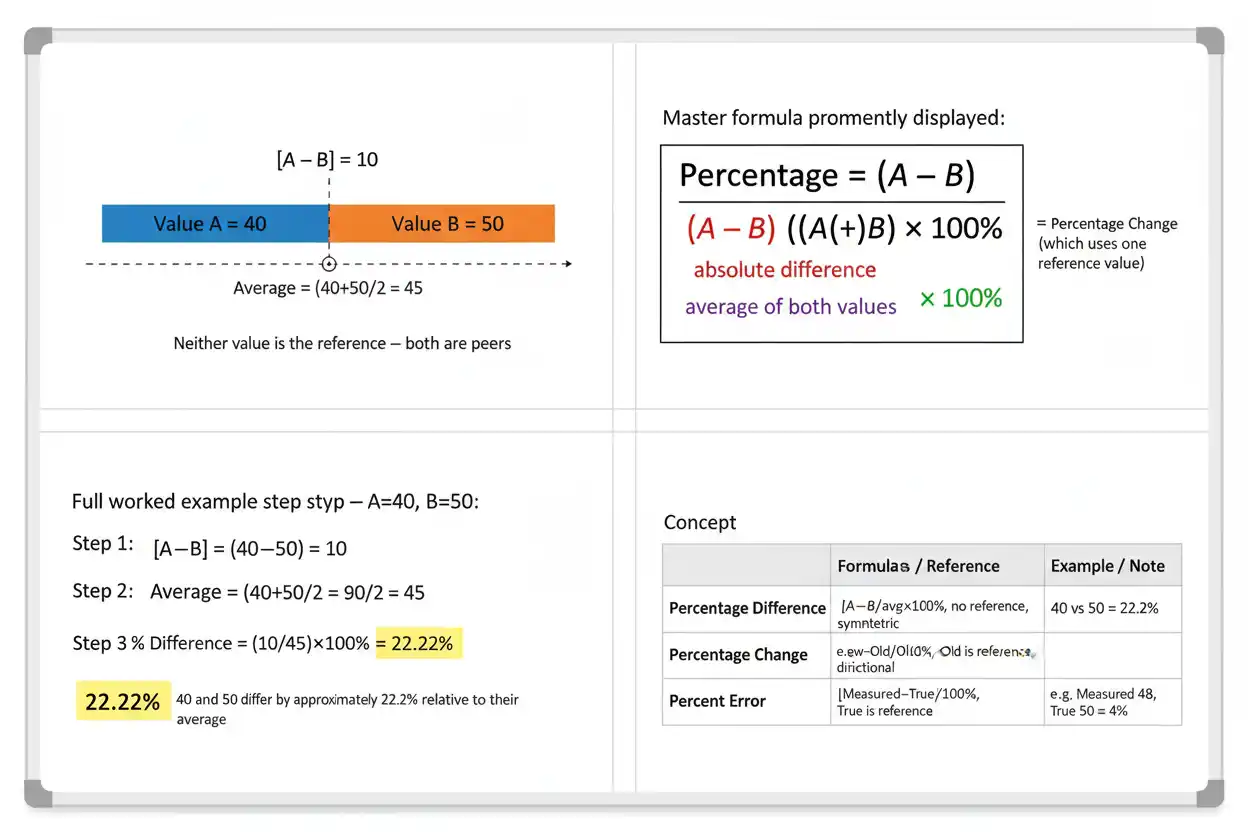

Percentage difference measures how far apart two comparable values are relative to their average. It is useful when neither value is naturally the original, baseline, accepted, or reference value.
For two positive values A and B, the standard formula is:
Percentage Difference = |A – B| / [(A + B)/2] × 100%
For example, compare:
A = 40
B = 50
Find the absolute difference:
|40 – 50| = 10
Find the average:
(40 + 50)/2 = 45
Divide:
10/45 ≈ 0.2222
Convert to a percentage:
0.2222 × 100% ≈ 22.22%
Therefore:
The percentage difference between 40 and 50 is approximately 22.22%.
Unlike percentage change, percentage difference does not treat either value as the starting point. Swapping the two values produces the same answer.
What Is Percentage Difference?
Percentage difference is a symmetric comparison between two values.
It answers:
How large is the gap between these two values relative to their typical size?
The absolute difference measures the gap:
|A – B|
The average of the two values provides the comparison scale:
(A + B)/2
For positive quantities:
Percentage Difference = Absolute Difference / Average × 100%
This differs from ordinary percentage calculations where a clearly defined part and whole are normally available.
Percentage Difference Formula
For positive values:
Percentage Difference = |A – B| / [(A + B)/2] × 100%
An equivalent form is:
Percentage Difference = 2|A – B| / (A + B) × 100%
Both formulas produce the same result.
For values that may be negative, some contexts use average magnitude:
Percentage Difference = |A – B| / [(|A| + |B|)/2] × 100%
The appropriate convention should be stated when negative values are possible because percentage comparisons across or near zero can become difficult to interpret.
Variables in the Formula
Let:
A = first value
B = second value
D = absolute difference
M = average or comparison midpoint
Then:
D = |A – B|
and, for positive values:
M = (A + B)/2
Therefore:
Percentage Difference = D/M × 100%
The calculation is built from three ordinary operations: subtraction, averaging, and percentage conversion.
Why Use the Absolute Difference?
Suppose:
A = 70
B = 80
Then:
A – B = -10
If the order is reversed:
B – A = 10
The magnitude of the separation is the same.
Using:
|A – B|
ensures:
|70 – 80| = |80 – 70| = 10
Therefore percentage difference does not depend on which value is written first.
Why Divide by the Average?
If neither value is the natural baseline, using either one alone as the denominator would make the result depend on order.
Compare:
40 and 50
Using 40 as denominator:
10/40 × 100% = 25%
Using 50:
10/50 × 100% = 20%
Neither denominator is inherently preferable when the two measurements have equal status.
Their average is:
45
so the symmetric comparison is:
10/45 × 100%
≈ 22.22%
This treats the two values equally.
Example: Percentage Difference Between 80 and 100
Find the absolute difference:
|100 – 80| = 20
Average:
(80 + 100)/2
= 180/2
= 90
Divide:
20/90 ≈ 0.222222
Convert:
0.222222 × 100% ≈ 22.22%
Therefore:
Percentage Difference ≈ 22.22%
Swapping 80 and 100 does not change the result.
Example: Percentage Difference Between 45 and 55
Difference:
|55 – 45| = 10
Average:
(45 + 55)/2
= 100/2
= 50
Then:
10/50 × 100%
= 20%
Therefore:
Percentage Difference = 20%
Example: Percentage Difference Between 95 and 100
Difference:
|100 – 95| = 5
Average:
(95 + 100)/2
= 195/2
= 97.5
Then:
5/97.5 × 100%
≈ 5.128%
Therefore:
Percentage Difference ≈ 5.13%
The small result reflects the fact that the two numbers are close relative to their average size.
Example With Decimal Values
Compare:
12.4
and:
12.8
Difference:
|12.8 – 12.4| = 0.4
Average:
(12.4 + 12.8)/2
= 25.2/2
= 12.6
Then:
0.4/12.6 × 100%
≈ 3.1746%
Therefore:
Percentage Difference ≈ 3.17%
Careful decimal arithmetic helps preserve accuracy before the final rounding step.
Example With Large Values
Compare:
9,800
and:
10,200
Difference:
|10,200 – 9,800| = 400
Average:
(9,800 + 10,200)/2
= 20,000/2
= 10,000
Then:
400/10,000 × 100%
= 4%
Therefore:
Percentage Difference = 4%
The absolute difference is 400, but relative to values near 10,000 the gap is only 4%.
Percentage Difference Is Symmetric
The defining property is:
PD(A,B) = PD(B,A)
For positive values:
|A-B| = |B-A|
and:
(A+B)/2 = (B+A)/2
Therefore swapping the order cannot change the answer.
This is the major conceptual distinction from percentage change.
Percentage Difference vs. Percentage Change
Suppose the values are:
80 and 100
Percentage difference:
|100-80| / 90 × 100%
≈ 22.22%
If the quantity actually changed from 80 to 100, percentage change uses 80 as the starting baseline:
(100-80)/80 × 100%
= 25%
If it changed from 100 to 80:
(80-100)/100 × 100%
= -20%
So:
Percentage difference = 22.22% regardless of order
while:
Percentage change depends on direction
Use the metric that matches the relationship between the values.
When to Use Percentage Difference
Percentage difference is appropriate when the values are peers.
For example, you might compare:
two experimental measurements,
two estimates,
two readings from equivalent instruments,
or:
two values where neither is designated as the correct or original value.
If one value is clearly the starting value, percentage change is normally more meaningful.
If one value is an accepted reference, percent error may be more appropriate.
Percentage Difference vs. Percent Error
Percent error compares a measured value with an accepted value:
Percent Error = |Measured – Accepted| / |Accepted| × 100%
The denominator is the accepted value.
Percentage difference instead uses an average-based denominator because neither value is privileged.
Consider:
Measurement = 48
Accepted = 50
Percent error:
2/50 × 100% = 4%
If 48 and 50 were instead two peer measurements:
Percentage Difference = 2/49 × 100%
≈ 4.08%
The formulas are close when the values are close, but they answer different questions.
Percentage Difference vs. Percentage Growth
Percentage growth requires a directional relationship from an earlier value to a later, larger value.
For:
40 → 50
percentage growth is:
(50-40)/40 × 100%
= 25%
But the percentage difference between the peer values 40 and 50 is:
10/45 × 100%
≈ 22.22%
Growth uses the starting value as the denominator; percentage difference uses the average.
Percentage Difference vs. Percent Off
Percent off also has a clearly defined reference: the original price.
Suppose:
Original Price = $100
Sale Price = $80
Percent off:
(100-80)/100 × 100%
= 20%
But if $100 and $80 were simply two peer prices with no original/sale relationship:
Percentage Difference = 20/90 × 100%
≈ 22.22%
The numerical values are identical, but the context determines the correct percentage metric.
Percentage Difference From Two Measurements
Suppose two instruments measure the same dimension:
Instrument A = 24.8 cm
Instrument B = 25.2 cm
Neither is designated as the accepted value.
Difference:
|25.2 – 24.8| = 0.4 cm
Average:
(24.8 + 25.2)/2
= 25 cm
Therefore:
Percentage Difference = 0.4/25 × 100%
= 1.6%
So:
The measurements differ by 1.6% relative to their average.
Percentage Difference Between Perfect Cubes
The formula works with any suitable pair of positive quantities, including perfect cubes.
Compare:
8 = 2³
and:
27 = 3³
Difference:
27 – 8 = 19
Average:
(8 + 27)/2
= 35/2
= 17.5
Then:
19/17.5 × 100%
≈ 108.57%
Therefore:
The percentage difference between 8 and 27 is approximately 108.57%.
A percentage difference can exceed 100% when the gap is large relative to the average.
Can Percentage Difference Exceed 100%?
Yes.
For positive values, suppose:
A = 10
B = 40
Difference:
30
Average:
25
Then:
30/25 × 100%
= 120%
Therefore:
Percentage Difference = 120%
Unlike probabilities or percentages of a fixed whole, percentage difference is not capped at 100%.
Maximum Percentage Difference for Nonnegative Values
For two nonnegative values where at least one is positive, the standard average-based percentage difference approaches or reaches:
200%
For example:
A = 0
B = 10
Difference:
10
Average:
5
Then:
10/5 × 100%
= 200%
So:
Percentage Difference = 200%
For ordinary nonnegative values under this formula, 200% is the upper limit.
What If the Values Are Equal?
If:
A = B
then:
|A-B| = 0
Therefore:
Percentage Difference = 0%
For example:
A = 75
B = 75
gives:
0/75 × 100% = 0%
The values have no difference.
What If Both Values Are Zero?
If:
A = 0
B = 0
the formula produces:
0/0
which is undefined.
Although the two values are numerically identical, the standard ratio formula has no nonzero scale against which to express a percentage.
Some applications may define this special case separately, but mathematically the direct formula is undefined.
What If One Value Is Zero?
Suppose:
A = 0
B = 20
Difference:
20
Average:
10
Then:
20/10 × 100%
= 200%
Therefore:
Percentage Difference = 200%
This differs from percentage change from zero, which is undefined because its denominator would be the zero starting value.
Negative Values Require Care
Suppose:
A = -40
B = -50
If average magnitudes are used:
Difference = |-40 – (-50)|
= 10
Average magnitude:
(40 + 50)/2 = 45
Then:
10/45 × 100%
≈ 22.22%
However, not every field defines percentage difference this way for signed values.
When quantities can be negative, the denominator convention should be made explicit.
Crossing Zero
Consider:
A = -10
B = 10
The values differ by:
20
Using average magnitudes:
(10 + 10)/2 = 10
gives:
200%
But a signed arithmetic average would be:
0
which cannot serve as a denominator.
This is why percentage comparisons involving values on opposite sides of zero need careful interpretation.
Sometimes the absolute difference and the original signed values are more informative than a percentage.
Percentage Difference as a Ratio
The underlying comparison is:
Difference / Average
For example:
Difference = 6
Average = 30
Then:
6/30 = 1/5
Using the ordinary fraction-to-percentage relationship:
1/5 = 20%
Therefore:
Percentage Difference = 20%
The formula is simply a specialized ratio expressed per hundred.
Rearranging the Formula
If the average M and percentage difference p are known:
p/100 = D/M
Therefore:
D = M × p/100
For example:
Average = 80
Percentage Difference = 15%
Then:
D = 80 × 0.15
= 12
Therefore the absolute difference between the two values is:
12
Finding Two Values From Their Average and Difference
If two values have:
Average = M
and:
Absolute Difference = D
then the values can be written:
A = M – D/2
B = M + D/2
assuming A ≤ B.
For:
M = 50
D = 20
we get:
A = 50 – 10 = 40
B = 50 + 10 = 60
Check:
Average = (40+60)/2 = 50
and:
Difference = 20
Example From a Known Percentage Difference
Suppose two positive peer values have average:
200
and percentage difference:
10%
Find their separation.
D = 200 × 0.10
= 20
Therefore:
A = 200 – 10 = 190
B = 200 + 10 = 210
Check:
|210-190|/200 × 100%
= 20/200 × 100%
= 10%
Rounding Percentage Difference
Suppose:
A = 67
B = 72
Difference:
5
Average:
69.5
Calculate:
5/69.5 × 100%
≈ 7.1942446%
Depending on the required precision, report:
7.19%
or perhaps:
7.2%
Avoid rounding the average or ratio too aggressively before the final step.
Order of Operations
The order of operations is important in the formula:
|A-B| / [(A+B)/2] × 100%
Calculate:
- the difference inside the absolute value;
- the sum and division by 2 in the denominator;
- the quotient;
- multiplication by 100%.
For:
A = 30
B = 42
Difference:
12
Average:
72/2 = 36
Then:
12/36 × 100%
= 33.33%
Correct grouping prevents the denominator from being misread.
Common Mistake: Using One Value as the Denominator
For two peer values:
60 and 75
using:
15/60
produces 25%.
Using:
15/75
produces 20%.
Neither is symmetric.
Correct percentage difference:
Average = 67.5
Then:
15/67.5 × 100%
≈ 22.22%
Common Mistake: Forgetting Absolute Value
If:
A = 80
B = 100
then:
A-B = -20
A percentage difference is normally nonnegative.
Use:
|-20| = 20
Therefore:
Percentage Difference ≈ 22.22%
not -22.22%.
Common Mistake: Dividing by the Sum Instead of the Average
For:
A = 40
B = 60
difference:
20
sum:
100
Using:
20/100 × 100% = 20%
is incorrect for the standard percentage-difference formula.
The denominator is the average:
100/2 = 50
So:
20/50 × 100%
= 40%
Therefore:
Percentage Difference = 40%
Common Mistake: Confusing Difference With Change
If a quantity moves from:
40 to 60
the percentage change is:
20/40 × 100%
= 50%
The percentage difference between the two peer values is:
20/50 × 100%
= 40%
Neither formula is universally “more correct.” The correct choice depends on whether 40 is a starting baseline or simply one of two comparable values.
Common Mistake: Assuming Percentage Difference Cannot Exceed 100%
Compare:
10 and 40
Percentage difference:
30/25 × 100%
= 120%
The result is valid because the absolute difference is larger than their average.
How to Check a Percentage Difference
Suppose the values are:
90 and 110
Average:
100
Difference:
20
The claimed percentage difference is:
20%
Check:
20% of 100 = 20
which matches the absolute difference.
Therefore:
20% is correct
Frequently Asked Questions
What is percentage difference?
Percentage difference measures the absolute difference between two peer values relative to their average.
What is the percentage difference formula?
For positive values:
Percentage Difference = |A-B| / [(A+B)/2] × 100%
Why is the average used?
Because neither value is treated as the original or accepted reference. The average provides a symmetric comparison scale.
Is percentage difference the same in both directions?
Yes.
PD(A,B) = PD(B,A)
What is the percentage difference between 40 and 50?
Difference = 10
Average = 45
10/45 × 100% ≈ 22.22%
What is the percentage difference between 80 and 100?
Approximately 22.22%
Can percentage difference exceed 100%?
Yes.
Can percentage difference equal 200%?
Yes. For example, between 0 and any positive value under the standard positive-value formula.
What is the percentage difference between equal values?
0%
provided the shared value is nonzero.
What if both values are zero?
The standard formula gives 0/0, so it is undefined without a special convention.
What is the difference between percentage difference and percentage change?
Percentage difference treats the values symmetrically and uses their average. Percentage change uses the original value as the denominator and preserves direction.
When should I use percent error instead?
Use percent error when one value is an accepted or reference value and the other is a measurement or estimate.
Final Example
Find the percentage difference between:
125
and:
155
First calculate the absolute difference:
|155 – 125| = 30
Now calculate their average:
(125 + 155)/2
= 280/2
= 140
Divide:
30/140
= 0.2142857…
Convert to percentage:
0.2142857 × 100%
≈ 21.43%
Therefore:
The percentage difference between 125 and 155 is approximately 21.43%.
Check by reversing their order:
|125 – 155| = 30
and the average remains:
140
so the result is unchanged.
The defining relationship is:
Percentage Difference = Absolute Difference / Average × 100%
Use it when two values have equal status and neither should be treated as the original or accepted baseline.