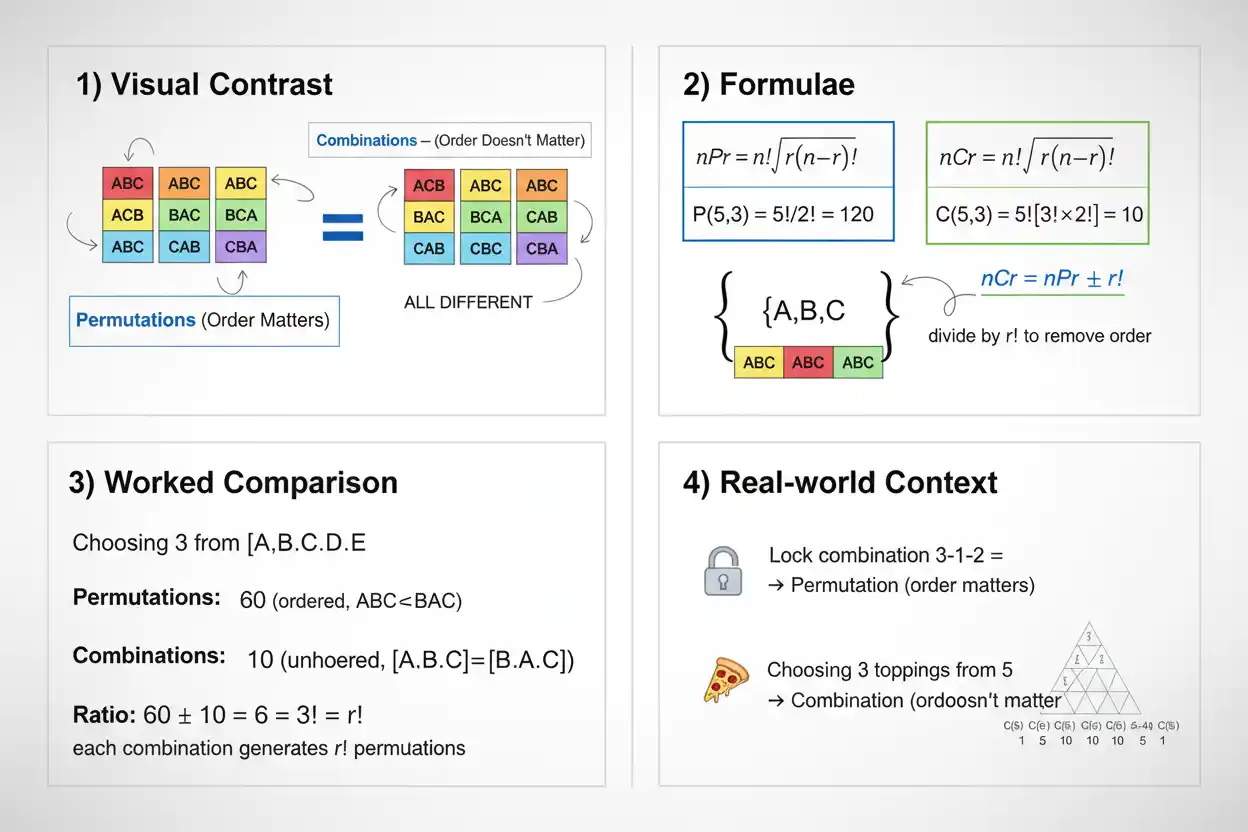
Permutations and combinations are counting methods used when selecting objects from a larger set. The key difference is whether order matters.
Use a permutation when changing the order creates a different outcome:
nPr = n! / (n-r)!
Use a combination when the selected group matters but its internal order does not:
nCr = n! / [r!(n-r)!]
For example, suppose 3 people are selected from 5.
If they receive first, second, and third place:
5P3 = 60
If they simply form a three-person committee:
5C3 = 10
The same five people and the same selection size produce different answers because ordering matters in the first problem but not the second.
Permutations vs. Combinations
The fundamental distinction is:
Permutation: order matters
Combination: order does not matter
Suppose the elements are:
A, B, C
The arrangements:
ABC
ACB
BAC
are different permutations.
But if the task is only to select the group:
{A,B,C}
all six possible orders describe the same combination.
This difference determines which formula to use.
Permutation Formula
For n distinct available objects and r positions:
nPr = n!/(n-r)!
For example:
7P3 = 7!/(7-3)!
= 7!/4!
Cancel:
= 7 × 6 × 5
= 210
Therefore:
7P3 = 210
The dedicated permutations page develops ordered-selection calculations in greater detail.
Combination Formula
For n distinct available objects and r objects selected without regard to order:
nCr = n!/[r!(n-r)!]
For example:
7C3 = 7!/[3!4!]
Cancel:
= (7 × 6 × 5)/(3 × 2 × 1)
= 210/6
= 35
Therefore:
7C3 = 35
The dedicated combinations page focuses specifically on nCr and unordered selections.
Variables in nPr and nCr
In both formulas:
n = total number of distinct available objects
r = number selected
For the standard no-replacement model:
0 ≤ r ≤ n
The letter P refers to permutations.
The letter C refers to combinations.
Why Permutation Counts Are Larger
Every combination of r distinct objects can be internally arranged in:
r!
different orders.
Therefore:
nPr = nCr × r!
and:
nCr = nPr/r!
For example:
5C3 = 10
Each three-person group has:
3! = 6
different orders.
Therefore:
10 × 6 = 60
which matches:
5P3 = 60
Example: Choosing 2 From 4
Suppose the objects are:
A, B, C, D
The combinations are:
AB
AC
AD
BC
BD
CD
There are:
6
Thus:
4C2 = 6
Now treat order as significant.
Each pair has two arrangements:
AB and BA
AC and CA
and so on.
Therefore:
4P2 = 12
Indeed:
4P2 = 4 × 3
= 12
How to Decide Which Formula to Use
Ask:
Would reversing or rearranging the selected objects create a different outcome?
If yes:
use a permutation.
If no:
use a combination.
For example, choosing three lottery numbers typically ignores their selection order:
combination
Assigning gold, silver, and bronze medals makes each position distinct:
permutation
Choosing a five-person committee:
combination
Assigning five different offices to those people:
permutation
Example: Race Positions
Ten runners compete for:
first,
second,
and:
third place.
The same three runners in different finishing orders produce different results.
Therefore use:
10P3
Calculate:
10 × 9 × 8
= 720
So:
720 ordered podium outcomes are possible
Example: Selecting a Committee
Ten people are available and three are selected for an ordinary committee.
There are no separate roles.
Therefore use:
10C3
Calculate:
10C3 = 10!/[3!7!]
= (10 × 9 × 8)/(3 × 2 × 1)
= 720/6
= 120
Therefore:
120 committees are possible
Same Numbers, Different Question
Compare:
10P3 = 720
with:
10C3 = 120
The relationship is:
720/120 = 6
and:
6 = 3!
Each three-person combination can be arranged in six different orders.
This illustrates exactly where the extra permutation outcomes come from.
Factorials in Both Formulas
Both formulas depend on factorials.
For a nonnegative integer n:
n! = n × (n-1) × … × 2 × 1
For example:
5! = 120
and:
0! = 1
Factorial cancellation makes many permutation and combination calculations much easier than evaluating complete factorial values first.
Simplifying nPr
Calculate:
12P4
Using:
12!/(12-4)!
we get:
12!/8!
Cancel:
12 × 11 × 10 × 9
Calculate:
12 × 11 = 132
10 × 9 = 90
Then:
132 × 90 = 11,880
Therefore:
12P4 = 11,880
Simplifying nCr
Calculate:
12C4
Use:
12!/[4!8!]
Cancel:
(12 × 11 × 10 × 9)/(4 × 3 × 2 × 1)
The numerator is:
11,880
The denominator is:
24
Therefore:
12C4 = 495
So:
12C4 = 495
Check with the relationship:
12P4 = 12C4 × 4!
495 × 24 = 11,880
Choosing All Objects
If:
r = n
then:
nPn = n!
because every object is being arranged.
For combinations:
nCn = 1
because there is only one group containing all n available objects.
For example:
5P5 = 120
but:
5C5 = 1
The difference comes entirely from whether order matters.
Choosing One Object
If:
r = 1
then:
nP1 = n
and:
nC1 = n
For example:
8P1 = 8
8C1 = 8
With only one selected object, there is no internal ordering distinction, so the counts coincide.
Choosing Zero Objects
Both formulas give:
nP0 = 1
and:
nC0 = 1
There is exactly one empty ordered selection and one empty subset.
The result also follows algebraically from:
0! = 1
Combination Symmetry
Combinations satisfy:
nCr = nC(n-r)
For example:
10C3 = 10C7
Both equal:
120
Choosing 3 people to include is equivalent to choosing the remaining 7 people to exclude.
Permutations do not have this same symmetry because arranging 3 positions is not equivalent to arranging 7 positions.
Example: Selecting Cards
Suppose 5 cards are selected from a 52-card deck and only the set of cards matters.
Use:
52C5
because rearranging the same five cards does not create a new hand.
If instead five distinct positions are being filled sequentially and order matters, the relevant count would be:
52P5
The underlying objects may be identical; the problem’s interpretation determines the method.
Example: Awarding Three Offices
Suppose 12 people are eligible for:
president,
vice president,
and:
secretary.
Since the offices differ:
12P3
Calculate:
12 × 11 × 10
= 1,320
Therefore:
1,320 office assignments are possible
Example: Selecting Three Representatives
If the same 12 people are simply used to select three equal-status representatives:
12C3
Calculate:
(12 × 11 × 10)/(3 × 2 × 1)
= 1,320/6
= 220
Therefore:
220 representative groups are possible
Permutations and Combinations Without Replacement
The standard nPr and nCr formulas assume that once an object is selected, it cannot be selected again.
For permutation:
first position → n choices
second → n-1
third → n-2
This decreasing choice count produces:
nPr
For combinations, those ordered arrangements are then grouped into sets of:
r!
equivalent orders.
What Changes When Repetition Is Allowed?
If there are n available choices for each of r ordered positions and repetition is allowed:
Number of ordered sequences = n^r
For example, if a four-character code uses 10 digits and digits may repeat:
10⁴ = 10,000
This is not:
10P4
because the same digit may be reused.
Repeated-selection combination problems require different formulas and should not be forced into the basic nCr model.
Distinct vs. Repeated Objects
Basic permutation and combination formulas generally assume the objects are distinct.
For example, arranging:
A, B, C
produces:
3! = 6
distinct orders.
But arranging:
A, A, B
does not produce six visibly different strings because the two A symbols are indistinguishable.
The distinct full arrangements are:
AAB
ABA
BAA
There are:
3!/2! = 3
Such repeated-object arrangements require adjusted combinatorial formulas.
Prime Factorization in Large Counts
Prime factorization can help simplify large factorial ratios without computing enormous factorials directly.
Suppose a combinatorial expression contains:
10!/(5!5!)
Prime-factor cancellation can reduce common factors before multiplication.
This is particularly useful for checking divisibility and controlling intermediate arithmetic in large counting problems.
Prime Numbers in Counting Problems
Prime numbers may appear as values of n, r, or as factors within factorial expressions, but primality does not determine whether a problem is a permutation or combination.
For example:
7P3
and:
7C3
both use the prime number 7.
The correct formula still depends entirely on whether order matters.
Permutation Rank Is Different From Counting Permutations
A permutation rank identifies where one particular full permutation appears in a specified ordering.
For four distinct objects:
4! = 24
tells us how many full permutations exist.
Ranking then assigns those arrangements indexes such as:
0 through 23
under a zero-based convention.
Thus:
permutation count → how many arrangements exist
while:
permutation rank → which position one arrangement occupies
Perfect Squares in Counting Results
A permutation or combination result can happen to be a perfect square.
For example:
9C1 = 9
and:
9 = 3²
The result being a square is a numerical property of the answer; it does not affect which counting formula is appropriate.
Combinatorics Framework
Combinatorics includes far more than just permutations and combinations.
It also studies:
counting principles,
recurrence relations,
inclusion-exclusion,
discrete structures,
and many related techniques.
Permutations and combinations are foundational because they distinguish two of the most common selection structures: ordered and unordered.
Word Clues Can Help, but Context Matters
Words such as:
arrange,
rank,
order,
position,
schedule
often suggest permutations.
Words such as:
choose,
select,
committee,
subset,
group
often suggest combinations.
But wording alone is not enough.
For example, “choose three officers” still requires a permutation if the three offices are different.
Always determine whether rearranging the selected objects changes the outcome.
Multi-Stage Counting
Some problems contain both combinations and permutations.
Suppose 5 people are chosen from 10, then one of those five becomes team leader.
First choose the five-person team:
10C5
Then choose one leader from those five:
5
Total:
10C5 × 5
Calculate:
252 × 5
= 1,260
Therefore:
1,260 outcomes are possible
A multi-stage problem does not have to use only one counting method.
Another Mixed Example
From 8 people, choose 3 for a committee and assign one of those three as chair.
Choose committee:
8C3 = 56
Choose chair:
3 choices
Total:
56 × 3
= 168
Therefore:
168 committee-chair outcomes are possible
Permutations and Combinations as Probabilities
Counting methods often provide the denominator or numerator in probability problems.
Suppose every three-person committee from 8 people is equally likely.
Total committees:
8C3 = 56
If a condition is satisfied by:
12
of those committees, probability is:
12/56
Simplify:
3/14
The combination count establishes the sample-space size.
Common Mistake: Assuming Every Selection Is a Combination
The word “select” does not guarantee that order is irrelevant.
If three people are selected for:
manager,
assistant,
treasurer
the assignments are different roles.
Therefore use:
permutation
not combination.
Common Mistake: Assuming Every Arrangement Uses All n Objects
A permutation may select only part of the set.
For example:
10P3
arranges 3 objects from 10.
Full arrangement:
10P10 = 10!
is only the special case:
r = n
Common Mistake: Forgetting r!
The formulas differ by:
r!
Since:
nPr = nCr × r!
forgetting this factor means counting all internal orders as if they were one—or counting one unordered group several times.
Common Mistake: Using nPr When Repetition Is Allowed
Suppose a three-character string has:
5
available symbols at each position, and symbols may repeat.
Correct count:
5³ = 125
Using:
5P3 = 60
would incorrectly remove a symbol after it appears once.
Common Mistake: Using Combinations for Ranked Positions
A podium has:
first,
second,
third.
The group:
A,B,C
can produce six distinct podium orders.
Therefore:
choosing the three finalists with
nC3
does not complete the counting problem if their final positions also matter.
How to Check a Permutation Calculation
Suppose:
6P2 = 30
Check:
6 × 5 = 30
or:
6!/4!
= 6 × 5
= 30
The two forms agree.
How to Check a Combination Calculation
Suppose:
6C2 = 15
Use:
6P2/2!
= 30/2
= 15
The relationship:
nPr = nCr × r!
provides an effective cross-check.
Quick Decision Examples
Select 4 books from 12 to take on a trip: order does not matter.
12C4
Choose 4 books from 12 and arrange them left to right: order matters.
12P4
Choose 3 winners from 20 with equal prizes: combination.
20C3
Choose first, second, and third from 20: permutation.
20P3
Choose 5 members for a committee: combination.
Assign president, secretary, and treasurer: permutation.
Frequently Asked Questions
What is the difference between permutations and combinations?
Permutations count selections where order matters. Combinations count selections where order does not matter.
What is the permutation formula?
nPr = n!/(n-r)!
What is the combination formula?
nCr = n!/[r!(n-r)!]
What does n represent?
The total number of distinct available objects.
What does r represent?
The number of objects selected.
When should I use nPr?
Use nPr when different orderings represent different outcomes.
When should I use nCr?
Use nCr when only the selected group matters.
What is 5P3?
60
What is 5C3?
10
Why is 5P3 larger than 5C3?
Each three-object combination can be arranged in:
3! = 6
ways.
Thus:
10 × 6 = 60
What is nPn?
n!
What is nCn?
1
What is nC0?
1
What is the relationship between permutations and combinations?
nPr = nCr × r!
Final Example
A club has:
9 members
and needs to fill:
president,
vice president,
and:
treasurer.
Because the three positions are different, order matters.
Use:
9P3
Calculate:
9 × 8 × 7
= 504
Therefore:
504 officer assignments are possible
Now suppose the club instead needs to choose an ordinary three-person committee.
Order no longer matters.
Use:
9C3
Calculate:
(9 × 8 × 7)/(3 × 2 × 1)
= 504/6
= 84
Therefore:
84 three-person committees are possible
The decision rule is:
Order matters → nPr
Order does not matter → nCr
and the formulas are linked by:
nPr = nCr × r!
Recognizing whether the selected objects occupy distinct positions is usually the most important step in solving a permutations-and-combinations problem.