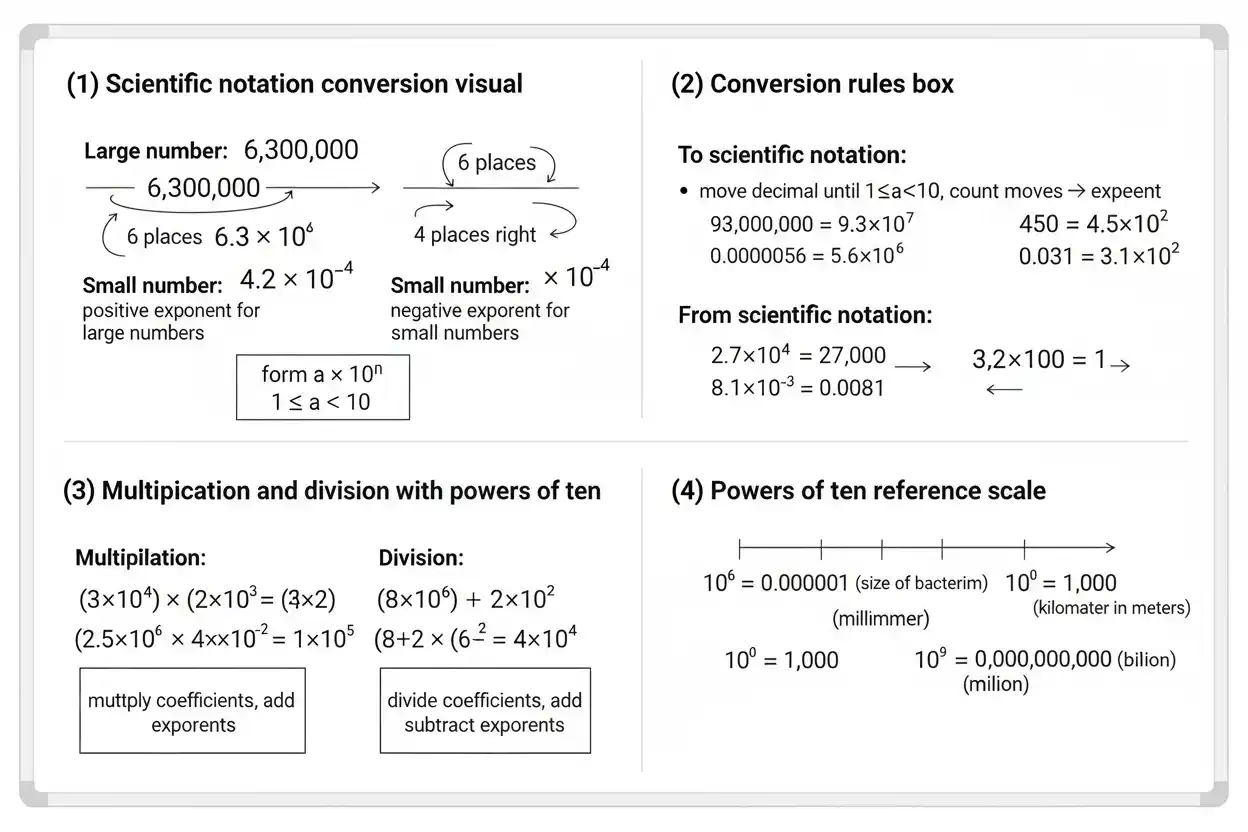
Scientific notation expresses very large or very small numbers as a coefficient multiplied by a power of 10.
The standard form is:
a × 10ⁿ
where:
1 ≤ |a| < 10
and:
n is an integer
For example:
6,300,000 = 6.3 × 10⁶
because moving the decimal point six places to the left produces:
6.3
Similarly:
0.00042 = 4.2 × 10^-4
because moving the decimal point four places to the right produces:
4.2
Scientific notation makes magnitude easier to see and simplifies calculations involving extreme values.
What Is Scientific Notation?
Scientific notation separates a number into:
a coefficient
and:
a power of 10.
The coefficient contains the significant digits.
The exponent records the decimal-place shift needed to recover the original number.
For example:
3.75 × 10⁸
has coefficient:
3.75
and exponent:
8
Expanding it gives:
375,000,000
Scientific Notation Formula
The standard form is:
N = a × 10ⁿ
where:
1 ≤ |a| < 10
and:
n ∈ Z
For positive numbers:
1 ≤ a < 10
For negative numbers:
-10 < a ≤ -1
Examples:
2.4 × 10⁵
-7.1 × 10^-3
are both normalized scientific notation.
Why the Coefficient Must Be Between 1 and 10
Consider:
42 × 10⁵
This represents a valid numerical expression but is not normalized scientific notation because:
42 ≥ 10
Move the coefficient decimal one place left:
42 = 4.2 × 10¹
Then:
42 × 10⁵
= 4.2 × 10¹ × 10⁵
= 4.2 × 10⁶
Therefore the normalized form is:
4.2 × 10⁶
Converting a Large Number to Scientific Notation
Convert:
8,450,000
Move the decimal point until only one nonzero digit remains to its left:
8.45
The decimal moved:
6 places left
Therefore the exponent is:
+6
So:
8,450,000 = 8.45 × 10⁶
Converting a Small Number to Scientific Notation
Convert:
0.0000072
Move the decimal point to obtain:
7.2
The decimal moved:
6 places right
Therefore the exponent is:
-6
So:
0.0000072 = 7.2 × 10^-6
Positive vs. Negative Exponents
A positive exponent typically represents a number with magnitude at least 10.
For example:
3.2 × 10⁴
= 32,000
A negative exponent represents division by a power of 10.
For example:
3.2 × 10^-4
= 3.2/10⁴
= 0.00032
The sign of the exponent controls the scale, not the sign of the number itself.
Negative Numbers in Scientific Notation
A negative value keeps its negative coefficient.
For example:
-52,000
becomes:
-5.2 × 10⁴
The exponent is positive because the magnitude is large.
Likewise:
-0.00031
becomes:
-3.1 × 10^-4
The negative sign belongs to the coefficient.
Scientific Notation and Powers of Ten
The scientific functions used on calculators include powers such as:
10ˣ
These directly support scientific notation.
Examples:
10³ = 1,000
10⁰ = 1
10^-1 = 0.1
10^-4 = 0.0001
Multiplying by these powers shifts the decimal point systematically.
Powers of Ten Table
| Power | Value |
|---|---|
| 10⁶ | 1,000,000 |
| 10⁵ | 100,000 |
| 10⁴ | 10,000 |
| 10³ | 1,000 |
| 10² | 100 |
| 10¹ | 10 |
| 10⁰ | 1 |
| 10^-1 | 0.1 |
| 10^-2 | 0.01 |
| 10^-3 | 0.001 |
| 10^-4 | 0.0001 |
| 10^-5 | 0.00001 |
| 10^-6 | 0.000001 |
Every decrease of 1 in the exponent divides the value by 10.
Why 10⁰ = 1
Using exponent rules:
10¹/10¹ = 10^(1-1)
Left side:
10/10 = 1
Right side:
10⁰
Therefore:
10⁰ = 1
This allows ordinary values from 1 through just under 10 to be written with exponent zero.
For example:
6.2 = 6.2 × 10⁰
Why Negative Exponents Produce Decimals
Use:
10^-n = 1/10ⁿ
For example:
10^-3 = 1/1000
= 0.001
Therefore:
4.6 × 10^-3
means:
4.6 × 0.001
= 0.0046
Decimal-Point Rule
To convert ordinary decimal notation into scientific notation:
For a number with magnitude:
≥ 10
move the decimal left and use a positive exponent.
For a nonzero number with magnitude:
< 1
move the decimal right and use a negative exponent.
The exponent’s magnitude equals the number of places moved.
Example: 73,900,000
Move the decimal:
73,900,000 → 7.39
Movement:
7 places left
Therefore:
73,900,000 = 7.39 × 10⁷
Example: 0.000000891
Move:
0.000000891 → 8.91
The decimal moves:
7 places right
Therefore:
0.000000891 = 8.91 × 10^-7
Convert Scientific Notation to Standard Form
To expand:
4.75 × 10⁵
move the decimal:
5 places right
giving:
475,000
For:
4.75 × 10^-5
move the decimal:
5 places left
giving:
0.0000475
Example: Expand 6.02 × 10²³
The exponent:
23
means move the decimal 23 places to the right.
This creates an extremely large integer.
In most calculations, retaining:
6.02 × 10²³
is much easier to read and manipulate than writing every zero.
That compactness is one of the principal advantages of scientific notation.
Multiplying Scientific Notation
To multiply:
(a × 10ᵐ)(b × 10ⁿ)
multiply coefficients and add exponents:
ab × 10^(m+n)
Then normalize the coefficient if necessary.
Example: Multiply 3 × 10⁴ by 2 × 10⁵
Calculate coefficients:
3 × 2 = 6
Add exponents:
4 + 5 = 9
Therefore:
(3 × 10⁴)(2 × 10⁵) = 6 × 10⁹
The coefficient is already normalized.
Example Requiring Normalization
Calculate:
(6 × 10³)(4 × 10⁵)
Multiply coefficients:
6 × 4 = 24
Add exponents:
3 + 5 = 8
Initial result:
24 × 10⁸
Normalize:
24 = 2.4 × 10¹
Therefore:
24 × 10⁸
= 2.4 × 10⁹
So:
Result = 2.4 × 10⁹
Dividing Scientific Notation
To divide:
(a × 10ᵐ)/(b × 10ⁿ)
divide coefficients and subtract exponents:
(a/b) × 10^(m-n)
with:
b ≠ 0
Then normalize if needed.
Example: Divide 8 × 10⁷ by 2 × 10³
Divide coefficients:
8/2 = 4
Subtract exponents:
7 – 3 = 4
Therefore:
(8 × 10⁷)/(2 × 10³) = 4 × 10⁴
Division Requiring Normalization
Calculate:
(2 × 10⁵)/(8 × 10²)
Coefficients:
2/8 = 0.25
Exponents:
5 – 2 = 3
Initial result:
0.25 × 10³
The coefficient is below 1.
Normalize:
0.25 × 10³
= 2.5 × 10²
Therefore:
Result = 2.5 × 10²
Raising Scientific Notation to a Power
For:
(a × 10ⁿ)ᵏ
apply the exponent to both factors:
aᵏ × 10^(nk)
Then normalize if necessary.
For example:
(2 × 10³)²
= 2² × 10⁶
= 4 × 10⁶
Therefore:
(2 × 10³)² = 4 × 10⁶
Example: Cube of 3 × 10²
Calculate:
(3 × 10²)³
Coefficient:
3³ = 27
Power of 10:
10^(2×3) = 10⁶
Initial result:
27 × 10⁶
Normalize:
2.7 × 10⁷
Therefore:
(3 × 10²)³ = 2.7 × 10⁷
Roots of Scientific Notation
Roots can be especially simple when the exponent is divisible by the root index.
For example:
√(9 × 10⁸)
Take each square root:
√9 = 3
√(10⁸) = 10⁴
Therefore:
√(9 × 10⁸) = 3 × 10⁴
Cube Root Example
Evaluate:
∛(8 × 10¹²)
Since:
∛8 = 2
and:
12/3 = 4
we get:
∛(8 × 10¹²) = 2 × 10⁴
The exponent division works cleanly because 12 is divisible by 3.
Roots With Nondivisible Exponents
Consider:
√(4 × 10⁷)
Rewrite:
4 × 10⁷ = 40 × 10⁶
Then:
√(40 × 10⁶)
= √40 × 10³
Alternatively:
√4 × 10^(7/2)
= 2 × 10^3.5
Both are mathematically valid, but the result may need further transformation depending on the desired form.
Adding Scientific-Notation Numbers
Addition is easiest when the powers of 10 match.
For example:
3.2 × 10⁵ + 4.7 × 10⁵
Factor:
10⁵
Then:
(3.2 + 4.7) × 10⁵
= 7.9 × 10⁵
Therefore:
Result = 7.9 × 10⁵
Subtracting Scientific-Notation Numbers
If exponents match:
8.5 × 10⁶ – 3.1 × 10⁶
subtract coefficients:
(8.5 – 3.1) × 10⁶
= 5.4 × 10⁶
Therefore:
Result = 5.4 × 10⁶
Addition With Different Exponents
Consider:
3.2 × 10⁵ + 4.7 × 10⁴
First express both using:
10⁵
Since:
4.7 × 10⁴ = 0.47 × 10⁵
Then:
3.2 × 10⁵ + 0.47 × 10⁵
= 3.67 × 10⁵
Therefore:
Result = 3.67 × 10⁵
Do not simply add coefficients while ignoring unequal exponents.
Example With a Very Small Addend
Calculate:
6.00 × 10⁸ + 2.00 × 10³
Convert:
2.00 × 10³ = 0.00002 × 10⁸
Then:
(6.00 + 0.00002) × 10⁸
= 6.00002 × 10⁸
The second term is tiny relative to the first.
Depending on measurement precision, subsequent rounding may make its contribution disappear from the reported result.
Scientific Notation and Rounding
rounding rules often work naturally with the coefficient.
Suppose:
6.78341 × 10⁸
must be reported to four significant figures.
Round:
6.78341 → 6.783
because the next digit is 4.
Therefore:
6.783 × 10⁸
The exponent remains unchanged.
Rounding That Changes the Exponent
Round:
9.9987 × 10⁵
to three significant figures.
Coefficient:
9.9987 → 10.0
So:
10.0 × 10⁵
Normalize:
1.00 × 10⁶
The rounding carry changes the power of 10.
Significant Figures in Scientific Notation
Scientific notation makes significant figures easy to identify.
For:
4.20 × 10⁷
the coefficient:
4.20
has:
3 significant figures
The exponent does not affect the count.
Likewise:
8.000 × 10^-4
contains:
4 significant figures
Scientific Notation Removes Zero Ambiguity
Consider:
120,000
Without additional context, the number of significant trailing zeros may be unclear.
Scientific notation makes precision explicit:
1.2 × 10⁵ → 2 significant figures
1.20 × 10⁵ → 3 significant figures
1.2000 × 10⁵ → 5 significant figures
The numerical magnitude is the same, but the expressed precision differs.
Comparing Scientific-Notation Numbers
For positive numbers, compare exponents first.
Suppose:
A = 7.9 × 10⁸
B = 4.5 × 10⁹
Since:
10⁹ > 10⁸
we know immediately:
B > A
No coefficient comparison is needed.
Same-Exponent Comparison
Compare:
6.2 × 10⁵
and:
7.1 × 10⁵
The exponents are equal.
Compare coefficients:
6.2 < 7.1
Therefore:
6.2 × 10⁵ < 7.1 × 10⁵
Comparing Negative Scientific-Notation Values
For negative numbers, remember ordinary signed ordering.
For example:
-8 × 10⁶
is less than:
-2 × 10⁶
because it lies farther to the left on the real number line.
Scientific notation does not change the usual rules for negative values.
Order of Magnitude
The power of 10 gives a quick sense of a number’s scale.
For example:
3.4 × 10⁷
has magnitude in the tens of millions.
2.1 × 10^-6
has magnitude around millionths.
This allows values differing by many powers of ten to be compared quickly.
Ratio of Magnitudes
Consider:
5 × 10⁹
and:
5 × 10⁶
Their ratio is:
(5 × 10⁹)/(5 × 10⁶)
= 10³
= 1000
Therefore the first number is:
1000 times larger
than the second.
A difference of 3 in the base-10 exponent corresponds to a factor of:
10³
Scientific Notation in Sequence Sums
When terms in sequence sums have very different magnitudes, scientific notation makes scale differences clearer.
For example:
2 × 10⁶ + 3 × 10⁵ + 4 × 10⁴
rewrite using:
10⁶
Then:
2 × 10⁶ + 0.3 × 10⁶ + 0.04 × 10⁶
= 2.34 × 10⁶
Matching exponents makes the addition transparent.
Scientific Notation and Series Convergence
In numerical work with series convergence, later terms may become extremely small.
Suppose successive terms have magnitudes:
1 × 10^-4
1 × 10^-6
1 × 10^-8
1 × 10^-10
Scientific notation makes the decreasing scale immediately visible.
It can also help judge whether newly added terms materially affect a rounded partial sum.
Small Terms and Numerical Precision
Suppose a calculation adds:
1.000000 × 10⁸
and:
1 × 10^-2
Mathematically, the second term is not zero.
But in limited-precision numerical systems, adding quantities separated by many orders of magnitude may lose some low-order information.
Scientific notation reveals that scale difference before computation.
Engineering-Style Exponents
Some technical contexts prefer exponents that are multiples of:
3
For example, ordinary normalized scientific notation:
4.7 × 10⁵
might be expressed as:
470 × 10³
in an engineering-style representation.
That form is useful with prefixes such as kilo, mega, milli, and micro, but its coefficient no longer satisfies the strict scientific-notation condition:
1 ≤ |a| < 10
Therefore the two conventions should be distinguished.
Calculator E Notation
Calculators and software often display scientific notation using:
E
For example:
6.5E7
means:
6.5 × 10⁷
Likewise:
4.2E-6
means:
4.2 × 10^-6
This is a compact machine-friendly representation.
E Notation Is Not Euler’s Number
The display:
3E5
means:
3 × 10⁵
It does not mean:
3 × e⁵
where:
e ≈ 2.71828
These expressions have entirely different values.
Entering Scientific Notation
A scientific calculator may provide:
EXP
EE
or an exponent-entry control.
To enter:
4.5 × 10^-8
a calculator might accept:
4.5 EXP -8
and display:
4.5E-8
The exact key sequence varies by device, but the mathematical value remains:
4.5 × 10^-8
Standard Form vs. Scientific Notation
“Standard form” can mean different things in different educational systems.
In this article:
ordinary decimal notation
means forms such as:
450,000
or:
0.00045
Scientific notation means:
4.5 × 10⁵
or:
4.5 × 10^-4
When a problem uses the phrase “standard form,” its local convention should be checked.
Zero in Scientific Notation
The ordinary normalized form:
a × 10ⁿ
requires:
1 ≤ |a| < 10
Therefore zero cannot satisfy that coefficient condition.
Zero is simply written:
0
rather than having a unique normalized scientific-notation exponent.
Expressions such as:
0 × 10⁵
all equal zero but are not normalized scientific notation.
Numbers Between 1 and 10
A number such as:
7.2
can be written:
7.2 × 10⁰
because:
10⁰ = 1
This is valid normalized scientific notation, although ordinary notation is usually simpler for such values.
Numbers Between -10 and -1
Similarly:
-4.8
can be written:
-4.8 × 10⁰
The coefficient satisfies:
1 ≤ |-4.8| < 10
so the representation is normalized.
Scientific Notation and Percentages
Suppose:
0.000025
is converted to a percentage.
First scientific notation:
2.5 × 10^-5
Multiply by:
100 = 10²
Then:
2.5 × 10^-5 × 10²
= 2.5 × 10^-3 %
So:
0.000025 = 0.0025%
Powers of ten can make decimal-to-percentage shifts easier to track.
Scientific Notation and Ratios
Consider:
(6 × 10⁸)/(3 × 10⁵)
Divide coefficients:
6/3 = 2
Subtract exponents:
8 – 5 = 3
Therefore the ratio is:
2 × 10³
or:
2000
The first quantity is 2000 times the second.
Scientific Notation and Roots
A useful strategy when taking roots is to rewrite the exponent as a multiple of the root index.
For example:
√(2.5 × 10¹⁰)
can be separated as:
√2.5 × 10⁵
because:
√(10¹⁰) = 10⁵
Thus:
√(2.5 × 10¹⁰) = √2.5 × 10⁵
Approximately:
√2.5 ≈ 1.5811
so:
≈ 1.5811 × 10⁵
Common Mistake: Wrong Exponent Sign
Convert:
0.00063
to scientific notation.
The decimal must move:
4 places right
So the exponent is:
-4
Correct:
6.3 × 10^-4
Using +4 would represent:
63,000
rather than 0.00063.
Common Mistake: Counting Decimal Moves Incorrectly
Convert:
52,800
The decimal location can be viewed as:
52,800.
Move to:
5.28
Count:
4 positions
Therefore:
52,800 = 5.28 × 10⁴
not:
5.28 × 10⁵
Common Mistake: Leaving an Unnormalized Coefficient
The expression:
15.2 × 10⁶
is numerically meaningful but not normalized scientific notation.
Move decimal one place left:
1.52
Increase exponent by 1:
1.52 × 10⁷
Common Mistake: Adding Exponents During Addition
Consider:
2 × 10⁴ + 3 × 10⁴
Do not calculate:
5 × 10⁸
Adding exponents is a multiplication rule.
For addition with matching exponents:
(2+3) × 10⁴
= 5 × 10⁴
Common Mistake: Multiplying Without Normalizing
Suppose:
(8 × 10³)(5 × 10⁴)
Initial product:
40 × 10⁷
Normalize:
4 × 10⁸
Therefore:
Result = 4 × 10⁸
Stopping at 40 × 10⁷ leaves the coefficient outside the normalized range.
Common Mistake: Treating E as Multiplication by e
The calculator value:
2.1E6
means:
2.1 × 10⁶
not:
2.1 × e⁶
Always distinguish exponent-entry notation from Euler’s constant.
Common Mistake: Dropping Significant Zeros
The forms:
4.5 × 10⁶
and:
4.500 × 10⁶
have the same numerical value but communicate different precision.
If trailing zeros are significant to the measurement, removing them loses information.
How to Check a Scientific-Notation Conversion
Suppose:
0.000072 = 7.2 × 10^-5
Check:
10^-5 = 0.00001
Then:
7.2 × 0.00001
= 0.000072
The original value is recovered.
Therefore the conversion is correct.
Frequently Asked Questions
What is scientific notation?
Scientific notation represents a number as:
a × 10ⁿ
where:
1 ≤ |a| < 10
and n is an integer.
How do you write a large number in scientific notation?
Move the decimal left until one nonzero digit remains before it. The number of places moved becomes a positive exponent.
How do you write a small decimal in scientific notation?
Move the decimal right until one nonzero digit remains before it. The number of places moved becomes a negative exponent.
Write 45,000 in scientific notation.
4.5 × 10⁴
Write 0.00045 in scientific notation.
4.5 × 10^-4
What does 10⁰ equal?
1
What does 10^-3 equal?
0.001
How do you multiply scientific notation?
Multiply coefficients and add powers of ten:
(a × 10ᵐ)(b × 10ⁿ) = ab × 10^(m+n)
then normalize.
How do you divide scientific notation?
Divide coefficients and subtract exponents:
(a × 10ᵐ)/(b × 10ⁿ) = (a/b) × 10^(m-n)
then normalize.
How do you add scientific-notation values?
First rewrite them with the same power of 10, then add the coefficients.
What does 6.02E23 mean?
6.02 × 10²³
Does E mean Euler’s number?
Not in calculator exponent notation.
Can zero be written in normalized scientific notation?
Zero does not have a unique normalized a × 10ⁿ representation satisfying 1 ≤ |a| < 10.
Final Example
Calculate:
(4.8 × 10⁷)(2.5 × 10^-3)
First multiply the coefficients:
4.8 × 2.5
= 12
Now add the exponents:
7 + (-3)
= 4
Initial result:
12 × 10⁴
Normalize the coefficient:
12 = 1.2 × 10¹
Therefore:
12 × 10⁴
= 1.2 × 10⁵
So:
(4.8 × 10⁷)(2.5 × 10^-3) = 1.2 × 10⁵
Check in ordinary notation:
4.8 × 10⁷ = 48,000,000
2.5 × 10^-3 = 0.0025
Multiply:
48,000,000 × 0.0025
= 120,000
and:
120,000 = 1.2 × 10⁵
The result agrees.
The central scientific-notation form is:
N = a × 10ⁿ, where 1 ≤ |a| < 10
Positive exponents represent movement toward larger powers of ten, negative exponents represent smaller decimal scales, and arithmetic follows the ordinary exponent rules once coefficients and powers of ten are handled separately.