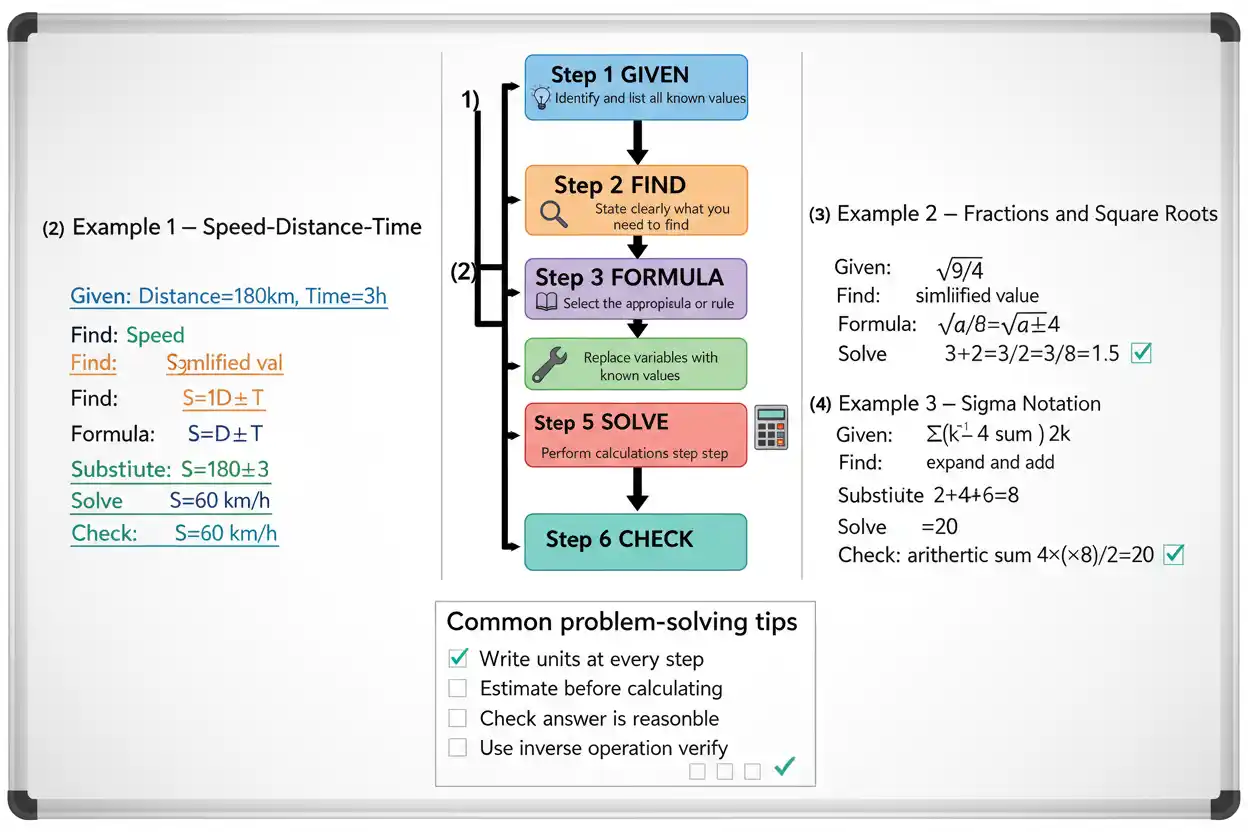

Step-by-step math solving is a structured method for turning a mathematical problem into a sequence of smaller, verifiable operations.
There is no single formula that solves every type of mathematics. Instead, a reliable general process is:
Understand → Identify → Choose → Substitute → Solve → Check → Report
For example, suppose a vehicle travels:
240 km
at:
80 km/h
and you need to find the travel time.
Identify the relevant relationship:
Time = Distance / Speed
Substitute:
Time = 240/80
Solve:
Time = 3
Check the units:
km ÷ (km/h) = h
Therefore:
Travel time = 3 hours
The arithmetic is simple, but the structure illustrates the central idea: identify what the problem is asking before calculating.
What Is Step-by-Step Math Solving?
Step-by-step math solving separates a problem into logical stages so that each decision and calculation can be checked.
A practical framework is:
1. Identify the question.
2. List the known information.
3. Identify unknown quantities.
4. Select the relevant formula or mathematical rule.
5. Make units or forms consistent.
6. Substitute values.
7. Simplify in the correct order.
8. Solve for the unknown.
9. Check the result.
10. State the answer with appropriate units or precision.
The process applies across arithmetic, algebra, geometry, ratios, roots, sequences, and many applied problems.
Step 1: Identify What the Problem Asks
Before calculating anything, identify the required output.
A problem may ask for:
a number,
an unknown variable,
a percentage,
a ratio,
a distance,
an exact radical,
a decimal approximation,
or another mathematical object.
For example:
“Find the square root of 72 in exact simplified form.”
The required answer is not merely a calculator decimal.
It asks specifically for:
an exact simplified radical.
That requirement changes the method.
Step 2: Extract the Given Information
Separate the known values from the narrative.
Suppose:
“A cyclist travels 54 km in 3 hours. Find the average speed.”
Given:
Distance = 54 km
Time = 3 h
Find:
Speed
This translation from words to mathematical quantities prevents irrelevant information from distracting the calculation.
Step 3: Define the Unknown
Represent the unknown clearly.
For an algebra problem:
x = unknown number
For a distance problem:
d = distance
For a percentage problem:
p = percentage
For a sequence problem:
Sₙ = sum of first n terms
Defining the target helps determine which relationship should be rearranged.
Step 4: Choose the Correct Formula or Rule
A formula is useful only when it matches the problem.
For motion:
Speed = Distance / Time
For percentage:
Percentage = Part/Whole × 100%
For a proportion:
a/b = c/d
For a square root:
√a = b ⇔ b² = a
For arithmetic sequences:
aₙ = a₁ + (n-1)d
Choosing the wrong formula accurately still produces the wrong answer.
Step 5: Make Units and Forms Consistent
Before substitution, check that the quantities are compatible.
If speed is:
km/h
and time is:
30 minutes
convert:
30 min = 0.5 h
before multiplying.
Likewise, when adding fractions:
1/3 + 1/4
the denominators must be made compatible.
Consistency is often the hidden step behind correct mathematics.
Step 6: Substitute Carefully
After selecting the formula, replace variables with the known values.
Suppose:
d = st
with:
s = 72 km/h
t = 2.5 h
Then write:
d = 72 × 2.5
Keeping the formula visible before substitution makes it easier to catch a misplaced value.
Step 7: Follow the Correct Order of Operations
Use standard order of operations when simplifying expressions.
A useful sequence is:
grouping symbols,
exponents and roots,
multiplication and division,
addition and subtraction.
For example:
3 + 4 × 2²
First:
2² = 4
Then:
4 × 4 = 16
Finally:
3 + 16 = 19
Therefore:
3 + 4 × 2² = 19
not 28.
Step 8: Solve the Equation
Once an equation has been set up, use inverse operations while preserving equality.
Suppose:
5x + 7 = 32
Subtract 7 from both sides:
5x = 25
Divide both sides by 5:
x = 5
Therefore:
x = 5
Each operation applied to one side must be applied consistently to the other.
Step 9: Check the Answer
Substitute the result into the original relationship whenever practical.
For:
5x + 7 = 32
with:
x = 5
check:
5(5) + 7
= 25 + 7
= 32
The original equation is satisfied.
Therefore the solution is verified.
Step 10: Report the Result Correctly
A complete answer may require:
units,
exact form,
decimal precision,
significant figures,
interval notation,
or another specified format.
For example:
√50 = 5√2
is an exact result.
If three decimal places are requested:
√50 ≈ 7.071
The reporting requirement should not be treated as an afterthought.
Worked Example: Basic Arithmetic Expression
Evaluate:
18 – 3(2+4) + 5
First evaluate parentheses:
2 + 4 = 6
Expression becomes:
18 – 3(6) + 5
Multiply:
3 × 6 = 18
Then:
18 – 18 + 5
= 5
Therefore:
Answer = 5
A step-by-step layout makes the calculation easy to audit.
Worked Example: Fraction Addition
Calculate:
3/4 + 5/6
The denominators are:
4 and 6
Their least common multiple is:
12
Convert:
3/4 = 9/12
5/6 = 10/12
Add:
9/12 + 10/12
= 19/12
As a mixed number:
19/12 = 1 7/12
The rules for fraction operations determine the computational method; the step-by-step framework organizes it.
Worked Example: Fraction Division
Calculate:
5/8 ÷ 3/4
Keep the first fraction and multiply by the reciprocal of the second:
5/8 × 4/3
Simplify:
4/8 = 1/2
Therefore:
5/2 × 1/3
= 5/6
So:
5/8 ÷ 3/4 = 5/6
Check approximately:
0.625 ÷ 0.75 ≈ 0.8333
and:
5/6 ≈ 0.8333
The result is consistent.
Worked Example: Percentage
Find:
18% of 250
Convert percentage:
18% = 18/100
Then:
18/100 × 250
Simplify:
0.18 × 250
= 45
Therefore:
18% of 250 = 45
Check:
45/250 × 100%
= 18%
Worked Example: Percentage Change
A value rises from:
80
to:
100
Change:
100 – 80 = 20
Divide by the original:
20/80 = 0.25
Convert to percentage:
0.25 × 100%
= 25%
Therefore:
Percentage increase = 25%
The phrase “original value” is important because percentage change uses the starting value as its reference.
Worked Example: Ratio Simplification
Simplify:
42:63
Find:
GCF(42,63) = 21
Divide both terms:
42/21 = 2
63/21 = 3
Therefore:
42:63 = 2:3
Check:
42/63 = 2/3
The numerical comparison is unchanged.
Worked Example: Proportion
Solve:
4/7 = x/21
Cross multiply:
4 × 21 = 7x
84 = 7x
Divide:
x = 12
Check:
12/21 = 4/7
Therefore:
x = 12
Worked Example: Linear Equation
Solve:
3x – 8 = 19
Add 8:
3x = 27
Divide by 3:
x = 9
Check:
3(9) – 8
= 27 – 8
= 19
Therefore:
x = 9
Worked Example: Equation With Parentheses
Solve:
4(x-3) = 28
Divide by 4:
x – 3 = 7
Add 3:
x = 10
Check:
4(10-3)
= 4 × 7
= 28
Therefore:
x = 10
Worked Example: Square Root
Simplify:
√108
Look for a perfect-square factor:
108 = 36 × 3
Then:
√108 = √36 × √3
= 6√3
Therefore:
Exact answer = 6√3
For a decimal:
√108 ≈ 10.392
The square roots page owns the detailed exact-versus-decimal methods; here the important problem-solving step is recognizing that simplification should come before approximation.
Worked Example: Surd Simplification
Consider:
√75 + √12
Simplify each radical:
√75 = √(25×3)
= 5√3
and:
√12 = √(4×3)
= 2√3
Now combine like radicals:
5√3 + 2√3
= 7√3
Therefore:
√75 + √12 = 7√3
The mapped surds topic handles radical expressions as its specialist intent.
Worked Example: Speed Distance Time
A car travels:
315 km
at:
70 km/h.
Find time.
Use the speed distance time relationship:
Time = Distance / Speed
Substitute:
t = 315/70
= 4.5 h
Therefore:
Time = 4.5 hours
Convert:
0.5 h × 60 = 30 min
So:
4.5 h = 4 h 30 min
Worked Example: Unit Conversion Before Solving
A cyclist travels at:
24 km/h
for:
45 minutes.
Find distance.
The speed uses hours, so convert time:
45/60 h
= 0.75 h
Then:
Distance = Speed × Time
= 24 × 0.75
= 18 km
Therefore:
Distance = 18 km
Without the unit conversion, multiplying 24 by 45 would be meaningless in the required units.
Worked Example: Arithmetic Sequence
Find the 15th term of:
4, 9, 14, 19, …
First term:
a₁ = 4
Difference:
d = 5
Use:
aₙ = a₁ + (n-1)d
Then:
a₁₅ = 4 + 14(5)
= 4 + 70
= 74
Therefore:
a₁₅ = 74
Check the pattern: every step adds 5.
Worked Example: Geometric Sequence
Find the sixth term of:
3, 6, 12, 24, …
First term:
a₁ = 3
Common ratio:
r = 2
Formula:
aₙ = a₁r^(n-1)
Then:
a₆ = 3 × 2⁵
= 3 × 32
= 96
Therefore:
a₆ = 96
Worked Example: Summation Notation
Evaluate:
Σ(2k+1), from k=1 to 4
The mapped summation notation expression means substitute each integer value of k:
For:
k = 1 → 3
k = 2 → 5
k = 3 → 7
k = 4 → 9
Add:
3 + 5 + 7 + 9
= 24
Therefore:
Σ(2k+1), k=1 to 4 = 24
Worked Example: Sequence Sum
Find:
5 + 8 + 11 + … + 32
This is arithmetic.
First determine n:
32 = 5 + (n-1)3
27 = 3(n-1)
n = 10
Now use:
Sₙ = n(a₁+aₙ)/2
Then:
S₁₀ = 10(5+32)/2
= 185
Therefore:
Sum = 185
The key step was finding the correct number of terms before applying the sum formula.
Translate Words Into Equations
Many word problems become easier once their sentences are translated into mathematical relationships.
Examples:
“twice a number”:
2x
“five more than a number”:
x + 5
“seven less than three times a number”:
3x – 7
“half of a quantity”:
x/2
“20% of a number”:
0.20x
Accurate translation often matters more than difficult arithmetic.
Example: Translate and Solve
“Seven more than twice a number is 31.”
Let:
x = the number
Translate:
2x + 7 = 31
Subtract 7:
2x = 24
Divide by 2:
x = 12
Therefore:
The number is 12
Check:
2(12) + 7 = 31
Work Backward When Appropriate
Some problems are easier to solve by reversing the stated operations.
Suppose:
“A number is multiplied by 4, then 9 is added, producing 41.”
Equation:
4x + 9 = 41
Reverse addition:
41 – 9 = 32
Reverse multiplication:
32/4 = 8
Therefore:
x = 8
This is ordinary algebra interpreted as undoing operations in reverse order.
Estimate Before Calculating
Estimation gives a reasonableness check.
Suppose:
498 × 21
Estimate:
500 × 20
= 10,000
Exact calculation:
498 × 21
= 10,458
The exact answer is close to the estimate.
An answer such as:
104,580
would immediately look suspicious.
Use Bounds for Roots
For:
√80
nearby squares are:
8² = 64
9² = 81
Therefore:
8 < √80 < 9
Any decimal calculator answer outside that range is wrong.
This is a simple but powerful verification method.
Check Units
Units behave algebraically.
If:
Speed = Distance / Time
then:
km/h = km/h
If a supposed speed answer ends with:
km·h
something has likely been multiplied when division was required.
Dimensional checks can identify structural errors even when the numerical arithmetic looks plausible.
Check Signs
A negative answer may or may not make sense depending on context.
For an algebraic variable:
x = -5
may be perfectly valid.
For a physical length:
-5 meters
may be invalid unless the quantity actually represents directed displacement.
Mathematical correctness includes checking whether the solution satisfies contextual restrictions.
Check Domains
Some functions have restricted inputs.
For real square roots:
radicand ≥ 0
For logarithms:
argument > 0
For fractions:
denominator ≠ 0
For factorials in elementary integer problems:
n ≥ 0
A candidate solution that violates the original domain must be rejected.
Example: Extraneous Candidate From a Denominator
Suppose an equation contains:
1/(x-3)
Then:
x ≠ 3
Any later algebraic manipulation producing:
x = 3
cannot make it a valid solution because the original expression would be undefined.
Restrictions should be recorded before solving.
Exact vs. Approximate Answers
Use:
=
for exact equality.
Use:
≈
for approximations.
For example:
√2 = √2
is exact.
But:
√2 ≈ 1.414
is approximate.
Likewise:
1/3 = 0.333…
but:
1/3 ≈ 0.333
to three decimal places.
Significant Figures
When measured values are involved, significant figures may determine the final reported precision.
Suppose:
distance = 125 km
and:
time = 2.4 h
Then:
speed = 125/2.4
≈ 52.0833 km/h
If the inputs support two significant figures, report:
52 km/h
Keep the extra calculator digits until the final reporting step.
Avoid Premature Rounding
Suppose an intermediate value is:
√7 ≈ 2.6457513
If you replace it immediately with:
2.6
and then multiply by:
100
you get:
260
Using the more accurate value gives:
264.57513
which might round to:
265
The premature approximation materially changed the result.
Break Complex Problems Into Subproblems
A complicated problem may require several mathematical tools.
For example:
- Find a geometric distance.
- Convert units.
- Apply a speed formula.
- Convert the resulting time.
- Round to requested precision.
Trying to perform every stage mentally in one expression increases the chance of mixing rules.
Solve and verify each subproblem before using its result in the next one.
Keep Algebraic Structure Visible
Instead of immediately inserting calculator values, preserve the symbolic relationship.
For example:
d = √[(x₂-x₁)² + (y₂-y₁)²]
Then substitute:
d = √[(7-3)² + (8-2)²]
Then simplify:
d = √(4² + 6²)
= √52
= 2√13
This makes the source of every number visible.
Use Parentheses Explicitly
A calculator input such as:
8/2(2+2)
can be interpreted ambiguously in casual notation.
Writing the intended grouping explicitly avoids confusion:
(8/2)(2+2)
or:
8/[2(2+2)]
Clear notation is part of correct problem solving.
Solve Symbolically Before Numerically When Useful
Suppose:
A = πr²
and you need r.
Rearrange first:
A/π = r²
Then:
r = √(A/π)
Only then substitute numerical values.
This symbolic approach exposes the structure and makes the formula reusable.
Common Mistake: Starting Arithmetic Before Understanding the Question
Seeing several numbers in a word problem can tempt you to immediately add, multiply, or divide them.
Instead ask:
What does each number represent?
What quantity is required?
What relationship connects them?
The correct operation follows from the relationship, not from the appearance of the numbers.
Common Mistake: Choosing a Formula by Keyword Alone
A word such as “distance” does not always mean:
Distance = Speed × Time
A coordinate-geometry problem may require the distance formula.
A number-line problem may use absolute difference.
A motion problem may use speed-distance-time.
Interpret the mathematical structure, not just isolated vocabulary.
Common Mistake: Losing Negative Signs
Suppose:
-3(x-4)
Distribute:
-3x + 12
not:
-3x – 12
Every sign should be treated as part of the factor being multiplied.
Common Mistake: Applying an Operation to Only One Side
From:
4x + 5 = 17
subtracting 5 gives:
4x = 12
because 5 is removed from both sides.
Changing one side without performing the equivalent operation on the other destroys equality.
Common Mistake: Ignoring Units
An answer of:
45
may be incomplete.
Is it:
45 km?
45 seconds?
45%?
45 square centimeters?
Units are part of applied mathematical answers.
Common Mistake: Forgetting to Check
An algebraic manipulation can introduce a sign error.
A root operation can introduce an extraneous solution.
A decimal may be mistyped.
A unit conversion may be reversed.
Substitution, estimation, units, bounds, and inverse operations are all effective checks.
A Compact Problem-Solving Framework
A practical reusable structure is:
Given: What information is known?
Find: What is required?
Rule: Which formula or property connects them?
Work: Substitute and calculate systematically.
Check: Does the result satisfy the original problem?
Answer: State it in the required form.
This format works for many elementary and intermediate problems without forcing every topic into the same formula.
Frequently Asked Questions
What is step-by-step math solving?
It is a structured method of breaking a mathematical problem into smaller logical and computational stages.
Is there one formula for solving every math problem?
No. The correct formula or rule depends on the mathematical structure of the problem.
What should I do first?
Identify exactly what the problem asks and list the known information.
Why should I write the formula before substituting?
It makes the intended relationship visible and reduces the risk of putting values in the wrong positions.
Why are units important?
Units help determine whether quantities are compatible and whether the final formula has been used correctly.
Should I round intermediate results?
Usually not. Keep extra precision and round near the end unless the method specifically requires intermediate rounding.
How do I check an algebra answer?
Substitute it into the original equation.
How do I check a square-root answer?
Square it and verify that the original radicand is recovered.
How do I check a percentage answer?
Reverse the calculation using the corresponding fraction or decimal.
How do I check a speed calculation?
Use one of the equivalent relationships, such as Distance = Speed × Time, and confirm the units.
What is the difference between exact and approximate answers?
Exact answers preserve the full mathematical value. Approximate answers use rounded numerical representations.
Why should I estimate first?
An estimate gives a range or magnitude against which the exact answer can be checked.
Final Example
Solve:
A square has area 200 cm². Find its side length in exact form and to three significant figures.
Identify the required quantity:
side length
Known:
Area = 200 cm²
For a square:
Area = side²
Let:
s = side length
Then:
s² = 200
Take the principal square root:
s = √200
Now simplify before approximating:
200 = 100 × 2
Therefore:
s = √100 × √2
= 10√2
So the exact answer is:
s = 10√2 cm
Now approximate:
√2 ≈ 1.41421356
Therefore:
10√2 ≈ 14.1421356 cm
To three significant figures:
s ≈ 14.1 cm
Check:
14.1421356² ≈ 200
and the units are correct because the square root of:
cm²
is:
cm
Therefore:
Exact side length = 10√2 cm
Decimal side length ≈ 14.1 cm
The general step-by-step math solving pattern is:
Understand → Identify → Choose → Substitute → Solve → Check → Report
Using that structure consistently makes errors easier to detect and keeps even multi-stage calculations logically organized.